
Simple acts like the coalescence of two droplets sitting on a surface can be beautiful and complex. As the droplets come together, they form a thin neck between them, and the curvature of that surface causes capillary forces that drive fluid into the neck. For two dissimilar droplets, like the ones above, there can be additional forces. Here, the upper drop is pure water, but the lower one has added surfactants, which reduce its surface tension. That difference in surface tension creates a Marangoni flow that tends to pull fluid away from the neck. The result is that full coalescence takes longer. Depending on other factors in this tug-of-war between capillary action and Marangoni flow, the process of coalescence can look very different. In this example, there’s a fingering instability that occurs as the neck spreads. Change the circumstances slightly and the drops may chase each other instead of merging or will merge with a perfectly smooth contact front. (Image and research credit: M. Bruning et al.)
Search results for: “water droplet”
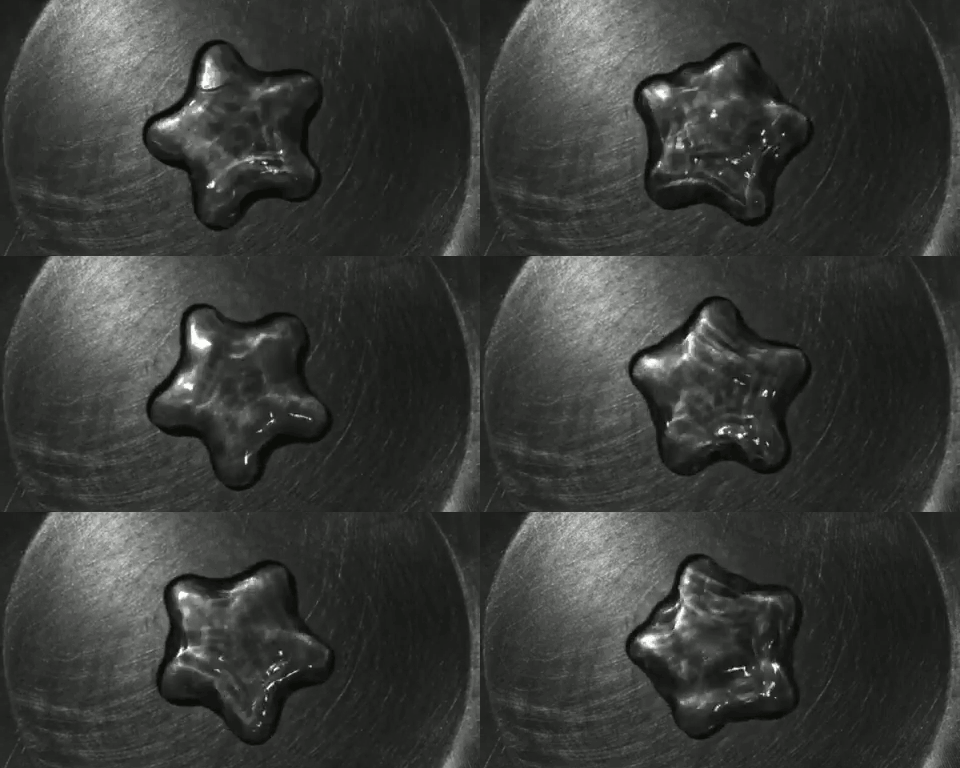
A Star Drop
There are many ways to make a droplet oscillate in a star-shape – like vibrating its surface or using acoustic waves to excite it – but these methods involve externally forcing the droplet’s oscillation. Leidenfrost drops – liquids levitating on a film of their own vapor caused by the extremely hot surface below – turn themselves into stars. It all starts with the constant evaporation driven by the heat below. This creates a thin, fast-moving layer of vapor flowing beneath the drop. That vapor shears the drop, causing capillary waves – essentially ripples – that travel through the drop in a characteristic way. Those ripples in turn cause pressure oscillations in the vapor layer, alternately squeezing and releasing it. Feedback from the vapor layer then drives the droplet into star-shaped oscillations. Under the right conditions, water drops can form stars with as many as 13 points! (Image and research credit: X. Ma and J. Burton, source)
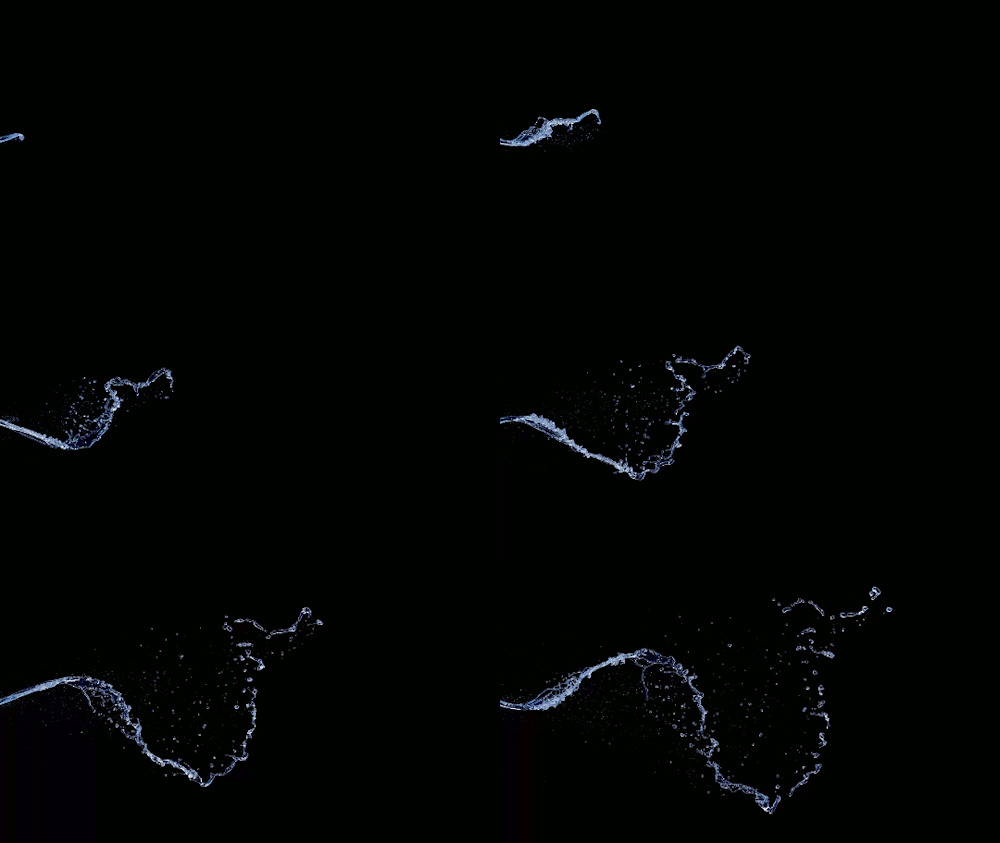
Breaking With a Wave
For rocket combustion and other applications, like watering your lawn with a hose, a stream of fluid may need to be broken up into droplets. While simply spraying a liquid jet will make it break up, waving that jet back and forth will break it up faster. A recent study simulated this problem numerically to determine the exact mechanisms driving that break-up. The researchers found two major culprits.
The first is a Kelvin-Helmholtz, or shear-based, instability. When a jet leaves the nozzle, there’s friction between it and the comparatively still air surrounding it. This creates tiny ripples in the surface that eventually grow into the distortions we can see, and it’s found in all jets, regardless of their side-to-side motion.
The second culprit, which is only found in the oscillating jet, is a Rayleigh-Taylor instability. By moving the jet side-to-side, you’re driving the dense liquid into less dense air, which creates a different set of disturbances that also help break up the jet. The final result: swinging the jet side-to-side breaks it into smaller droplets faster. (Image and research credit: S. Schmidt et al.)

Collecting Fog


In some parts of the world, fog is a major source of freshwater, but collecting it is a challenge. Most systems use a wire mesh to capture and collect droplets, but the process is highly inefficient, pulling only 1-3% of droplets from the fog. Researchers found that this is due largely to aerodynamic effects. The presence of the wire deflects droplets around it (bottom left). To solve this, engineers introduced an electric charge into the fog. The subsequent electric field actually pulls droplets to the wires (bottom right). When applied to a mesh (top), the efficiency of fog capture improves dramatically.
The technique can also be used to capture water vapor that would otherwise escape from the cooling towers of power plants. The MIT researchers who developed the technique will conduct a full-scale test at the university’s power plant this fall. They hope the technique will recapture millions of gallons of water that would otherwise drift away from the plant. (Image credits: MIT News, source; image and research credits: M. Damak and K. Varanasi, source)

The Disintegrating Splash
A drop of blue-dyed glycerine impacts a thin film of isopropanol, creating a spectacular splash and breakup. The drop’s impact flings a layer of the isopropanol into the air, where air currents make the thin sheet buckle inward and break into a spray of droplets. Meanwhile, the liquid from the drop forms a thick, blue crown that rises and expands outward. When tiny droplets of the isopropanol hit the splash crown, their lower surface tension causes the blue glycerine to pull away, due to the Marangoni effect. This opens up holes in the crown, which grow quickly, until the entire sheet breaks apart. (Image and research credit: A. Aljedaani et al., source)

Happy 2000 Posts!


Happy Friday and happy 2000th FYFD post! To celebrate, I played with surface tension and the Marangoni effect to make some art. For a run-down on the physics, check out this previous post on water calligraphy. Two thousand posts feels like a major milestone. Not everyone realizes this, but FYFD is a one-woman operation, so 2000 posts is a whole lot of research, image editing, and writing. For fun, I’m including here eight completely random FYFD entries, representing less than one-half of one percent of my total archives:
1. Why did Chinese junks put holes in their rudders?
2. Making droplets in an ultrasonic humidifier
3. Floating on a granular raft
4. Air-trapping fur keeps otters warm
5. The physics of the knuckleball
6. What makes badminton so fast?
7. Playing with fluorescein
8. How frost formsWant to keep up the random walk? Use https://fyfluiddynamics.com/random to find random entries, or if you prefer your browsing to be more directed, check out the visual archive or the themed series page.
As always, a special thanks to those who help support FYFD through Patreon subscriptions – I couldn’t keep writing and making videos without your help! And thank you to all of you who read and share FYFD. Whether you’ve been following along for a week or for the last eight years, your enthusiasm keeps me motivated! Thank you!
(Image credits: 2k animation – N. Sharp; Chinese junk ship – Premier Ship Models; ultrasonic humidifier – S. J. Kim et al.; granular raft – E. Jambon-Puillet and S. Protiere; 3D-printed “fur” – F. Frankel; knuckleball – L. Kang; shuttlecock – Science Friday; fluorescein – Shanks FX; freezing droplets – J. Boreyko et al.)

Sunset Flow
Day and night mix in this flow visualization of watercolor pigments and ferrofluid. The former, as suggested by their name, are water-based, whereas ferrofluids typically contain an oil base. This means the two fluids are immiscible. Like oil and vinegar in salad dressing, the only way to mix them is to break one into tiny droplets floating in the other. This is what happens near their boundary, where brightly-colored paint droplets float in a network of dark channels. To the right, the paint and ferrofluid have been swirled around to create viscous mixing patterns among the paint colors with occasional intrusions of thin ferrofluid fingers. (Image credit: G. Elbert)
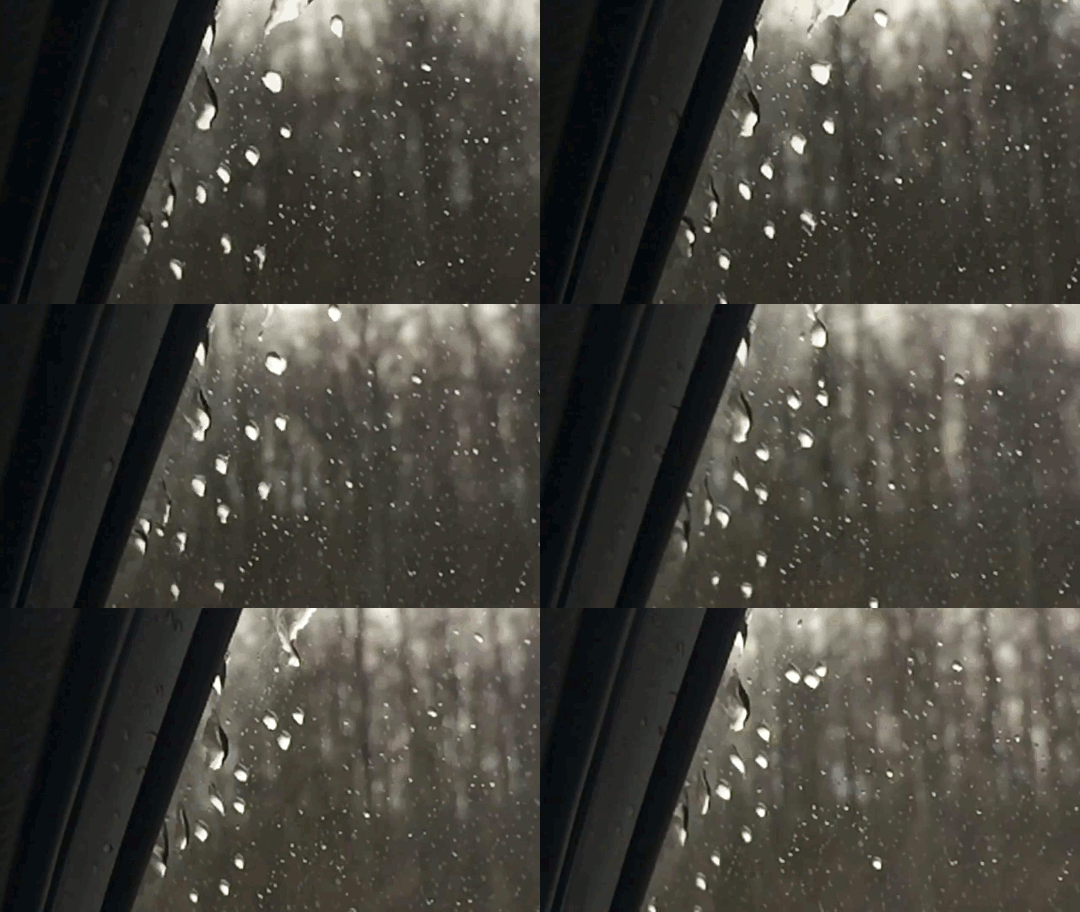
Rain on Car Windows

As a child, I loved to ride in the car while it was raining. The raindrops on the window slid around in ways that fascinated and confused me. The idea that the raindrops ran up the window when the car moved made sense if the wind was pushing them, but why didn’t they just fly off instantly? I could not understand why they moved so slowly. I did not know it at the time, but this was my early introduction to boundary layers, the area of flow near a wall. Here, friction is a major force, causing the flow velocity to be zero at the wall and much faster – in this case roughly equal to the car’s speed – just a few millimeters away. This pushes different parts of large droplets unevenly. Notice how the thicker parts of the droplets move faster and more unsteadily than those right on the window. This is because the wind speed felt by the taller parts of the droplet is larger. Gravity and the water’s willingness to stick to the window surface help oppose the push of the wind, but at least with large drops at highway speeds, the wind’s force eventually wins out. (Image credit: A. Davidhazy, source; via Flow Viz)

PyeongChang 2018: Snow-Making
These days artificial snow-making is a standard practice for ski resorts, allowing them to jump-start the early part of the season. Snow guns continuously spray a mixture of cold water and particulates 5 or more meters in the air to generate artificial snow. The tiny droplet size helps the water freeze faster and the particles provide nucleation sites for snow crystals to form. As with natural snow, the shape and consistency of the snow depends on humidity and temperature conditions. Pyeongchang is generally cold and dry, so even the artificial snow there tends to be similar to snow in the Colorado Rockies. Recreational skiers tend to look down on artificial snow, but Olympic course designers actually prefer it. With artificial snow, they can control every aspect of an alpine course. For them, natural snowfall is a disruption that puts their design at risk. (Video credit: Reactions/American Chemical Society)

Pilot-Wave Hydrodynamics: Resources
This is the final post in a collaborative series with FYP on pilot-wave hydrodynamics. Previous posts: 1) Introduction; 2) Chladni patterns; 3) Faraday instability; 4) Walking droplets; 5) Droplet lattices; 6) Quantum double-slit experiments; 7) Hydro single- and double-slit experiments; 8) Quantum tunneling; 9) Hydrodynamic tunneling; 10) de Broglie’s pilot-wave theory
Thanks for joining us this week as we explored nearly two centuries’ worth of scientific discoveries around vibration, fluid dynamics, and quantum mechanics. For those who’d like to learn more about these and related topics, we’ve compiled some helpful resources below.
Other Videos, Articles, and Resources by Topic
Chladni Patterns
- ANSYS, “Chladni Plates”
- Brusspup, “Amazing Resonance Experiment!”
- Kenichi Kanazawa, “Color Sound”
- Microfluidic Chladni patterns
- Nigel Stanford, “Cymatics”
- Peter Remco, “Chladni patterns in a violin plate”
- Steve Mould, “Random couscous snaps into beautiful patterns”
Faraday Instability
- FYFD, Alligators and water dancing
- FYFD, Liquid crystals vibrating on a tuning fork
- Gallery of Fluid Motion, “The Tibetan singing bowl”
- Nigel Stanford, “Cymatics”
- Slow Mo Guys, “Chinese spouting bowl in slow motion.”
Quantum Mechanics
Pilot-wave Hydrodynamics
- Dual Walkers, learn about the physics from the researchers themselves
- Gallery of Fluid Motion, “The pilot-wave dynamics of walking droplets.”
- Gallery of Fluid Motion, “Shedding light on pilot-wave phenomena.”
- The Lutetium Project, “Never-ending bouncing droplets.”
- The Lutetium Project, “Dual walkers: drops and waves.”
- Through the Wormhole, Interview with Y. Couder
- Wired, “Have we been interpreting quantum mechanics wrong this whole time?”
- Veritasium, “Is this what quantum mechanics looks like?”
Selected (Academic) Bibliography by Topic
Articles marked with an asterisk (*) are recommended for their approachability and/or broad overview of the subject.
Chladni Patterns
- (*) M. Faraday, “On a peculiar class of acoustical figures; and on certain forms assumed by groups of particles upon vibrating elastic surfaces,” 1831.
- Lord Rayleigh, “On the circulation of air observed in Kundt’s tubes, and on some allied acoustical problems,” 1884.
- H. van Gerner et al., “Air-induced inverse Chladni pattern,” 2011.
Faraday Instability
- (*) M. Faraday, “On a peculiar class of acoustical figures; and on certain forms assumed by groups of particles upon vibrating elastic surfaces,” 1831.
Pilot-wave Hydrodynamics
- Y. Couder and E. Fort, “Single-particle diffraction and interference at a macroscopic scale,” 2006.
- A. Eddi et al., “Unpredictable tunnel of a classical wave-particle association,” 2009.
- (*) Y. Couder et al., “Walking droplets: A form of wave-particle duality at macroscopic scale?”, 2010.
- J. Molacek and J. Bush, “Droplets bouncing on a vibrating bath,” 2013.
- J. Molacek and J. Bush, “Droplets walking on a vibrating bath: toward a hydrodynamic pilot-wave theory,” 2013.
- D. Harris et al., “Wave-like statistics from pilot-wave dynamics in a circular corral,” 2013.
- O. Wind-Willassen et al., “Exotic states of bouncing and walking droplets,” 2013.
- (*) J. Bush, “Pilot-wave hydrodynamics,” 2015.
- D. Harris et al., “Visualization of hydrodynamic pilot-wave phenomena,” 2016.
(Image credit: A. Labuda and J. Belina)
