Search results for: “vorticity”

  • The Bathtub Vortex

    The Bathtub Vortex

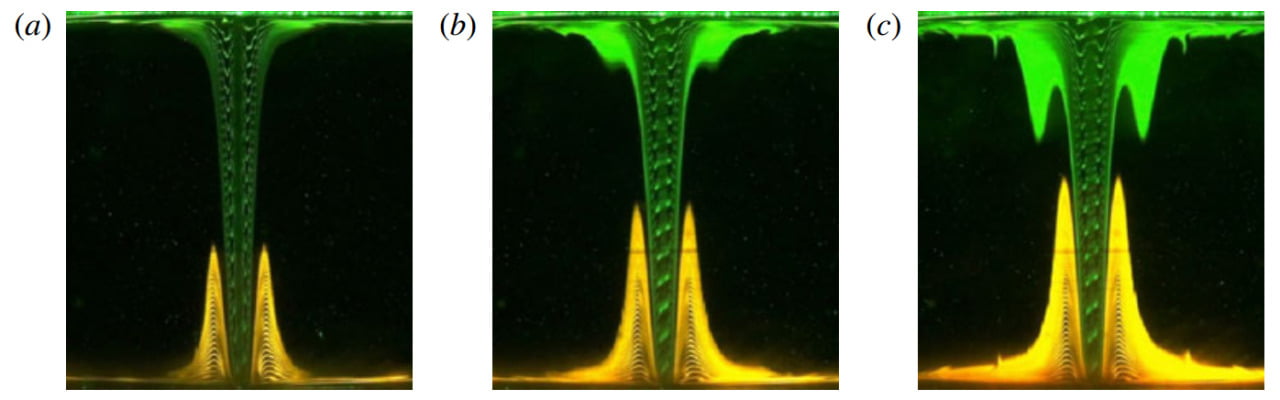
    If you’ve ever watched a swirling vortex disappear down the drain of your bathtub and wondered what was happening, you’ll appreciate these images. This dye visualization shows a one-celled bathtub vortex, created by rotating a cylindrical tank of water until all points have equal vorticity before opening a drain in the bottom of the tank. A recirculating pump feeds water back in to keep the total fluid mass constant. Once a steady vortex is established, green dye is released from the top plate of the tank and yellow dye from the bottom. The green dye quickly marks the core of the vortex. Ekman layers–similar to the boundary layers of non-rotating flows–form along the top and bottom surfaces, and the yellow dye is drawn upward in a region of upwelling driven by Ekman pumping. (Photo credit: Y. Chen et al.)

    Just a reminder for those at Texas A&M University: I will be giving a talk today Wednesday, October 2nd entitled “The Beauty of the Flow” as part of the Applied Mathematics Undergraduate Seminar series at 17:45 in BLOC 164.

  • Featured Video Play Icon

    Stingray Wakes

    This numerical simulation shows a swimming stingray and the vorticity generated by its motion. Stingrays are undulatory swimmers, meaning that the wavelength of their motion is much shorter than their body length. Manta rays, in contrast, move their fins through a wavelength longer than their body length, making them oscillatory swimmers. Observe the difference in this video. To swim faster, stingrays increase the frequency of their undulation, not the amplitude. This is quite common among swimmers because increasing the amplitude also increases projected frontal area, which causes additional drag. Increasing the frequency of motion does not affect the projected area, making it the more efficient locomotive choice. (Video credit: G. Weymouth; additional research credit: E. Blevins; submitted by L. Buss)

    Also, FYFD now has a Google+ page for those who prefer to follow along and share that way. – Nicole

  • Flow Over a Delta Wing

    Flow Over a Delta Wing

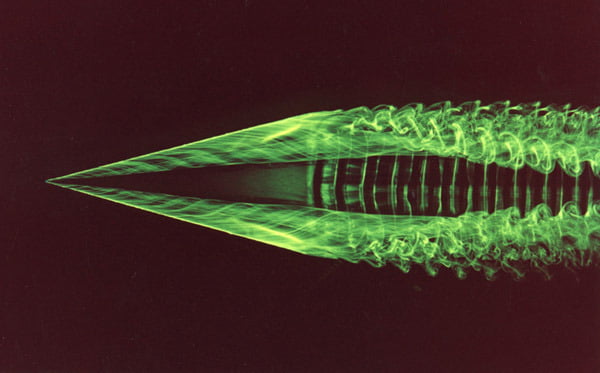
    Fluorescent dye illuminated by laser light shows the formation and structure of vortices on a delta wing. A vortex rolls up along each leading edge, helping to generate lift on the triangular wing. As the vortices leave the wing, their structure becomes even more complicated, full of lacy wisps of vorticity that interact. Note how, by the right side of the photo, the vortices are beginning to draw closer together. This is an early part of the large-wavelength Crow instability. Much further downstream, the two vortices will reconnect and break down into a series of large rings. (Photo credit: G. Miller and C. Williamson)

  • Featured Video Play Icon

    H Booms

    Holidays involving fireworks deserve high-speed videos of hydrogen explosions. Although Periodic Table of Videos focuses on the chemistry involved in setting hydrogen on fire, there are some lovely fluid dynamics on display, too. There’s turbulence, combustion (obviously), and, if you watch closely, you can even see the initial vorticity caused by the rubber’s burst twisting the growing flames. (Video credit: Periodic Table of Videos)

  • Featured Video Play Icon

    Supercell Thunderstorm

    Photographer Mike Olbinski has captured a spectacular timelapse of a supercell thunderstorm over the plains of Texas. Supercells are characterized by a strong, rotating updraft known as a mesocyclone, seen clearly in the video. These storms are commonly isolated occurrences, forming when horizontal vorticity in the form of wind shear is redirected upwards by an updraft. Such a strong updraft is typically created by a capping inversion, a situation where a layer of warmer air traps the colder air beneath it. (This is why one sees a distinctive cut-off at the top of some clouds.) As warm air rises from the surface, either the air above the cap will cool or the air below the cap will warm. Either situation results in an instability with cooler air on top of warmer air, providing a catalyst for the kind of dramatic weather seen here. (Video credit: M. Olbinski; via io9)

  • Reader Question: Does Flow Viz Alter Flow?

    Reader Question: Does Flow Viz Alter Flow?

  • Dye Droplet

    Dye Droplet

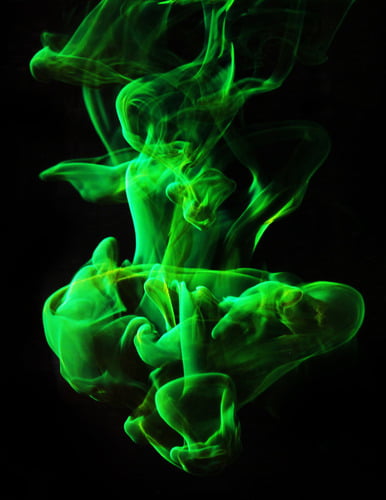
    A drop of fluorescent dye falling into quiescent water forms fantastical structures that are a mixture of vorticity, turbulence, and molecular diffusion. The horseshoe-like shape near the front of the drop is a typical shape for two fluids strained by moving past one another. The main section of the drop billows outward like a parachute, but the turbulence of its wake stretches the dye into fine threads that quickly disperse in the water. (Photo credit: D. Quinn et al.)

  • Mercedes-Benz Tornado

    Mercedes-Benz Tornado

    The world’s most powerful artificial tornado is part of the Mercedes-Benz Museum in Stuttgart, Germany. Though popular enough with visitors that the staff will bring out smoke generators to make it visible, the tornado was not built as an attraction – It’s actually part of the building’s fire protection system. The modern open design of the museum meant that conventional smoke removal systems were inadequate. Instead vorticity is generated in the central lobby with 144 wall-mounted jets. The angular velocity created by the jets is strongest at the middle, in the vortex core, due to conservation of angular momentum – exactly the way a spinning ice skater speeds up by pulling his arms in. The core of the vortex is a low pressure area, which draws outside air toward it – this is how the tornado pulls in smoke when there is a fire. The fan on the ceiling provides the pressure draw necessary for the smoke to be pulled up and out of the building at a supposed rate of 4 tons per minute. See the tornado in action here. (Photo credit: Mercedes-Benz Passion; submitted by Ivan)

  • Featured Video Play Icon

    Flapping Foil Wake

    This gorgeous visualization shows the flow behind a flapping foil. Flow in the water tunnel is from right to left, with dye introduced to show streamlines. A flapping foil is a good base model for most flapping flight as well as finned swimming – anything that oscillates to create thrust. As the foil flaps, vorticity is generated and shed along the trailing edge, creating a regularly patterned wake of trailing vortices. (Video credit: R. Godoy-Diana)

  • Real-Life Whirlpools

    Real-Life Whirlpools

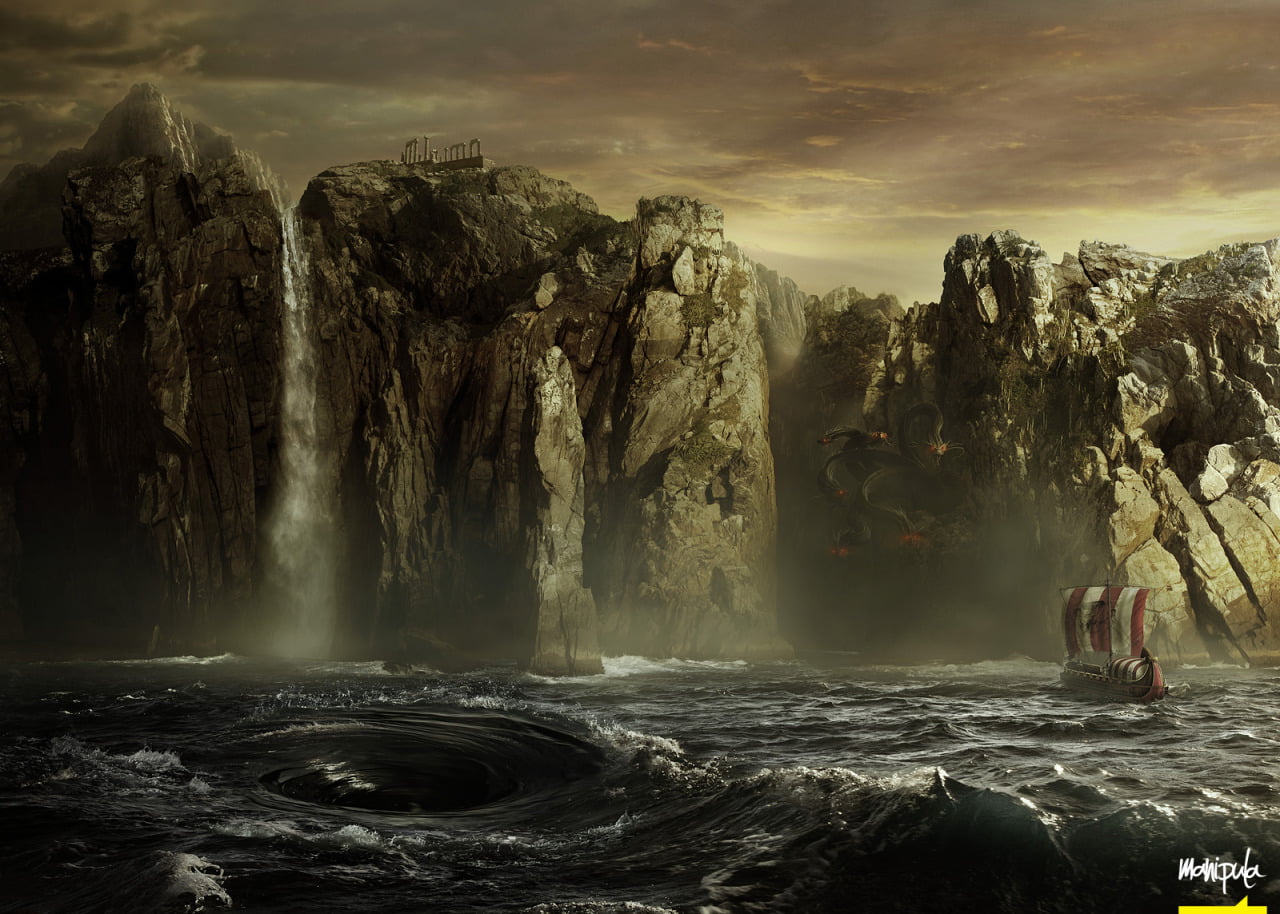
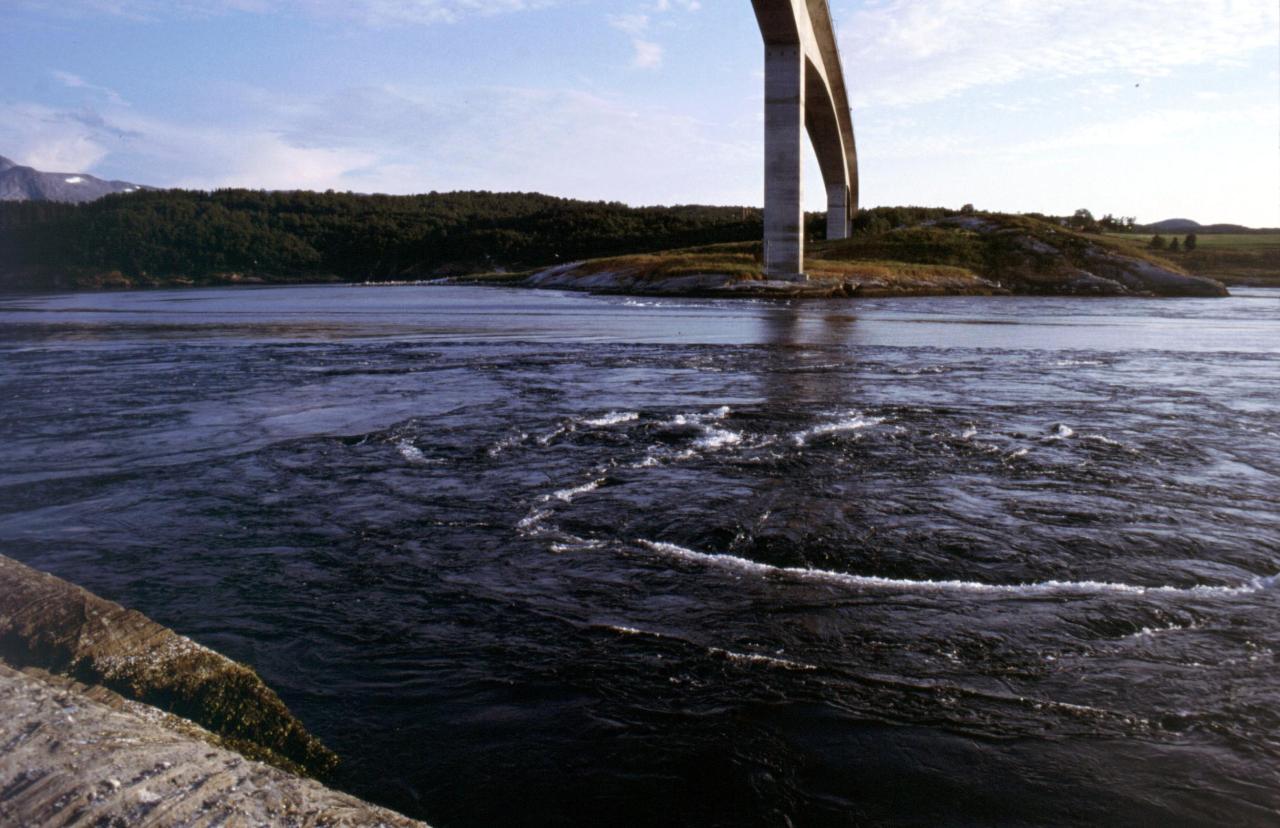
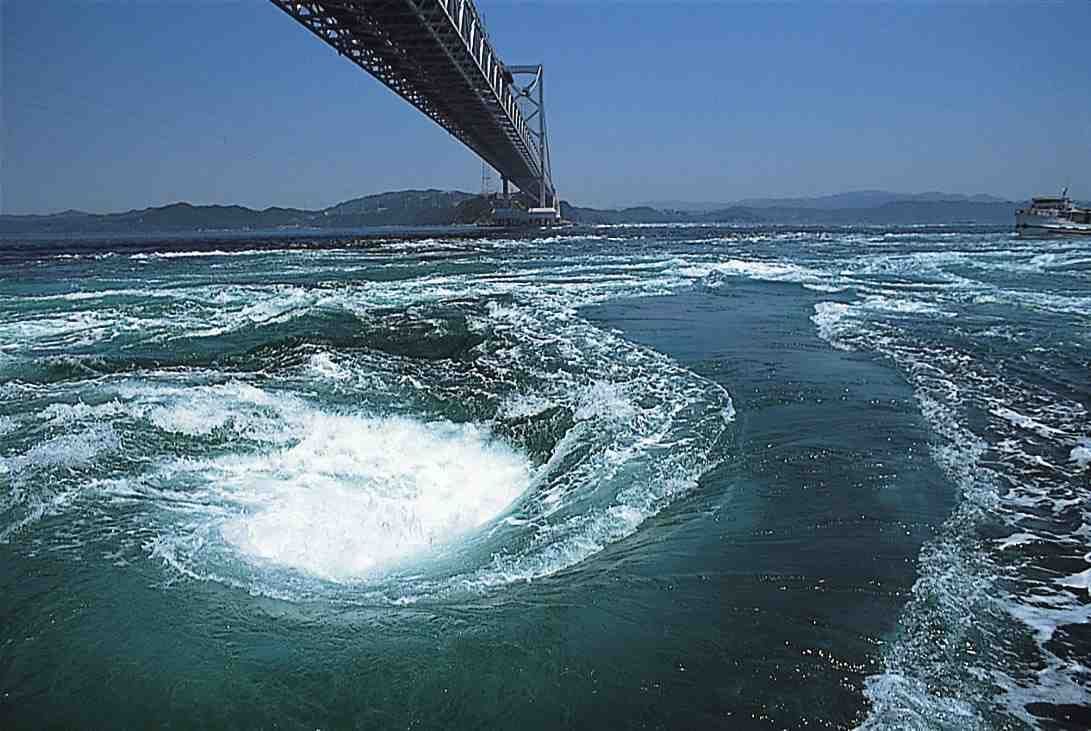
    Literature is full of descriptions of monstrous whirlpools like Charybdis, which threatens Homer’s Odysseus. While it’s not unusual to see a small free vortex in bodies of water, most people would chalk boat-swallowing maelstroms up to literary device. But it turns out that, while there may not be permanent Hollywood-style whirlpools, there are several places in the world where the local tides, currents, and topology combine to produce turbulence, dangerously vortical waters, and even standing vortices on a regular basis. 

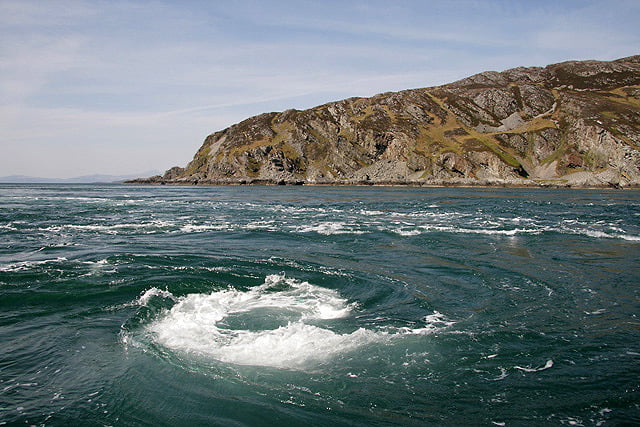
    One example is the Corryvreckan, between the islands of Jura and Scarba off Scotland. In this narrow strait, Atlantic currents are funneled down a deep hole and then thrust upward by a pinnacle of rock that rises some 170 m to only 30 m below the surface. The swift waters and unusual topology produce strong turbulence near the surface and whirlpools pop up throughout the strait. Other “permanent” maelstroms, such as those in Norway and Japan, arise from tidal interactions with similar structures rising from the sea floor.

    For more, check out this Smithsonian article, Gjevik et al., Moe et al., and the videos linked above! (Photo credits: Manipula, Tokushima Gov’t, Wikimedia, and W. Baxter; requested by @kb8s)