Fire tornadoes, despite their name, are more closely related to dust devils or waterspouts than to true tornadoes. Though rarely documented, they are relatively common, especially in wildfires. The heat of the fire creates an updraft of warm, rising air that leaves behind a low-pressure region. Air from outside is drawn toward this low-pressure area, gets heated, and rises. As the outside air gets pulled in, any vorticity or rotation it had gets intensified via conservation of angular momentum–the same way a spinning ice skater speeds up when she pulls her arms in. The result is the tightly-spinning vortex at the heart of a fire tornado. (Video credit: C. Fleur; via NatGeo)
Search results for: “vorticity”

“En Plein Vol”
Artist Antoine Terrieux’s “En Plein Vol” exhibit shows off the power of hair dryers. Parts of the exhibit, like the floating ball at 0:16, rely on Bernoulli’s principle and the moving stream of air the dryers generate. Others, like the smoke tornado at 0:39 or the (suspended) paper airplane at 0:56, use the hair dryers to generate vorticity essential to the installation. It’s a neat concept and very well executed. (Video credit: A. Terrieux; via io9; submitted by Joseph S. and Eliza M.)

Reader Question: Lift
everyonelikespotatissallad asks:
so, how is lift actually generated? i’ve been going through Anderson’s Introduction to Flight (6th Ed.) and while it offers the derivation of various equations very thoroughly, it barely touches on why lift is generated, or how camber contributes to the increase of C(L)
This is a really good question to ask. There are a lot of different explanations for lift out there (and some of the common ones are incorrect). The main thing to know is that a difference in pressure across the wing–low pressure over the top and higher pressure below–creates the net upward force we call lift. It’s when you ask why there’s a pressure difference across the wing that explanations tend to start diverging. To be clear, aerodynamicists don’t disagree about what produces lift – we just tend to argue about which physical explanation (as opposed to just doing the math) makes the most sense. So here are a couple of options:
Newton’s third law states that for every action there is an equal and opposite reaction. If you look at flow over an airfoil, air approaching the airfoil is angled upward, and the air leaving the aifoil is angled downward. In order to change the direction of the air’s flow, the airfoil must have exerted a downward force on the air. By Newton’s third law, this means the air also exerted an upward force–lift–on the airfoil.
The downward force a wing exerts on the air becomes especially obvious when you actually watch the air after a plane passes:
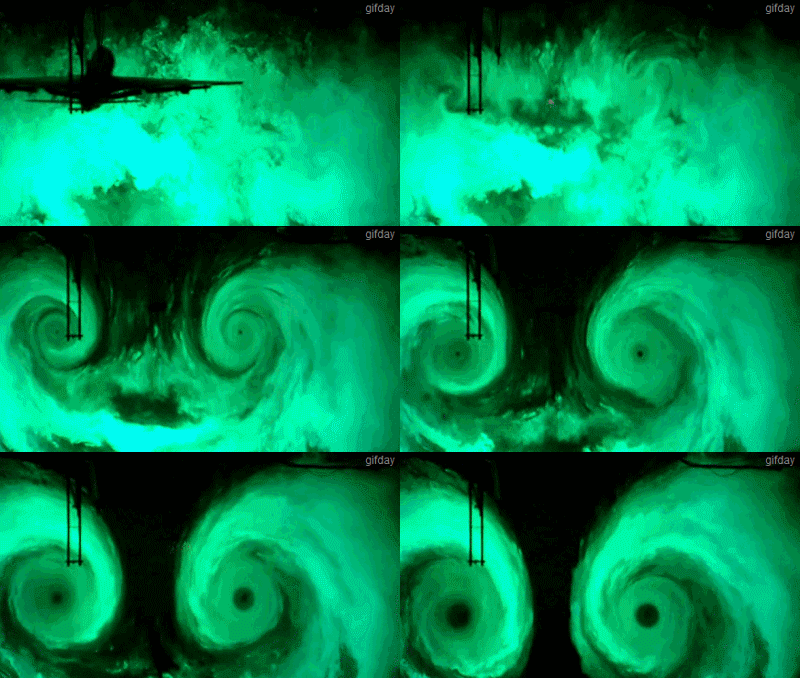
This one can be harder to understand. Circulation is a quantity related to vorticity, and it has to do with how the direction of velocity changes around a closed curve. Circulation creates lift (which I discuss in some more detail here.) How does an airfoil create circulation, though? When an airfoil starts at rest, there is no vorticity and no circulation. As you see in the video above, as soon as the airfoil moves, it generates a starting vortex. In order for the total circulation to remain zero, this means that the airfoil must carry with it a second, oppositely rotating vortex. For an airfoil moving right to left, that carried vortex will spin clockwise, imparting a larger velocity to air flowing over the top of the wing and slowing down the air that moves under the wing. From Bernoulli’s principle, we know that faster moving air has a lower pressure, so this explains why the air pressure is lower over the top of the wing.
Asymmetric Flow and Bernoulli’s Principle

There are two basic types of airfoils – symmetric ones (like the one in the first picture above) and asymmetric, or cambered, airfoils (like the one in the image immediately above this). Symmetric airfoils only generate lift when at an angle of attack. Otherwise, the flow around them is symmetric and there’s no pressure difference and no lift. Cambered airfoils, by virtue of their asymmetry, can generate lift at zero angle of attack. Their variations in curvature cause air flowing around them to experience different forces, which in turn causes differing pressures along the top and the bottom of the airfoil surface. A fluid particle that travels over the upper surface encounters a large radius of curvature, which strongly accelerates the fluid and creates fast, low-pressure flow. Air moving across the bottom surface experiences a lesser curvature, does not accelerate as much, and, therefore, remains slower and at a higher pressure compared to the upper surface.
(Image credit: M. Belisle/Wikimedia; National Geographic/BBC2; O. Cleynen/Wikimedia; video credit: J. Capecelatro et al.)
Coriolis
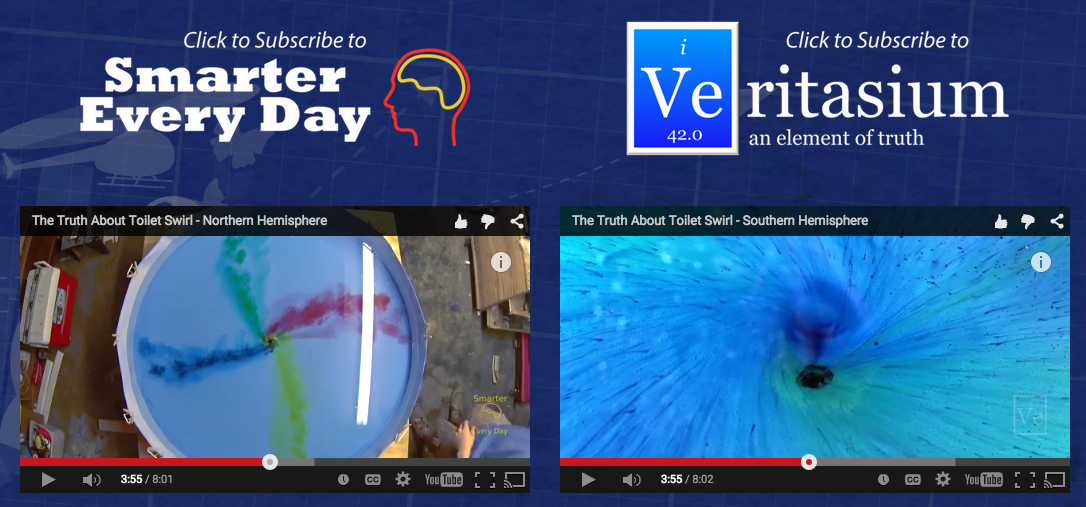
There’s an infamous supposition about drains swirling one way in the Northern Hemisphere and the other way in the Southern Hemisphere. Destin from Smarter Every Day and Derek from Veritasium have put the claim to the test with experiments on either side of the globe. First, go here and watch their synchronized videos side-by-side. (To synchronize, start the left video and pause it at the sync point. Then start the second video and unpause the first video when the second video hits the sync point.) I’ll wait here.
…
That was awesome, right?! The demonstration doesn’t work with toilets because they’re driven by the placement of jets around the circumference. And your bathtub doesn’t usually work either because any residual vorticity in the tub gets magnified by conservation of angular momentum as it drains. It’s like a spinning ice skater pulling their arms in; the rotation speeds up. So, to get around that problem, Destin and Derek let their pools sit for a day to damp out any motion before draining. At that point, the Coriolis effect is strong enough to cause the pools to rotate in opposite directions when drained. You may wonder why the effect is so slight for the pools when it’s pretty stark with hurricanes and cyclones. The answer is a matter of scale. The pools are perhaps 2 meters wide, which means that the difference in latitude across the the pool is very slight and therefore, the differential speed imparted by the Earth’s rotation is also very small. Because hurricanes and cyclones are much larger, they experience stronger influence from the Coriolis effect. (Image credits: Smarter Every Day/Veritasium; via It’s Okay To Be Smart)

Martian Dust Devil
This photo from the Mars Reconnaissance Orbiter stares almost straight down a dust devil on Mars. Like their earthbound brethren, Martian dust devils form when the surface is heated by the sun, causing warm air to rise. The rising air causes a low pressure area that the surrounding air flows into. Any rotational motion of the air intensifies as it is entrained. This is a consequence of conservation of angular momentum. Just as a spinning ice skater spins faster when he pulls his arms in, the vorticity of the inward-flowing air increases, forming a vortex. In addition to dust devils, this same physical mechanism applies to waterspouts and fire tornadoes, although the heating source for those is different. (Photo credit: NASA; via APOD)

Below a Surfer’s Wave
From below a plunging breaking wave–the classic surfer’s wave–looks like a giant vortex tube. Smaller rib vortices, the rings around the main vortex in the photo above, can form where there are variations along the breaking wave. As the wave rolls on, it stretches the vorticity variations along the wave’s span. When stretched, vortices spin up and intensify; this is a result of conservation of angular momentum. Check out more amazing photos of waves in Ray Collins’ portfolio. (Photo credit: R. Collins; via The Inertia)

Lava-Driven Waterspouts
Seven waterspouts align as lava from the Hawaiian volcano Kilauea pours into the ocean in this striking photo from photographer Bruce Omori. Like many waterspouts–and their landbound cousins dust devils–these vortices are driven by variations in temperature and moisture content. Near the ocean surface, air and water vapor heated by the lava create a warm, moist layer beneath cooler, dry air. As the warm air rises, other air is drawn in by the low pressure left behind. Any residual vorticity in the incoming air gets magnified by conservation of angular momentum, like a spinning ice skater pulling her arms in. This creates the vortices, which are made visible by entrained steam and/or moisture condensing from the rising air. (Photo credit: B. Omori, via HPOTD; submitted by jshoer)

Volcanic Vortex
This infrared image shows a kilometer-high volcanic vortex swirling over the Bardarbunga eruption. The bright red at the bottom is lava escaping the fissure, whereas the yellow and white regions show rising hot gases. Although the vortex looks similar to a tornado, it is actually more like a dust devil or a so-called fire tornado. All three of these vortices are driven by a heat source near the ground that generates buoyant updrafts of air. As the hot gases rise, cooler air flows in to replace them. Any small vorticity in that ambient air gets amplified as it’s drawn to the center, the same way an ice skater spins faster when she pulls her arms in. With the right conditions, a vortex can form. Unlike a harmless dust devil, though, this vortex is likely filled with sulphur dioxide and volcanic ash and would pose a serious hazard to aviation. (Image credit: Nicarnica Aviation; source video; via io9)

4th Birthday: Wingtip Vortices


Wingtip vortices are a result of the finite length of a wing. Airplanes generate lift by having low-pressure air travelling over the top of the wing and higher pressure air along the bottom. If the wing were infinite, the two flows would remain separate. Instead, the high-pressure air from under the wing sneaks around the wingtip to reach the lower pressure region. This creates the vorticity that trails behind the aircraft. I was first introduced to the concept of wingtip vortices in my junior year during introductory fluid dynamics. As I recall, the concept was utterly bizarre and so difficult to wrap our heads around that everyone, including the TA, had trouble figuring out which way the vortices were supposed to spin. A few good photos and videos would have helped, I’m sure. (Photo credits: U.S. Coast Guard, S. Morris, Nat. Geo/BBC2)
Vortex Ring Tricks
Vortex rings are wonderful at maintaining coherent vorticity while moving over significant distances. If you stand several meters from a foam cup and try blowing to knock it over, it’s not likely to budge. But move the air impulsively with a vortex cannon, and you can knock it over from the opposite side of the room. The same principle works underwater with added visual effect. Here an impulsive burst of air exhaled by the diver forms a bubble ring with vorticity strong enough to knock over a stack of rocks. It may look like a superpower, but this is science! Dolphins and whales are also known to play with this trick. For the non-scuba-divers among you, it’s also possible to learn to do it in a swimming pool. (Video credit: DjDeutchTv; h/t to coolsciencegifs)

