Search results for: “vorticity”

  • Featured Video Play Icon

    Truck Vortices

    The video above shows vortex rings of smoke ejected from the burning tire of a moving truck. Without seeing the damaged tire, it’s tough to pinpoint the cause with certainty, but here are a couple of ideas. Typically vortex rings are formed with a burst of air through a narrow orifice; this is, for example, how humans, dolphins, vortex cannons, and volcanoes all make smoke rings. If air is escaping the tire through small holes, this could cause rings. Unlike in those situations, though, the tire is spinning, which means its motion is already imparting vorticity to the flow, so that any air escaping the tire forms a vortex ring. (Video credit: The Armory; submitted by eruditebaboon)

    ETA: Others are suggesting the vortex rings are due to a failure of the engine, with unsteady exhaust velocities resulting in the vortex structures. I think this might still depend on the exhaust pipe’s geometry. Regardless of the exact cause, the video remains an interesting bit of fluid dynamics.
  • Featured Video Play Icon

    Stirring Faces

    This video features simulation of the laminar flow around a plate plunging sinusoidally in a quiescent flow. As the plate moves up and down, it mixes the fluid around it. This is visualized in several ways, beginning with the vorticity. Clockwise and anti-clockwise vortices are shed by the edges of the plate as it moves. The flow is also visualized using particle trajectories, which are classified by their tendency to accumulate (attract) or lose (repel) particles. These trajectories are particularly intriguing to watch develop as they appear to show ornate faces and designs. (Video credit: S. L. Brunton and C. W. Rowley)

  • Featured Video Play Icon

    Supersonic Bubble Shock Waves

    Supercomputing has been an enormous boon to fluid dynamics over the past few decades. Many problems, like the interaction between a supersonic shock wave and a bubble, are too complicated for analytical solutions and difficult to measure experimentally. Numerical simulation of the problem, combined with visualization of key variables, adds invaluable understanding. Here a shock wave strikes a helium bubble at Mach 3, and the subsequent interactions in terms of density and vorticity are shown. This situation is relevant to a number of applications, such as supersonic combustion and shockwave lithotripsy–a medical technique in which kidney stones are broken up inside the body using shock waves. After impact, an air jet forms and penetrates the center of the structure while the outer regions mix and form a persistent vortex ring. (Video credit: B. Hejazialhosseini et al.; via Physics Buzz)

  • Featured Video Play Icon

    Superfluid Vortices

    Cooling helium to a few degrees Kelvin above absolute zero produces superfluid helium, a substance with some very bizarre behaviors caused by a lack of viscosity. Superfluids exhibit quantum mechanical properties on a macroscopic scale; for example, when rotated, a superfluid’s vorticity is quantized into distinct vortex lines, known as quantum vortices. These vortices can be visualized in a superfluid by introducing solid tracer particles, which congregate inside the vortex line, making it appear as a dotted line, as shown in the video above. When these vortex lines approach one another, they can break and reconnect into new vortices. These reconnections provoke helical Kelvin waves, a phenomenon that had not been directly observed until the present work by E. Fonda and colleagues. They are even able to show that the waves they observe match several proposed models for the behavior. (Video credit: E. Fonda et al.)

  • Featured Video Play Icon

    Brine Shrimp Swimming

    For small creatures, swimming is dominated by viscosity. Here researchers use particle image velocimetry (PIV) to explore the flow field around brine shrimp. Its motion is divided into two vorticity-generating phases–the wide power stroke where the shrimp generates most of its forward motion and the recovery stroke where the shrimp returns its starting position while generating as little motion and drag as it can. (Video credit: B. Johnson, D. Garrity, L. Dasi)

  • Shark Wakes

    Shark Wakes

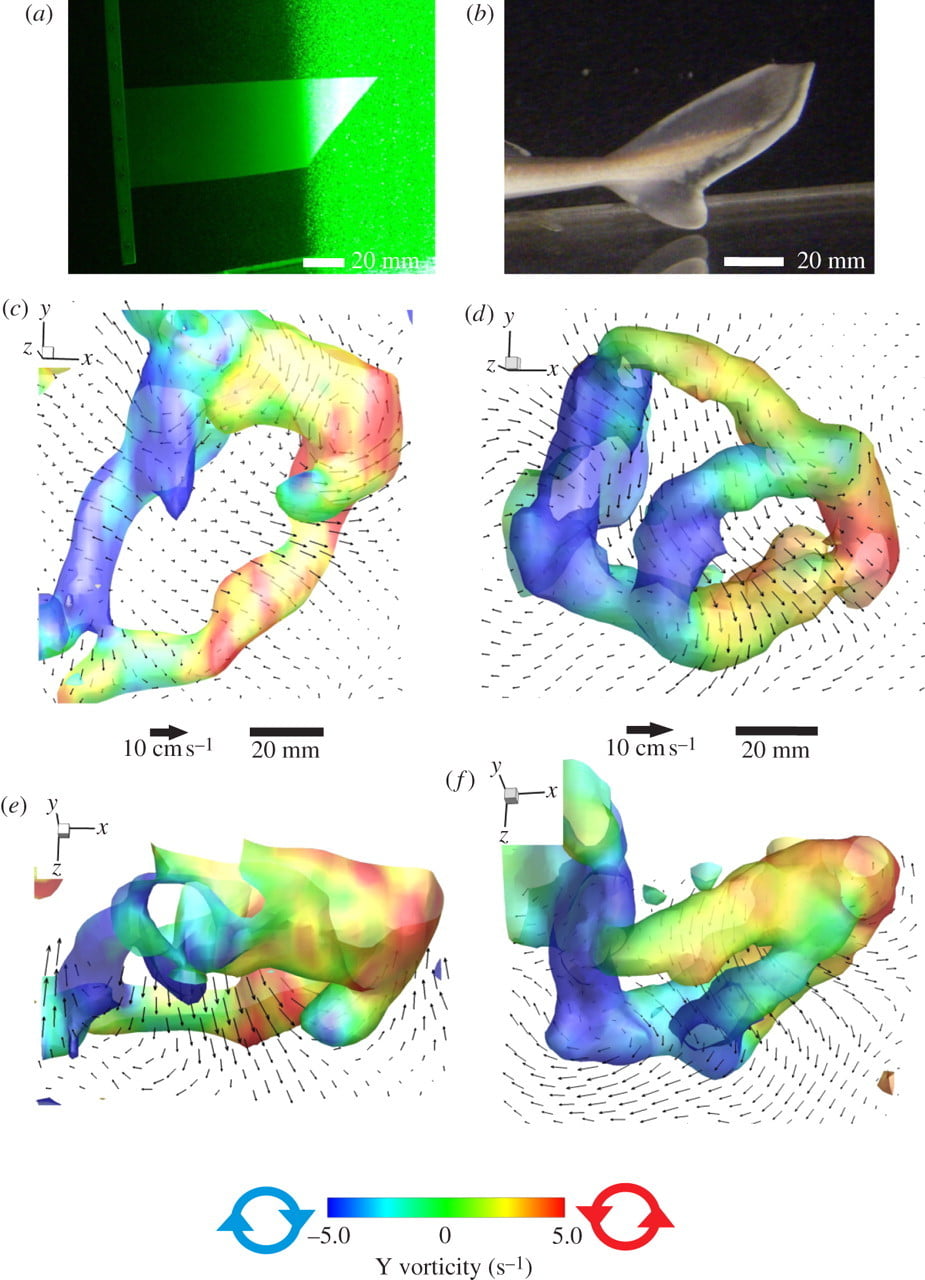
    Volumetric imaging of swimming spiny dogfish, a type of shark, shows that their distinctively asymmetric tails produce a set of dual-linked vortex rings with every half beat of their tail. The figure above shows data from the actual shark on the right (b,d,f) and a similarly shaped robotic tail on the left (a,c,e). The second row contains lateral views (c,d) and the bottom row contains dorsal views (e,f) of the vorticity isosurfaces measured. The robotic tail does not demonstrate the same double vortex structure, leading scientists to suspect that the shark may be actively stiffening its tail mid-stroke to control its wake. The finding could help engineers design aquatic robots whose morphing fins help it swim more efficiently. For more, see Wired.

  • Featured Video Play Icon

    Diesel Ignition

    In a diesel engine, ignition of the injected fuel occurs due to the heat caused by the compression of the fuel/air mixture. (In petrol/gasoline engines, spark plugs are used for ignition.) The subsequent expansion of gases drives the pistons of the engine downward, creating mechanical energy. This high-speed video shows the in-cylinder combustion within a diesel engine. Note the symmetry and vorticity of the flow.

  • Smokestack Plumes

    Smokestack Plumes

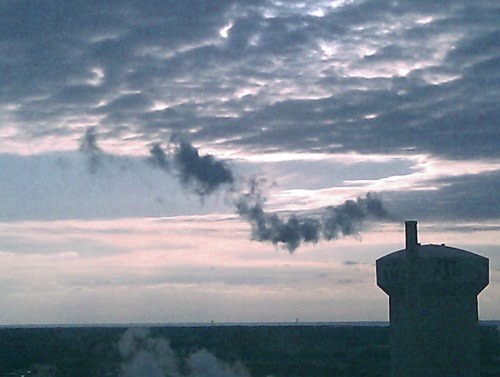
    On a cold and windy day, the plume from a smokestack sometimes sinks downstream of the stack instead of immediately rising (Figure 1). This isn’t an effect of temperature–after all, the exhaust should be warm compared to the ambient, which would make it rise. It’s actually caused by vorticity.

    Figure 2: Simple geometry (side view)

    In Figure 2, we see a simplified geometry. The wind is blowing from right to left, and its velocity varies with height due to the atmospheric boundary layer. Mathematically, vorticity is the curl of the velocity vector, and because we have a velocity gradient, there is positive (counterclockwise) vorticity generated.

    Figure 3: Vortex lines (top view)

    According to Helmholtz, we can imagine this vorticity as a bunch of infinite vortex lines convecting toward the smokestack, shown in Figure 3. Those vortex lines pile up against the windward side of the smokestack–Helmholtz says that vortex lines can’t end in a fluid–and get stretched out in the wake of the stack. If we could stand upstream of the smokestack and look at the caught vortex line, we would see a downward velocity immediately behind the smokestack and an upward velocity to either side of the stack. It’s this downward velocity that pulls the smokestack’s plume downward.

    Figure 4: Vortex wrapped around stack

    Now Helmholtz’s theories actually apply to inviscid flows and the real world has viscosity in it–slight though its effects might be–and that’s why this effect will fade. The vortex lines can’t sit against the smokestack forever; viscosity dissipates them.

  • Featured Video Play Icon

    Steam Devils

    The formation of the ethereal steam devil is quite similar to the formation of a fire tornado. In this case, the first frost of the season cooled air temperatures substantially below the temperature of the water of the lake, creating conditions for steam and for updrafts of rising, warmer air. A slight breeze across the lake is enough to create pockets of vorticity, which stretch due to the updrafts and intensify due to conservation of angular momentum. This creates the narrow spinning vortex filaments that pull steam up and dance across the lake’s surface. #