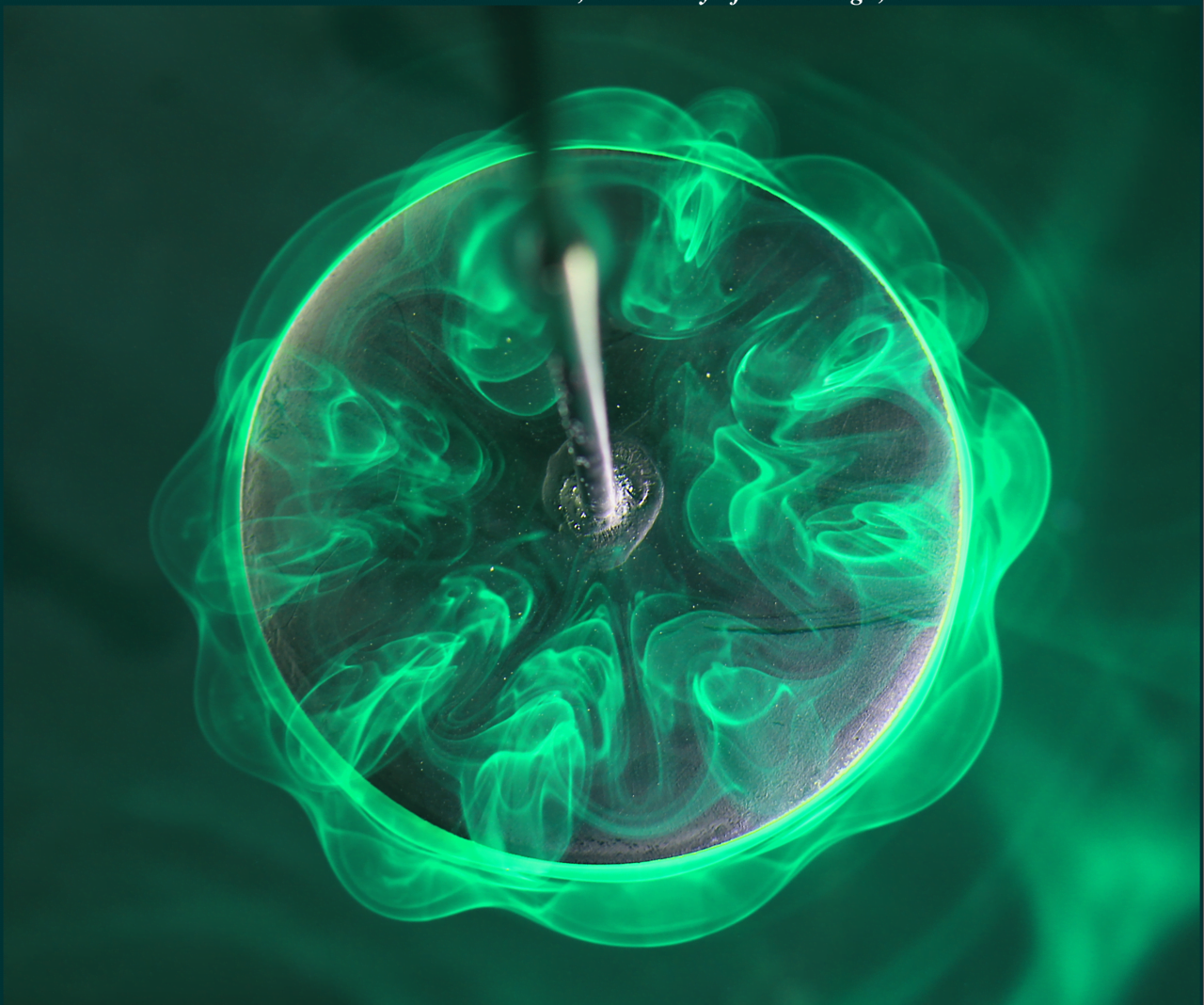
Vortex rings are ubiquitous in nature, showing up in droplet impacts, in propulsion, and even in volcanic eruptions. Understanding the interaction and breakdown of multiple vortices with one another is therefore key. The image above shows a circular disk that’s being oscillated up and down (in and out of the page). As the disk moves and changes direction, it generates vortices that interact with one another. Here some of those interactions are visualized with fluorescent dye. The overlapping vortices form complex and beautiful shapes on their way to breakdown. (Image credit: J. Deng et al., poster, paper)
Search results for: “vortex”

Leapfrogging Vortices
Two vortex rings travelling along the same line can repeatedly leapfrog one another. During my recent visit to the University of Chicago, PhD student Robert Morton of the Irvine Lab demonstrated this leapfrogging in the same apparatus they use to study knotted vortices. Leapfrogging works because of the mutual interaction of the flow fields of the two vortex rings. Their influence on one another causes the front vortex ring to slow down and widen while the trailing vortex narrows and speeds up. Once the vortices have switched places, the process repeats. In a real fluid, viscosity eventually breaks things down and causes the vortex rings to merge, but in simulation, inviscid vortex rings can leapfrog indefinitely. Our friend Physics Girl even showed that half-vortex-rings can leapfrog. (Image credit: N. Sharp; thanks to R. Morton for the demo)
Turbine Wakes in the Sea
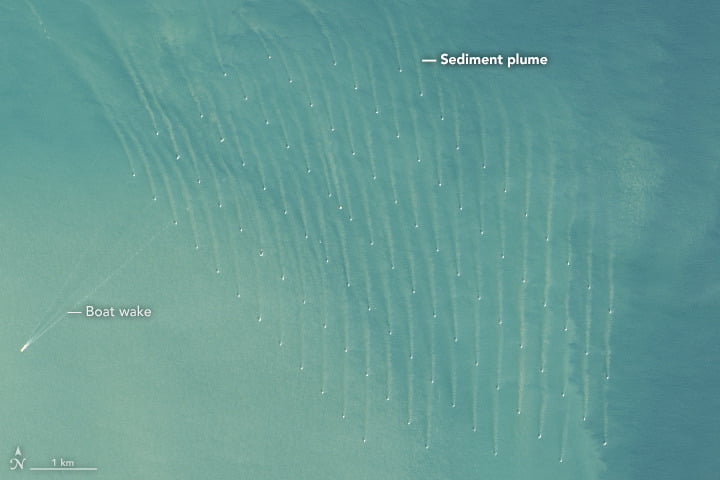
What we we build always has an impact on the environment around us. The white dots you see in the image above are an array of offshore wind turbines, standing in waters 20 to 25 meters deep. The brownish lines extending from each turbine show the underwater wakes of the turbines, colored by the sediment they’ve picked up. As with trees in a snowstorm, the currents flowing past the base of the turbine likely form a horseshoe vortex that lifts up the sediment into the wake. Because the tides in this area reverse direction every six hours, these sediment plumes can appear quite dynamic in satellite imagery, frequently changing strength and direction. (Image credit: NASA Earth Observatory)

Visualizing Flow with Snowfall
One of the challenges in engineering and operating wind turbines is that full-scale turbines rarely behave as predicted in smaller-scale laboratory experiments and simulations. One way to reconcile these differences (and discover what our experiments and simulations are missing) is to take the experiments out into the field. One research group has done this by using snowfall to visualize the flow around wind turbines. In this video, they share some of their observations, which include interactions of tip vortices with one another and with the vortex from the tower. My favorite part starts around 1:50 where you can observe tip vortices leap-frogging one another behind the wind turbine! (Video credit: Y. Liu et al.)

Jovian Poles


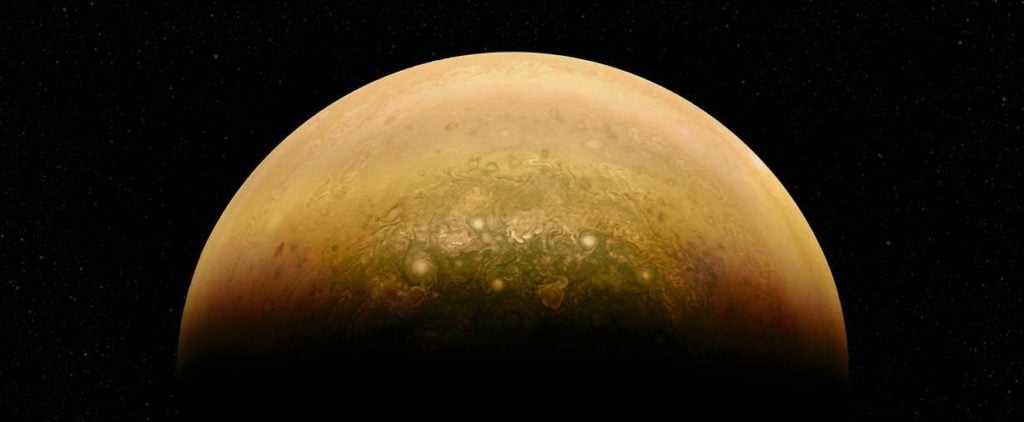


NASA’s Juno mission has been revealing a side of Jupiter we’ve never seen before. We all recognize the familiar stripes of the planet’s cloud bands, but its poles are entirely different. Unlike Saturn with its hexagonal polar vortex, Jupiter’s poles are a swirling tapestry of turbulent vortices – full of features that citizen scientists are helping to reveal. All of the images in this post were created by citizen scientists helping to process raw images from Juno, and you can contribute, too! The Juno mission solicits input from the public on where and what should be imaged, in addition to providing raw images individuals can process and repost. Check it out at the JunoCam website and become part of the science! (Image credits: All images – NASA/SwRI/MSSS + R. Tkachenko, Orion76; A. Mai)
The Blue Whirl
We wrote earlier this year about the discovery of a new type of fire whirl – the blue whirl – but now the authors have published video of the blue whirl in action! The blue whirl was discovered while investigating the use of fire whirls to more efficiently burn off oil spilled atop water. A tightly spinning yellow fire whirl produces less soot than a non-vortex burn; the blue whirl is even more efficient, producing little to no soot at all. Much remains to be learned about this new type of fire vortex, but in the meantime, enjoy some high-speed video of the blue whirl, particularly from 1:50 onward. (Video credit: M. Gollner et al.)

A Buoyant Rise
Hold a buoyant sphere like a ping pong ball underwater and let it go, and you’ll find that the ball pops up out of the water. Intuitively, you would think that letting the ball go from a lower depth would make it pop up higher – after all, it has a greater distance to accelerate over, right? But it turns out that the highest jumps comes from balls that rise the shortest distance. When released at greater depths, the buoyant sphere follows a path that swerves from side to side. This oscillating path is the result of vortices being shed off the ball, first on one side and then the other. (Image and research credit: T. Truscott et al.)

Crow Instability
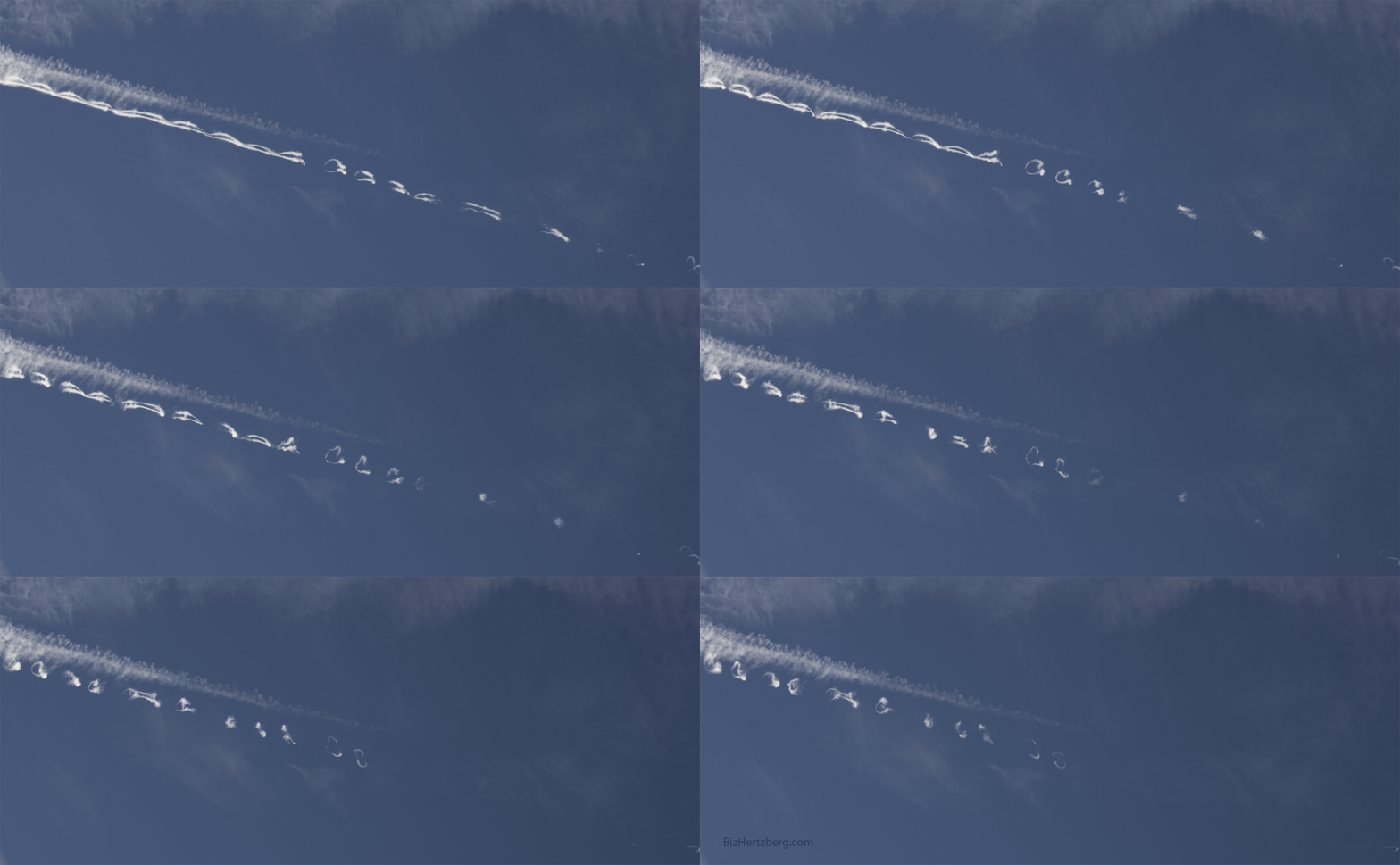
Watching airplane contrails overhead, you may have noticed them transform into a daisy chain of distorted rings. This is an effect known as the Crow instability. The contrails themselves are the airplane’s wingtip vortices, made visible by water vapor condensed out of the engine exhaust. These two initially parallel vortex lines spin in opposite directions. A slight crosswind can disturb the initially straight lines, causing them to become wavy. This waviness increases over time until the vortex lines almost touch. Then the vortices pinch off and reconnect into a line of vortex rings that slowly dissipate. Be sure to check out the full-resolution version of this animation for maximum effect. (Image credit: J. Hertzberg, source)

Shaking in the Wind

Sitting at a traffic stop on a windy day, you may have noticed the beam holding the traffic lights shaking steadily up and down. This phenomenon is called vortex-induced vibration. When the wind flows over the beam, it looks something like the flow animation shown above. Airflow follows the shape of the beam until near the backside, where the air separates from the surface and creates a vortex that sloughs off into the beam’s wake. These vortices form asymmetrically on the beam – first on one side, then the other. This creates unequal pressures on either side of the beam, and those pressure differences create a force that moves the beam. Because vortices are being steadily shed off the beam, it will keep moving back and forth as long as the wind is strong enough. (Image credits: traffic light – L. Sennick, source; cylinder – Aphex82/Wikimedia)
“Gargantua”
Peering into a vortex feels like staring into an abyss in the Julia Set Collective’s “Gargantua”. Like their previously featured works, this video uses a macro perspective on fluid phenomenon to create an alternate sense of scale. Instead of a whirlpool, we could be observing a wormhole. Part of this is a matter of fooling our brains with perspective, but it also works because, on some level, we recognize that these same fluid patterns occur at very different lengthscales and so it is believable that what we see is much bigger than in reality. (Video credit and submission: S. Bocci/Julia Set Collective)