Search results for: “vortex”

  • Mosquito Flight

    Mosquito Flight

    Mosquitoes are unusual fliers. Their wings are long and skinny, and they beat at around 700 strokes a second – incredibly quickly for their size. Examining how they move has uncovered some interesting mechanics. Despite their short stroke length, the mosquito generates a lot of lift on both its upstroke (when the wing is moving backward) and its downstroke (when the wing moves forward). Some features of the mosquito’s flight are highlighted in the images above. In the animation, blue indicates areas of low pressure and red indicates high pressure.

    Like most flapping fliers, the mosquito generates a leading-edge vortex during its downstroke (and its upstroke). This vortex helps concentrate low pressure on the upward-facing wing surface, thereby creating lift. One of the things that makes the mosquito unique, however, is that it also creates trailing-edge vortices on both half-strokes. To do this, the mosquito rotates its wings precisely to catch the wake of its previous half-stroke. The flow gets trapped near the trailing edge of the wing and forms a vortex and low-pressure region. Like the leading-edge vortex, this low-pressure area on the upward-facing wing surface creates lift. For more secrets of mosquito flight, check out this video from Science or the original paper. (Image credit: R. Bomphrey et al., source)

  • Featured Video Play Icon

    Quad Copter Schlieren

    Schlieren photography is a classic method of flow visualization that utilizes small variations in density (or temperature) to make otherwise unseen air motion visible. Because changing air’s density or temperature changes its index of refraction, variations in either quantity show up as dark and light regions. Here researchers use it to reveal some of the airflow around a small quadcopter, including the vortices that spiral off each propeller and help generate the lift necessary for take-off. The full video includes a couple of neat demos, including what happens when the blades are wet (shown below). In that case, the wingtip vortices are somewhat disrupted by strings of water droplets being flung off the blades by centrifugal force. Beautiful!  (Video and image credit: K. Nolan et al., source; submitted by J. Stafford)

  • When Chaos is Not So Chaotic

    When Chaos is Not So Chaotic

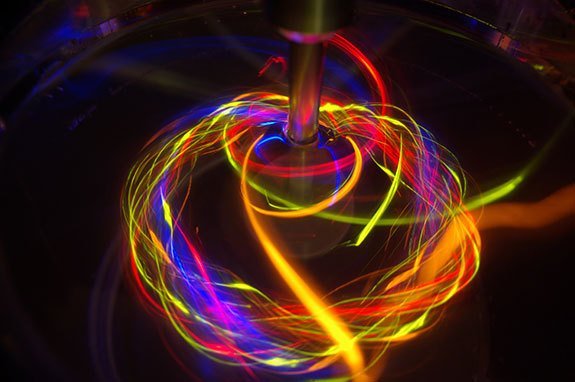
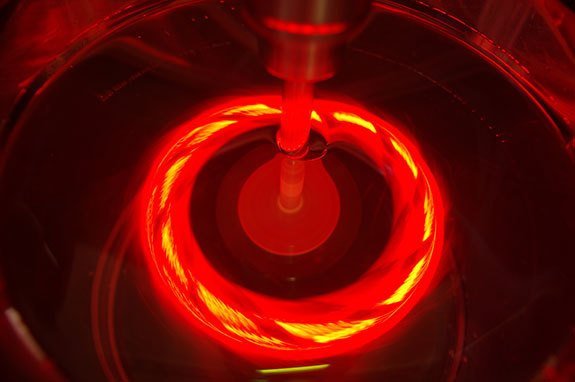
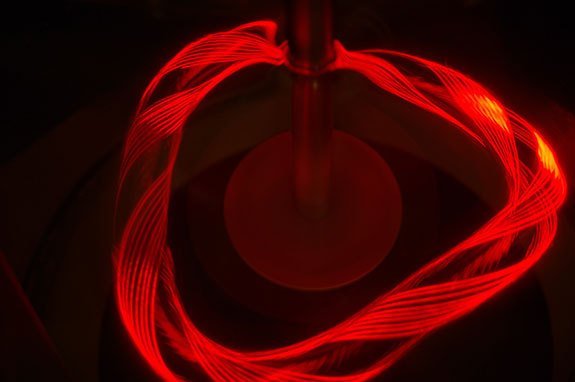
    In industry, tanks are often agitated or stirred to mix different elements. The goal is to create a laminar but chaotic flow field throughout the mixture. Introducing particles to such a system reveals that things are not quite as chaotic as they might seem. The photographs above show the pathlines of various large, glowing particles initially poured into the tank from above. Over time, the particles scatter off of structures in the mixed sections of the tank and end up trapped in vortex tubes that form above and below the agitator. Once trapped in the vortex tube, the particles follow helical paths inside the tube, creating patterns like those seen in the lower two photos. (Image and research credit: S. Wang et al., 1, 2, 3)

  • When Vortices Collide

    When Vortices Collide

    In a new ad campaign for paint manufacturer Sherwin-Williams, the production team at Psyop show off some awesome fluid dynamics by swirling and injecting paint underwater. You can see one sequence above, where red and blue paint vortex rings collide head-on before breaking down into a purple turbulent cloud. (What a great way to demonstrate the mixing power of turbulence, right?) Here’s the full 30-second ad clip. Impressively, everything in the video is a practical effect, even the segment that flies past multicolored turbulent plumes. You can see how they filmed everything in their behind-the-scenes featurette below. In the meantime, enjoy the mesmerizing beauty of real-world physics and check out FYFD’s “fluids as art” tag for more examples. (Image and video credit: Psyop for Sherwin-Williams; submitted by Alan B.)

  • Fanning the Flame

    Fanning the Flame

    A fan’s blade passes through the hot air rising above a flame in this iconic image by high-speed photography pioneer Harold Edgerton. This photo uses an optical technique known as schlieren photography that makes density differences in transparent media like air visible. Because of its lower density, the hot plume of air above the flame rises. When the fan blade swings past, it sheds a vortex off its tip and the rising air from the flame gets pulled into the vortex to make it visible. To the left, a ghostly counter-rotating vortex sits on the opposite side of the fan blade. (Photo credit: H. Edgerton and K. Vandiver)

  • Breaking Down Vortices

    Breaking Down Vortices

    Vortex rings are ubiquitous in nature, showing up in droplet impacts, in propulsion, and even in volcanic eruptions. Understanding the interaction and breakdown of multiple vortices with one another is therefore key. The image above shows a circular disk that’s being oscillated up and down (in and out of the page). As the disk moves and changes direction, it generates vortices that interact with one another. Here some of those interactions are visualized with fluorescent dye. The overlapping vortices form complex and beautiful shapes on their way to breakdown. (Image credit: J. Deng et al., poster, paper)

  • Leapfrogging Vortices

    Leapfrogging Vortices

    Two vortex rings travelling along the same line can repeatedly leapfrog one another. During my recent visit to the University of Chicago, PhD student Robert Morton of the Irvine Lab demonstrated this leapfrogging in the same apparatus they use to study knotted vortices. Leapfrogging works because of the mutual interaction of the flow fields of the two vortex rings. Their influence on one another causes the front vortex ring to slow down and widen while the trailing vortex narrows and speeds up. Once the vortices have switched places, the process repeats. In a real fluid, viscosity eventually breaks things down and causes the vortex rings to merge, but in simulation, inviscid vortex rings can leapfrog indefinitely. Our friend Physics Girl even showed that half-vortex-rings can leapfrog. (Image credit: N. Sharp; thanks to R. Morton for the demo)

  • Turbine Wakes in the Sea

    Turbine Wakes in the Sea

    What we we build always has an impact on the environment around us. The white dots you see in the image above are an array of offshore wind turbines, standing in waters 20 to 25 meters deep. The brownish lines extending from each turbine show the underwater wakes of the turbines, colored by the sediment they’ve picked up. As with trees in a snowstorm, the currents flowing past the base of the turbine likely form a horseshoe vortex that lifts up the sediment into the wake. Because the tides in this area reverse direction every six hours, these sediment plumes can appear quite dynamic in satellite imagery, frequently changing strength and direction. (Image credit: NASA Earth Observatory)

  • Featured Video Play Icon

    Visualizing Flow with Snowfall

    One of the challenges in engineering and operating wind turbines is that full-scale turbines rarely behave as predicted in smaller-scale laboratory experiments and simulations. One way to reconcile these differences (and discover what our experiments and simulations are missing) is to take the experiments out into the field. One research group has done this by using snowfall to visualize the flow around wind turbines. In this video, they share some of their observations, which include interactions of tip vortices with one another and with the vortex from the tower. My favorite part starts around 1:50 where you can observe tip vortices leap-frogging one another behind the wind turbine! (Video credit: Y. Liu et al.)

  • Jovian Poles

    Jovian Poles

    NASA’s Juno mission has been revealing a side of Jupiter we’ve never seen before. We all recognize the familiar stripes of the planet’s cloud bands, but its poles are entirely different. Unlike Saturn with its hexagonal polar vortex, Jupiter’s poles are a swirling tapestry of turbulent vortices – full of features that citizen scientists are helping to reveal. All of the images in this post were created by citizen scientists helping to process raw images from Juno, and you can contribute, too! The Juno mission solicits input from the public on where and what should be imaged, in addition to providing raw images individuals can process and repost. Check it out at the JunoCam website and become part of the science! (Image credits: All images – NASA/SwRI/MSSS + R. Tkachenko, Orion76; A. Mai)