Search results for: “vortex”

  • Wrinkling Fluids

    Wrinkling Fluids

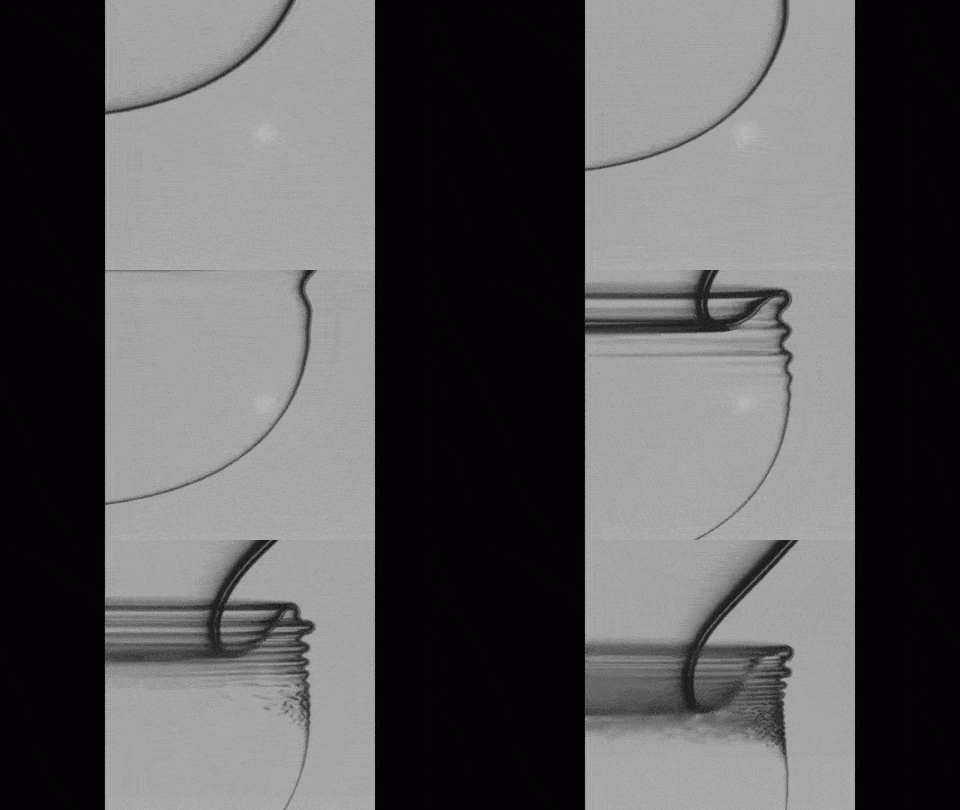
    What you see here is a viscous drop falling into a less viscous fluid. Shear forces between the drop and the surrounding fluid cause the drop to quickly deform into a shape like an upside-down mushroom as it descends. The cap forms a vortex ring that curls the viscous fluid back on itself. As it does, that motion compresses the viscous sheet, causing it to wrinkle, as seen in the close-up in the bottom animation. Check out the full video here. (Image credit: E. Q. Li et al., source)

  • Fire Tornadoes in Action

    Fire Tornadoes in Action

    Commonly called fire tornadoes, these terrifying vortices often occur in large wildfires and have more in common with dust devils or waterspouts than true tornadoes. They form when warm, buoyant air rises due to the fire’s heat. This creates low pressure over the fire source and draws in fresh, cooler air from the surroundings. If there is any small vorticity or rotational motion to that surrounding air, its spin will be amplified as it gets drawn in. This is akin to an ice skater spinning faster when she pulls her arms in – it’s a result of conservation of angular momentum. That intensification of the air’s rotation is what forms the vortex, which we see here due to the flames it draws upward. This footage was captured yesterday by crews fighting fires in Missouri.  (Image credit: Southern Platte Fire Protection District/WCPO 9, source)

    Special thanks to FYFD’s Patreon supporters who help support the website!

  • Featured Video Play Icon

    Perching Physics

    Compared to birds, manmade aircraft tend to be quite limited and inelegant. Fixed-wing aircraft, for example, require long, flat areas for take-off and landing, whereas birds of all sizes are adept at maneuvers like perching. This video examines the perching behaviors of large birds and extends the physics to a small unmanned aerial vehicle (UAV). As a bird approaches a perching location, it pitches its body and wings upward. This places the bird in what’s known as deep stall, where air flowing over the upper surface of the wing separates just after the leading edge. This move dramatically increases drag on the bird, slowing it for landing. At the same time, the speed of the pitch maneuver generates a vortex on the wing that helps the bird maintain lift despite the drop in speed. With the help of both forces, the bird can make a graceful, controlled landing in only a short distance. (Video credit: J. Mitchell et. al.)

  • Falling Ink

    Falling Ink

    Photographer Linden Gledhill created these nebula-like composites from photos of ink diffusing in water. The work was inspired by Mark Stock’s “Spherical Rayleigh-Taylor Instabilities” series featured here last week. Like Stock’s computational art, the twisted fingers and vortex rings above form due to the denser ink falling through less dense water. The interface between the two fluids distorts under the effects of gravity and the fluids’ relative motion. Such shapes are ephemeral at best; the falling ink will quickly become turbulent and diffuse throughout the water.  (Photo credit and submission: L. Gledhill)

  • Helicopter Tip Vortices

    Helicopter Tip Vortices

    Airplanes and other fixed-wing aircraft produce wingtip vortices as a result of their finite length. Rotor blades, like those on helicopters, produce the effect as well. Both wings and rotors generate lift by trapping low-pressure air on their top surface and high-pressure air below. At their tips, though, the high-pressure air can sneak around the wing or rotor, creating vortices like the ones visualized above. Here smoke from a wire is entrained by the rotors’ inflow and twisted into a tip vortex. The line of vortices drifts downward due to the rotor’s downwash. (Image credit: M. Giuni et al., source)

  • Numerical Rayleigh-Taylor

    Numerical Rayleigh-Taylor

    If you’ve ever dripped food coloring or ink into a glass of water, you’ve probably created a cascade of tiny vortex rings similar to the images above. This is the Rayleigh-Taylor instability, in which the heavier ink/food coloring falls under gravity into the less dense water. What’s shown above is a special case–one that no experiment can recreate. It’s a numerical simulation of a spherical Rayleigh-Taylor instability. Imagine a sphere of a dense fluid “falling” outward under the influence of a radial gravitational field. This is one of the interesting aspects of computational fluid dynamics–it can simulate situations that are impossible to create experimentally. That can be both a strength and a weakness, allowing researchers to probe otherwise unavailable physics or fooling the unwary into thinking they have captured something real. (Image credit: M. Stock)

  • Hiding in the Sand

    Hiding in the Sand

    Flounders, stingrays, and other flat, bottom-dwelling fish often hide under sand for protection. These fish move by oscillating their fins or the edge of their bodies. They use a similar mechanism to bury themselves–quickly flapping to resuspend a cloud of particles, then hitting the ground so that the sand settles down to cover them. Researchers have been investigating this process by oscillating rigid and flexible plates and observing the resulting flow. When the flapping motion exceeds a critical velocity, the vortex that forms at the plate’s edge is strong enough to pick up sand particles. Understanding and controlling how and when these vortex motions kick up particles is useful beyond the ocean floor, too. Helicopters are often unable to land safely in sandy environments because of the particles their rotors lift up, and this work could help mitigate that problem. (Image credits: TylersAquariums, source; Richmondreefer, source; A. Sauret, source; research credit: A. Sauret et al.)

  • Featured Video Play Icon

    Fire Tornado

    Fire tornadoes, despite their name, are more like dust devils than your typical tornado. In nature, they’ll often form in wildfires, but here the Slow Mo Guys simulate one for the high-speed cameras using a ring of box fans set up to provide rotational flow, or vorticity, around a kerosene fire. As the fire burns, the warm air over the flame moves upward due to buoyancy. This creates a low-pressure area around the fire that draws in the spinning air from further out. Like an ice skater who pulls her arms in when spinning, the rotating air spins faster as it moves in toward the fire, resulting in a swirling turbulent vortex of flame. Hopefully it goes without saying, but, seriously, don’t try this at home. (Video credit: Slow Mo Guys; submitted by Chris S.)

  • Featured Video Play Icon

    Visualizing Vortices

    Flow visualization can be a valuable tool for understanding fluid dynamics. In this video, we see how it can help elucidate the mechanisms of flapping flight. By dyeing vortices from the leading edge in red rhodamine and vortices from the trailing edge in green fluorescein, it’s possible to distinguish their competing effects for wings of different size. The speed and efficiency of a flapping wing depends on the vortices it sheds–these provide its lift and thrust. On a short wing, the leading edge vortex is significant and spins in a counter-clockwise (positive) direction. When it reaches the trailing edge, it meets a vortex spinning clockwise (negative). The interference of the two vortices weakens the shed vortex, thereby slowing the wing. Lengthening the wing weakens the leading edge vortex, which reduces its interference at the trailing edge and makes the longer wings more efficient. (Video credit: T. Mitchel et al.; via @AlbanSauret)

  • Fire Tornadoes

    Fire tornadoes, despite their name, are more closely related to dust devils or waterspouts than to true tornadoes. Though rarely documented, they are relatively common, especially in wildfires. The heat of the fire creates an updraft of warm, rising air that leaves behind a low-pressure region. Air from outside is drawn toward this low-pressure area, gets heated, and rises. As the outside air gets pulled in, any vorticity or rotation it had gets intensified via conservation of angular momentum–the same way a spinning ice skater speeds up when she pulls her arms in. The result is the tightly-spinning vortex at the heart of a fire tornado. (Video credit: C. Fleur; via NatGeo)