
This photo series shows the development of a Kelvin-Helmholtz instability. It’s formed when two layers of fluid move past one another at different speeds. In this case, the two fluids meet off the back of a flat plate (seen at the left of the top image) when fast-moving flow from the top of the plate encounters slower fluid beneath. Friction and shear between the fluid layers causes billows to rise up and form waves very similar to those on the ocean (wind across the water works the same way!). Those waves turn over into vortex-like spirals and keep mixing until they break down into turbulence. This pattern crops up pretty frequently, especially in clouds. (Image credit: G. Lawrence)
Search results for: “vortex”

“Catacomb of Veils”


Burning Man’s “Catacomb of Veils”, the largest sculpture burned in the 2016 event, produced a series of smoke tornadoes as it blazed. Like dust devils or fire tornadoes, these vortices are driven by hot, buoyant air rising – in this case, from the fire. As the surrounding air moves in toward the fire, any rotational motion, or vorticity, in the air is intensified due to conservation of angular momentum. That concentrates it into a vortex, which becomes visible when it picks up smoke. Simultaneously, the wind was blowing in a consistent direction, sending any new vortices generated marching downstream. You can watch even more vortices and some slow-motion footage of the burning in the full video by Mark Day. (Image credit: M. Day, source; submitted by Larry B)

Happy 50th, Star Trek!
Today’s post is largely brought to you by the fact that I have been sick the past four days and my fiance and I have been bingeing on Star Trek Voyager. At some point, we began wondering about the sequence from 0:30-0:49 in which Voyager flies through a nebula and leaves a wake of von Karman vortices. Would a starship really leave that kind of wake in a nebula?
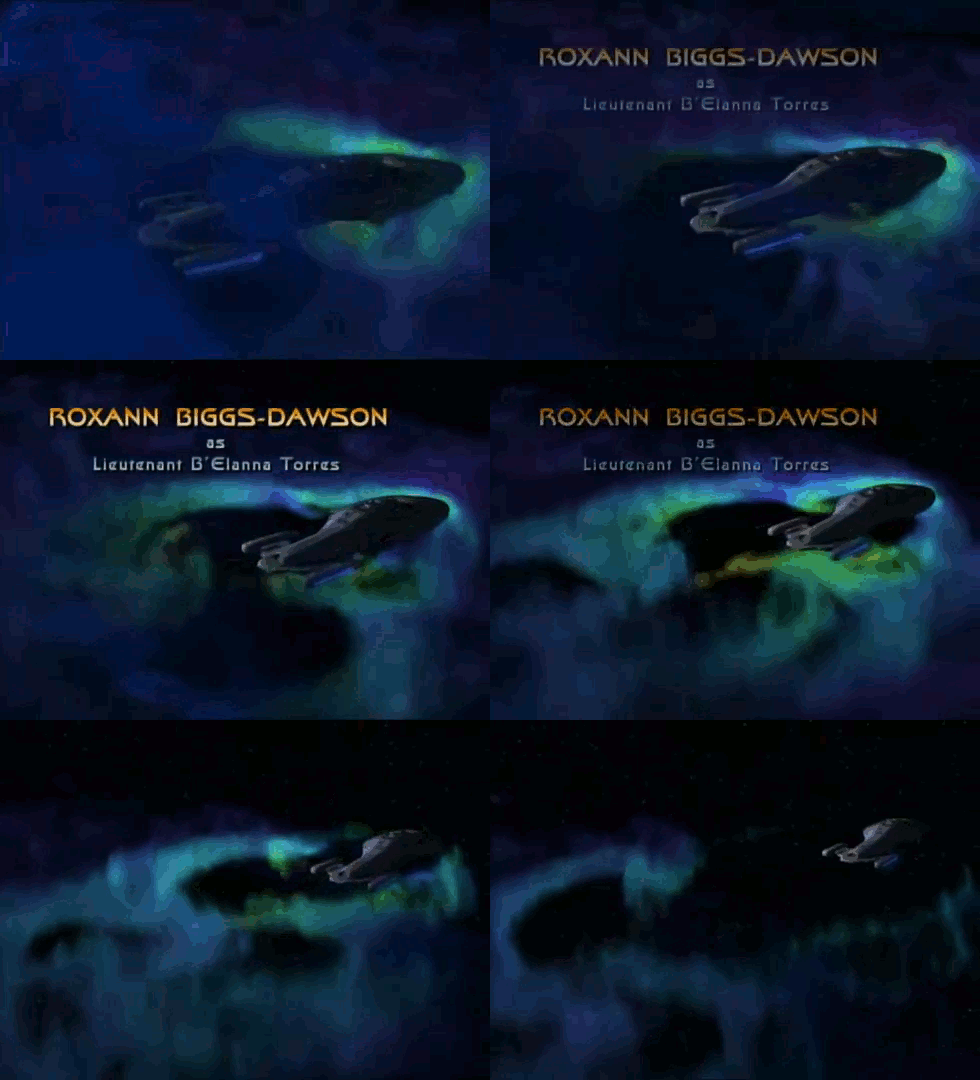
My first question was whether the nebula could be treated as a continuous fluid instead of a collection of particles. This is part of the continuum assumption that allows physicists to treat fluid properties like density, temperature, and velocity as well-defined quantities at all points. The continuum assumption is acceptable in flows where the Knudsen number is small. The Knudsen number is the ratio of the mean free path length to a characteristic flow length, in this case, Voyager’s size. The mean free path length is the average distance a particle travels before colliding with another particle. Nebulae are much less dense than our atmosphere, so the mean free path length is larger (~ 2 cm by my calculation) but still much smaller than Voyager’s length of 344 m. So it is reasonable to treat the nebula as a fluid.
As long as the nebula is acting like a fluid, it’s not unreasonable to see alternating vortices shed from Voyager. But are the vortices we see realistic relative to Voyager’s size and speed? Physicists use the dimensionless Strouhal number to describe oscillatory flows and vortex shedding. It’s a ratio of the vortex shedding frequency times the characteristic length to the flow’s velocity. We already know Voyager’s size, so we just need an estimate of its velocity and the number of vortices shed per second. I visually estimated these as 500 m/s and 2.5 vortices/second, respectively. That gives a Strouhal number of 0.28, very close to the value of 0.2 typically measured in the wake of a cylinder, the classical case for a von Karman vortex street.
So far Voyager’s wake is looking quite reasonable indeed. But what about its speed relative to the nebula’s speed of sound? If Voyager is moving faster than the local speed of sound, we might still see vortex shedding in the wake, but there would also be a bow shock off the ship’s leading edge. To answer this question, we need to know Voyager’s Mach number, its speed relative to the local speed of sound. After some digging through papers on nebulae, I found an equation to estimate speed of sound in a nebula (Eq 9 of Jin and Sui 2010) using the specific gas constant and temperature. Because nebulae are primarily composed of hydrogen, I approximated the nebula’s gas constant with hydrogen’s value and chose a representative temperature of 500 K (also based on Jin and Sui 2010). This gave a local speed of sound of 940 m/s, and set Voyager’s Mach number at 0.53, inside the subsonic range and well away from any shock wave formation.
Of course, these are all rough estimates and back-of-the-envelope fluid dynamics calculations, but my end conclusion is that Voyager’s vortex shedding wake through the nebula is realistic after all! (Video credit: Paramount; topic also requested by heuste11)
Happy 50th anniversary, Star Trek! Some of my earliest memories of TV are of watching TNG with my parents. Star Trek taught me that curiosity and scientific inquiry were vital and valuable, and that anyone could grow up to be a scientist, engineer, and leader. Thank you for such an inspiring and hopeful vision for humanity’s future!
And, seriously, those von Karman vortices are awesome.

Soap Film Wakes
Soap films can create remarkable flow visualizations when illuminated with monochromatic (single color) light. Each of the photos above shows a flow moving from left to right with a small object near the left creating an obstruction. In the top two images, the objects are cylinders; in the lower one it’s a flat plate tilted at 45 degrees. All of the objects shed vortices as the flow moves past. These vortices alternate in direction – the first spins clockwise, the next counter-clockwise, then clockwise again and so on. This pattern is known as a von Karman vortex street and can even show up in the atmosphere! (Image credit: D. Araya et al.)

Rio 2016: Sailing and Rule 42

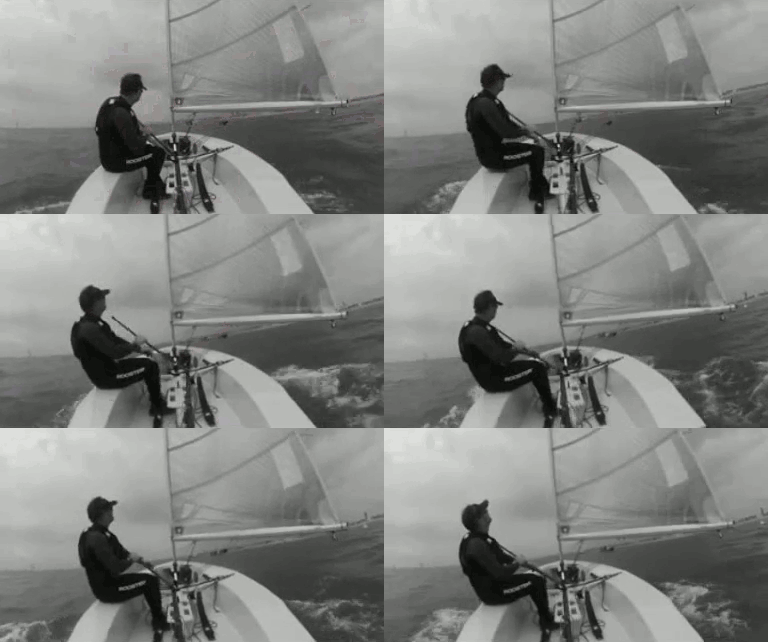

If you watch some of the sailing in Rio, you may hear commentators mention sailors being penalized for breaking Rule 42. Broadly speaking, Rule 42 says that sailors can’t use their body to propel the boat. While it seems like a little rocking couldn’t make much difference, it turns out events have these rules for good reason.
One way to break Rule 42 is to perform sail flicking, demonstrated in the animation above. The sailor uses his or her body weight to roll the boat slightly, which causes the sail to flick. Aerodynamically speaking, we’d call this motion heaving. On the flexible sail, this unsteady motion decreases drag, allowing the boat to go faster. Done with the right frequency and amplitude, sail flicking actually makes the sail’s drag become negative, thereby creating thrust!
The bottom image shows a visualization of the wake of a normal sail (left) and a sail being flicked (right). Both sails shed vortices in the downstream direction, but the flicked sail has much stronger vortices, indicated by the darker colors. In addition to giving a sailor an illegal boost, sail flicking creates more difficult, turbulent conditions for any competitors downstream, so it’s restricted in many (but not all) sailing events. (Image credits: AP Photos; Reuters; National Solo, source; research and flow diagram credit: R. Schutt and C. Williamson, pdf)
Join us throughout the Rio Olympics for more fluid dynamics in sports. If you love FYFD, please help support the site!

Dust Devils
Dust devils, like fire tornadoes and waterspouts, form from warm, rising air. As the sun heats the ground to temperatures hotter than the surrounding atmosphere, hot air will begin to rise. When it rises, that air leaves behind a region of lower pressure that draws in nearby air. Any vorticity in that air gets intensified as it gets pulled toward the low pressure area. It will start to spin faster, exactly like a spinning ice skater who pulls in his arms. The result is a spinning vortex of air driven by buoyant convection. On Earth, dust devils are typically no more than a few meters in size and can only pick up light objects like leaves or hay. On Mars, dust devils can be hundreds of meters tall, and, though they’re too weak to do much damage, they have helpfully cleaned off the solar panels of some of our rovers! (Image credit: T. Bargman, source; via Gizmodo)
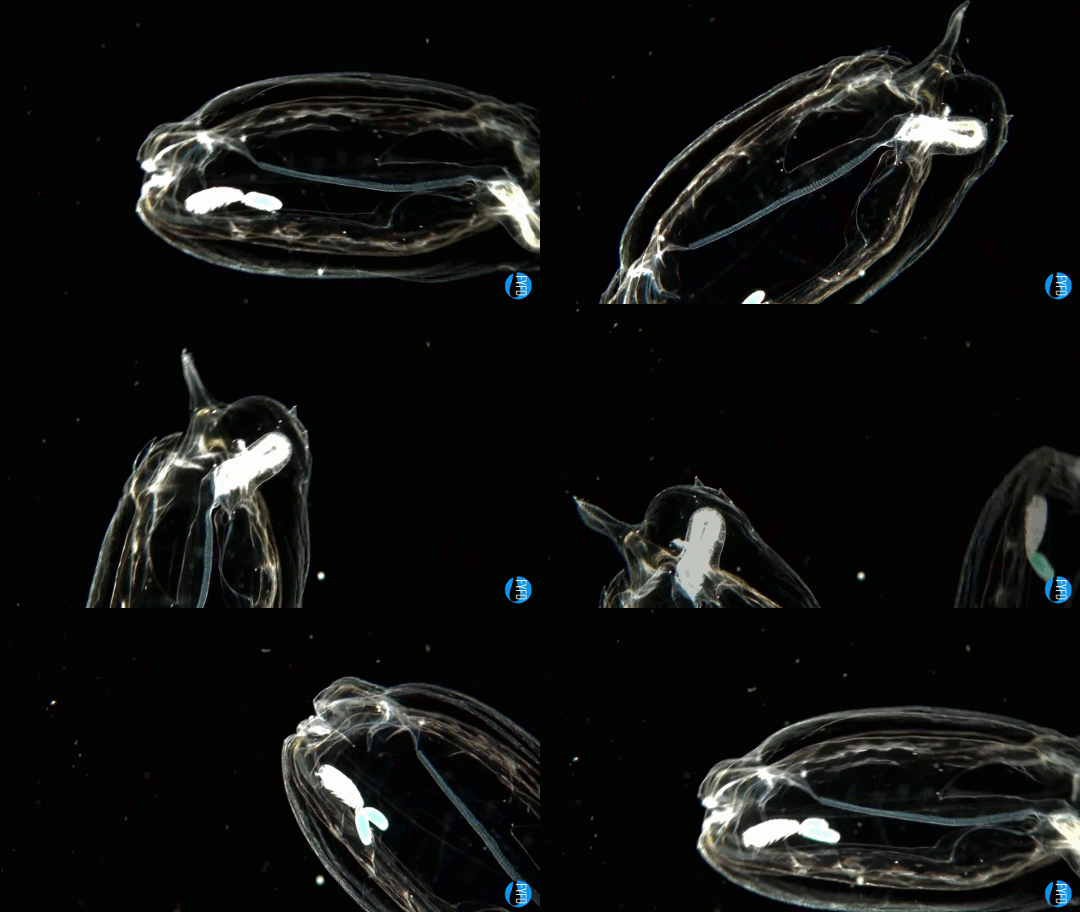
These Invertibrates May Help Robots Swim



New FYFD video! Learn all about salps, vortex rings, and underwater robots. Thanasi Athanassiadis takes me inside his lab and his newly published research into how proximity affects the thrust two vortex rings can produce.
There are a ton of little things I love about how this video came out, especially the chalkboard animations. Check it the full video below and click through to the video description for lots more information about salps and vortex rings.
(Image and video credits: N. Sharp and A. Athanassiadis; Original salp images: A. Migotto and D. Altherr)

Vortices in the Wind
Heard Island, a remote patch of rock in the southwestern Indian Ocean, peeks its head above the marine cloud layer. The volcanic island disrupts the atmosphere enough to generate a von Karman vortex street, a line of alternating vortices shedding from either side of the island. Usually these vortices would march in a straight line downstream from their source. But here strong winds from the south have blown a bunch of its vortices northward, creating an unusual kink in the island’s wake. (Image credit: J. Schmaltz/LANCE EOSDIS Rapid Response; via NASA Earth Observatory)
Bubble Tricks
[original media no longer available]
Everyone remembers playing with soap bubbles as a child, but most of us probably never became as adept with them as magician Denis Lock. In this video, Lock shows off some of the clever things one can do with surface tension and thin films. My favorite demo starts at 1:25, when he constructs a spinning vortex inside a bubble. He starts with one big bubble and adds a smaller, smoke-filled one beneath it. Then, using a straw, he blows off-center into the large bubble. This sets up some vorticity inside the bubble. When he breaks the film between the two bubbles, the smoke mixes into the already-swirling air in the larger bubble. Then he pokes a hole in the top of the bubble. Air starts rushing out the deflating bubble. As the air flows toward the center of the bubble, it spins faster because of the conservation of angular momentum and a miniature vortex takes shape. (Video credit: D. Lock/Tonight at the London Palladium/ via J. Hertzberg)
Reader Question: Shower Curtains
Reader thansy asks:
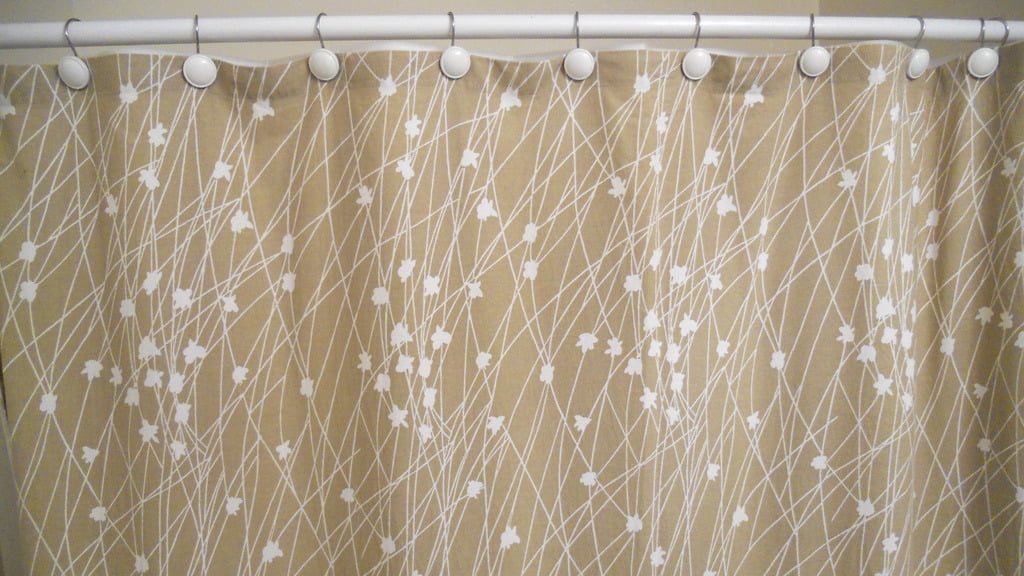
Why do the bottoms of shower curtains drift in toward the water coming from the shower head?
We all know that moment. You’re minding your own business, scrubbing away, and all of a sudden, the shower curtain billows up and grabs you. Scientists have debated the cause of this behavior for years. Some argued that the curtain billowed due to hot air rising from the shower. Others claimed the fast-moving spray caused lift that pulled the curtain up. But fifteen years ago, one scientist tackled the problem computationally. He performed a numerical simulation of a shower head spraying into a bath and found that this spray of droplets creates a weak horizontal vortex in the shower.

This shower vortex has a low-pressure core at the middle, which is thought to provide the suction that causes the shower curtain to billow. The scientist, David Schmidt, was awarded the 2001 Ig Nobel Prize for his work. (Image credits: N. Paix, D. Schmidt; research credit: D. Schmidt)