
The volcano Tungurahua erupts in a cloud of ash while molten lava flows down the mountain’s sides. Overhead a wispy lenticular cloud has formed where moist air flowing over the volcano dropped below its dew point. Volcanic eruptions have been known to produce shock waves and vortex rings as well as their distinctive turbulent plumes. (submitted by A. Jones III)
Search results for: “turbulence”

Science Off the Sphere: Liquid Lenses
Astronaut Don Pettit delivers more “Science Off The Sphere” in his latest video. Here he demonstrates diffusion and convection in a two-dimensional water film in microgravity. He notes that the viscous damping in the water is relatively low and that, left undisturbed, mixing in the film will continue for 5-10 minutes before coming to rest, which tells us that the Reynolds numbers of the flow are reasonably large. The structures formed are also intriguing; he notes that drops mix with mushroom-like shapes that are reminiscent of Rayleigh-Taylor instabilities and cross-sectional views of vortex rings. It would be interesting to compare experiments from the International Space Station with earthbound simulations of two-dimensional mixing and turbulence, given that the latter behaves so differently in 2D.
Reynolds Stress
[original media no longer available]
From reader jessecaps who hung it on the office door. I expect this joke will make sense to very few but as someone who once dabbled in turbulence, I could not resist.
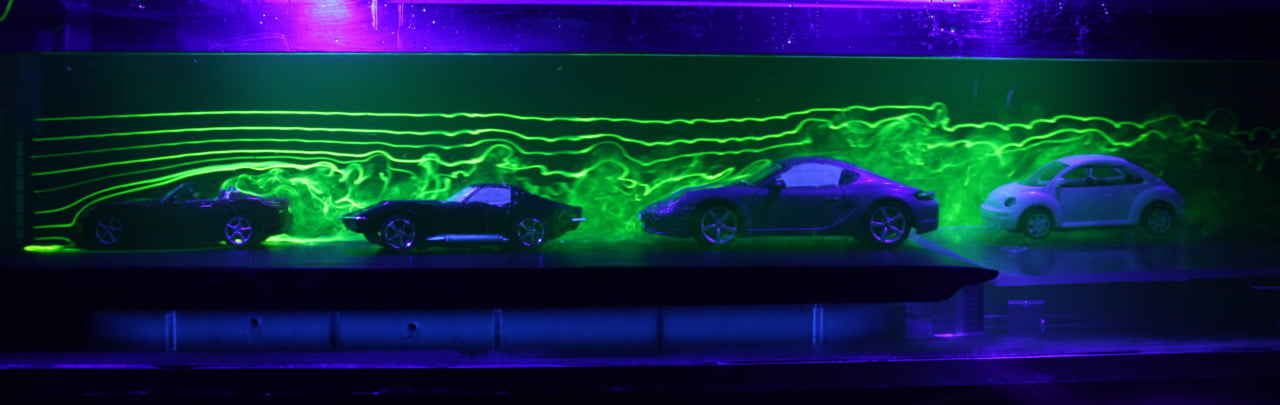
Flow Around Traffic
Flow visualization in a water tunnel shows what the flow around a line of traffic looks like. Note the progressively more turbulent flow around each car as it sits in the wake of the car before it. Turbulent flow is usually associated with increased drag forces, but because turbulence can actually help prevent flow separation it is sometimes desirable as a method for decreasing drag. In the case of these cars drafting on one another, it is clear that the cars further back in the line cause less effect on the fluid–and thus have less drag to overcome–than the front car. (Photo credit: Rob Bulmahn)
Wind Tunneling Testing for BASE Jumpers
While we usually think of wind tunnel testing airplane models, the truth is that wind tunnels today test a much wider array of subjects. From oil rigs and skyscrapers to athletes and police sirens, if you can imagine it, it’s probably been stuck in a wind tunnel. This video shows some wind tunnel testing of a tracking suit used for BASE jumping. The primary focus seems to be on lift and drag at angle of attack–which can be used to determine glide ratios for the pilot–but there is also some study of localized turbulence generation, as evidenced by the use of smoke generators and the streamers attached to the suit’s arms and legs. (submitted by Jason C)
Smoke Flow Viz
Smoke visualization, illuminated by a laser sheet, shows a 2D slice from an axisymmetric jet as it breaks down to turbulence. The flow is laminar upon exiting the nozzle, but the high velocity at the edge of the jet and low velocity of the surrounding air causes shear that leads to the Kelvin-Helmholtz instability. This instability leads to the formation of small vortices that grow as they are advected downstream until they are large enough to interrupt the jet and it breaks down into fully turbulent flow. (Video credit: B. O. Anderson and J. H. Jensen)
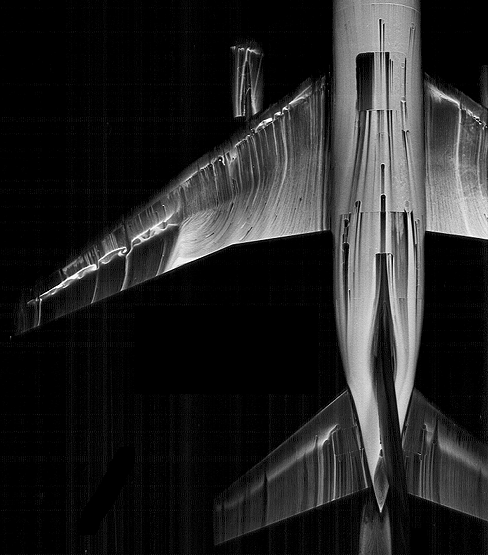
Flow Over Swept Wings
Flow over a swept wing behaves very differently than a straight fixed wing or an airfoil. Instead of flowing straight along the chord of the wing in a two-dimensional fashion, air is also directed along the wing, parallel to the leading edge. The above oil flow visualization on a swept wing airplane model shows this curvature of streamlines. As a result of this three-dimensional flow behavior, boundary layers on swept wings are subject to the crossflow instability, which manifests as co-rotating vortices aligned to within a few degrees of the streamlines. Triggering this boundary layer instability can lead to turbulence and higher drag for the aircraft.
Dove in Flight
This spectacular high-speed video shows a dove in flight. Note how its wings flex through its stroke and the way the wings rotate over the course of the downstroke and reversal. There is incredible beauty and complexity in this motion. The change in wing shape and angle of attack is what allows the bird to maximize the lift it generates. Note also how the outer feathers flare during the downstroke. This promotes turbulence in the air moving near the wing, which prevents separated flow that would cause the dove to stall. (See also: how owls stay silent. Video credit: W. Hoebink and X. van der Sar, Vliegkunstenaars project)
Inside a Blender
[original media no longer available]
High-speed video visualizes the complicated flow field inside a blender. Note that the video is placed in reverse for artistic effect. This flowfield is clearly too turbulent for reversible flow. That said, it is possible to mix two fluids and then unmix them, under the right circumstances.
Separation and Stall
This flow visualization of a pitching wind turbine blade demonstrates why lift and drag can change so drastically with angle of attack. When the angle the blade makes with the freestream is small, flow stays attached around the top and bottom surfaces of the blade. At large (positive or negative) angles of attack, the flow separates from the turbine blade, beginning at the trailing edge and moving forward as the angle of attack increases. The separated flow appears as a region of recirculation and turbulence. This is the same mechanism responsible for stall in aircraft. (Submitted by Bobby E)