Search results for: “turbulence”

  • Featured Video Play Icon

    Jellyfish Flow

    Florescent dye reveals the flow pattern of ocean water around a swimming jellyfish. Some researchers posit that fluid drift associated with the swimming of marine animals may be as substantial a factor in ocean mixing as turbulence caused by the wind and tides. If true, modeling of climate change–past, present, and future–would need to take into account the biology of the ocean as well! #

  • Jovian Storms

    Jovian Storms

    Home to storms capable of lasting for a hundred years or more, Jupiter’s atmosphere is a highly turbulent place. Currently, no comprehensive theory exists to explain the symmetry of Jupiter’s bands of clouds and the persistence of vortices such as the Great Red Spot, however, the mixing and stratification visible on the planet remains a beautiful reminder of the power of fluid dynamics. (Photo credits:Cassini – 1, 2,  Voyager 1, New Horizons – 1, 2)

  • Featured Video Play Icon

    Smoke Transition

    Smoke issuing from a round jet undergoes transition from laminar to turbulent flow. As the smoke moves past the unmoving ambient air, the friction between these two layers creates shear and triggers a Kelvin-Helmholtz instability, recognizable by the formation and roll up of vortices along the edges of the jet. Those vortices then roll together in pairs, detach, and devolve into a generally turbulent flow. Because turbulence is far more efficient at mixing than a laminar flow is, the smoke seems to disappear.

  • Featured Video Play Icon

    Coughing Contagions

    Schlieren imaging has applications even in public health. This video demonstrates the spread of contagion via coughing with and without a mask on. Although air from the cougher’s lungs escapes the sides of the mask, it mostly rises on a thermal plume rather than projecting 1 to 2 meters forward in a turbulent jet as in the maskless case. Flu season is just starting. Don’t forget to get your flu shot!

  • Featured Video Play Icon

    Airfoil Boundary Layer

    This video shows the turbulent boundary layer on a NACA 0010 airfoil at high angle of attack (15 degrees). Notice how substantial the variations are in the boundary layer over time. At one instant the boundary layer is thick and smoke-filled and in another we see freestream fluid (non-smoke) reaching nearly to the surface. This variability, known as intermittency, is characteristic of turbulent flows, and is part of what makes them difficult to model.

  • Featured Video Play Icon

    Reader Question: Faucet Physics

    jessecaps-blog-deactivated20170 asks:

    With respect to the laminar/turbulent flow in the faucet, at the end he explains that the diameter is smaller inside the valve compared to the nozzle and therefore the velocity is greater and turbulence is achieved there before it leaves the nozzle. But turbulence is characterized by the Reynolds number not the velocity, so a larger velocity with a smaller diameter will yield the same Reynolds number, why would we expect turbulence in the nozzle before the stream?

    ETA: As pointed out in the comments, I made a very silly mistake when calculating the Reynolds number last night. While most of what I say below is still true in general, it’s not in the case in the faucet, and so I’ve edited the entry to reflect that.

    Great question! A quick control volume analysis of an incompressible fluid shows that, while the flow speed is higher through the faucet’s valve, the Reynolds number (based on diameter) at the valve is the same as higher than the Reynolds number at the nozzle by a factor of (nozzle diameter)/(valve diameter). Thus transition can occur at the valve before the nozzle. A word of caution, though: although we often use Reynolds number as a method of characterizing when a flow becomes turbulent, it is not a hard and fast rule.

    As undergraduates we learn that pipe flow transitions to turbulence at a Reynolds number of 2,300 based on the pipe’s diameter. However, under the right laboratory conditions, it’s possible to maintain laminar flow in a pipe to a Reynolds number an order of magnitude larger. (#) It all depends on the initial conditions of the flow and the influence of factors like surface roughness. What this means in the case of the faucet is that the same Reynolds number (based on diameter) may not correctly indicate whether the flow is laminar or turbulent at a given point.

    Now, while it may be possible that the contraction at the valve introduces some small turbulence that decays prior to the flow’s exit from the nozzle, that does not seem overly likely to me. Even though, by Reynolds number, transition can occur at the valve before the nozzle, I suspect most of the sound we hear comes from the increased flow rate caused by turning the faucet. It may also be that the sound is associated with the onset of turbulence at the valve but the turbulence is still slight enough that we do not notice it by eye in the external flow.

  • Featured Video Play Icon

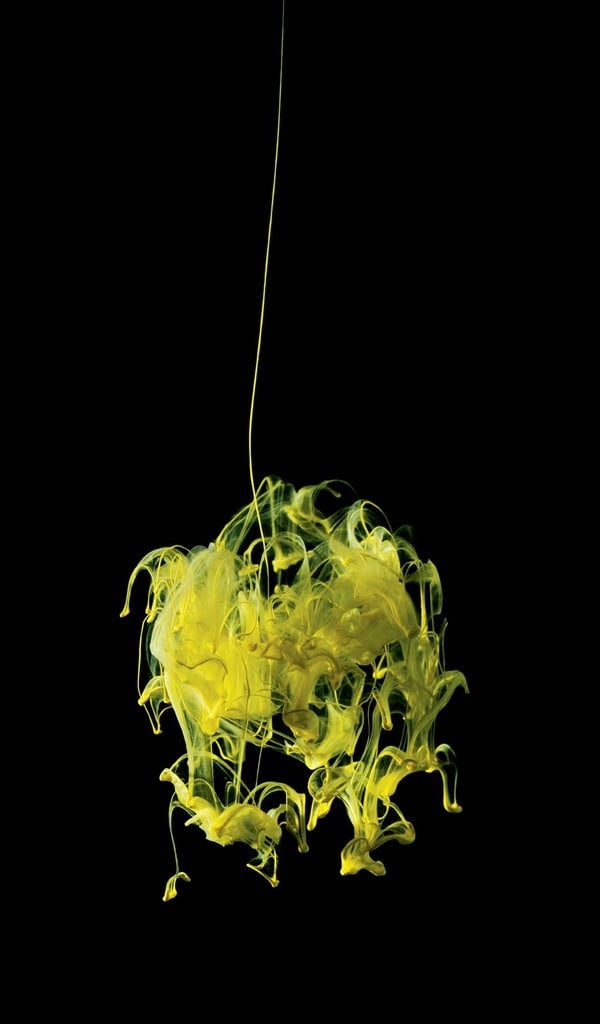
    Laminar and Turbulent Flows from a Faucet

    Here laminar and turbulent flows, basic concepts in fluid mechanics, are demonstrated in the kitchen sink! While laminar flow is often desirable for decreasing drag due to friction, most practical flows are turbulent. The hissing the video author associates with the onset of turbulence is not a coincidence either. The chaotic motion of turbulent flows can produce aerodynamic noise like the roar produced by airplane propellers or the hum of electrical lines in the wind.

  • Featured Video Play Icon

    Toroidal Vortex

    When instabilities exist in laminar flow, they do not always lead immediately to turbulence. In this video, a viscous fluid fills the space between two concentric cylinders. As the inner cylinder rotates, a linear velocity profile (as viewed from above) forms; this is known as Taylor-Couette flow. If any tiny perturbations are added to that linear profile–say there is a nick in the surface of one of the cylinders–the flow will develop an instability. In this type of flow, an exchange of stabilities will occur. Rather than transitioning to turbulence, the fluid develops a stable secondary flow–the toroidal vortex highlighted by the dye in the video. If the rotation rate is increased further other instabilities will develop.

  • Airshow Wakes

    Airshow Wakes

    Turbulent plumes stream out behind airplanes in an airshow. #

  • Featured Video Play Icon

    Un-Mixing a Fluid Demo

    Not only is this demonstration one of my favorites, it’s a reader favorite, too. Even though I posted it nearly a year ago, I’ve had it resubmitted over and over. Here’s what I originally wrote:

    Laminar flow (as opposed to turbulence) has the interesting property of reversibility. In this video, physicists demonstrate how flow between concentric cylinders can be reversed such that the initial fluid state is obtained (to within the limits of molecular diffusion, of course!)

    For more examples, see the first half of this video.

    The results of those videos might be surprising, but they highlight the difference between laminar flow and turbulence. In laminar flow, the motion of the dye is caused by molecular diffusion and momentum diffusion, the latter of which is exactly reversible. In turbulence, much of the fluid motion is tied up in momentum convection, which is irreversible. This is why you can “unstir” the glycerin but not the milk in your coffee.