The high-speed video above shows an atomized spray of flammable liquid being ignited using a lighter. It was filmed at 10,000 fps and is replayed at 30 fps. Although uncontained, this demonstration is similar to the combustion observed inside of many types of engines. Automobiles, jet engines, and rockets all break their liquid fuel into a spray of droplets to increase the efficiency of combustion. The turbulence of the flames dances and swirls, with small-scale motions close to the sprayed droplets and larger-scale motions around the vaporized fuel. This variation in size of the scales of motion is a hallmark feature of turbulence and can be used to characterize a flow.
Search results for: “turbulence”
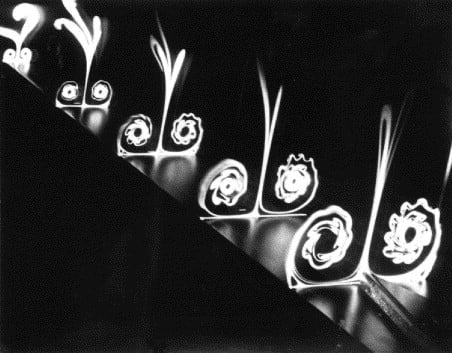
Vortex Cross-Sections

The photos above show cross-sections through the leading edge vortices on a highly swept delta wing at angle of attack. Flow in the photos is from the upper left to lower right. Notice how the vortices grow and develop waviness as they move downstream. When perturbations enter the vortex–for example, due to the shear between the vortex fluid and the freestream–some will grow and eventually cause a break down to turbulence, as in the lower picture. (Photo credits: R. Nelson and A. Pelletier)

London 2012: Cycling Physics

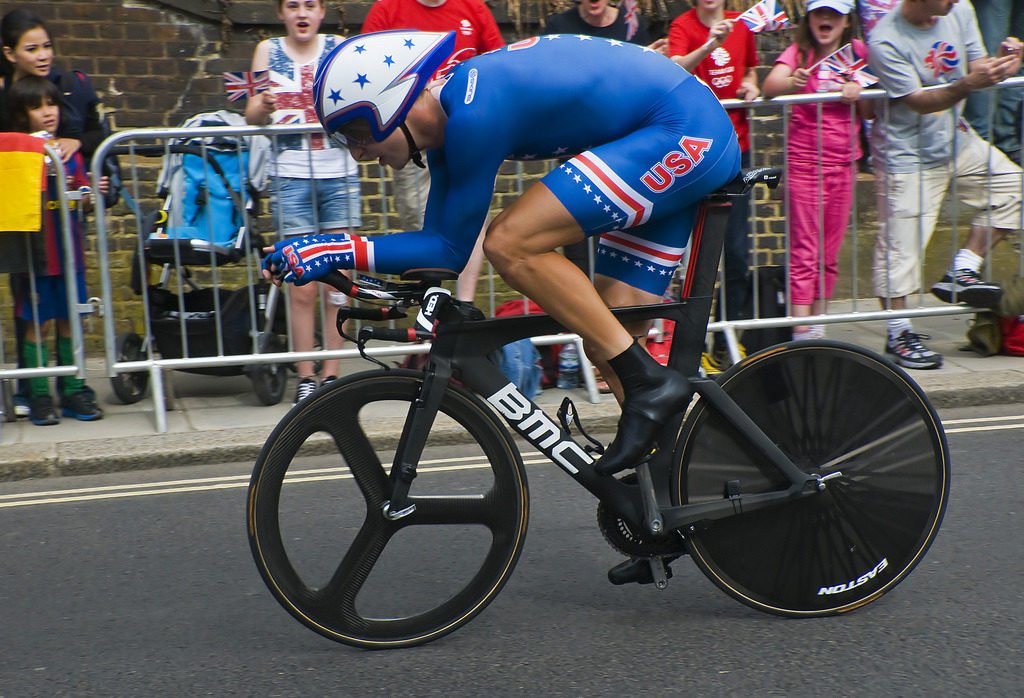


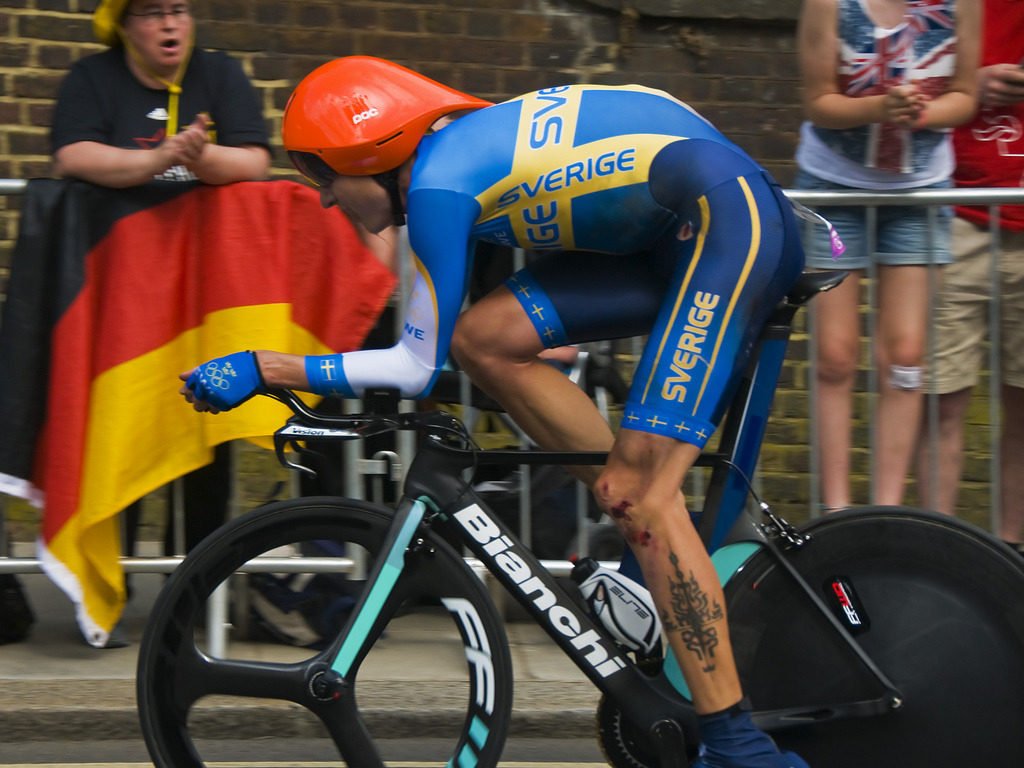


In no discipline of cycling is more emphasis placed on fluid dynamics than in the individual time trial. This event, a solo race against the clock, leaves riders no place to hide from the aerodynamic drag that makes up 70% or more of the resistance riders overcome when pedaling. Time trial bikes are designed for low drag and light weight over maneuverability, using airfoil-like shapes in the fork and frame to direct airflow around the bike and rider without separation, which creates an area of low pressure in the wake that increases drag. Riders maintain a position stretched out over the front wheel of the bike, with their arms close together. This position reduces the frontal area exposed to the flow, which is proportional to the drag a rider experiences.
Special helmets, some with strangely streamlined curves, are used to direct airflow over the rider’s head and straight along his or her back. Both helmets and skinsuits are starting to feature areas of dimpling or raised texturing. These function in much the same way as a golf ball; the texture causes the boundary layer, the thin layer of air near a surface, to become turbulent. A turbulent boundary layer is less susceptible to separating from the surface, ultimately leading to lower drag than would be observed if the boundary layer remained laminar. Wheels, skinsuits, gloves, shoe covers, and even the location of the brakes on the bike are all tweaked to reduce drag. In an event that can be decided by hundredths of a second between riders, every gram of drag counts. (Photo credits: Stefano Rellandini, POC Sports, Reuters, Paul Starkey, Louis Garneau)
FYFD is celebrating the Olympics by featuring the fluid dynamics of sports. Check out our previous posts on how the Olympic torch works, what makes a pool fast, the aerodynamics of archery, and the science of badminton.

London 2012: Swimming Pool Physics


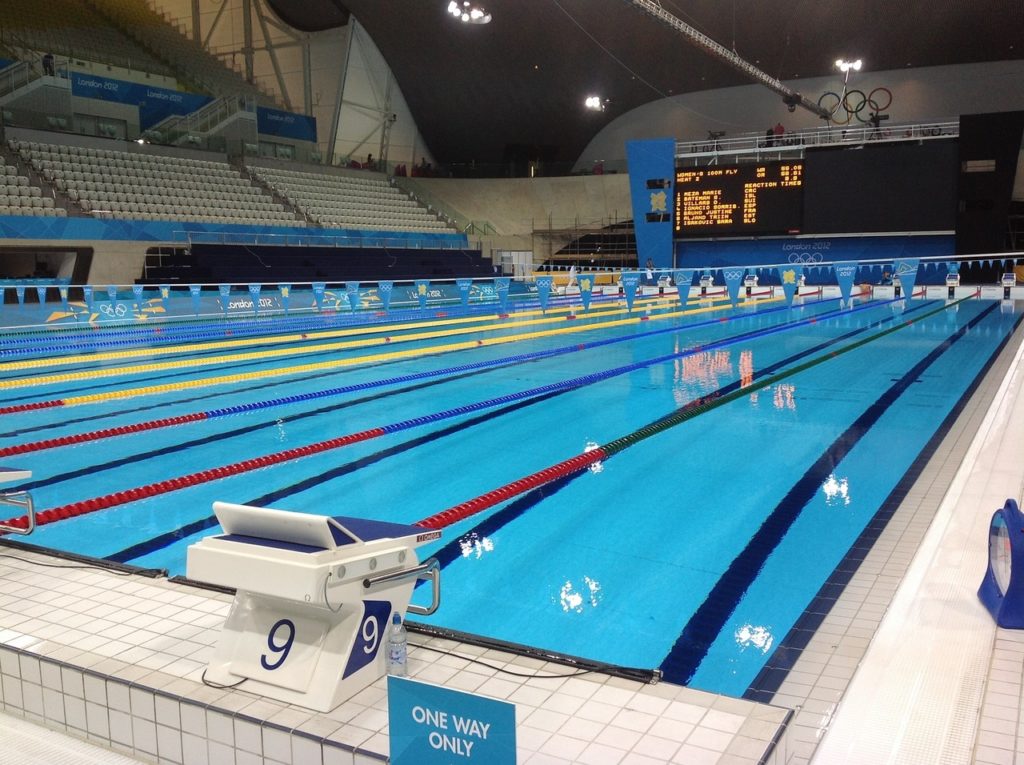
The era of the LZR suit may be over in swimming, but technology is still making an impact when it comes to making swimmers faster. One thing you’ll often hear from commentators is how the London Aquatic Center boasts one of the world’s fastest pools. When swimmers compete, they have to contend with all the turbulence created in the pool by eight people trying to direct as much water behind them as possible as quickly as possible. Like ripples spreading on a pond, these waves travel, reflect, and interfere, ultimately disrupting the swimmers and causing extra drag. In a fast pool, engineers have made adjustments to reduce the impact of these waves on swimmers. Firstly, the pool is 3 meters deep, meaning that vertical disruptions are mostly damped out before they reach the bottom, so any wave reflected off the bottom of the pool will be extremely weak. Along the sides and ends of the pool, a special trough captures surface waves, preventing them from reflecting back out into the pool. The lane lines are also designed to soak up wave energy so that it does not propagate as much between lanes. When waves hit the lines, their links spin, dissipating some of the wave’s energy.
Despite these advances, the outermost lanes–those against the walls–are not used in competition. This helps to equalize the turbulence between lanes. Whether there is any fluid mechanical advantage to being in a particular lane is debatable. The outer lanes have the advantage of only one competitor’s wake to contend with, but they isolate the swimmer so he or she cannot see their competition as well. In the inner lanes, you’ll sometimes see swimmers try to swim close to the lane line if their competition is ahead of them, the idea being that they may be able to draft on their competitor’s bow wave to reduce drag. Generally speaking, the lane positions are determined by seeding going into the event, where the faster swimmers are given the innermost lanes. This is why it’s rare to see gold medals coming from the outermost lanes. For more, check out NBC’s video on designing fast pools (US only, unfortunately). (Photo credits: Associated Press, Reuters, Geoff Caddick)
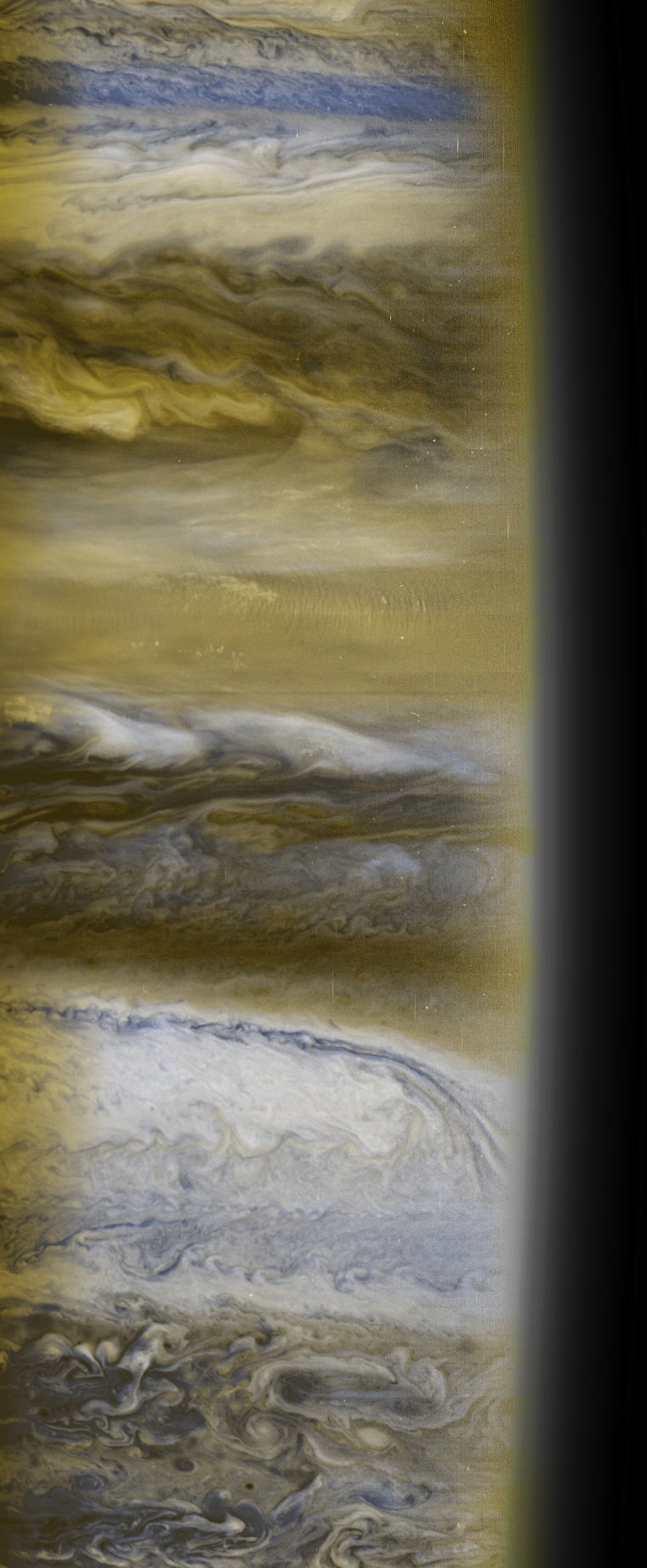
The Cloud Bands of Jupiter
The cloud bands of Jupiter stripe the planet with turbulence. Throughout its upper atmosphere, Jupiter shows signs of gravity waves and complicated wave patterns. Near the equator, the cloud bands are driven by planetary winds that reach speeds of 500 kph, whereas near the poles, the clouds show greater evidence of mottling and convection. At present, the reasons for this patterning are undetermined. (Image Credit: NASA; via APOD)

Sea Surface Temperatures
This video shows sea surface temperature results and their seasonal variation from a numerical simulation modeling circulation in the atmosphere and oceans. Modeling such enormous problems requires the development of reasonable models of the turbulent physics, clever algorithms to quickly progress the solutions, relatively low-fidelity (a single grid node may cover tens of kilometers), and enormous computing power. (Video credit: NOAA; via Gizmodo)
Canyon Fire Timelapse
Wildfires continue to burn across Colorado and other parts of the United States. This timelapse video shows 5 days worth of the Waldo Canyon fire. Smoke billows through the night and day, with diurnal temperature changes and winds affecting whether the turbulent plumes rise high or hover on the horizon. It is hard to describe the eeriness of watching a fire burn uncontrollably on the horizon; we hope those fighting the fires stay safe and that those affected by the fires are able to return and recover soon. (Video credit: Steve Moraco; submitted by Chris P)
Rotating or Not-Rotating?
Rotating a fluid often produces different dynamical behavior than for a non-rotating fluid. Here this concept is demonstrated by dropping creamer into a tank of water. Both experiments produce a turbulent plume, but the way the plume spreads and diffuses is much different in the case of the rotating tank, thanks to the Coriolis effect. (Video credit: SPINLab UCLA)

Helicopter Vortices
When conditions are just right, the low pressure at the center of a wingtip vortex can drop the local temperature below the dew point, causing condensation to form. Here vortices are visible extending from the tips of the propellers in addition to the wingtip. Because of the spinning of the propeller and the forward motion of the airplane, the prop vortices extend backwards in a twisted spiral that will quickly break down into turbulence. The same behavior can be observed with helicopter blades. (Photo credit: benurs)

F-18 Flow Viz
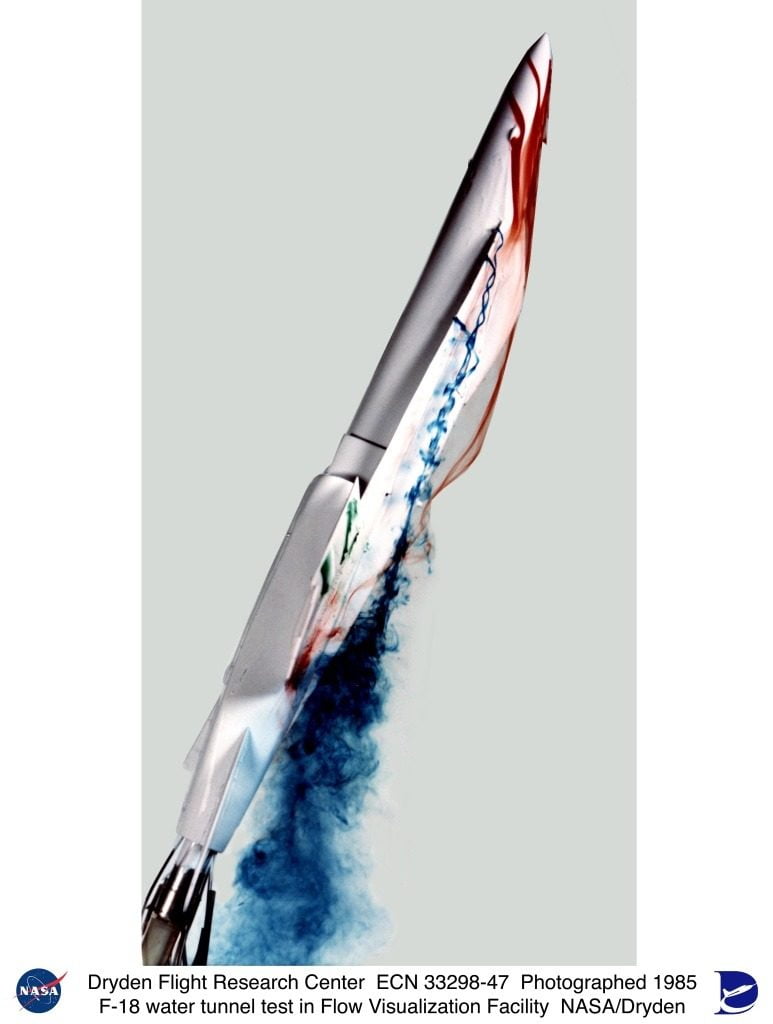
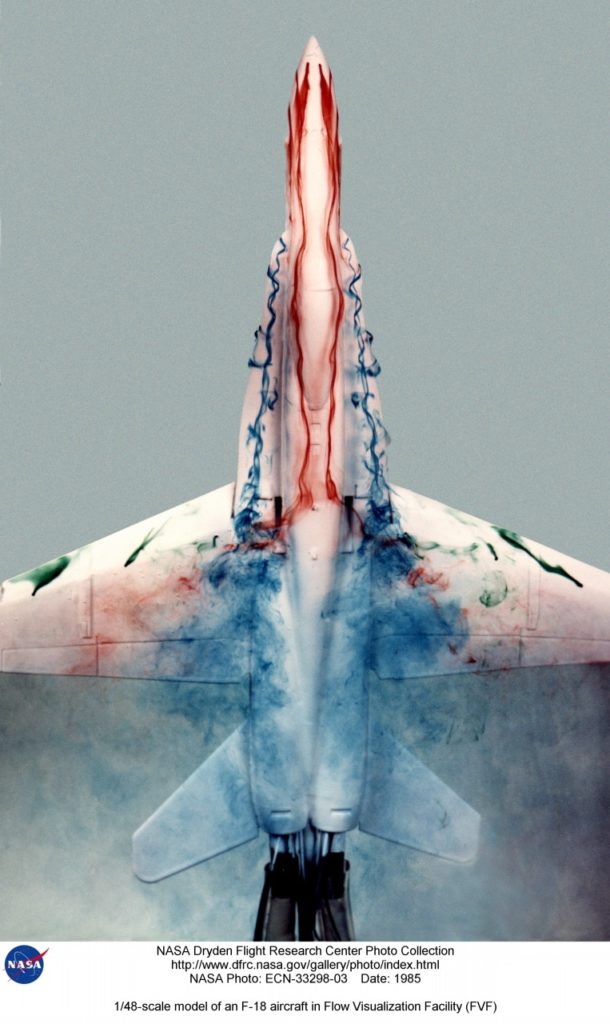
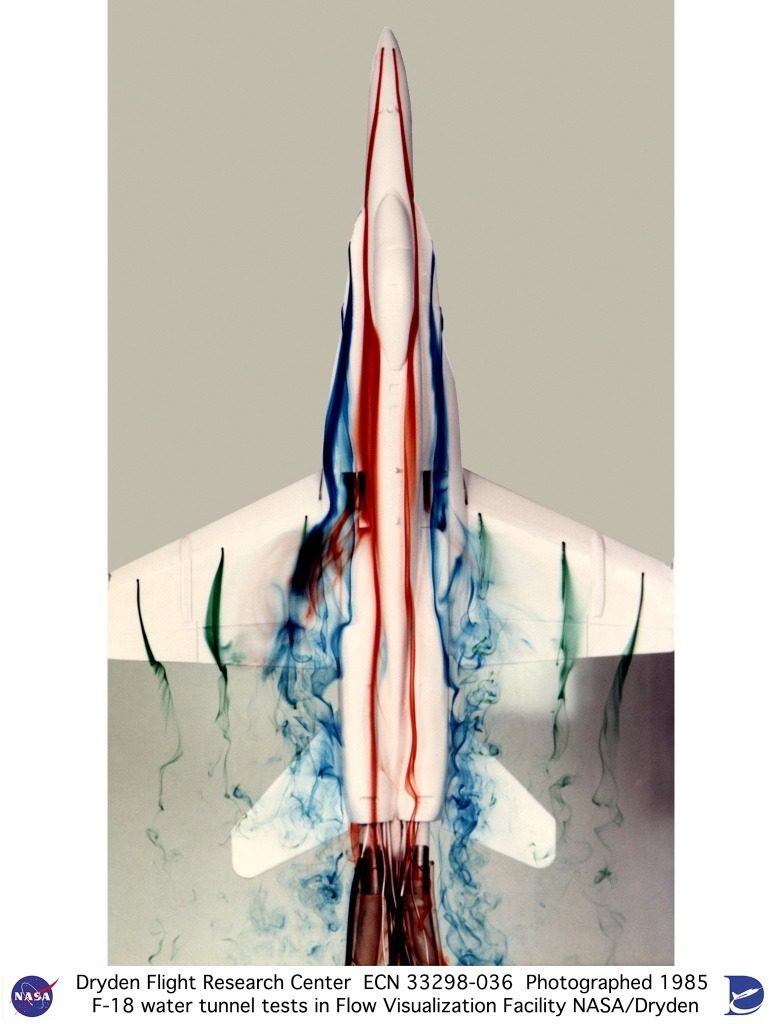


Water tunnels are useful tools for determining aerodynamic characteristics of aircraft, such as this F-18 model placed in the NASA Dryden Flow Visualization Facility. By matching the Reynolds number of the model in the water tunnel to that of the full-scale aircraft in air, engineers can observe flow around the aircraft inside the laboratory. This similarity of flows is a powerful design tool. Here dye introduced along the nose, wings, and fuselage traces streamlines around the F-18, revealing areas of turbulence at different flight conditions.