
Most venomous snakes deliver venom to their prey via grooves in their fangs, rather than through a pressurized bolus through hollow fangs. New research shows that these venoms are shear-thinning non-Newtonian fluids. The surface tension of the venom is such that a drop of venom will tend to flow into and down the groove. Once moving, the shear-thinning properties of the venom decrease the venom’s viscosity, increasing its flow rate down the fang and into the snake’s prey. (via Scientific American; Photo: green mamba, banded snake fang)
Search results for: “surface tension”

Giant Water Balloon Physics
Playing with a giant water balloon and high-speed cameras is like a giant experiment in surface tension, right up until the tensile strength of the balloon comes into play. The rippling in the balloon is reminiscent of the motion of droplet breakup or impact on superhydrophobic surfaces. (submitted by Daniel B)

Jet Breakup
A non-cylindrical stream falling through a slit nozzle exhibits the Plateau-Rayleigh instability, which drives a falling jet of fluid to break into droplets due to surface tension. The fingers formed off the falling stream may be a form of Rayleigh-Taylor instability. #
Liquids Lens Breakup
A decane liquid lens floating on water (think drops of fat in chicken soup) displays different breakup and pinch-off than seen in three-dimensional droplet breakup. The pinch-off process in two dimensions relies on line tension rather than surface tension, and the quasi-2D liquid lens system is somewhere between these. The video above is a magnification of the filament connecting one liquid lens as it is broken into two smaller liquid lenses (the dark areas on the left and right of the screen). # (via scienceisbeauty)
Boiling in Microgravity
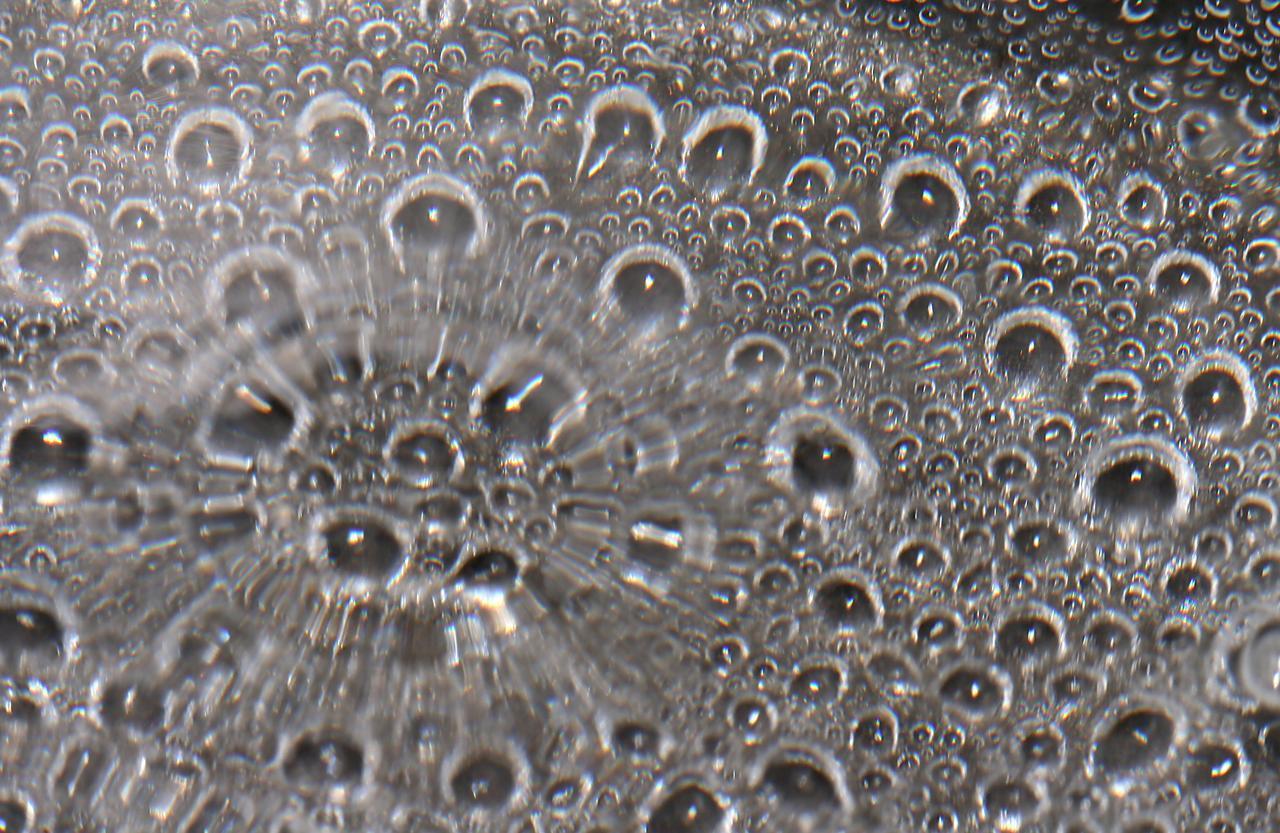
This week’s edition of the ISS research blog focuses on the Boiling Experiment Facility (BXF) and the goals of unlocking the secrets of boiling in microgravity. Without gravity to provide buoyant convection, boiling in space tends to produce one giant bubble instead of the hundreds of tiny ones we’re accustomed to seeing on our stoves. According to Dr. Tara Ruttley:
TheBoiling Experiment Facility or BXF, which launched on STS-133 in February 2010, will enable scientists to perform in-depth studies of the complexities involved in bubble formation as a result of heat transfer. For instance, what roles do surface tension and evaporation play during nucleate boiling when buoyancy and convection are not in the equation? What about the variations in the properties of the heating surface? By controlling for gravity while on the International Space Station, scientists can investigate the various elements of boiling, thus potentially driving improved cooling system designs. Improved efficiency in cooling technology can lead to positive impacts on the global economy and environment; two hot topics that have much to gain from boiling in space.

Marangoni Effect
Dyed milk pulls away after a drop of acetone is added. The acetone creates a gradient in the surface tension, which causes mass flow due to the Marangoni effect. See a video of the effect (or try it yourself at home!) here.
Flying Paint
High speed footage of flying paint demonstrates a world of viscosity and surface tension, as well as another great example of fluid dynamics as art. (via Gizmodo)
If you enjoy FYFD, why not take a minute to recommend us in the Tumblr directory? Thanks!
DIY Solutal Convection
In this video, the HouseholdHacker heads to the kitchen and uses milk, food coloring, and dish soap to create some solutal convection much like this one with cream and liqueur. The food coloring serves as a tracer for the fluid motion; it’s really the interaction of the milk and the dish soap that drives the motion. The dish soap lowers the surface tension of the milk, causing motion via the Marangoni effect. That motion redistributes some of the dish soap as well, causing further motion in the form of a surface tension instability. As with the cream and liqueur experiment, the fat in the milk is important; you won’t see much (if any) effect with fat free milk because its surface tension properties aren’t as dissimilar to dish soap. (via misterhonk.de)
Soap Bubble Shapes
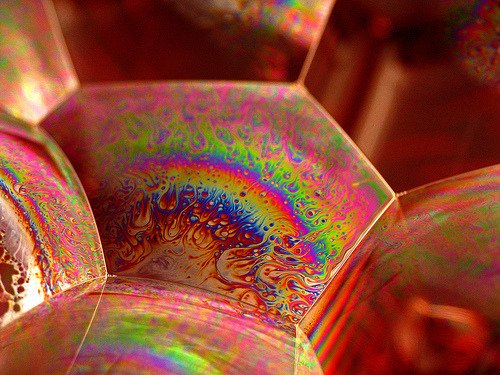
The shapes of soap bubbles are determined by surface tension, which ensures the smallest surface area for a given contained volume. (#) Their iridescent colors are created by the interference and refraction of light waves passing through the nonuniform thickness of the bubble, as well as to the motion of the soap mixture itself.
Photo credit: found via fuckyeaheyegasms, originally from teacupofmoons
Microgravity Marangoni
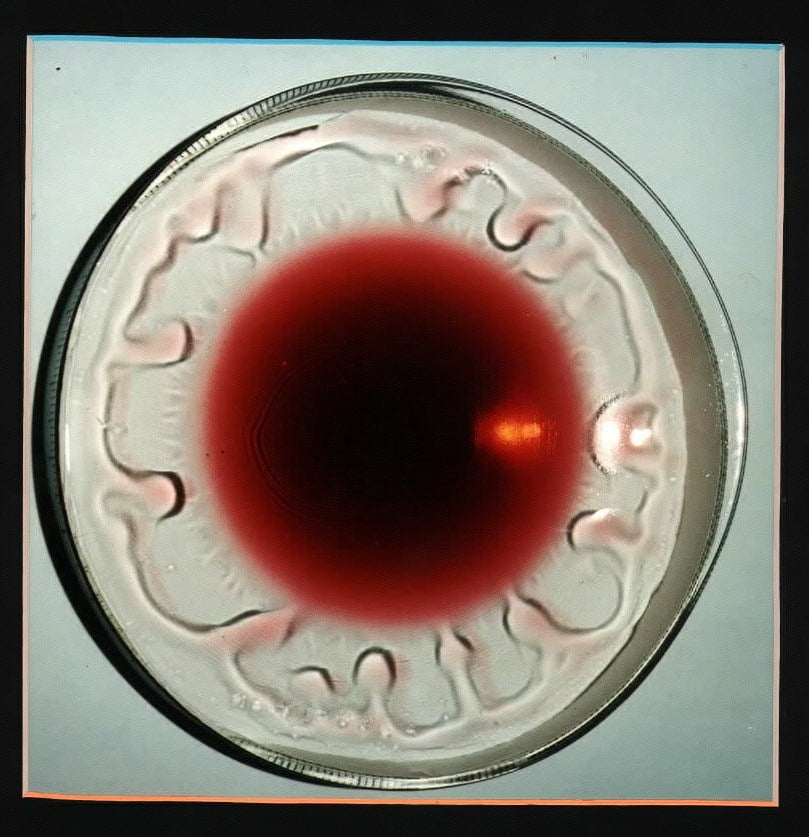
Astronauts are preparing an experiment on the Marangoni effect, in which a variation in surface tension can cause mass flow, for flight aboard the International Space Station. The effect, also responsible for causing tears of wine, will benefit from study in microgravity because competing effects like gravity-induced sedimentation and buoyant convection will be negligible. Astronaut Ron Garan reports more on the upcoming experiment on the Fragile Oasis blog.

