A little polymer goes a long way when it comes to changing a fluid’s behavior. Normally, a falling jet of fluid will develop waviness and be driven by surface tension and the Plateau-Rayleigh instability to break up into a stream of droplets. We see this at our water faucets all the time. But when traces of a polymer are dissolved in water, the behavior is much different. The viscoelasticity of the polymer chains creates a force that opposes the thinning effects caused by surface tension. So, instead of thinning to the point of breaking into droplets, a drop is able to climb back up the jet until it reaches a critical mass where it reverses direction, accelerates downward due to gravity and eventually breaks off the jet. Then the whole process begins again with a new terminal drop. (Video credit: C. Clasen et al)
Search results for: “surface tension”

Water Drops on Sand
This high-speed video captures the impact of liquid droplets onto a granular surface. While there is some similarity to liquid-solid and liquid-liquid impacts, the permeability of the granular surface helps to “freeze” the splash rather quickly. Energy is dissipated in the initial impact, causing a splash of grains. Then the surface tension, viscosity and inertia of the droplet compete in causing the deformations seen in the video. The deformation appears strongly dependent on the kinetic energy with which the droplet hits the surface (i.e. proportional to the height from which it is dropped). (Video credit: G. Delan et al)
Ejecting Drops
Large droplets ejected from a liquid pool do not coalesce immediately back into the whole. Instead, a thin layer of air gets trapped beneath them, much like the oil lubricating bearings. The weight of the droplet causes the air to drain away, and eventually the droplet comes in contact with the pool. Some of the droplet gets drained away before surface tension snaps the interface back into a low energy state. A new smaller droplet then bounces upward before repeating the process over again. Eventually the droplet becomes small enough that its entire mass gets sucked away by the pool. Researchers call this process the coalescence cascade.

Worthington Jet
A drop of sugar syrup falls into a pool of methylated spirits, producing a Worthington jet and several ejected droplets. Although surface tension holds the jet in a smooth shape, the refractive index of the spirits reveals the turbulent mixing within the jet. (Photo credit: Rebecca Ing)
Fragmenting Raindrops
This numerical simulation demonstrates the fragmentation of droplets of water falling through a quiescent medium–essentially how a raindrop behaves. As the initial droplet falls, drag forces deform the droplet, contorting it until surface tension causes it to break into smaller droplets, which can themselves be broken up by the same mechanisms.
Viscoelastic Fluids in Space
In honor of astronaut Don Pettit’s launch to the International Space Station (and in the hope that he’ll do more neat microgravity fluids demonstrations while in space!), here’s a look a the behavior of viscoelastic fluids in microgravity. The elasticity of these fluids means that, when strained, the fluid deforms instantaneously and then returns to its initial shape when the strain is removed. Pettit demonstrates both Plateau-Rayleigh instability behavior, where a column of fluid breaks apart due to surface tension variations, and die swell, where a fluid jet expands beyond the diameter of nozzle from which it was extruded. Such swelling is commonly caused by the stretching and relaxation of polymers in the fluid as they react to forces caused by the nozzle opening.
Sound Sculptures
This is another fun and artistic use of non-Newtonian fluids (paint) vibrating on a speaker cone for advertising purposes. The shear-thinning viscous properties of the paint vie with surface tension to create lovely instantaneous sculptures of color. Check out Canon’s Pixma ads for similar artwork.
Freezing Drops
[original media no longer available]
The physics of droplets freezing is important for understanding applications like ice formation on airplane wings. Here we see how a warm droplet deposited on a cold plate freezes. A freezing front advances through the drop, which expands vertically as it freezes. Ultimately, the expansion of the ice and the surface tension of the water create a pointed singular tip.
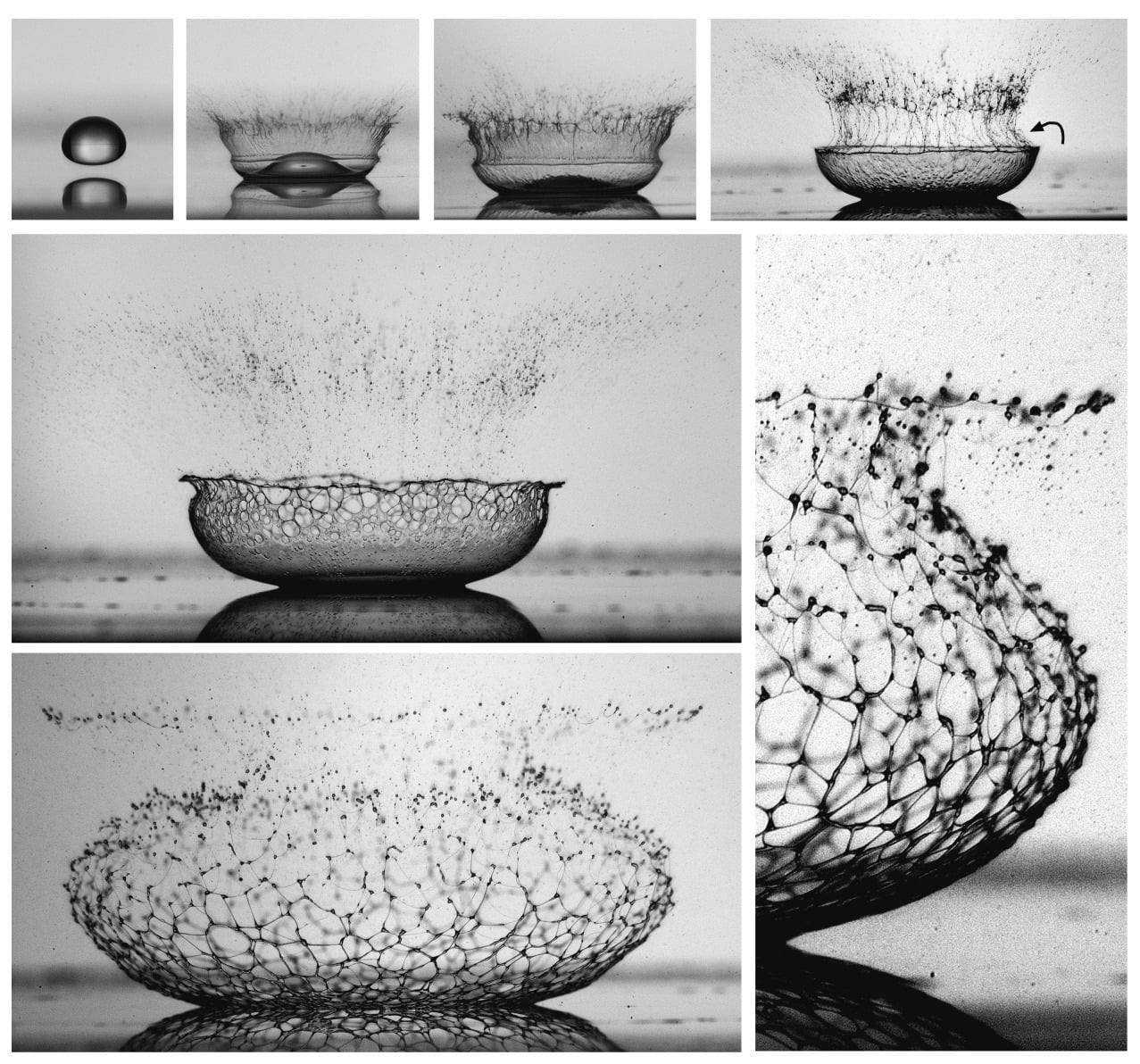
The Disintegrating Bowl
A viscous fluid droplet impacts a thin layer of ethanol, which has a lower surface tension than the viscous fluid. A spray of tiny ethanol droplets is thrown up while a bowl-shaped crown of the viscous fluid forms. As the ethanol droplets impact the bowl, the lower surface tension of the ethanol causes fluid to flow away from points of contact due to the Marangoni effect. This outflow causes holes to form in the crown, forming a network of thin fluid ligaments. For more, see this paper (PDF) and video. (Photo credit: S.T. Thoroddson et al)
Convection Visualization
Here on Earth a fascinating form of convection occurs every time we put a pot of water on the stove. As the fluid near the burner warms up, its density decreases compared to the cooler fluid above it. This triggers an instability, causing the cold fluid to drift downward due to gravity while the warm fluid rises. Once the positions are reversed, the formerly cold fluid is being heated by the burner while the formerly hot fluid loses its heat to the air. The process continues, causing the formation of convection cells. The shapes these cells take depend on the fluid and its boundary conditions. For the pot of water on the stove and in the video above, the surface tension of the air/water interface can also play a role in modifying the shapes formed. The effects caused by the temperature gradient are called Rayleigh-Benard convection. The surface tension effects are sometimes called Benard-Marangoni convection.