As a follow-up to last week’s “dancing droplet” post, here’s a video that describes how to recreate the experiment yourself at home. The droplet motion is driven by the two-component structure of the droplets, where differing evaporation rates and surface tension values between the two fluids in the drop cause the attractions and chasing behavior you see. To demonstrate this at home, you’ll need glass, fire (for sterilization), tweezers, a pipette, water, and food coloring. Looks like a fun way to spend a weekend afternoon! (Video credit: M. Prakash et al.; via io9)
Search results for: “surface tension”
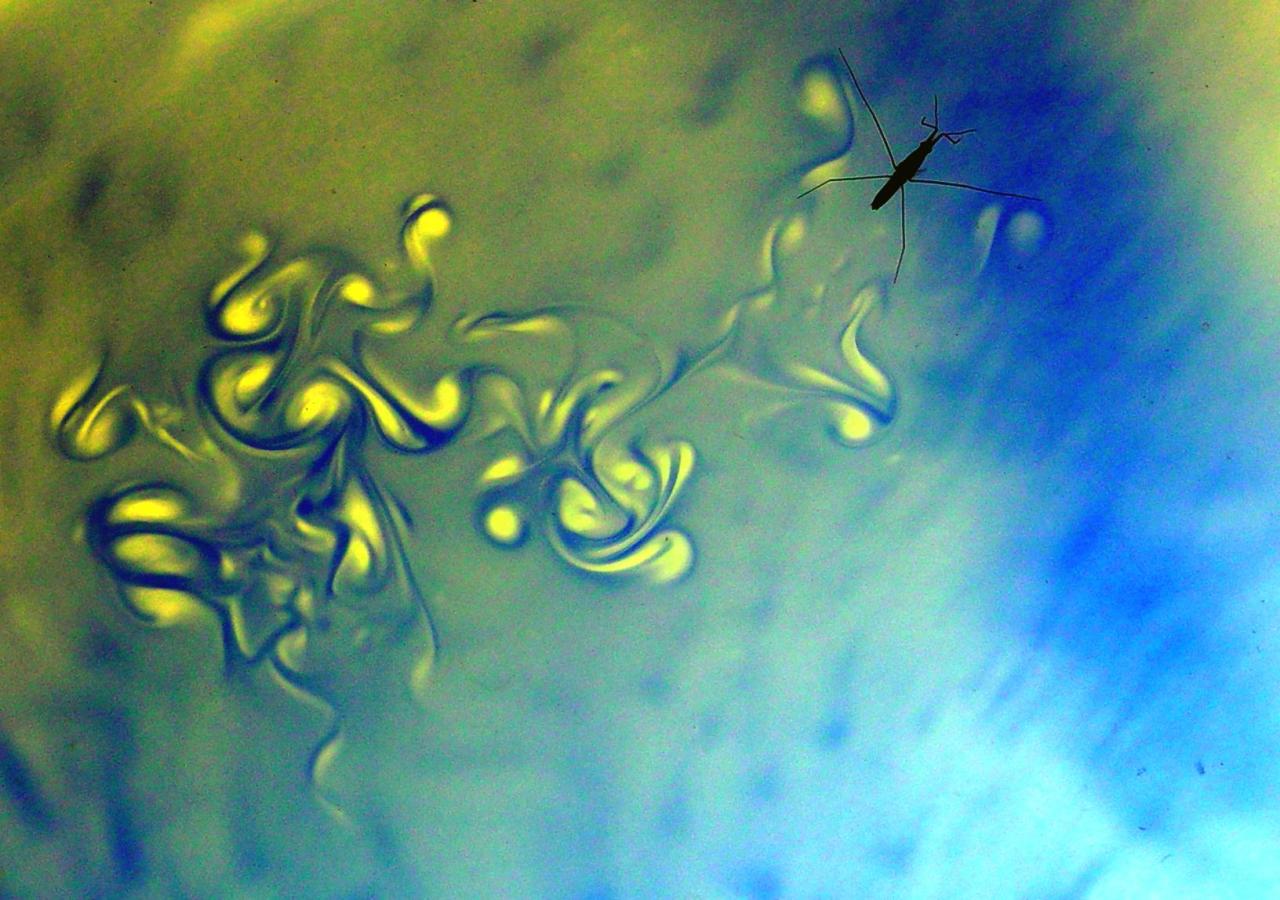
Rowing Water Striders

Water strider insects are light enough that their weight can be supported by surface tension. For some time, they were thought to propel themselves by using their long middle legs to generate capillary waves–ripples– that pushed them forward, but juvenile water striders are too small for this technique to work. Instead researchers found that water striders move by using their middle legs like oars. The leg motion creates vortices about 4 mm below the water surface, and this water moving backward propels the insect forward. In the photos above, the scientists visualized the flow by sprinkling thymol blue on the water and letting the striders move freely. You can learn more about the work here or in this Science Friday episode. (Photo credits: J. Bush et al.)

Dancing Droplets


What makes drops of food coloring able to dance, chase, sort themselves, or align with one another? This unexpected behavior is a consequence of food coloring consisting of two mixed liquids: water and propylene glycol. Both have their own surface tension properties and evaporation rates, which ultimately drives the behavior you see in the animations above. Both long-range and short-range interactions are observed. The former are due to vapor from each droplet adsorbing onto the glass around the droplet, thereby changing the local surface tension and causing nearby drops to feel an attractive force. The short-range effects are also surface-tension-driven. Droplets with lower surface tension will naturally try to flow toward areas of higher surface tension, which causes them to “chase” dissimilar adjacent drops. You can learn more about the research in the videos linked below (especially the last two), or you can read about the work in this article or the original research paper. (Image credit: N. Cira et al., source videos 1, 2, 3, 4; GIFs via freshphotons; submitted by entropy-perturbation)

The Milk Crown
This frequently imitated photograph of a drop of milk splashing was taken by engineer Harold Edgerton in 1934. Edgerton pioneered the application of stroboscopic photography to everyday objects, allowing him to capture images with an effective shutter speed much faster than could be mechanically achieved. The photo captures the crown or coronet of a splash. The momentum of the incoming drop flings a thin sheet of liquid radially outward. The rim of this sheet breaks down into thin ligaments that eject tiny droplets at their tips when surface tension can no longer hold the milk together. (Image credit: H. Edgerton, via The Art Reserve; submitted by Vince G)

Manipulating Fluids
Combining water-repelling superhydrophobic surfaces with water-loving hydrophilic surfaces allows scientists and engineers to manipulate common fluids. Here a hydrophilic track surrounded by a superhydrophobic background collects and distributes drops of dyed water. The wetting characteristics of the surface combined with surface tension in the liquid drives the flow. No pumping or power input is necessary. This kind of manipulation of droplets can be especially useful in biomedical applications where fast-acting, low-cost devices could be used to diagnose diseases or measure blood glucose levels. (Image credit: A. Ghosh et al., via NSF; see also source video)

Raindrops on Sand
Here is a high-speed look at the impact of a raindrop on a sandy beach. In this case, a water droplet is falling on a bed of uniform glass beads, but the situation is effectively the same. Depending on the speed of the drop at impact, many types of craters are possible. The higher the impact velocity, the greater the momentum of the drop at impact and the more likely the drop is to tear apart when surface tension can no longer hold it together. Interestingly, there is remarkable similarity between the shape and behavior of these liquid drop impacts and those of a catastrophic asteroid impact. (Video credit: R. Zhao et al.)

Piazza del Popolo
The lions of the fountain in Rome’s Piazza del Popolo eject a turbulent sheet of water. Random fluctuations in the water sheet cause holes to form. Driven by surface tension, these holes grow and merge, leaving behind ligaments of water which quickly break up into a spray of unevenly-sized drops. (Image credit: E. Villermaux)
Coalescence in Microgravity
Microgravity is a wonderful playground for fluid dynamics. Here astronaut Reid Wiseman demonstrates the interplay of forces involved in coalescence. When smaller droplets hit with insufficient force, they bounce off the water sphere. But if they hit hard enough to overcome surface tension, they coalesce with the sphere. I think the space station needs a high-speed video camera; I’d like to see this behavior at a few thousand frames per second! (Video credit: R. Wiseman/NASA)
Inside a Water Blob
This new video from the Space Station shows once again that astronauts have the most fun job on–or off–the planet. In it, the Expedition 40 crew members submerge a GoPro camera in a microgravity water blob. Here on Earth, we’re used to surface tension being a minor or secondary force with most fluids we experience daily. This is because gravity often provides the overwhelming effect. But in microgravity, those effects are absent, and forces like surface tension and adhesion dominate water’s behavior. This both why the crew can make such a large water sphere hold together, and why one astronaut eventually gets his hands stuck in the sphere. (Video credit: NASA; submitted by jshoer)

“Milky WaY”


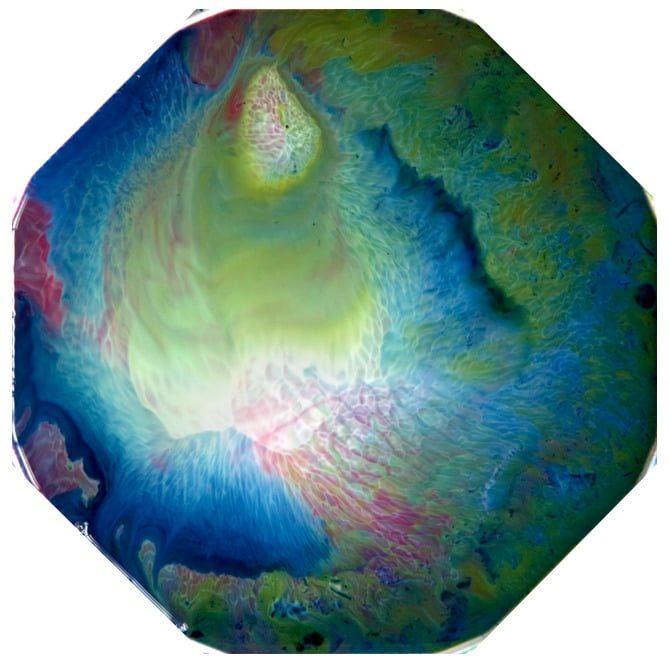
Photographer Paulo Stagnaro uses milk and food coloring in his series “Milky WaY”. Despite the simple ingredients, the photos illustrate the enormous variety of shape and form in fluid dynamics. Surface tension, diffusion, and intentional mixing create abstract and ephemeral portraits of fluid motion. For similar work, see Pery Bruge’s art or just try browsing through FYFD’s “fluids as art” tag for more examples of science and art intersecting. (Photo credit: P. Stagnaro; submitted by Stephanie M.)