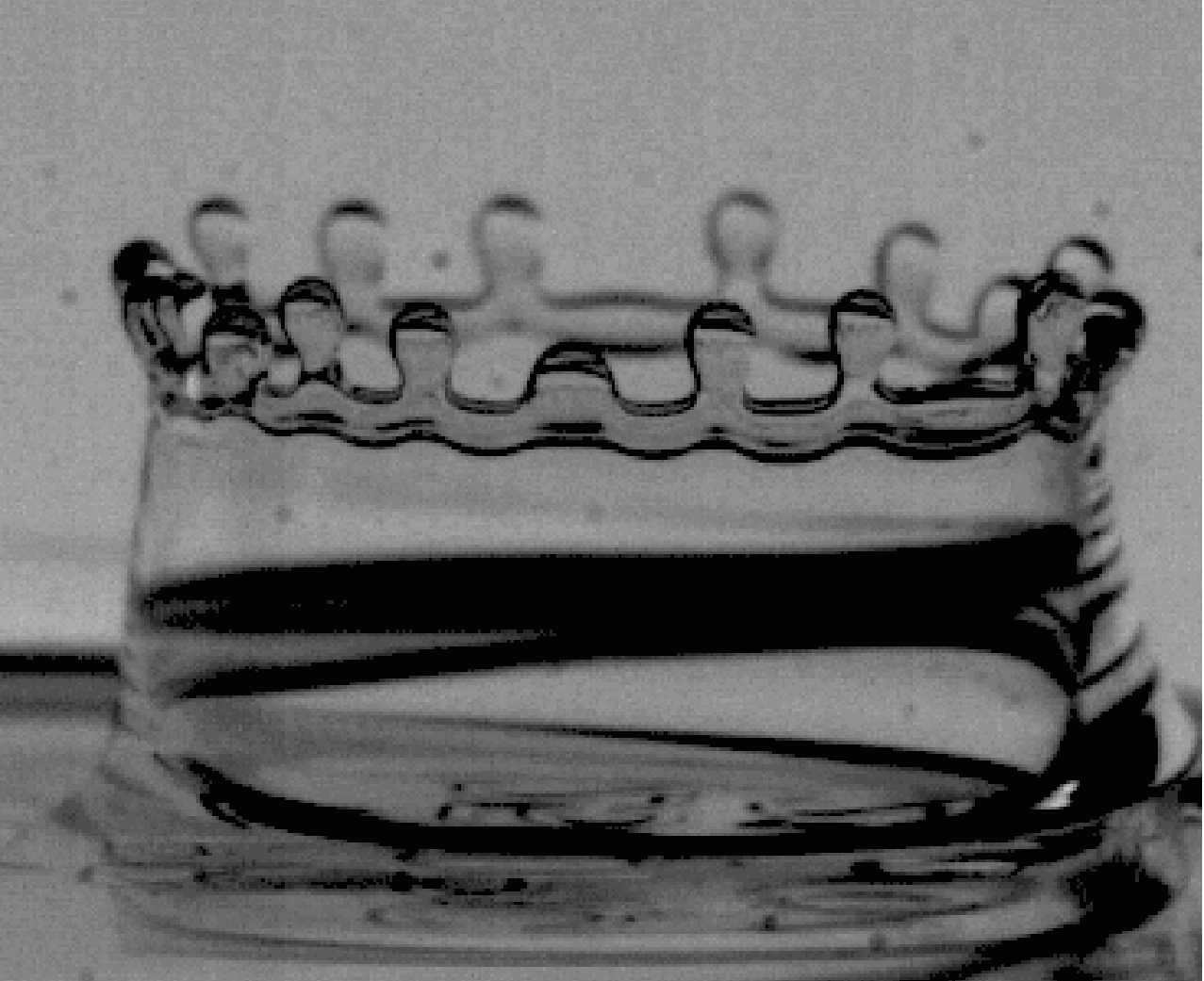
When a drop falls on a liquid film, its impact drives a thin liquid sheet called the ejecta upward and outward from the point of impact. Within milliseconds, tiny perturbations develop in the ejecta and begin growing exponentially. These become the distinctive spikes of the crown. The momentum from the impact drives the ejecta and spikes further outward until it overcomes surface tension’s ability to hold the liquid crown together. Tiny droplets escape the crown before the ejecta comes crashing down. The whole process takes only a few hundred milliseconds from start to finish. (Photo credit: S. Jung et al.)
Search results for: “surface tension”
The Marangoni Effect
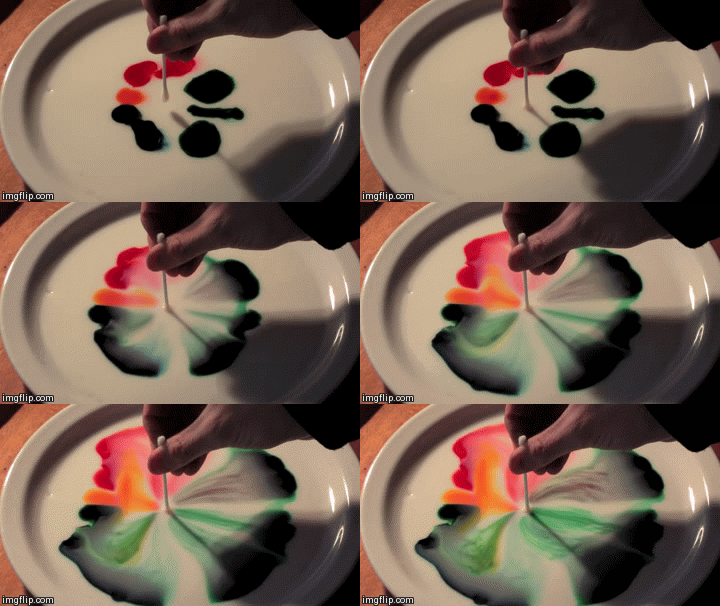
Differences in surface tension can create Marangoni flow along an interface. Imagine a shallow bowl filled with a liquid. In the middle of the fluid, every molecule is surrounded on all sides by like molecules, which push and pull it equally in all directions. But at the surface, the fluid molecules are only acted on by similar molecules in some directions. This imbalance in molecular forces is what creates surface tension. When the surface tension is constant, the fluid surface is like a taut rubber sheet. Poke a hole in that sheet, and everything pulls away from the hole. Likewise, when the surface tension varies, fluid will move from areas of low surface tension toward areas of higher surface tension. This effect is easily demonstrated at home in a setup like the animation above. Pour milk (higher fat content is better) and food coloring in a shallow container. Then lower the local surface tension using dish soap or rubbing alcohol and watch the colors run away! (Image credit: Flow Visualization at UC Boulder, source video)

Meandering Rivulet
This rivulet is the result of a horizontal liquid jet impacting a vertical pane of glass. Gravity, surface tension, adhesion, and even surface finish can affect the path the water follows. Like the meandering path of rain on a windshield, it’s hard to predict a priori where the flow will go without accounting for a myriad of seemingly inconsequential variables governing both the liquid and solid surface. (Photo credit: T. Wang)

Shooting Droplets
This animation shows high-speed video of a polystyrene particle striking a falling water droplet. Under the right conditions, the particle rips through the droplet, stretching the water into a bell-shaped lamella extending from a thicker rim. When the particle detaches, surface tension rapidly collapses the lamella into a ring which destabilizes. Thin ligaments and droplets fly off the crown-like ring as momentum overcomes surface tension’s ability to hold the droplet together. Be sure to check out the full video on YouTube or later next month at the APS Division of Fluid Dynamics meeting. (Yes, I will be there!) (Image credit: V. Sechenyh et al., source video)

Reconfigurable Liquid Metal
Terminator 2’s T-1000, a liquid metal robot capable of changing its shape at will, just became a little less far-fetched. Researchers at NC State have reported a new method for controlling the form of a liquid gallium alloy. Surface tension governs the shape a liquid assumes when it is not confined by a container, and, although adding surfactants can slightly lower the surface tension, it does not substantially alter the liquid’s shape. Adding soap to water lets one make bubbles, but surface tension keeps the bubbles spherical no matter how much soap you add. Instead, these researchers control the surface tension of the liquid metal using a mild voltage. Applying a voltage creates (or removes) an oxide layer on the liquid metal’s surface, thereby altering the surface tension. By controlling the formation of the oxide layer, the researchers can change the surface tension from approximately 7x that of water to nearly zero. The video above demonstrates some of the liquid shape control this lets them achieve. (VIdeo credit: M. Dickey et al.; research: M. Khan et al.; via PopSci)

Beading Fluids
Adding just a few polymers to a liquid can substantially change its behavior. The presence of polymers turns otherwise Newtonian fluids like water into viscoelastic fluids. When deformed, viscoelastic fluids have a response that is part viscous–like other fluids–and part elastic–like a rubber band that regains its initial shape. The collage above shows what happens to a thinning column of a viscoelastic fluid. Instead of breaking into a stream of droplets, the liquid forms drop connected with a thin filament, like beads on a string. In a Newtonian fluid, surface tension would tend to break off the drops at their narrowest point, but stretching the polymers in the viscoelastic fluid provides just enough normal stress to keep the filament intact. If the effect looks familiar, it may be because you’ve seen it in the mirror. Human saliva is a viscoelastic liquid! (Image credit: A. Wagner et al.)
Soap Film Physics
Soap films consist predominantly of water, yet their thin, virtually two-dimensional nature is impossible for water alone to achieve. The small amount of added soap acts as a surfactant, lowering the surface tension of the fluid and preventing it from bursting into droplets. When forming a film, the soap molecules align themselves along the outer surfaces of the film, with their hydrophilic heads among the water molecules and their hydrophobic tails oriented outward. For the most part, the water molecules stay sandwiched between the surfactant layers, forming a film only about as thick as the wavelength of visible light. In fact, the psychedelic colors of a soap film are directly related to the film’s thickness with the black regions being the thinnest. The video above shows a horizontal soap film at the microscopic scale and some of the dynamics exist therein. (Video credit: J. Hart)
Hydrophobicity and Viscous Flow
Hydrophobic surfaces are great for creating some wild behaviors with water droplets, but they make neat effects with other liquids, too. The viscous honey in the first segment of this Chemical Bouillon video is a great example. Because the honey doesn’t adhere to the hydrophobic surface, the viscoelastic fluid does not maintain the form it had when drizzled on the surface. Instead, the honey contracts, with surface tension driving Plateau-Rayleigh-like instabilities that break the contracting ligaments apart to form nearly spherical droplets of honey on the surface. (Video credit: Chemical Bouillon)
Fluid Fingers
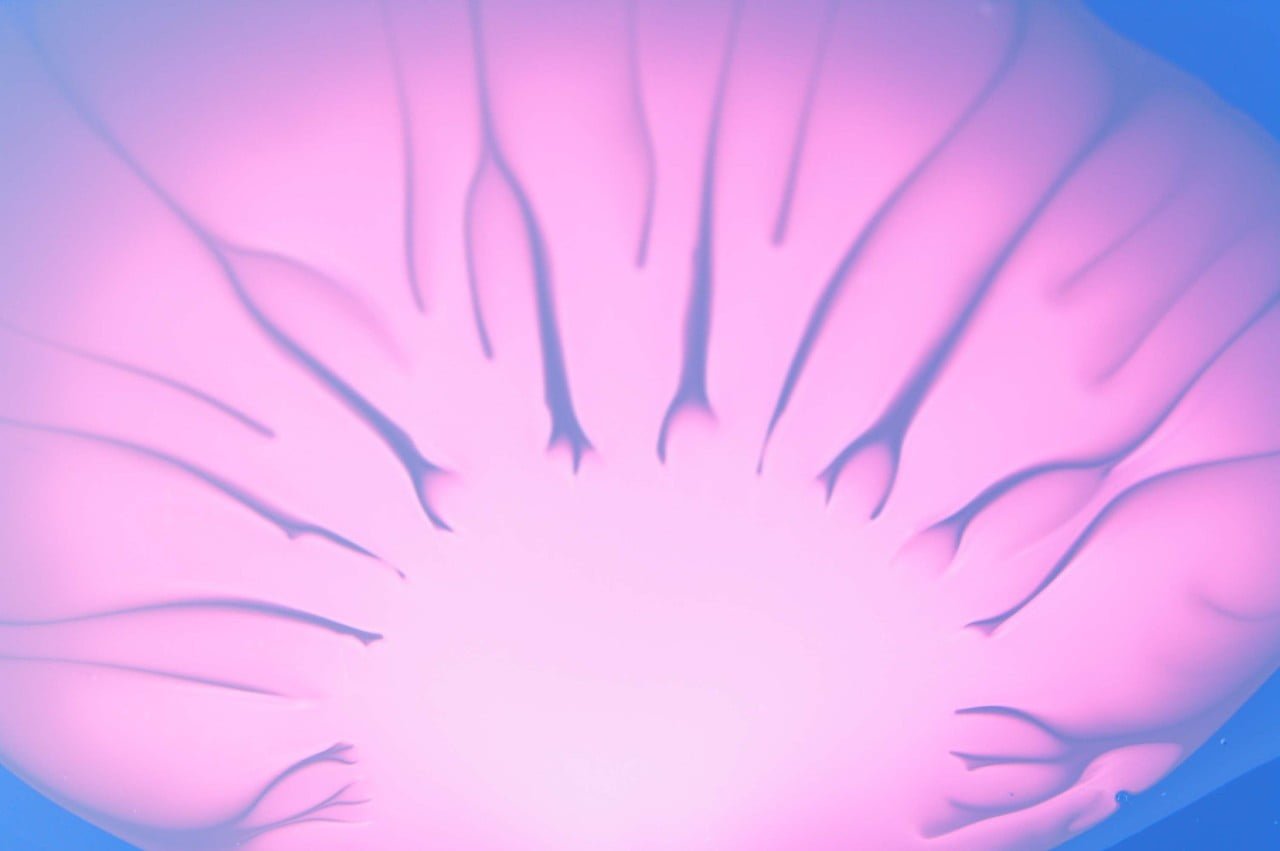
Differences in viscosity or surface tension between two fluids can lead to finger-like instabilities. Here food dye placed on corn syrup forms narrow tendrils driven by the differing surface tensions of the two liquids. Similar dendritic shapes can be generated by injecting a low viscosity fluid into a high viscosity one (Saffmann-Taylor instability) or by pulling apart glass plates sandwiched around a high viscosity fluid. (Photo credit: T. Gaskill et al.)
What’s in a Splash?
A droplet falling onto a solid, dry surface seems like a simple situation, one that would be easy to understand. But splashes can be unpredictable. Velocity, viscosity, and surface tension all play clear roles, but the surrounding air also has an impact – drop the air pressure low enough and a droplet won’t splash. A new paper has tackled the problem, producing a mathematical model in agreement with experimental results. So why do some drops splash and others don’t? When a drop falls, its momentum flattens it into a pancake shape while surface tension struggles to hold it together. The spreading edge, called the lamella, can pull away from the surface. When it does, a pocket of high pressure forms beneath it due to lubrication effects, and the faster airflow over the top of the lamella creates a suction effect. This is analogous to a wing producing lift. Like the momentum that spread the droplet, the lift force pulls the lamella and ejecta sheet further up and outward, overcoming the restoring force of surface tension and tearing the droplet apart. For more on the effect, check out the research paper or this Inside Science article. (Video credit: G. Riboux and J. Gordillo; via Inside Science)
