Soap bubbles are ephemeral creations. The slightest prick will send them tearing apart in the blink of an eye. It may come as a surprise, therefore, that dropping a water droplet through a bubble will not break it. Instead, the bubble will heal itself using the Marangoni effect. In a soap bubble, the soap molecules act as a surfactant, lowering the surface tension of the water and allowing the fragile structure to hold together. When the water drop impacts the bubble, the local surface tension increases because of the relative lack of soap molecules. This increase in surface tension pulls at the rest of the bubble, drawing more soap molecules toward the point of contact. The effect evens out surface tension across the surface and stabilizes the bubble. You can test the effect at home, too. If you wet your finger, you can poke a soap bubble without popping it. (Video credit: G. Mitchell; via io9)
Search results for: “surface tension”

Paint on Speakers
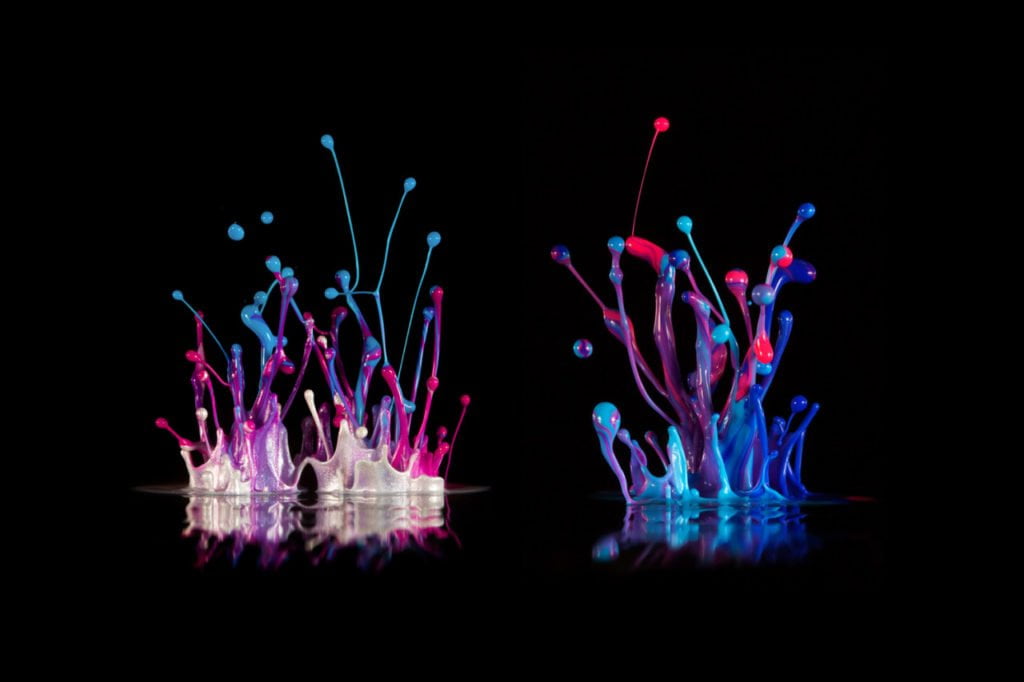
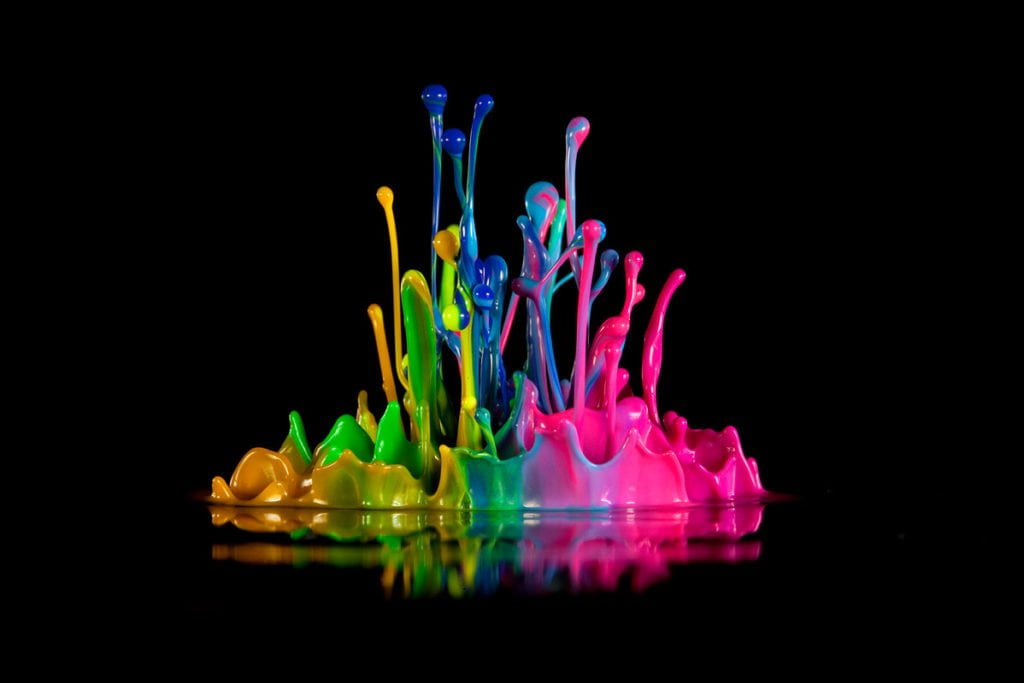
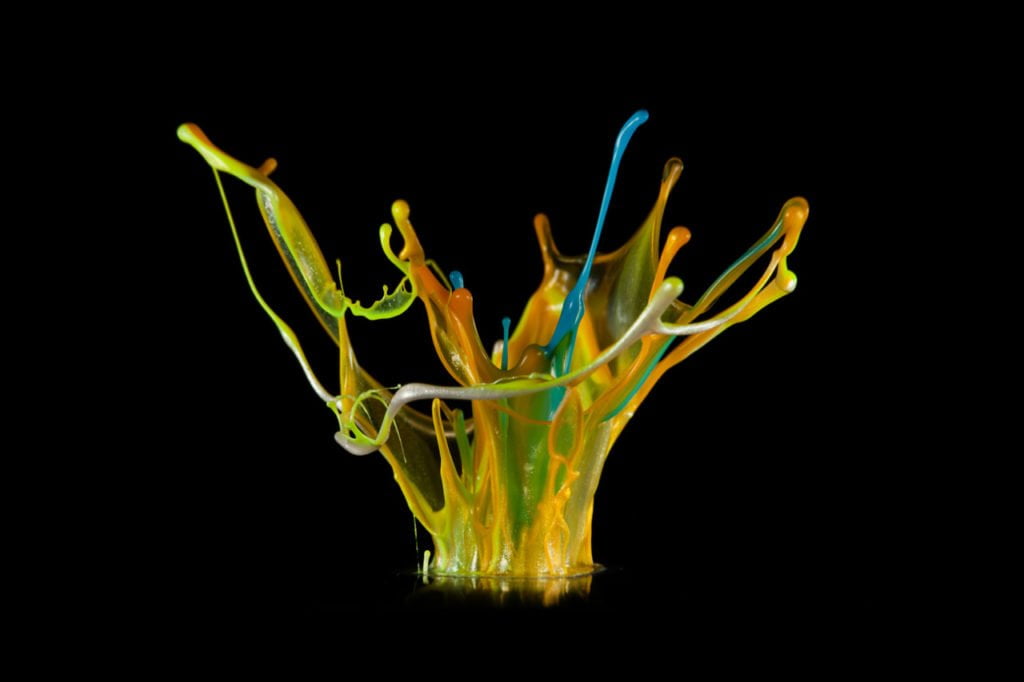


Paint seems to dance and leap when vibrated on a speaker. Propelled upward, the liquid stretches into thin sheets and thicker ligaments until surface tension can no longer hold the the fluid together and droplets erupt from the fountain. Often paints are shear-thinning, non-Newtonian fluids, meaning that their ability to resist deformation decreases as they are deformed. This behavior allows them to flow freely off a brush but then remain without running after application. In the context of vibration, though, shear-thinning properties cause the paint to jump and leap more readily. For more images, see photographer Linden Gledhill’s website. (Photo credit: L. Gledhill; submitted by pinfire)

The Real Shape of Raindrops
We often think of raindrops as spherical or tear-shaped, but, in reality, a falling droplet’s shape can be much more complicated. Large drops are likely to break up into smaller droplets before reaching the ground. This process is shown in the collage above. The initially spherical drops on the left are exposed to a continuous horizontal jet of air, similar to the situation they would experience if falling at terminal velocity. The drops first flatten into a pancake, then billow into a shape called a bag. The bags consists of a thin liquid sheet with a thicker rim of fluid around the edge. Like a soap bubble, a bag’s surface sheet ruptures quickly, producing a spray of fine droplets as surface tension pulls the damaged sheet apart. The thicker rim survives slightly longer until the Plateau-Rayleigh instability breaks it into droplets as well. (Image credit: V. Kulkarni and P. Sojka)

“The Flow II”
“The Flow II” film by Bose Collins and colleagues features a ferrofluid, a magnetically-sensitive liquid made up of a carrier fluid like oil and many tiny, ferrous nanoparticles. Although ferrofluids are known for many strange behaviors, their most distinctive one is the spiky appearance they take on when exposed to a constant magnetic field. This peak-and-valley structure is known as the normal-field instability. It’s the result of the fluid attempting to follow the magnetic field lines upward. Gravity and surface tension oppose this magnetic force, allowing the fluid to be drawn upward only so far until all three forces balance. (Video credit: B. Collins et al.)
Giant Bubbles
In their latest video, Gavin and Dan of The Slow Mo Guys demonstrate what giant bubbles look like in high-speed video from birth to death. Surface tension, which arises from the imbalance of intermolecular forces across the soapy-water/air interface, is the driving force for bubbles. As they move the wand, cylindrical sheets of bubble film form. These bubble tubes undulate in part because of the motion of air around them. In a cylindrical form, surface tension cannot really counteract these undulations. Instead it drives the film toward break-up into multiple spherical bubbles. You can see examples of that early in the video. The second half of the video shows the deaths of these large bubble tubes when they don’t manage to pinch off into bubbles. The soap film tears away from the wand and the destructive front propagates down the tube, tearing the film into fluid ligaments and tiny droplets (most of which are not visible in the video). Instead it looks almost as if a giant eraser is removing the outer bubble tube, which is a pretty awesome effect. (Video credit: The Slow Mo Guys)

“Clourant”
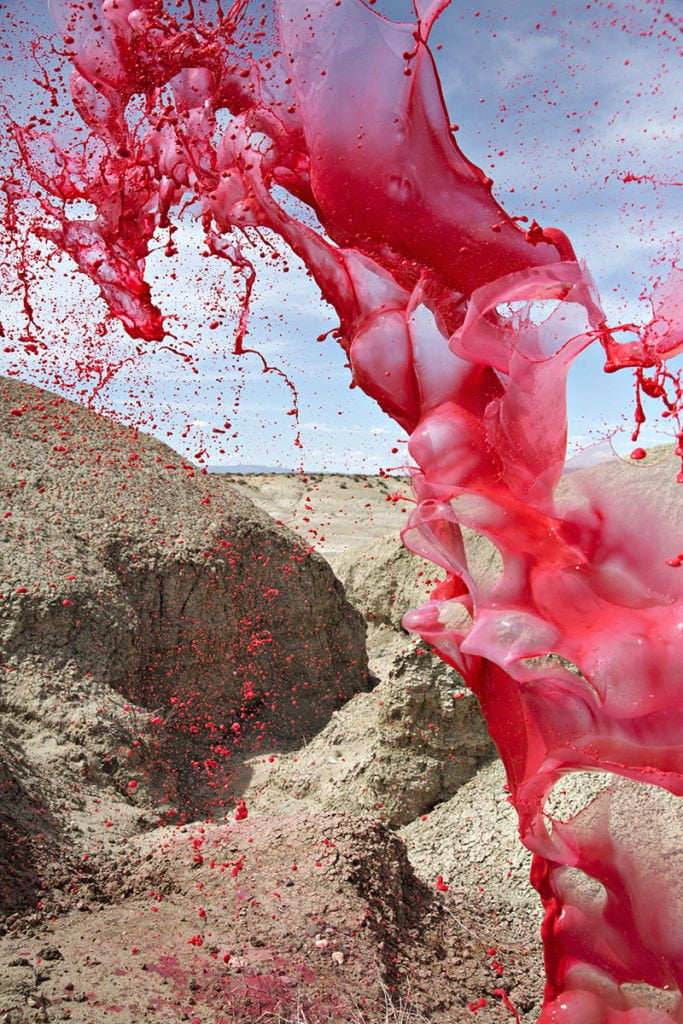
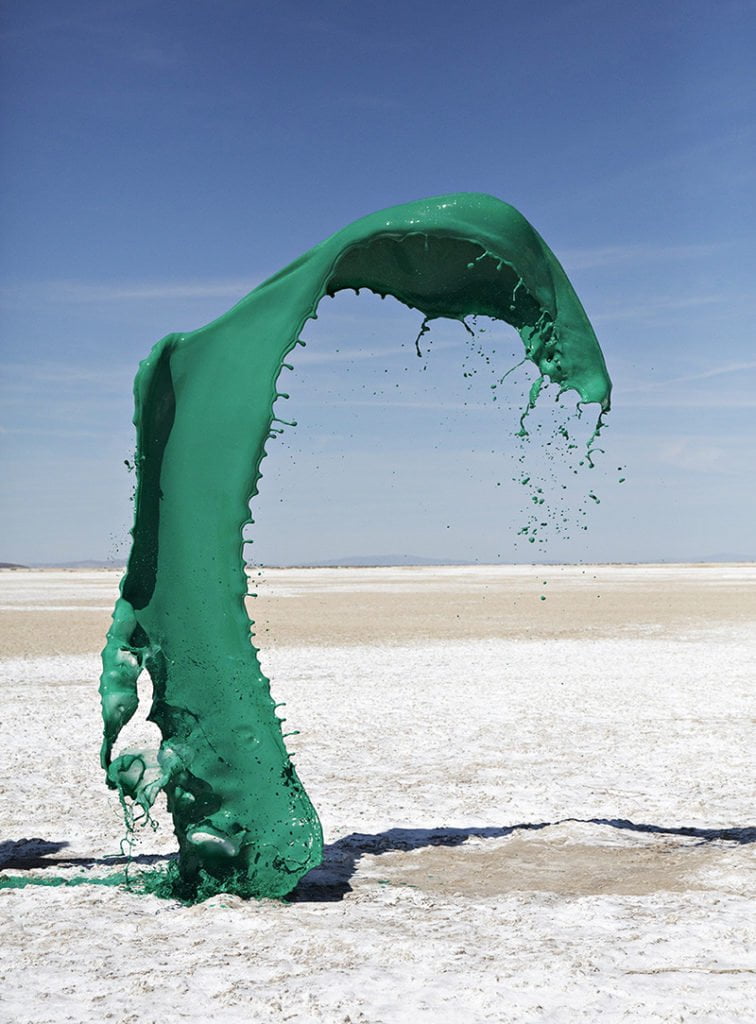

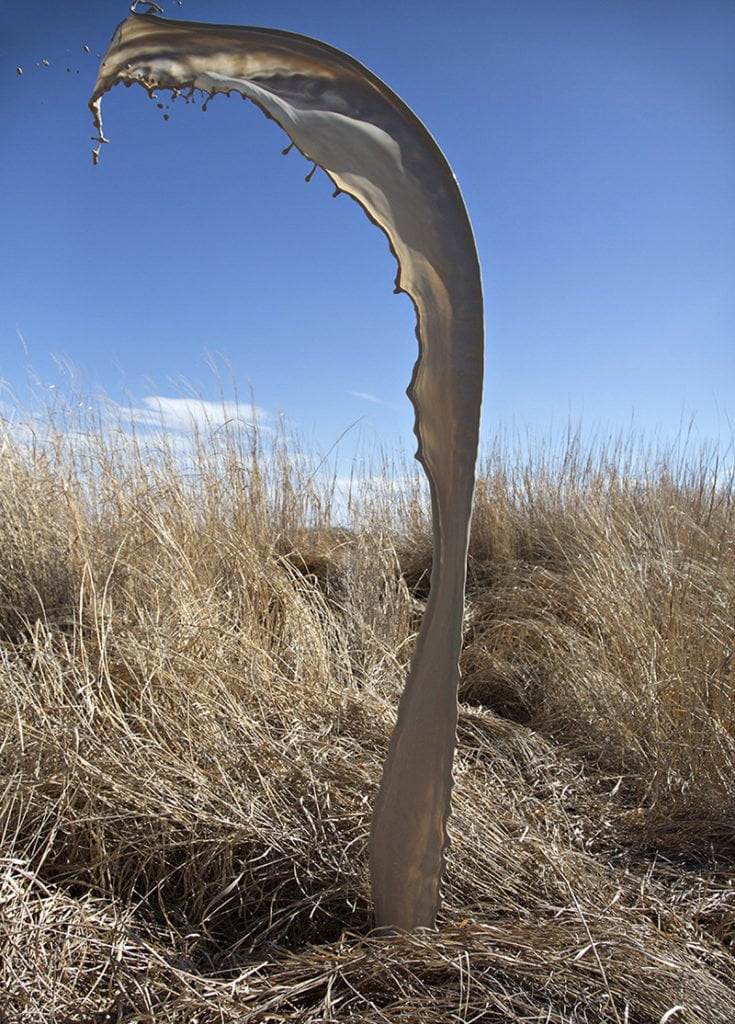
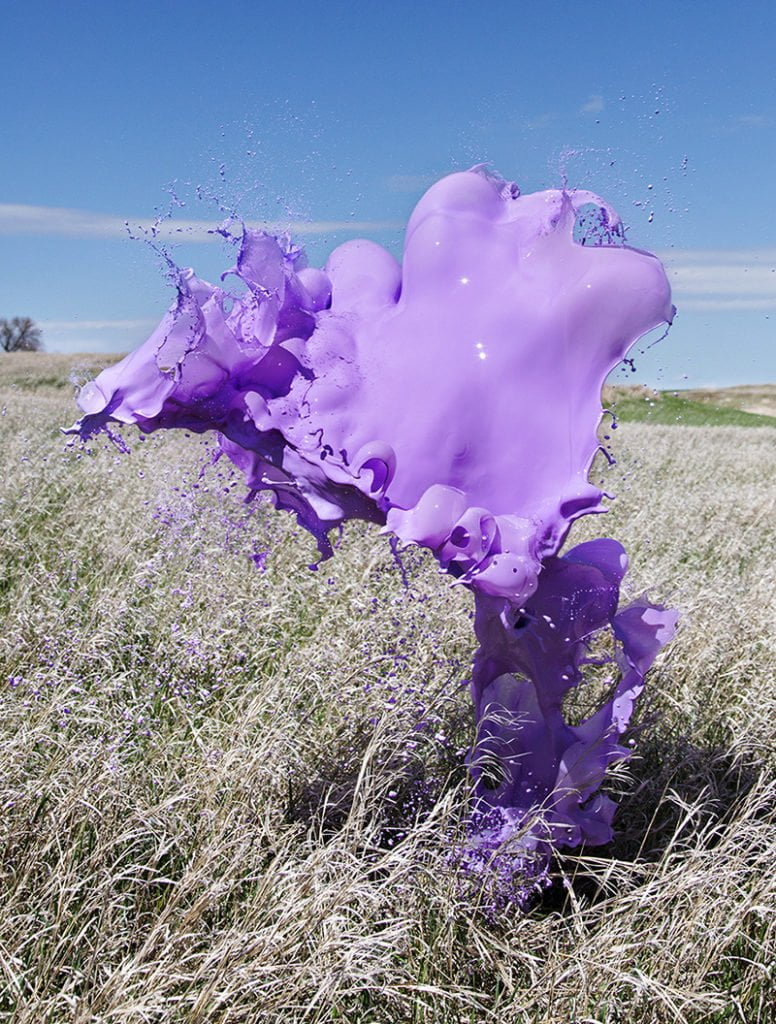


Photographers Cassandra Warner and Jeremy Floto produced the “Clourant” series of high-speed photographs of colorful liquid splashes. The artists took special care to disguise the origin of splashes, making them appear like frozen sculptures. The photos are beautiful examples of making fluid effects and instabilities. Many of them feature thin liquid sheets with thicker rims just developing ligaments. In other spots, surface tension has been wholly overcome by momentum’s effects and what was once ligaments has exploded into a spray of droplets. (Photo credit: C. Warner and J. Floto; submitted by jshoer; via Colossal)
Distorted Rings
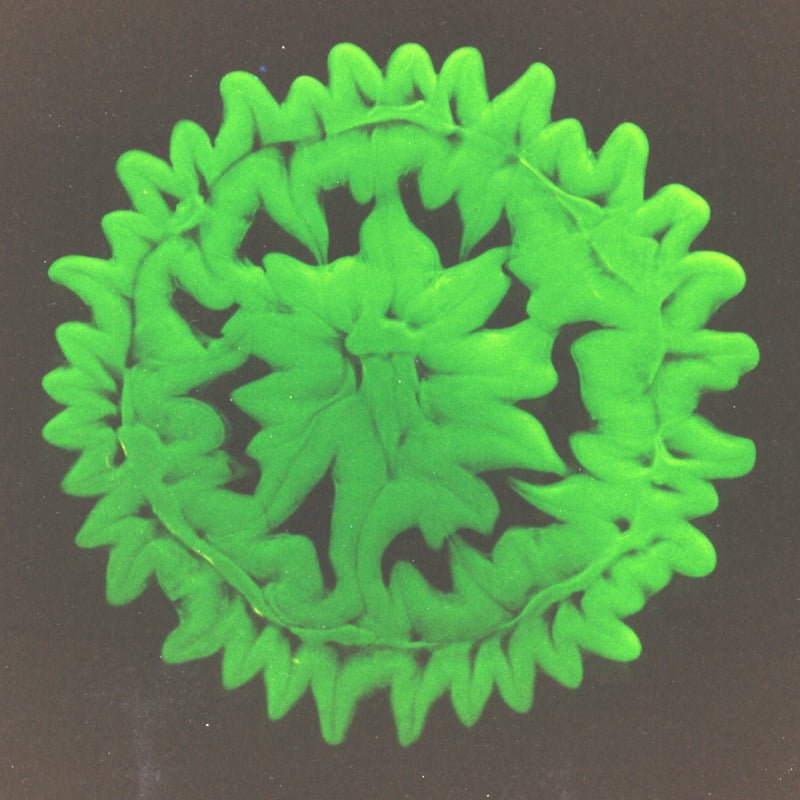
The Marangoni effect is generated by variations in surface tension at an interface. Such variations can be temperature-driven, concentration-driven, or simply due to the mixing between fluids of differing surface tensions as is the case here. The pattern in the image above formed after a dyed water droplet impacted a layer of glycerin. The initial impact of the drop formed an inner circle and outer ring. This image is from 30 seconds or so after impact, after the Marangoni instability has taken over. The higher surface tension of the water pulls the glycerin toward it, resulting in a flower-like pattern. (Photo credit: E. Tan and S. Thoroddsen)
Going Supercritical
Supercritical fluids exist at temperatures and pressures above the critical point, in a region of the phase diagram where there is no clear boundary between the liquid and gaseous state. Supercritical fluids have some of the properties of each state: they can move as freely as a gas, but they are still capable of dissolving materials like a liquid does. They also have no surface tension because there is no interface between liquid and solid. These properties make supercritical fluids very useful in industrial applications, including decaffeination and chemical deposition. Interestingly, the temperatures and pressures on Venus are so high that scientists think the atmosphere at the surface is a supercritical fluid. (Video credit: SCFED Project)
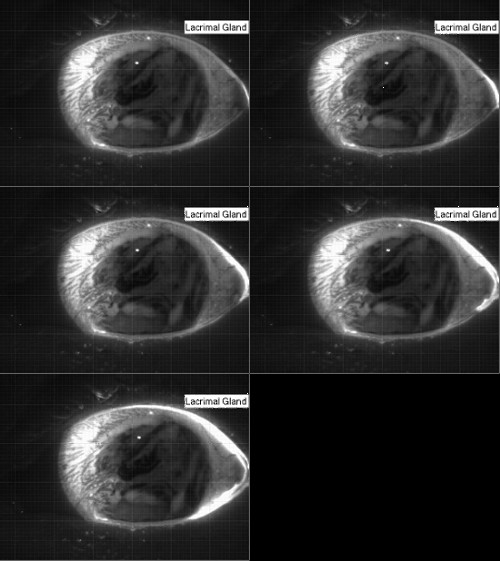
Tear Films
The human eye has a thin tear film over its surface to maintain moisture and provide a smooth optical surface. The film consists of multiple layers: a lipid layer at the air interface to decrease surface tension and delay evaporation; an aqueous middle layer; and an inner layer of hydrophilic mucins that keep the film attached to the eye. The entire film is a few microns thick, with the lipid layer estimated to be only 50-100 nm thick and the mucin layer just a few tenths of a micron. The aqueous portion of the tear film is supplied from the lacrimal gland in the corner of the eye. In the animation above, the fresh aqueous fluid is fluorescent. It gathers in the corner of the eye several seconds after a blink due to reflex tearing. The tear fluid then flows around the outer edges of the eye until the subject blinks and the fresh tear gets distributed throughout the film. (Research credit: L. Li et al.; original video)
Colliding in Microgravity
On Earth, it’s easy for the effects of surface tension and capillary action to get masked by gravity’s effects. This makes microgravity experiments, like those performed with drop towers or onboard the ISS, excellent proving grounds for exploring fluid dynamics unhindered by gravity. The video above looks at how colliding jets of liquid water behave in microgravity. At low flow rates, opposed jets form droplets that bounce off one another. Increasing the flow rate first causes the droplets to coalesce and then makes the jets themselves coalesce. Similar effects are seen in obliquely positioned jets. Perhaps the most interesting clip, though, is at the end. It shows two jets separated by a very small angle. Under Earth gravity, the jets bounce off one another before breaking up. (The jets are likely separated by a thin film of air that gets entrained along the water surface.) In microgravity, though, the jets display much greater waviness and break down much quicker. This seems to indicate a significant gravitational effect to the Plateau-Rayleigh instability that governs the jet’s breakup into droplets. (Video credit: F. Sunol and R. Gonzalez-Cinca)