Search results for: “supersonic”

  • Inside a Champagne Pop

    Inside a Champagne Pop

    When the cork pops on a bottle of champagne, the physics is akin to that of a missile launch in more ways than one. In this study, researchers used computational fluid dynamics to closely examine the gases that escape behind the cork. They identified three phases to the flow. In the first, the exhaust gases form a crown-shaped expansion region, complete with shock diamonds. Once the cork has moved far enough downstream, the axial flow accelerates to supersonic speeds and a bow shock forms behind the cork. Finally, the pressure in the bottle drops low enough that supersonic conditions cannot be maintained and the flow becomes subsonic. (Image credit: top – Kindel Media, simulation – A. Benidar et al.; research credit: A. Benidar et al.; via Ars Technica; submitted by Kam-Yung Soh)

    A numerical simulation showing the ejection of a champagne cork from a bottle. The colors indicate the speed of gases escaping from the bottle.
    A numerical simulation showing the ejection of a champagne cork from a bottle. The colors indicate the speed of gases escaping from the bottle.
  • Re-Entry For X-Wings

    Re-Entry For X-Wings

    Fans of sci-fi and fantasy have a long-standing tradition of exploring the physics and/or practicality of creations in their fandom, and Star Wars fans are no exception. Here engineers ask whether Luke Skywalker’s X-wing fighter could survive the descent through Dagobah’s atmosphere as he searched for Master Yoda. Their results are based on a numerical simulation, with some assumptions about the spacecraft’s descent path and design as well as the planet’s atmosphere. Fans of the Jedi will be glad to hear that the X-wing can survive its supersonic descent intact, delivering the last Jedi safely to his mentor. (Image credit: Y. Ling et al.)

  • Featured Video Play Icon

    Why Compressed Air Cans Get Cold

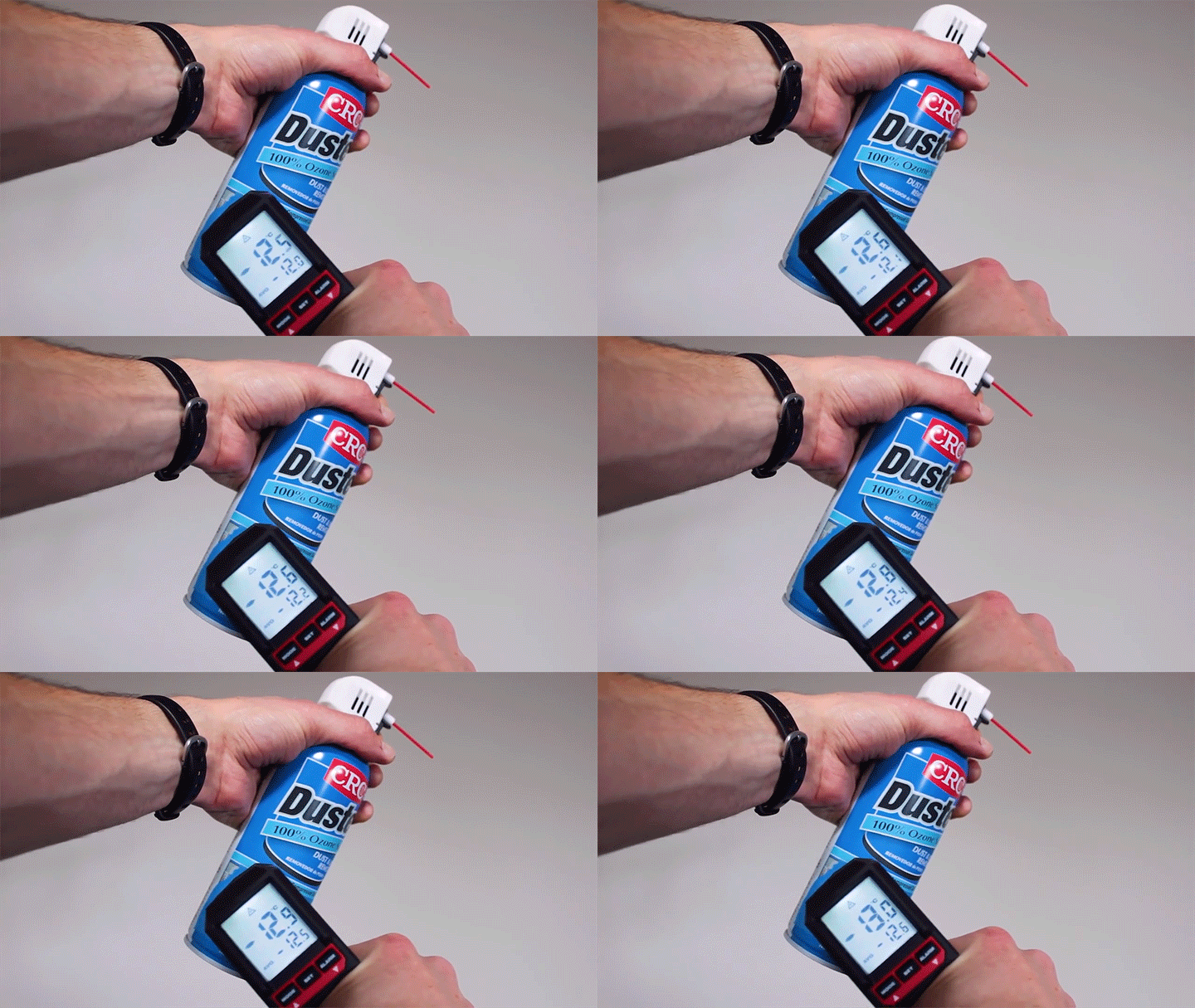
    Anyone who’s used a can of compressed air to clean their computer or keyboard knows that the can quickly gets quite cold to the touch. This Minute Physics video explores some of the thermodynamics behind that process. Henry first identifies a few explanations that don’t quite line up with observations, before focusing in on the contents of the can: 1,1-difluoroethane. Inside the sealed can, this chemical sits in an equilibrium of part-liquid, part-vapor. But when pressure is released by opening the nozzle, the liquid boils, generating extra vapor and cooling whatever remains in the reservoir.

    Although it’s not a good explanation for the compressed air can’s cooling, the cooling of an expanding gas is very important in applications like supersonic wind tunnels. That first equation you see at 0:36 in the video (for isentropic adiabatic expansion) is key to what happens in a nozzle with supersonic flow. As the flow accelerates to supersonic speeds, its temperature drops dramatically. When I was in graduate school, we actually had to preheat our hypersonic wind tunnel (in pretty much the same way you would preheat your oven at home) before we ran at Mach 6 because otherwise the temperature inside the test section would drop so low that the oxygen would liquefy out of the air! (Image and video credit: Minute Physics)

  • Champagne’s Shock Wave

    Champagne’s Shock Wave

    The distinctive pop of opening a champagne bottle is more than the cork coming free. The sudden release of high-pressure gas creates a freezing jet that’s initially supersonic. It even creates a Mach disk, like those seen in rocket exhaust. That supersonic flow can only be maintained, though, with a large enough pressure difference between the gas in the bottle and the atmosphere outside. Once the pressure drops below that critical point, the jet slows down and becomes subsonic. For more on champagne popping and its colorful plume, check out this previous post. (Image and research credit: G. Liger-Belair et al.; via Nature; submitted by Kam-Yung Soh)

  • Featured Video Play Icon

    Why Do Backwards Wings Exist?

    Over the years, there have been many odd airplane designs, but one you probably haven’t seen much is the forward-swept wing. While most early aircraft featured straight wings, rear-swept wings are fairly common today, especially among commercial airliners. A rear-swept wing has its forward-most point at the root of the ring, where it attaches to the fuselage. The sweep breaks up the incoming flow into a chordwise component that flows from the leading edge to the trailing edge of the wing and a spanwise component that flows along the wing. Compared to straight wings, a swept wing provides better stability and control when flying at transonic speeds where shock waves can form on the wing (even though the plane itself is not supersonic).

    The trouble with rear-swept wings is that when they stall, they do so from the wingtips inward. Since the ailerons that control the plane’s orientation are out near the wingtips, that’s a problem. Forward-swept wings were supposed to solve this issue because they would stall from the root outward. But they came with a whole new set of problems, which included the need for robust onboard computers controlling them constantly to keep them in stable flight. In the end, the disadvantages outweighed any gains and so, for the most part, the forward-swept wing design has seen little flight time. (Image and video credit: Real Engineering)

  • Plasma Shock Waves

    Plasma Shock Waves

    Solar flares and coronal mass ejections send out shock waves that reverberate through our solar system. But shock waves through plasma – the ionized, high-energy particles making up the solar wind – do not behave like our typical terrestrial ones. Instead of traveling through collisions between particles, these astrophysical shock waves are driven by interactions between moving, charged particles and magnetic fields. 

    A driving burst of plasma accelerated into ambient plasma creates electromagnetic forces that accelerate ambient ions to supersonic speeds, pushing the shock wave onward even without particles directly colliding. Thus far, piecing together the physics of these interactions has been a challenge because spacecraft are limited in what and where they can measure. But a group here on Earth has now recreated and observed some of this process in the lab. (Image credit: NASA Solar Dynamics Observatory; research credit: D. Schaeffer et al.; via phys.org)

  • Featured Video Play Icon

    Experimenting with Speakers

    In her ongoing quest to explore natural resonance, Dianna has enlisted some very nice, very expensive speakers to find out just what happens when the bass drops. If you ever wondered what the natural frequency of your eyeballs is, then this one’s for you.

    If you’re more intrigued by the idea of putting out fires with sound (and/or explosions), I’ve got some posts on that including a sound-based fire extinguisher and a supersonic cannon capable of blowing out fires. (Video credit: Physics Girl)

  • Astrophysical Turbulence

    Astrophysical Turbulence

    Subsonic turbulence – like the random and chaotic motions of air and water in our everyday lives – is something we have only a limited understanding of. Our knowledge of supersonic turbulence, where shock waves and compressibility rule, is even more tenuous. In part this is because, although we can observe snapshots of supersonic turbulence in astronomical settings like the Orion Nebula shown above, we cannot watch it evolve. On these scales, features simply don’t change appreciably on human timescales.

    This has limited scientists to mostly numerical and theoretical studies of supersonic turbulence, but that is starting to change. Researchers are now building experimental set-ups that collide laser-driven plasma jets to generate boundary-free turbulence at Mach 6. Thus far, the observations are consistent with what’s been seen in nature: at low speeds, the turbulence is consistent with Kolmogorov’s theories, with energy cascading from large scales to smaller ones predictably. But as the Mach number increases, the nature of the turbulence shifts, moving toward the large density fluctuations seen in nebulae and other astrophysical realms. (Image credit: F. Battistella; research credit: T. White et al.; see also Nature Astronomy; submitted by Kam-Yung Soh)

  • Seeing Shock Waves

    Seeing Shock Waves

    This week NASA released the first-ever image of shock waves interacting between two supersonic aircraft. It’s a stunning effort, requiring a cutting-edge version of a century-old photographic technique and perfect coordination between three airplanes – the two supersonic Air Force T-38s and the NASA B-200 King Air that captured the image. The T-38s are flying in formation, roughly 30 ft apart, and the interaction of their shock waves is distinctly visible. The otherwise straight lines curve sharply near their intersections.

    Fully capturing this kind of behavior in ground-based tests or in computer simulation is incredibly difficult, and engineers will no doubt be studying and comparing every one of these images with those smaller-scale counterparts. NASA developed this system as part of their ongoing project for commercial supersonic technologies. (Image credit: NASA Armstrong; submitted by multiple readers)

  • Noisy Jets

    Noisy Jets

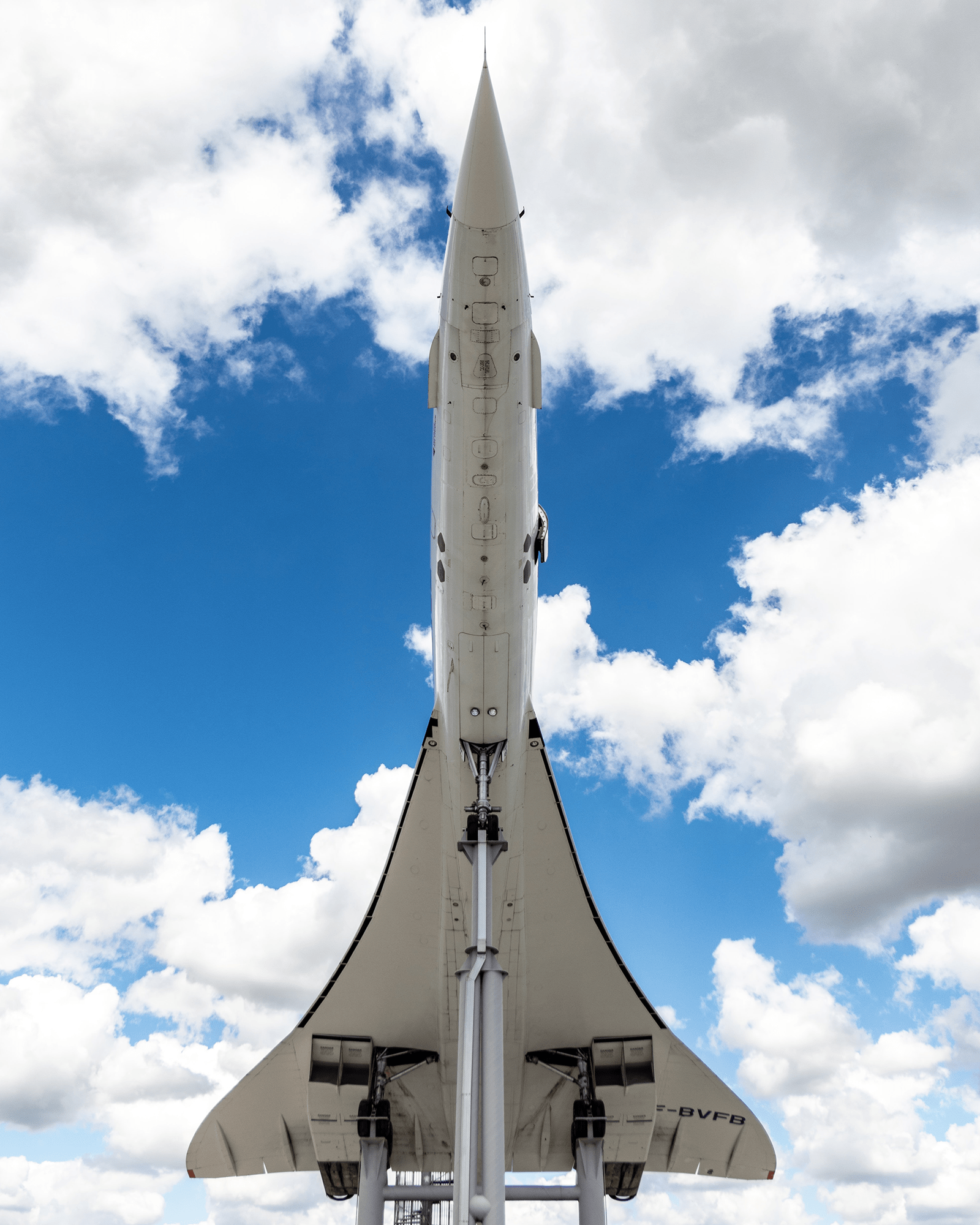
    One major problem that has plagued supersonic aircraft is their noise. The Concorde – thus far the only supersonic commercial airliner – was plagued with noise complaints that ultimately restricted its usability. Noise reduction is a major area of inquiry in aerospace, and the video below shows one experiment trying to understand the connections between supersonic flow and noise.

    Above you see a supersonic, Mach 1.5 microjet emanating from a nozzle at the top of the image. The jet is hitting a flat plate at the bottom of the image. Just beyond nozzle’s exit, you can see the X-shape of shock waves inside the jet. The position of that X is oscillating up and down.

    In the background, you can see horizontal light and dark lines traveling up and down. Those horizontal lines in the background are acoustic waves. When they hit the bottom plate, they reflect and travel upward until they hit another surface (outside the picture) and reflect back down. As they travel, they interact with the jet, causing those X-shaped shock waves to move up and down. This coupling between flow and acoustic waves makes the jet much louder – up to 140 dB – than it would be otherwise.

    Researchers hope that unraveling the physics of simpler systems like this one will help them quiet more complicated aircraft. (Image and video credit: F. Zigunov et al.)