The forces on an object in flight come from the distribution of pressure on the surface. To alter an object’s trajectory, one has to shift the pressure distribution. On subsonic and transonic aircraft, this is usually done with control surfaces like an aileron, but at supersonic speeds this can require a lot of force. The schlieren images above show an alternative approach in which a plasma actuator near the nosetip generates asymmetric forces on the cone. The actuator discharges plasma at t=0, and flow is from left to right. In the first image, the bubble of plasma is expanding on the upper side of the cone, disrupting the nearby shock wave. Over time, it moves downstream, carrying its disruption with it. The asymmetric effect of the plasma causes uneven pressures on either side of the cone that can be triggered in order to turn it in flight. (Photo credit: P. Gnemmi and C. Rey)
Search results for: “supersonic”

Supersonic Oil Flow Viz
This image shows oil-flow visualization of a cylindrical roughness element on a flat plate in supersonic flow. The flow direction is from left to right. In this technique, a thin layer of high-viscosity oil is painted over the surface and dusted with green fluorescent powder. Once the supersonic tunnel is started, the model gets injected in the flow for a few seconds, then retracted. After the run, ultraviolet lighting illuminates the fluorescent powder, allowing researchers to see how air flowed over the surface. Image (a) shows the flat plate without roughness; there is relatively little variation in the oil distribution. Image (b) includes a 1-mm high, 4-mm wide cylinder. Note bow-shaped disruption upstream of the roughness and the lines of alternating light and dark areas that wrap around the roughness and stretch downstream. These lines form where oil has been moved from one region and concentrated in another, usually due to vortices in the roughness wake. Image © shows the same behavior amplified yet further by the 4-mm high, 4-mm wide cylinder that sticks up well beyond the edge of the boundary layer. Such images, combined with other methods of flow visualization, help scientists piece together the structures that form due to surface roughness and how these affect downstream flow on vehicles like the Orion capsule during atmospheric re-entry. (Photo credit: P. Danehy et al./NASA Langley #)

Supersonic Bubble Shock Waves
Supercomputing has been an enormous boon to fluid dynamics over the past few decades. Many problems, like the interaction between a supersonic shock wave and a bubble, are too complicated for analytical solutions and difficult to measure experimentally. Numerical simulation of the problem, combined with visualization of key variables, adds invaluable understanding. Here a shock wave strikes a helium bubble at Mach 3, and the subsequent interactions in terms of density and vorticity are shown. This situation is relevant to a number of applications, such as supersonic combustion and shockwave lithotripsy–a medical technique in which kidney stones are broken up inside the body using shock waves. After impact, an air jet forms and penetrates the center of the structure while the outer regions mix and form a persistent vortex ring. (Video credit: B. Hejazialhosseini et al.; via Physics Buzz)

The Supersonic Plonk
Everyone knows the familiar plonk of a stone falling into a pond but few realize the complexity of the physics. When a solid object falls into a pool, a sheet of liquid, the crown splash, is sent upward. Simultaneously, the object pulls a cavity of air down with it. As the water moves inward, this cavity is pinched, creating an hourglass-like shape reminiscent of the shape of a rocket’s nozzle. As the diameter of that pinched cavity shrinks, the velocity of the upward escaping air increases, resulting in the formation of an air jet moving faster than the speed of sound. This air jet is followed by a slower liquid jet that may rebound to a height higher than then original height of the dropped object. So next time you throw a stone into a pond, enjoy the knowledge that you’ve broken the sound barrier. (Photo credit: D. van der Meer; see also Physics World)
Supersonic Flow
This video shows a sphere in a small supersonic wind tunnel at Mach 2.7. Once the tunnel starts, a curved bow shock forms in front of the sphere, close to but not touching the model’s surface. Areas of low pressure are visible behind the sphere, as is a weak shock wave caused by overexpansion in those low pressure areas. Contrast this with a sharp cone in the same tunnel at the same Mach number. In the case of the cone, the shock wave is attached at the nose of the model. The attached shock follows the body more closely, resulting in a shock that impacts the walls of the tunnel further downstream than in the sphere’s case.
Supersonic Flow Around a Cylinder
This numerical simulation shows unsteady supersonic flow (Mach 2) around a circular cylinder. On the right are contours of density, and on the left is entropy viscosity, used for stability in the computations. After the flow starts, the bow shock in front of the cylinder and its reflections off the walls and the shock waves in the cylinder’s wake relax into a steady-state condition. About halfway through the video, you will notice the von Karman vortex street of alternating vortices shed from the cylinder, much like one sees at low speeds. The simulation is inviscid to simplify the equations, which are solved using tools from the FEniCS project. (Video credit: M. Nazarov)
Supersonic Stellar Jets
Astronomers studying stellar jets–massive outflows of gases and particles pouring from the poles of newborn stars–are finding reasons to turn to fluid dynamicists to understand the timelapse videos they’ve stitched together from multiple exposures from the Hubble telescope. Usually astronomical events unfold on such a slow timescale that our only view of them is as a snapshot frozen in time. Stellar jets can move relatively quickly, though, with portions of the jet flowing at supersonic speeds. Over the course of Hubble’s lifetime, these jets have been imaged multiple times, allowing astronomers to create movies that reveal swirling eddies and shock wave motion previously unseen. (submitted by sakalgirl)
Supersonic Bullet
[original media no longer available]
This video shows a CFD simulation of a bullet passing through a parallel channel at Mach 2. The simulation captures 3 milliseconds of real-time and shows the Mach number in the top view and the temperature in the bottom view. Note how the bow shock near the front of the bullet and the trailing shock behind it reflect off the walls of the channel and interact. Even though the calculation is inviscid, the shock waves cause intense heating (white) in front of and behind the bullet.
Supersonic
Moving supersonically–faster than the local speed of sound–can cause some awesome effects. Among these are vapor cones (a.k.a. Prandlt-Glauert singularities), shock waves, and, of course, the sonic boom.
Making Quieter Shock Waves
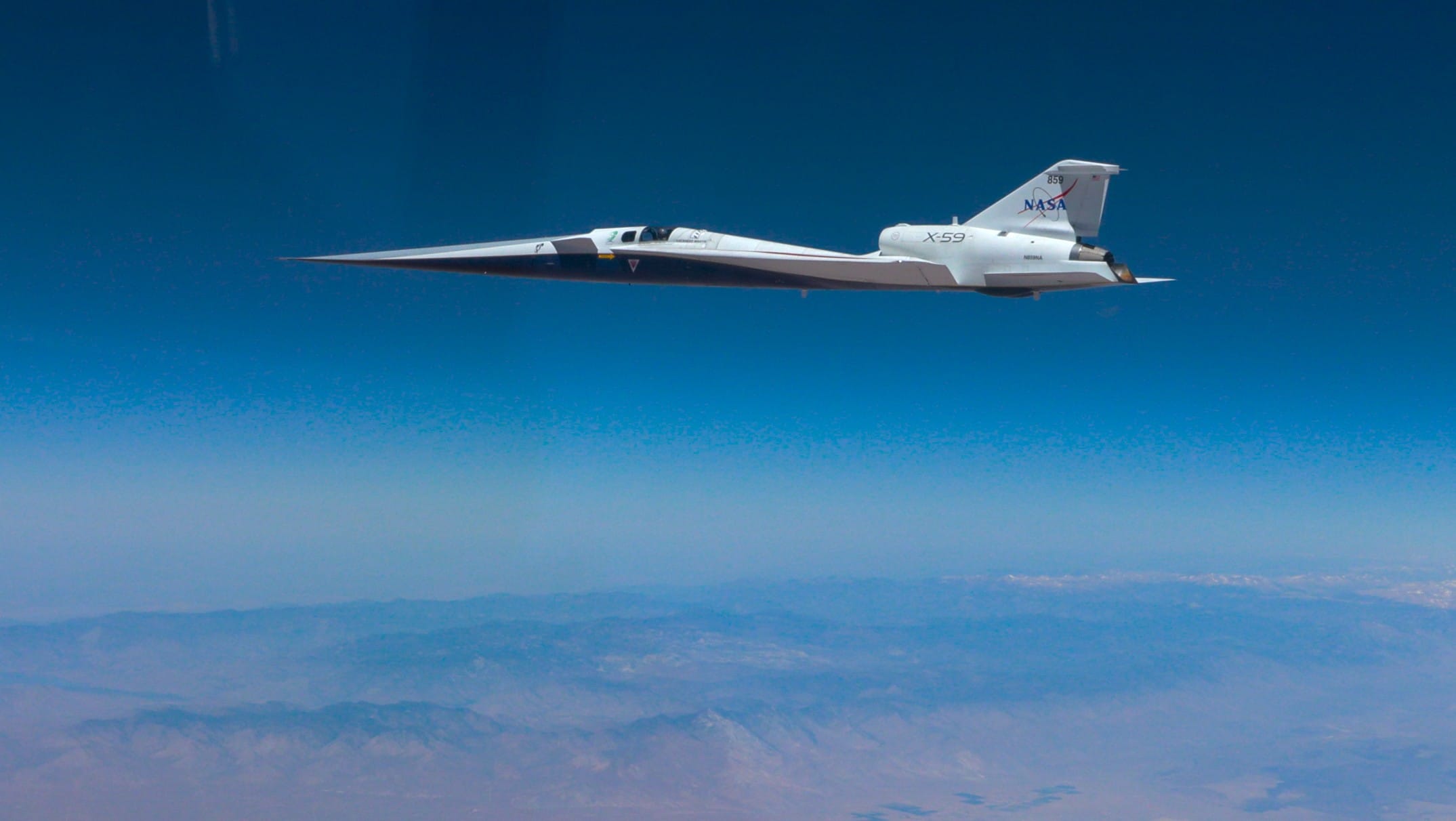
NASA’s X-59 aircraft is intended to demonstrate supersonic flight without the boom. Although it’s broken into supersonic speeds, we haven’t yet heard its “sonic thump” because, so far, it’s been accompanied by conventional supersonic aircraft, which are louder.
The idea behind the long, skinny X-59 is to create weaker, widely-spaced shocks along the aircraft body. Weaker shocks are easier for atmospheric effects to damp out before they reach the ground, and spacing them out makes it harder for them to “pile up” at the nose and tail to create the strong double shocks that merge into a sonic boom.
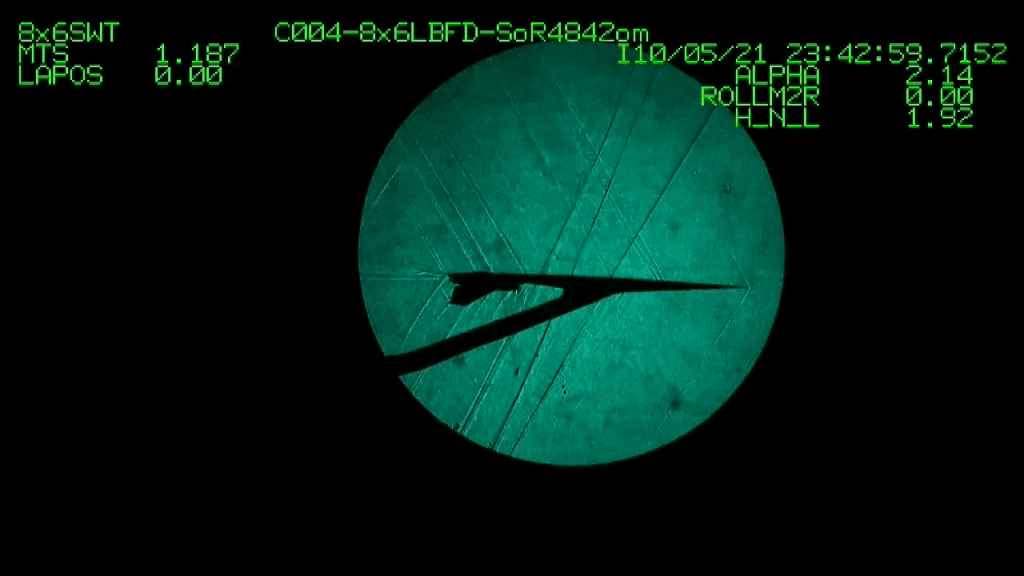
Schlieren image of a model X-59 tested at supersonic conditions in a wind tunnel. The model is mounted upside-down. The three dark diagonal lines are shock waves originating from the wind tunnel and can be ignored. The fainter lines coming off parts of the aircraft model are the plane’s shock waves. NASA is preparing to test the X-59’s in-flight shocks soon, including with in-air schlieren photography like they’ve done in the past for other aircraft. But we’ve already have a glimpse of what to expect, thanks to wind tunnel testing, shown above. Ignore the three dark diagonal lines in the middle of the image (those are from the wind tunnel, not the model aircraft), and focus instead on the thin bright lines coming off the plane. Those are some impressively subtle shock waves!
Hear more from the aircraft’s designer and test pilots in this Ars Technica article. (Image credit: NASA; see also: Ars Technica, M. Ahaus et al.)
Fediverse Reactions
-