Search results for: “supersonic”

  • Featured Video Play Icon

    Hydraulic Jumps

    Chances are that you’ve seen plenty of hydraulic jumps in your life, whether they were in your kitchen sink, the whitewater of a river, or at the bottom of a spillway. Practical Engineering has a great primer on this oddity of open channel flow. 

    When water (or other liquids) flow with a surface open to the air – think like a river rather than a pipe – the flow has three important regimes: subcritical, critical, and supercritical. Which state the flow is in depends on the speed of the flow compared to the speed of a wave traveling in that flow. If the waves are faster than the flow, we call it subcritical. If the flow is faster than the waves, it’s called supercritical. (This is equivalent to subsonic or supersonic flow, where the regime depends on the flow speed compared to the speed of sound.)

    Flows can transition naturally from one state to another, and where they transition from fast, supercritical flow to slower, subcritical flow, we find hydraulic jumps – places where the kinetic energy of the supercritical flow gets changed into turbulence and potential energy through a change in height. Check out the video above to learn how civil engineers use hydraulic jumps to control water and erosion. (Video and image credit: Practical Engineering)

  • Sheep as a Compressible Flow

    Not everything that flows is a fluid. And when viewed from above traffic, crowds, and even herds of sheep flow in patterns like those of a fluid. In particular, these conglomerations move like compressible fluids – ones that allow substantial changes in density as they flow. From above, each sheep is just a few pixels of white, but you can see which areas of the herd have the highest density by how white an area looks. The highest density regions also tend to be the slowest moving – not surprising in a crowd.

    Now watch the gates. They act like choke points in the flow and, to some extent, like a nozzle in supersonic flow. As the sheep approach the gate, they’re in a dense, slow moving clump, but as they pass through it, the sheep speed up and spread out. This is exactly what happens in a supersonic nozzle. On the upstream end, flow in the nozzle is subsonic and dense. But once the flow hits the speed of sound at the narrowest point in the nozzle, the opening on the downstream side allows the flow to spread out and speed up past Mach 1.  (Video credit: MuzMuzTV*; submitted by Trent D.)

    *Editor’s Note: I do my best to credit the original producers of any media featured on FYFD, but this is especially difficult with viral videos as there can be many copies, all of which are uncredited. I’ve made my best guess on this one, but if this is your video, please let me know so that I can credit you properly. Thanks!

  • Turbulence and Star Formation

    Turbulence and Star Formation

    Space, as I’ve discussed previously, is surprisingly full of matter, especially clouds of dust. And yet the rate of star formation we observe is bizarrely low; the Milky Way, for example, produces only about one solar mass worth of new stars every year. If gravity were the sole force driving star formation, we’d see far more stars forming. Recent research suggests that turbulence plays a major role in regulating the star formation process, both by countering gravity’s attempts to collapse gases into a proto-star and by creating supersonic shocks that drive material together to jump-start star formation. There seem to be other important ingredients as well: young stars tend to form jets that blow material back into the interstellar clouds they’re forming in, feeding the turbulent background. For more, check out Physics Today. (Image credit: ESA/NASA/Hubble/ESO, via APOD; research credit: C. Federrath)

  • Flying Fragments

    Flying Fragments

    Flying fragments can be a big danger in explosions. Shown above are two shadowgraph images of 1 gram explosives originally packed in solid containers. Each explosion produced a visible spherical shock wave, about 1 meter across in both pictures. On the left side, the container has fragmented into large pieces, each of which travels near to but less than the speed of sound. On the right, the fragments are much smaller, but many of them are traveling at supersonic speeds ahead of the main shock wave. If you look closely, you can even see faint Mach cones extending from each fragment. In a real, full-scale explosion, these shards would strike like a hail of bullets ahead of the blast wave. (Image credit: G. Settles)

  • Featured Video Play Icon

    Shadows of Flow

    In the latest Veritasium video, Derek demonstrates how to see gas motions that are normally invisible using a schlieren photography set-up. Schlieren techniques have been important in fluid dynamics for well over a century, and Derek’s set-up is one of the two most common ways to set up the technique. (The other method uses two collimating mirrors instead of a single spherical or parabolic one.) As explained in the video, the schlieren optical set-up is sensitive to small changes in the refractive index, making density changes or differences in a gas visible. This makes it possible to distinguish gases of different temperatures or compositions and even lets you see shock waves in supersonic flows. (Video and image credit: Veritasium; submitted by Paul)

  • Watching a Model Rocket Burn

    Watching a Model Rocket Burn

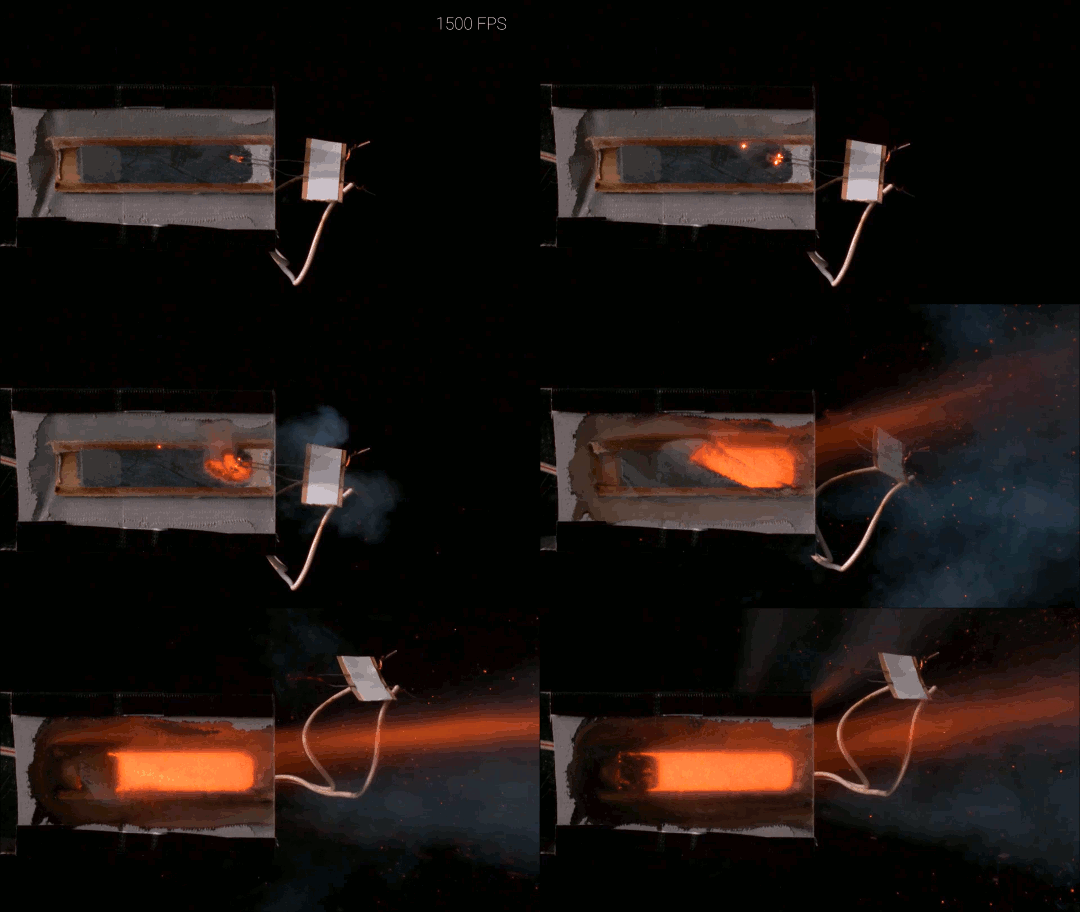
    Rockets operate on a pretty simple principle: if you throw something out the back really fast, the rocket goes forward. Practically speaking, we accomplish this with a combination of chemistry and physics, by burning fuel and oxidizer together and accelerating the exhaust out a nozzle. Solid rocket propellant, like that found in the model rockets shown here, is a combination of fuel and oxidizer that don’t react until they’re ignited. You don’t want your rocket to just explode as soon as it’s lit, though, so solid rocket motors are carefully designed to burn in a particular way. By packing the propellant into different shapes – and even including patterns of propellants with different burn rates – engineers can create a rocket that burns with the thrust pattern they want.

    In the case of this model rocket motor, what we observe is not really how it is intended to burn; you can see how some of the combustion products are working their way out of cracks that wouldn’t normally exist. But the video and animation do show how the burn front moves gradually through the engine, allowing it to produce a relatively steady amount of thrust for a longer period before reaching the darker burning propellant on the left, which would normally launch the model rocket’s parachute. (Image and video credit: Warped Perception; via Gizmodo)

  • Featured Video Play Icon

    Sheep as a Fluid

    Not all fluids are, well, fluid. Traffic, flocks of birds, ants, and even sheep can behave like fluids. This video shows an aerial perspective on sheep being herded, and despite the four-legged nature of these particles, they have a lot of fluid-like characteristics. You can watch ripples and waves travel through the herd and see how disturbances propagate. The herd is actually a brilliant example of compressible flow; notice how the sheep slow down and bunch up as they near the gate then speed up and spread out once they pass the constriction. This is exactly how supersonic fluids behave! (Video credit: T. Whittaker; submitted by Simon H and John B)

    If you’re in the DC area, I’ll be speaking at the Annals of Improbable Research Show at the AAAS meeting Saturday evening. Our session is open to the public, but it’s likely to be crowded, so you may want to arrive early!

  • Shock Diamonds

    Shock Diamonds

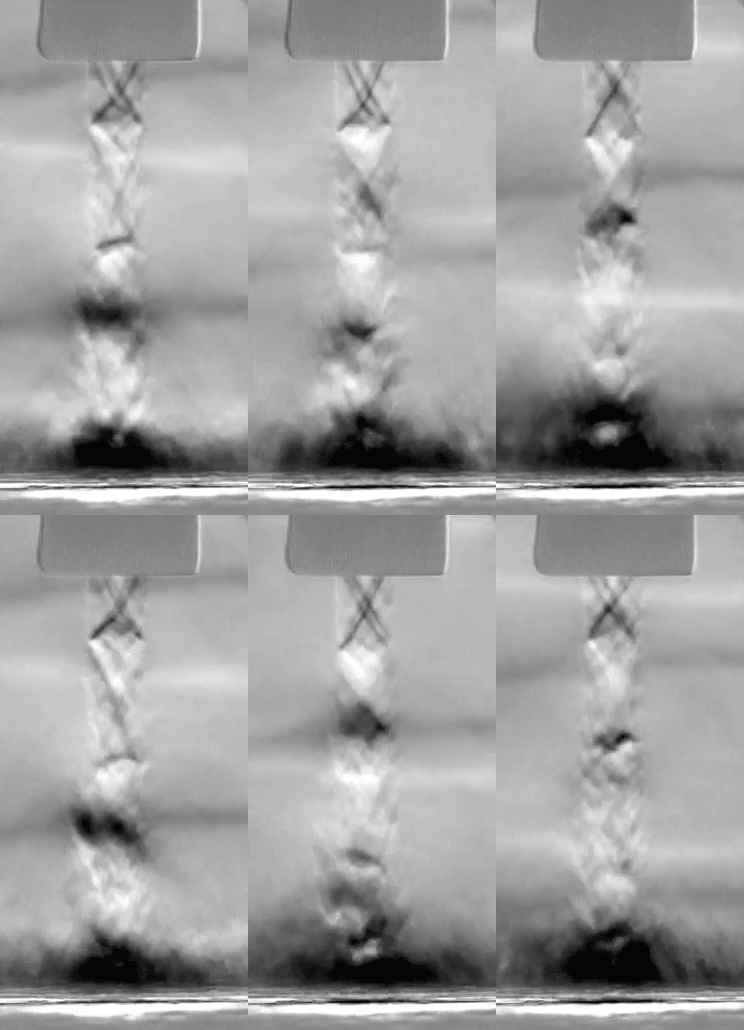
    Rocket engine exhaust often contains a distinctive pattern known as shock diamonds or Mach diamonds. These are a series of shock waves and expansion fans that increase and decrease, respectively, the supersonic exhaust gases’ pressure until it equalizes with atmospheric pressure. The bright glowing spots visible to the naked eye are caused by excess fuel in the exhaust igniting. As awesome as shock diamonds look, they’re actually an indication of inefficiencies in the rocket: first, because the exhaust is over- or underexpanded, and second, because combustion inside the engine is incomplete. Both factors reduce a rocket engine’s efficiency (and both are, to some extent, inescapable). (Photo credit: XCOR)

  • Shock Waves in Flight

    Shock Waves in Flight

    Schlieren optical systems have been used to visualize shock waves in labs for more than a century, but the technique did not translate well to photographing shock structures outside the lab. But now NASA’s Armstrong Research Center and Ames Research Center have developed a method that allows them to capture highly-detailed images of the shock waves around airplanes while they are flying. This is incredible stuff. Be sure to check out the high-resolution versions on this page, along with more description of the coordination necessary to pull off the photos.

    The light and dark lines you see emanating from the airplane are places with strong density gradients. The dark lines are mostly shock waves, with the strongest shock waves appearing black due to the large change in air density. Many of the light streaks are expansion fans, areas where the density and pressure drop as air speeds up.

    The goal of this research is to better understand shock wave structures around supersonic planes in order to reduce the noise supersonic aircraft cause when flying overhead. As you can see in the photos, the shock waves at the nose and tail of the aircraft persist far away from the aircraft; these are what cause the twin sonic boom heard when the plane flies by. (Photo credit: NASA; via J. Hertzberg)

  • Flow Around a Delta Wing

    Flow Around a Delta Wing

    Colorful streaks of dye wrap like ribbons along the leading edge of a delta wing. At an angle of attack, this triangular wing forms a set of vortices that run along its edge, providing much of the low pressure–and therefore lift–on the upper surface of the wing. In contrast, the red streaks of dye in the middle of the wing demonstrate clean, laminar flow. Highly swept delta wings are popular for aircraft traveling at supersonic speeds, but they can also work well subsonically, as shown here. For more incredible and beautiful examples of flow visualizations by Henri Werlé, check out his 1974 film Courants et couleurs. (Photo credit: H. Werlé; via eFluids)