
Newton’s third law says that forces come in equal and opposite pairs. This means that when air exerts lift on an airplane, the airplane also exerts a downward force on the air. This is clear in the image above, which shows a an A380 prototype launched through a wall of smoke. When the model passes, air is pushed downward. The finite size of the wings also generates dramatic wingtip vortices. The high pressure air on the underside of the wings tries to slip around the wingtip to the upper surface, where the local pressure is low. This generates the spiraling vortices, which can be a significant hazard to other nearby aircraft. They are also detrimental to the airplane’s lift because they reduce the downwash of air. Most commercial aircraft today mitigate these effects using winglets which weaken the vortices’ effects. (Image credit: Nat. Geo./BBC2)
Search results for: “smoke”

Fluids Round-up – 7 December 2013
Fluids round-up time! I missed out last weekend because of the holidays, so this is a long list of links. There’s a lot of really great stuff here, including some neat fluidsy geophysics and astronomy.
- xkcd’s Randall Munroe explains why you can’t boil your tea by stirring it.
- LATimes describes a flying jellyfish robot.
- Wired takes a detailed look at archerfish physics, including some of the fluid dynamics we’ve discussed previously. (via iamaponyrocket)
- Several readers have also pointed out this ASCII CFD simulator, seen in action in this video.
- New models suggest that Europa’s chaotic terrain features may be due to turbulence in its lower latitudes.
- In a similar vein, nearby Jupiter’s Great Red Spot may owe its longevity to existing in three-dimensions.
- NASA revealed new movies and images of Saturn’s polar hexagon this week. For more, see some of the earlier photos and laboratory recreations of the hexagon and this summary from io9. (submitted by @AndrisPiebalgs)
- Continuing with the astronomical bent, check out Anders Sandberg’s musings on what a habitable planet twice the size of Earth would be like.
- Back here on Earth, NASA released some impressive images of global weather patterns as computed by their high-resolution models.
- PhysicsBuzz takes a look at the fluid dynamics of flying fish.
- I’ve seen plenty of videos of people doing crazy things with non-Newtonian fluids, but Hard Science adds an interesting new one: attempting to ride a bike across a pool of oobleck.
- PopSci reported from CES 2013 about a non-Newtonian fluid for protecting tech gadgets from impacts.
- Drummer Ali Siadat shows how to blow the perfect smoke rings using a bass drum. (via Jennifer Ouellette)
- Finally, this week’s lead image comes from the Grand Canyon where a strong temperature inversion created spectacular fog-filled vistas.
(Photo credit: E. Whittaker)

Volcanic Vortices from Etna


Italy’s Mount Etna is erupting again, producing a series of beautiful vortex rings. Like a dolphin’s bubble ring or a vortex cannon, the volcano’s rings are formed when gases are rapidly expelled through a narrow opening. Such formations are extremely common but are generally not visible to the eye. In this case, steam has gotten entrained into the rings to make them visible. Vortex rings can maintain their structure over substantial distances. The photographer of these rings noted that they lasted as many as ten minutes before dissipating. (Photo credit: T. Pfeiffer; via NatGeo)

Fire in Microgravity
In the movie “Gravity” Sandra Bullock’s character battles a fire aboard the International Space Station. Combustion is a huge concern in space habitats. Microgravity fires are challenging to detect and fight because they behave very differently in the absence of buoyancy. On Earth, buoyancy makes hot air rise from a flame while cooler air is pulled in near the base. This feeds fresh oxygen to the teardrop-shaped flame. In space, there is no buoyancy and flames are spherical. They also burn at lower temperatures and lower oxygen concentrations–so low, in fact, that the oxygen depletion necessary to extinguish a fire is lower than what humans require to survive.
No buoyancy makes it harder for fires to spread, but it also makes them harder to detect since smoke doesn’t rise toward a detector on the ceiling. Instead, fire detectors aboard the Space Station are housed in the ventilation system that moves air through the modules constantly. In the event of a fire, astronauts use a three-step fire suppression system. First, they shut off the ventilation system to delay the fire’s spread. Then they shut off power to the affected unit, and, finally, they use fire extinguishers on the flames. The Russian module is equipped with a foam extinguisher and the others use CO2 units. (Image credit: Warner Brothers)
Fluids Round-up – 2 November 2013
Fluids round-up time! Here are your latest links:
- Over at PhysicsFocus, Colin White discusses the Bernoulli fallacy and other zombie myths of physics. (Via @JenLucPiquant)
- Aviation Week has an exclusive look at Skunk Works’ SR-72 next-gen hypersonic aircraft.
- MinutePhysics asks if it’s better to walk or run through rain. This post has another take on the question.
- io9 describes why bubbles lose their color as they pop.
- Physics Buzz looks at knotted fluid vortices. They also have a nice write-up on the foaming of a struck beer, which we talked about last week.
- Enjoy the beauty of mathematics next to the physics they describe. (via io9)
- More fun fluids from Physics Buzz, this time looking at new tiny jellyfish-like flying robots.
- Remember the Chelyabinsk meteor from February? Discovery reports on an analysis of the air burst and its probability.
- Is there fluid mechanics in neck cracking? (?!?)
- New research shows that mesoscale self-assembly can be achieved using capillary charges.
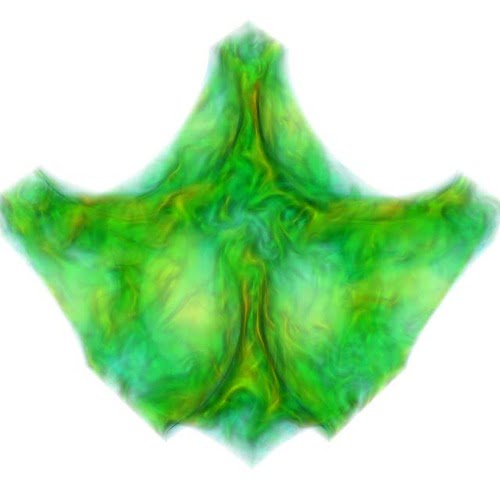
- Finally, our lead image shows a simulation of turbulent flow in a tightly packed lattice of spheres. It’s an entry from Argonne National Laboratory’s annual “Art of Science” contest. Take a look at the entries and vote for your favorites!
While not strictly fluid dynamical, I want to take a moment to talk about education. I receive a lot of stunned reactions and self-deprecation when people learn I study aerospace engineering. Many people say, “Oh, I could never do that!” or “You must be some kind of genius.” I’m not. It’s true that studying engineering and fluid dynamics involves a lot of math and some it is complex (no pun intended). There’s a lot of unfounded fear about science and math in our society, when really they are just skills that any of us can improve with practice and effort. So, for those out there who have ever thought, “I can’t do that, there’s too much math,” please watch this young woman address mathphobia. She sums up just about everything I’ve always wanted to tell you.(Photo credit: Argonne National Laboratory)
Wind Tunnel Testing
Wind tunnel testing is an important step in designing new aircraft. This video shows footage of visualization tests of the 21-ft wingspan Boeing X-48C model in NASA Langley’s Full-Scale Tunnel. The X-48C is a blended wing body design capable of higher lift-to-drag ratios than conventional aircraft, which should lead to a higher range and greater fuel economy. The video shows some smoke visualization that illustrates airflow around the airfoil-shaped craft. The long probe sticking forward from the starboard wing is used to measure air pressure, angle of attack, and sideslip angle of the model. Notice how smoke from the wand is pulled from below the leading edge of the wing up and over the top of the wing. This is because there is lower pressure over the top of the wing than the bottom, and, like an electrical charge seeking the path of least resistance, fluids flow preferentially toward lower pressures. (Video credit: NASA Langley)
Ski Jumping Aerodynamics
Last summer we featured fluid dynamics in the Summer Olympics and there’s more to come for Sochi. Winter athletes like ski jumper Sarah Hendrickson are hard at work preparing, which can include time in wind tunnels, as shown here. There are two main diagnostics in tests like these: drag measurements and smoke visualization. The board Hendrickson stands on is connected to the tunnel’s force balance, which allows engineers to measure the differences in drag on her as she adjusts equipment and positions. This gives a macroscopic measure of drag reduction, and reduced drag makes the skier faster on the snow and lets her fly longer in the jump. The smoke wand provides a way to visualize local flow conditions to ensure flow remains attached around the athlete, which also reduces drag. (Video credit: Red Bull/Outside Magazine; submitted by @YvesDubief)

Reader Question: Does Flow Viz Alter Flow?


 gorbax asks:
 I’ve been wondering for a while, actually, how do we know when the method of flow visualization doesn’t actually alter the flow of a fluid itself?
This is a great question and one that fluid dynamicists have to deal with all the time. Ideally, we’d love to measure everything we want from a flow at all points at all times without doing anything to affect it. In reality, however, that just doesn’t happen. Some measurement techniques are less intrusive than others, but just about everything risks having some effect. This raises two questions: 1) How small can we make that effect? and 2) Do we even care if we’re affecting the flow?
With regards to the first, the onus is typically on the experimentalist to show that whatever visualization technique he/she uses is not significantly affecting the flow. For something like particle image velocimetry, which requires seeding the flow with particles, this means selecting particles that follow the flow rather than changing it and considering carefully how and where to seed the flow such that any added vorticity from the injection does not alter the flow significantly. Checking for this can be done many ways, for example with comparisons to other measurement techniques (with and without seeding) or by comparing to simulation.
The second question–do we care?–is also a significant consideration. Because the purpose of flow visualization is often to get a qualitative feel for the flow field rather than quantitative information, it is often not a significant concern if there is some slight effect from the visualization technique. This can often be the case with smoke-wire and dye visualizations where we just want to see what’s going on.
Finally, there are some instances of flow visualization which are completely unobtrusive to the flow. Schlieren photography and infrared thermography are two examples. Both are optical techniques that act from a distance and take advantage of extant flow properties to make certain features visible. The real key is knowing what technique(s) will work for the flow you have and will give you the information you want. After that, it’s all about proper and thorough execution. (Photo credits: N. Vandenberge et al., T. Omer, M. Canals, P. Danehy et al., A. Wilkens et al., W. Saric et al.)
Visualization Via Temperature
One downside to many flow visualization techniques, like those using dye, smoke, or particles, is the difficulty of dealing with their aftermath. You can only introduce so much of them into a wind or water tunnel before it’s necessary to shutdown and clean everything. One alternative is to use temperature, as shown in the video above. By simply introducing a warmer fluid and using an IR camera, it’s possible to accomplish many of the same effects without the mess. (Video credit: A. Khandekar and J. Jacob; submitted by J. Jacob)

Visualizing F-18 Flow
Flow visualization techniques are helpful outside of wind and water tunnels, too. The photo above comes from the F-18 High Alpha Research Vehicle (HARV) program in which techniques like smoke and dye visualization were used in-flight to visualize airflow around an F-18 at large angles of attack. During flight a glycol-based liquid dye was released from tiny holes along the plane’s forebody, creating the pattern seen here later on the ground. This particular test corresponded to about 26 degrees angle of attack. (Photo credit: NASA Dryden)
