
A smoke wire shows the deformation of streamlines around a swept-winged micro air vehicle (MAV). These crafts typically feature wingspans smaller than one foot and, thus, never develop the type of flow fields associated with larger fixed-wing airplanes. This complicates theoretical predictions of lift and drag for MAVs as well as making them difficult to control. MAVs have numerous commercial and military applications, including search and rescue operations. (Photo credit: Tom Omer)
Search results for: “smoke”

Vortex Cannon
Building a vortex cannon is a great way to demonstrate the power and longevity of vortex rings. As demonstrated here, it’s possible to create one with just a box with a round hole in it. Adding some smoke or stage fog helps visualize the rings. Vortex rings are found frequently in nature: volcanoes make them, some plants use them to distribute spores, and dolphins and whales use them to play. (submitted by @aggieastronaut)
Tornado in a Bubble
In this video, a miniature tornado-like vortex is created inside a soap bubble. Here’s how it works: after the first bubble is formed and the smoke-filled bubble is attached to the outside, he blows into the main bubble, creating a weak angular velocity, before breaking the interface between the two bubbles. As the smoke mixes in the main bubble, note how it is already spinning slowly due to the free vortex he created. Then, when the top of the bubble is popped, surface tension pulls the bubble’s surface inward. Because the bubble radius is decreasing, conservation of angular momentum causes the angular velocity of the fluid inside to increase, pulling the smoke into a tight vortex, much like a spinning ice skater who pulls her arms inward.
Wind Tunneling Testing for BASE Jumpers
While we usually think of wind tunnel testing airplane models, the truth is that wind tunnels today test a much wider array of subjects. From oil rigs and skyscrapers to athletes and police sirens, if you can imagine it, it’s probably been stuck in a wind tunnel. This video shows some wind tunnel testing of a tracking suit used for BASE jumping. The primary focus seems to be on lift and drag at angle of attack–which can be used to determine glide ratios for the pilot–but there is also some study of localized turbulence generation, as evidenced by the use of smoke generators and the streamers attached to the suit’s arms and legs. (submitted by Jason C)
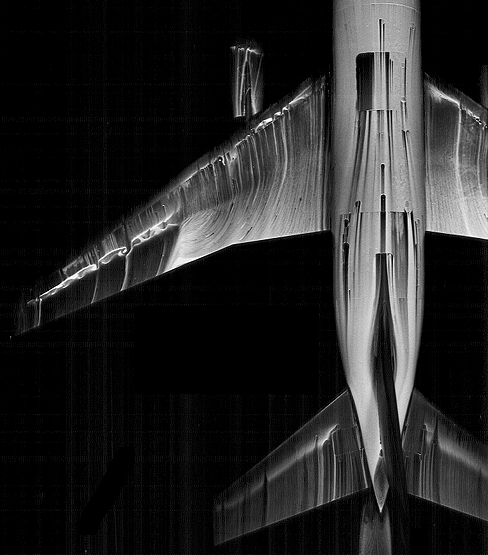
Flow Over Swept Wings
Flow over a swept wing behaves very differently than a straight fixed wing or an airfoil. Instead of flowing straight along the chord of the wing in a two-dimensional fashion, air is also directed along the wing, parallel to the leading edge. The above oil flow visualization on a swept wing airplane model shows this curvature of streamlines. As a result of this three-dimensional flow behavior, boundary layers on swept wings are subject to the crossflow instability, which manifests as co-rotating vortices aligned to within a few degrees of the streamlines. Triggering this boundary layer instability can lead to turbulence and higher drag for the aircraft.

How Shock Waves Form


Most people are familiar with the Doppler effect–in which the frequency of a wave changes depending on the motion of the observer relative to the wave source–from the shifting pitch of sirens as they pass. But the effect is important for pressure waves in addition to acoustic waves. When an object moves through air, its motion disturbs the surrounding air via pressure waves, which travel at the speed of sound. If an object moves slower than the speed of sound (top right), then those pressure waves extend in front of the object, carrying information about the object and allowing the air to shift and move smoothly around it.
If the object is moving at the speed of sound (bottom left), then it arrives at the same time as the pressure waves. In essence, the object is striking a stationary wall of air–this is what was meant by “breaking the sound barrier”. At Mach 1, the physics of the problem have fundamentally shifted. Now the only way for air to deflect to allow the object’s passing is by the sudden compression of a shock wave.
Moving even faster than the speed of sound (bottom right) the pressure and sound waves created by the object’s motion stretch in a cone behind it. The cone, known as a Mach cone, is the shock wave that deflects air around the moving object. The result is that the object will actually pass an observer before the observer will hear it. This is because no information can travel forward of the Mach cone’s leading edge. That’s why the area outside of the Mach cone is sometimes called the Zone of Silence. When the Mach cone passes an observer, the shock wave will register as a boom, like when the space shuttle passes overhead while landing. (via fyeahchemistry)

Transition to Turbulence
Smoke introduced into the boundary layer of a cone rotating in a stream highlights the transition from laminar to turbulent flow. On the left side of the picture, the boundary layer is uniform and steady, i.e. laminar, until environmental disturbances cause the formation of spiral vortices. These vortices remain stable until further growing disturbances cause them to develop a lacy structure, which soon breaks down into fully turbulent flow. Understanding the underlying physics of these disturbances and their growth is part of the field of stability and transition in fluid mechanics. (Photo credit: R. Kobayashi, Y. Kohama, and M. Kurosawa; taken from Van Dyke’s An Album of Fluid Motion)

Flow Around a Delta Wing
Smoke visualization in a wind tunnel shows the vortices wrapping around and trailing behind a delta wing. As with more commonly seen rectangular or swept wings, the vortices that form around delta wings affect lift, drag, and control of an aircraft. They can also be hazardous to aircraft nearby. Note that, although delta wings are often seen on supersonic aircraft, this visualization only applies at subsonic speeds. The flow field changes drastically above the speed of sound.
Airfoil Boundary Layer
This video shows the turbulent boundary layer on a NACA 0010 airfoil at high angle of attack (15 degrees). Notice how substantial the variations are in the boundary layer over time. At one instant the boundary layer is thick and smoke-filled and in another we see freestream fluid (non-smoke) reaching nearly to the surface. This variability, known as intermittency, is characteristic of turbulent flows, and is part of what makes them difficult to model.

Reader Question: Locust Follow-up
omaewayowai-blog asks:
in your latest post, is that bug mounted with a yaw angle or what? because the bugs antenna and its head are not disturbing the flow. and the flow perfectly follows the surface of the bug’s aft body. how does this happen? is it something about low reynolds number?
The locust in that post is fully immersed in the flow and its antenna and head are disturbing the air, just not the smoke. The smoke generator is placed in a single vertical plane that’s offset from the bug’s midsection. According to the published paper, the smoke visualization corresponds to:
“[…] the vertical plane that intercepts the hindwing at the mid-wing position when the wing is horizontal.”
That’s why you can see perfectly smooth lines of smoke between the camera and the locust’s head.
