Artist Antoine Terrieux’s “En Plein Vol” exhibit shows off the power of hair dryers. Parts of the exhibit, like the floating ball at 0:16, rely on Bernoulli’s principle and the moving stream of air the dryers generate. Others, like the smoke tornado at 0:39 or the (suspended) paper airplane at 0:56, use the hair dryers to generate vorticity essential to the installation. It’s a neat concept and very well executed. (Video credit: A. Terrieux; via io9; submitted by Joseph S. and Eliza M.)
Search results for: “smoke”

Re-lighting a Candle
When you blow out a candle, you can re-light the wick using the smoke trail left behind. This is a topic we’ve discussed before, but I’m thrilled to finally see the process in true high-speed, thanks to the Slow Mo Guys. The plume that rises from the extinguished candle is an atomized mixture of fuel (wax) and air. When you bring a new combustion source–the match–close enough, that mixture ignites and the flame spreads downward back to the wick. (Video credit: The Slow Mo Guys)
Making a Bottle Resonate
If you’ve ever blown across the top of a bottle to make it play a note, then you’ve created a Helmholtz resonator. Air flow across the top of the bottle causes air in and around the bottle neck to vibrate up and down. Like a mass on a spring, the air oscillates with a particular frequency that depends on the system’s characteristics. We hear this vibration as a a deep hum, but in the high-speed video above, you’re actually seeing the vibration as smoke pulsing in and out of the bottle. Helmholtz resonance shows up more than just in blowing across beer bottles; it’s also a factor in many resonating instruments, like the guitar. To learn more about the physics and mathematics of the effect, check out this page from the University of New South Wales. (Video credit: N. Moore)
American Football Aerodynamics
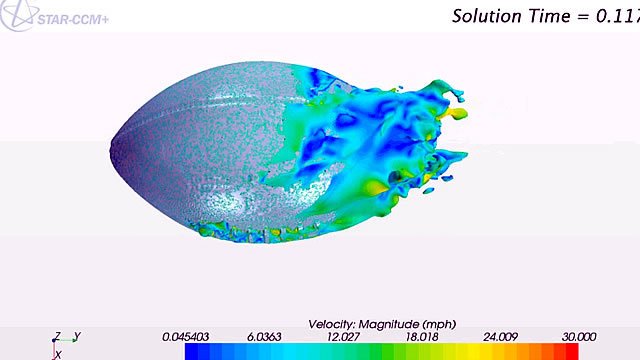
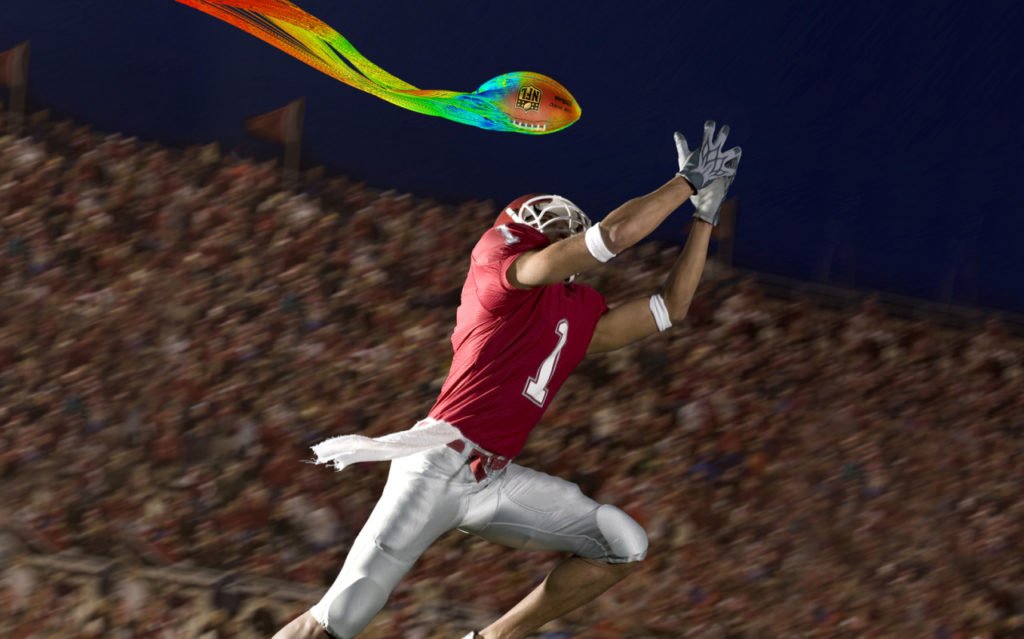

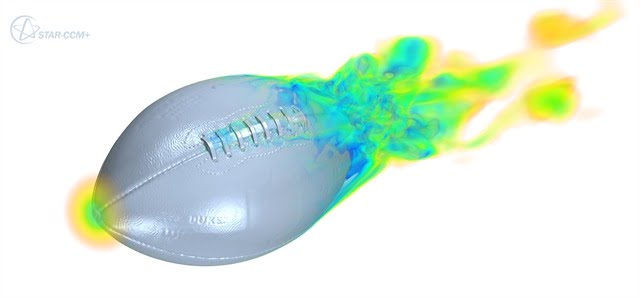
Like many sports balls, the American football’s shape and construction make a big difference in its aerodynamics. Unlike the international football (soccer ball), which undergoes significant redesigns every few years thanks to the World Cup, the American football has been largely unchanged for decades. The images above come from a computational fluid dynamics (CFD) simulation of a spiraling football in flight. Although the surface is lightly dimpled, the largest impact on aerodynamics comes from the laces and the air valve (just visible in the upper right image). Both of these features protrude into the flow and add energy and turbulence to the boundary layer. By doing so, they help keep flow attached along the football longer, which helps it fly farther and more predictably. For more, check out the video of the CFD simulation. (Image credits: CD-adapco; via engineering.com)
Half Vortex Rings
Vortices are one of the most common structures in fluid dynamics. In this video, Dianna from Physics Girl explores an unusual variety of vortex you can create in a pool. Dragging a plate through the water at the surface creates a half vortex ring, which can be tracked either by the surface depressions created or by using food dye for visualization. Vortex rings are quite common, but a half vortex ring is not. The reason is that, ignoring viscous effects, a vortex filament cannot end in a fluid. The vortex must close back on itself in a loop, or, like the half vortex ring, the ends of the vortex must lie on the fluid boundary. It is possible to break vortex lines like those in smoke rings, but the lines will reattach, creating new vortex rings–just as they do in these vortex knots. (Video credit: Physics Girl; submitted by Tom)
Crow Instability
Behind airplanes in flight, water vapor from the engine exhaust will sometimes condense in the wingtip vortices, thereby forming visible contrails. The two initially parallel vortex lines are unstable and any small perturbation to them–a slight crosswind, for example–will cause an instability known as the Crow instability. The contrails become wavy, with the amplitude of the wave growing exponentially in time due to interactions between the two vortices. Eventually, the vortex lines can touch and pinch off into vortex rings. The effect is also quite noticeable when smoke generators are used on a plane, and there are some great examples in this air show video between 3:41:00 and 3:44:00. (Video credit: M. Landy-Gyebnar; h/t to Urs)
Lighting a Match
The schlieren optical technique is ideal for visualizing differences in fluid density and is an important tool for revealing flows humans cannot see with their naked eyes. In this high speed video, a professor lights a match. The initial strike generates friction and heat sufficient to convert some of the red phosphorus in the match head to its more volatile white phosphorus form. We see this in the schlieren as the cloud-like burst in the first several seconds. The heat from the phosphorus combustion ignites the sulfur fuel and potassium chlorate oxidizer in the match head to create a more sustained flame. During this period, wavy, smoke-like whorls of hot air rise from around the flame as buoyancy takes over. The upward movement of hot air draws in cooler air from the surroundings, providing the flame with an ongoing source of oxygen and allowing it to grow. (Video credit: RMIT University)

Pyrocumulus Clouds
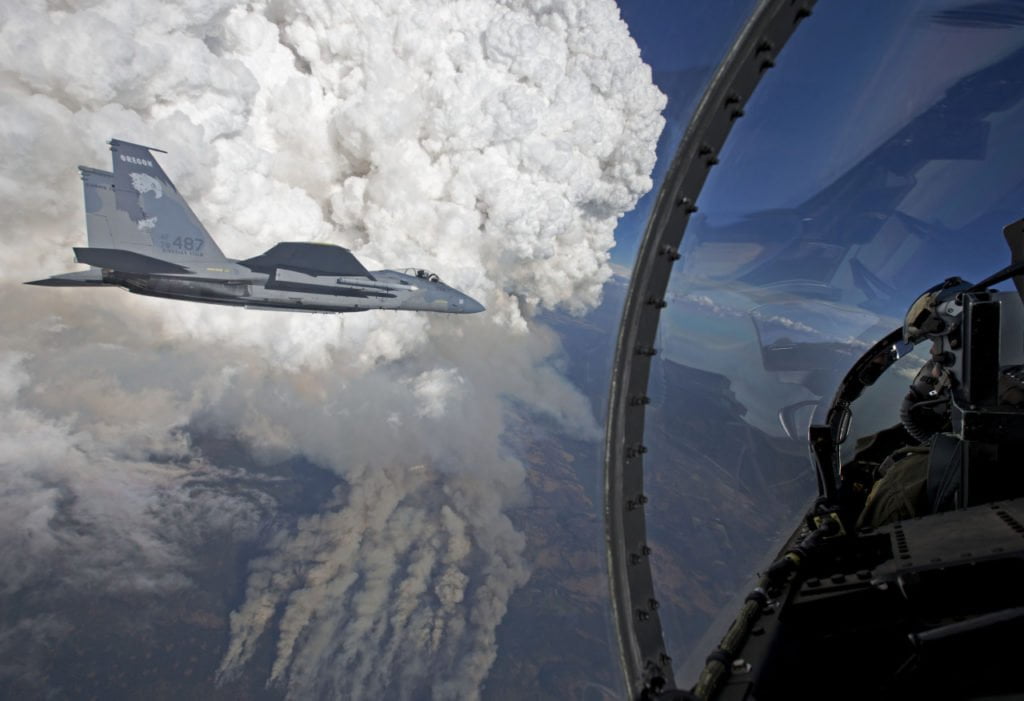
Pyrocumulus clouds tower tall above a wildfire in these photos taken last week from an Oregon National Guard F-15C. Most cumulus clouds form when the sun-warmed surface heats air, causing it to rise and carry moisture upward where it condenses to form clouds. In pyrocumulus clouds, the driving heat is supplied by a forest fire or volcanic eruption. The hot, rising air carries smoke and soot particles upward, where they become nucleation sites for condensation. Pyrocumulus clouds can be especially turbulent, and the gusting winds they produce can exacerbate wildfires. In some cases, the clouds can even develop into a pyrocumulonimbus thunderstorm with rain and lightning. (Photo credit: J. Haseltine; via NASA Earth Observatory)

Tip Vortex
Smoke released from the end of a test blade shows the helical pattern of a tip vortex from a horizontal-axis wind turbine. Like airplane wings, wind turbine blades generate a vortex in their wake, and the vortices from each blade can interact downstream as seen in this video. These intricate wakes complicate wind turbine placement for wind farms. A turbine located downstream of one of its fellows not only has a decreased power output but also has higher fatigue loads than the upstream neighbor. In other words, the downstream turbine produces less power and will wear out sooner. Researchers visualize, measure, and simulate turbine wakes and their interactions to find ways of maximizing the wind power generated. (Photo credit: National Renewable Energy Laboratory)

Brazuca
Since 2006, Adidas has unveiled a new football design for each FIFA World Cup. This year’s ball, the Brazuca, is the first 6-panel ball and features glued panels instead of stitched ones. It also has a grippy surface covered in tiny nubs. Wind tunnel tests indicate the Brazuca experiences less drag than other recent low-panel-number footballs as well as less drag than a conventional 32-panel ball. Its stability and trajectory in flight are also more similar to a conventional ball than other recent World Cup balls, particularly the infamous Jabulani of the 2010 World Cup. The Brazuca’s similar flight performance relative to a conventional ball is likely due to its rough surface. Like the many stitched seams of a conventional football, the nubs on the Brazuca help trip flow around the ball to turbulence, much like dimples on a golf ball. Because the roughness is uniformly distributed, this transition is likely to happen simultaneously on all sides of the ball. Contrast this with a smooth, 8-panel football like the Jabulani; with fewer seams to trip flow on the ball, transition is uneven, causing a pressure imbalance across the ball that makes it change its trajectory. For more, be sure to check out the Brazuca articles at National Geographic and Popular Mechanics, as well as the original research article. (Photo credit: D. Karmann; research credit: S. Hong and T. Asai)