Search results for: “shock wave”

  • Microscale Kelvin-Helmholtz

    Microscale Kelvin-Helmholtz

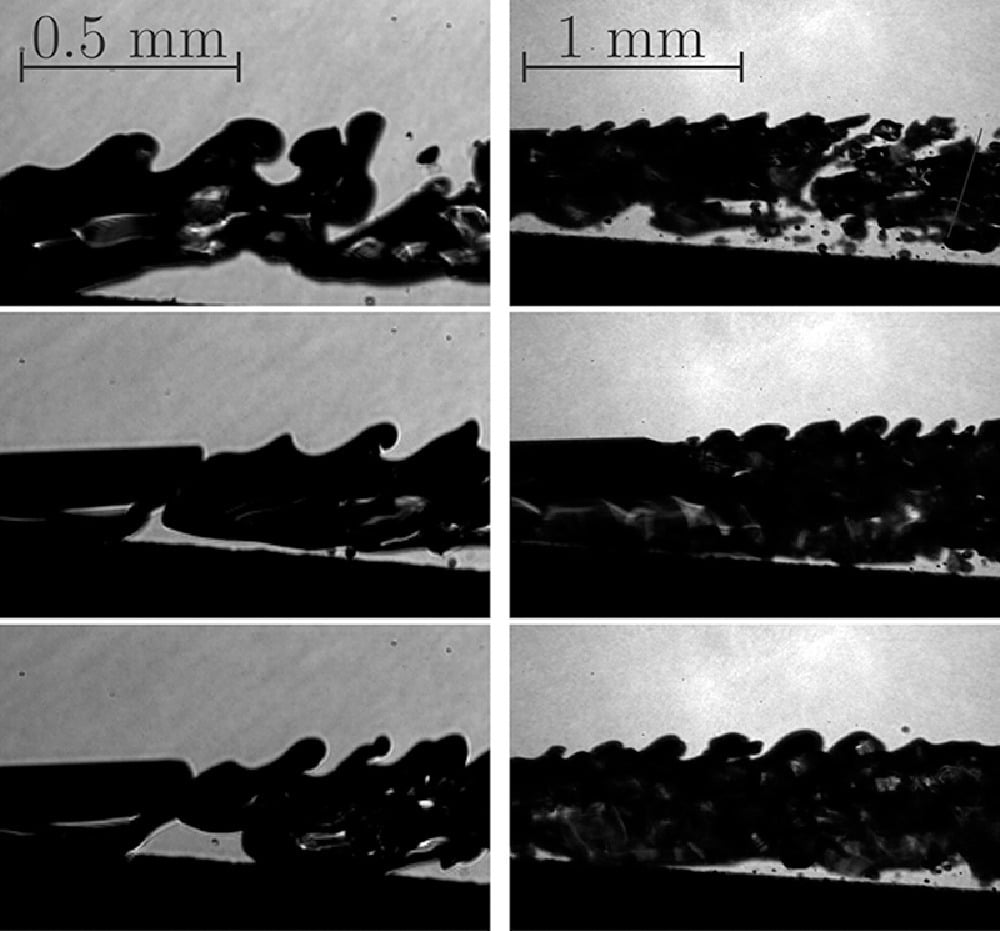
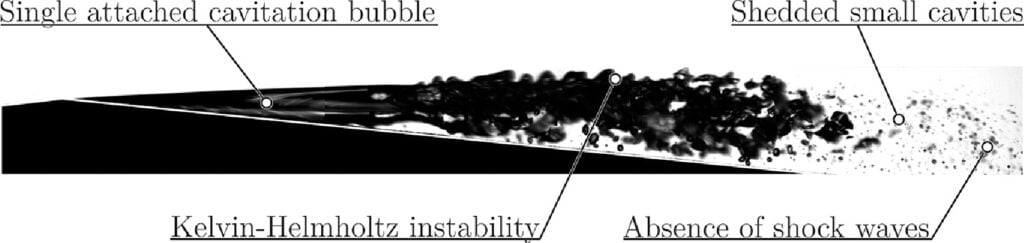
    When we think of cavitation in a flow, we often think of it occurring at a relatively large scale — on the propeller of a boat, for example. But cavitation takes place on microscales, too, including around fuel-injection nozzles. In this study, researchers investigated submillimeter-scale cavitation using a flow through a tiny Venturi tube. What they found was something we usually associate with larger scale flows: the Kelvin-Helmholtz instability.

    The Kelvin-Helmholtz instability takes place on this cavitation bubble.

    The wavy shape of a Kelvin-Helmholtz instability forms when two layers of fluid move past one another at different speeds and the interface where they meet becomes unstable. Here, that happens along a cavitation bubble, where the bubble and the flow meet. Interestingly, at these scales, the Kelvin-Helmholtz instability seems to be the primary method of break-up, instead of shock wave interactions.

    For those keeping track, we’ve now seen the Kelvin-Helmholtz instability from the quantum scale up to 160 thousand light-years. It’s hard to achieve a much wider range than that! (Image and research credit: D. Podbevšek et al.; submitted by M. Dular)

  • Sonic Booms and Urban Canyons

    Sonic Booms and Urban Canyons

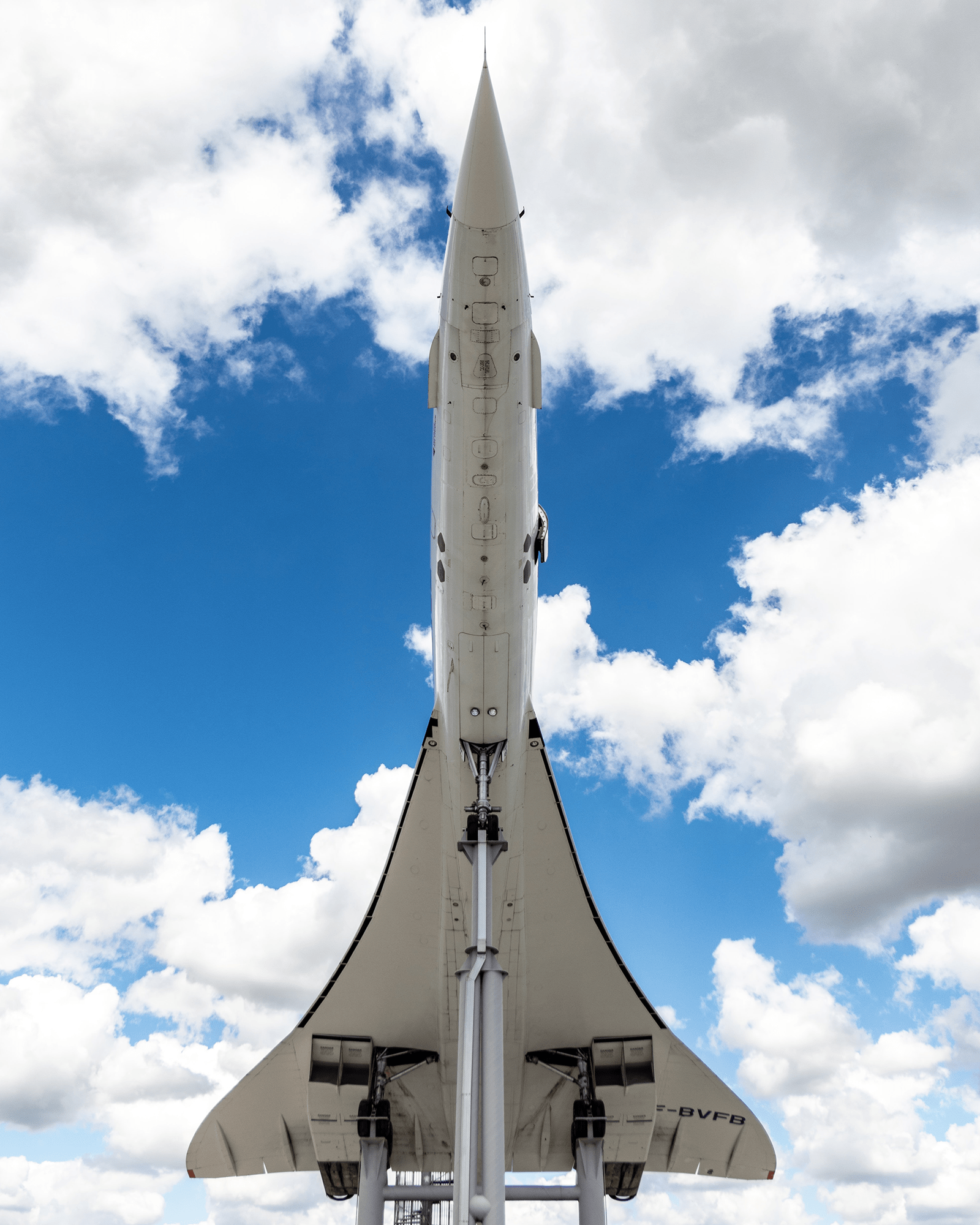
    In the days of the Concorde — thus far the world’s only supersonic passenger jet — noise complaints from residents kept the aircraft from faster-than-sound travel except over the open ocean. With many pursuing a new generation of civil supersonic aircraft, researchers are looking at how those sonic booms could interact with those of us on the ground.

    In this study, researchers simulated the shock waves from aircraft interacting with single and multiple buildings on the ground. They found that the presence of a building increases the perceived sound level of the boom by about 7 dB at the most. But the most interesting results are what happens between multiple buildings.

    If the street between buildings is wide enough, they each act independently, as if they were single buildings. But for narrower streets, the acoustics waves reflect and diffract between the buildings, creating a resonance that makes the acoustic echoes last longer. The effect is especially pronounced for a sonic boom traveling across a series of buildings, which mimics the layout of a dense city full of urban canyons. (Image credit: Concorde – M. Rochette, simulation – D. Dragna et al.; research credit: D. Dragna et al.)

    Acoustic waves reflect and propagate through 2D urban canyons with widths of 10 meters (top), 20 meters (middle), and 30 meters (bottom).
    Acoustic waves reflect and propagate through 2D urban canyons with widths of 10 meters (top), 20 meters (middle), and 30 meters (bottom).
  • Dripping Impact

    Dripping Impact

    How does water drip, drip, dripping onto stones erode a crater? Water is so much more deformable that it seems impossible for it to wear harder materials away, even over thousands of impacts. To investigate this, a team of researchers developed a new measurement technique: high-speed stress microscopy. In the process, they found that water owes its incredible erosive power to three factors: 1) The drop’s impact creates surface shock waves along the material, which helps increase erosive power; 2) After the shock wave passes, a decompression wave in the material helps loosen surface matter; and 3) The spreading drop sends a non-uniform wave of stress across the material that simultaneously presses and scrubs at the surface. Together, these factors enable simple, repetitive droplet impacts to wear away at hard surfaces. (Image credit: cottonbro; research credit: T. Sun et al.; via Cosmos; submitted by Kam-Yung Soh)

  • Deciphering Krakatau

    Deciphering Krakatau

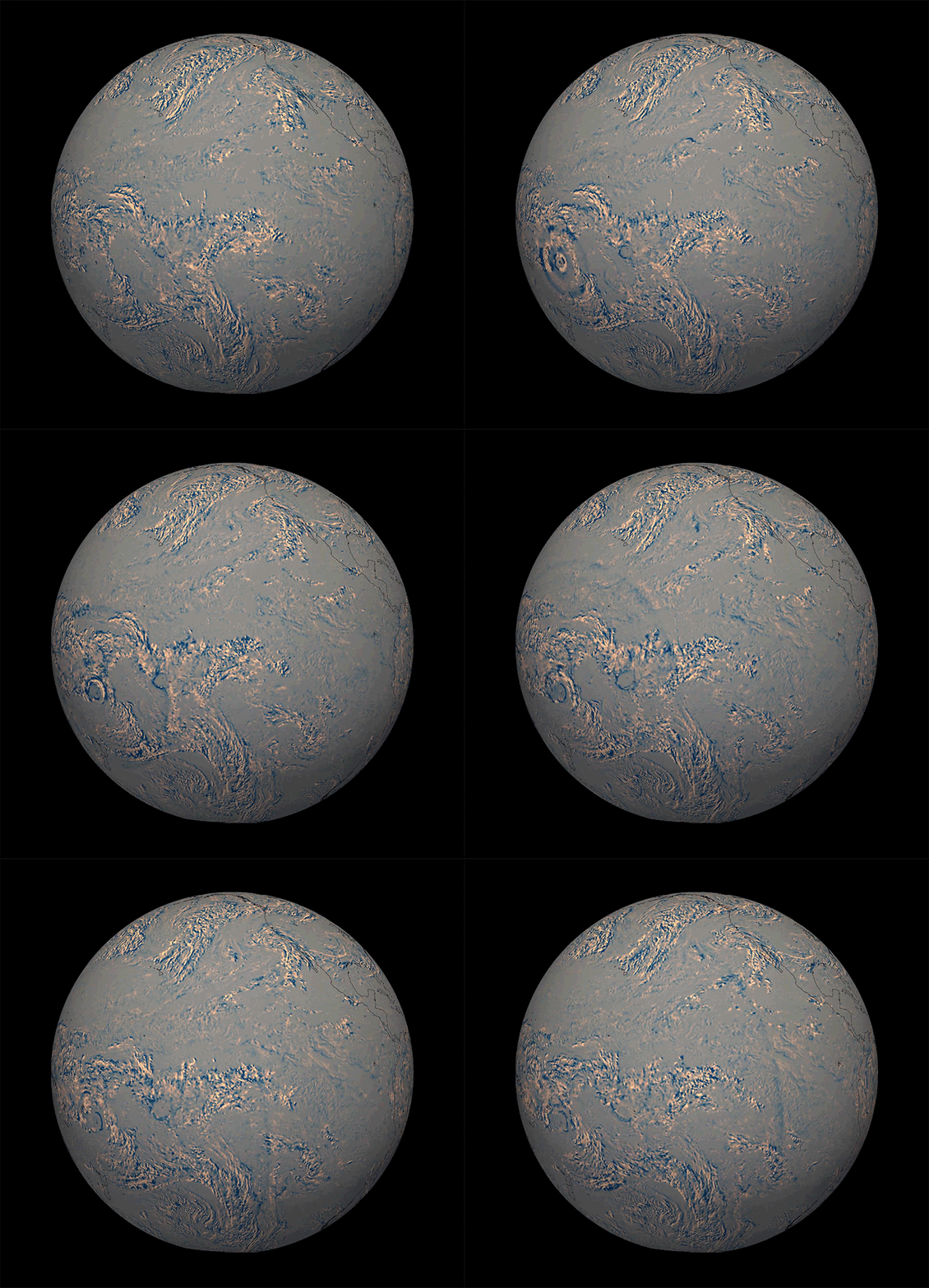
    In 1883, the eruption of Krakatau (also called Krakatoa) shook the world, sending shock waves and tsunamis ricocheting across the globe. Some of the smaller waves hit shorelines in the Atlantic and Pacific that were entire continents and ocean basins away from the original explosion. At the time, scientists were so perplexed by the phenomenon that they blamed coincidental earthquakes for the wave action.

    Only when Tonga experienced a similarly devastating volcanic eruption earlier this year were scientists able to verify what they’d long suspected: these smaller tsunamis were not caused by solid material displacing water; instead they are the result of atmospheric pressure waves coupling to the ocean. Follow the full story over at Quanta. (Image credit: M. Barlow; via Quanta; submitted by Kam-Yung Soh)

  • Featured Video Play Icon

    Cavitation-Induced Microjets

    In cavitation, tiny bubbles of vapor form and collapse in a liquid, often sending shock waves ricocheting. In most occurrences beyond the lab, cavitation bubbles aren’t a solo act; many bubbles can form and interact. This video takes a look at some of the effects of those interactions. When close together, two cavitation bubbles can act to focus the flow during collapse, generating a microjet strong enough to penetrate into nearby surfaces. Researchers hope this technique may one day be used for needle-free injections. (Image, video, and submission credit: A. Mishra et al.)

  • Witch’s Broom

    Witch’s Broom

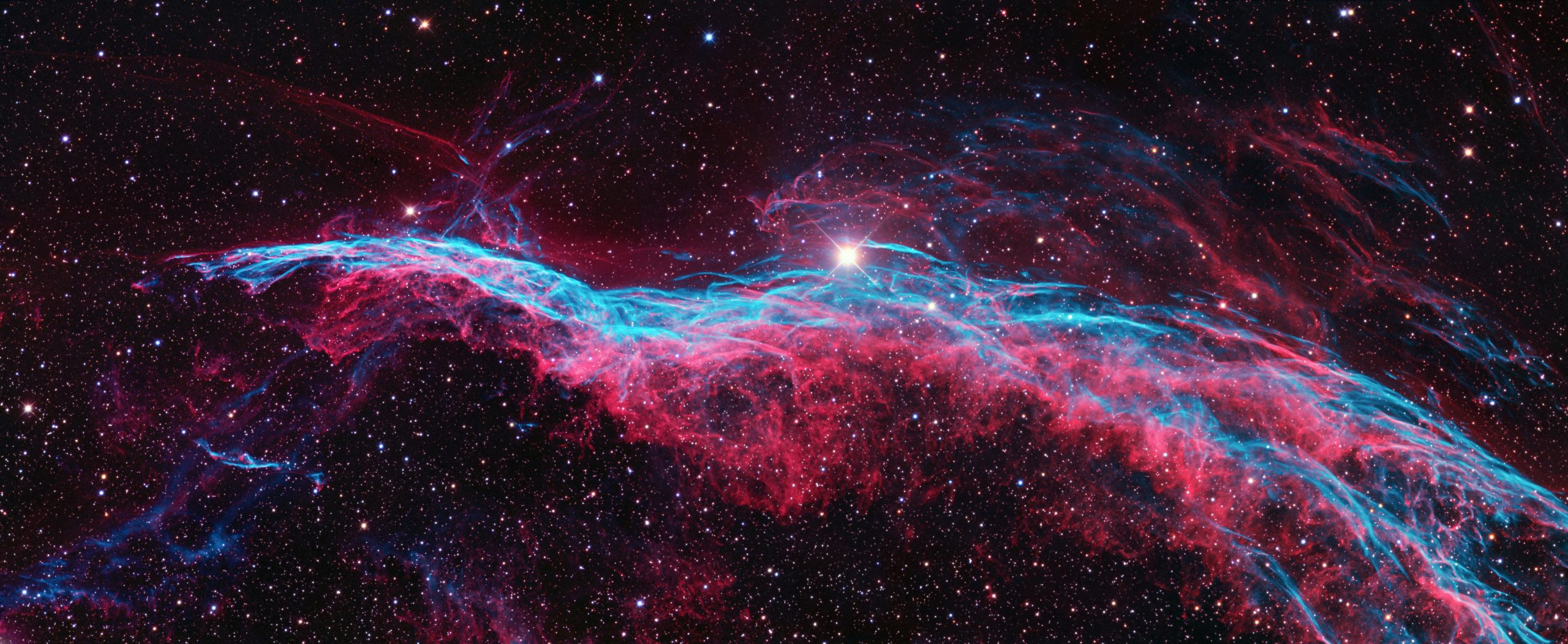
    Known by many names — including the Witch’s Broom Nebula — NGC 6960 is part of a supernova remnant visible in the constellation Cygnus. The wisp-like filaments of the nebula are shock waves moving through the cloud of dust and ionized gas. Based on observations using the Hubble Space Telescope, the nebula is expanding at around 1.5 million kilometers per hour. When the original supernova exploded thousands of years ago, astrophysicists estimate it would have been bright enough to see during daytime! (Image credit: K. Crawford)

  • Featured Video Play Icon

    Underwater Explosions and Submarines

    In the early days of submarines, it did not take physicists and engineers long to discover how destructive underwater explosions can be. In this Slow Mo Guys video, Gav gives us a glimpse of that destruction using a model submarine in a fish tank and several small explosives. You’ll have to be quick to notice the initial shock waves that ripple through the tank, but the footage captures spectacular detail on some of the slower-moving phenomena. You can see the uneven ripples of the explosion bubble’s surface as it expands. There are some great shots from the front and side showing the bubbly vortex ring that forms when the explosion hits the side of the tank wall (something that wouldn’t happen out in the ocean, of course). You can even catch a glimpse of some unexploded powder streaking out of the explosion. (Image and video credit: The Slow Mo Guys)

  • Featured Video Play Icon

    Breaking Bubbles

    What do a nineteenth-century war ship, a sardine-hunting shark, and a viral bottle trick have in common? Cavitation! The phenomenon of cavitation occurs when a fluid is accelerated such that its local pressure drops below the vapor pressure. As a result, bubbles form and then violently collapse, creating shock waves that can damage nearby surfaces or stun prey. Dianna explains — and reveals some cool historical context that was new to me! — in the video above. (Image and video credit: Physics Girl)

  • Understanding Stars’ Seismology

    Understanding Stars’ Seismology

    Our understanding of Earth’s interior is based mostly on observations of seismic waves, which travel differently through our rocky crust and the molten core. Scientists similarly use seismic waves in stars to determine their interiors. But the pressure and temperature conditions in stars are far beyond anything we have here on Earth, which makes predicting how waves will travel in such exotic material difficult.

    To better understand these extreme temperatures and pressures, scientists are using Lawrence Livermore’s National Ignition Facility (NIF) to mimic conditions similar to the outer envelope of a white dwarf star, like the one shown in the center of the image above. NIF’s laser array – shown as the blue lines in the artist’s conception above – can generate spherical shock waves that, as they converge on a solid sample, create pressures as high as 450 Mbar, more than 400 million times sea level atmospheric pressure here on Earth. Although the shock wave takes only 9 ns to travel across the sample, it’s enough to give researchers a glimpse into star-like conditions. (Image credit: NASA/ESA/C. O’Dell/D. Thompson, Lawrence Livermore National Laboratory; via Physics Today)

  • Cavitation Through Acceleration

    Cavitation Through Acceleration

    Cavitation refers to the formation of destructive bubbles of vapor within a liquid. Traditionally, we think of it as occurring when the velocity in a flow becomes high enough for the pressure to drop below the local vapor pressure, causing bubbles to form. This is what we see around turbine blades and ship propellers.

    But cavitation also occurs in situations where the overall velocity is relatively low, provided there’s a sudden acceleration. That’s the situation we see above. The impact — either of a mallet off-screen or of the tube striking the floor — causes the liquid inside suddenly accelerate upward. Notice in the second image how the liquid interface moves upward as the first bubbles form.

    Each of these cavitation bubbles has such a low pressure that they’re basically a vacuum, and their collapse can cause shock waves that reverberate through the container, causing it to break. Check out that test tube in the last image. Notice that there’s no sign of cracking when the test tube hits the floor; in fact, the researchers demonstrate in their paper that an empty test tube dropped from the same height doesn’t break. Fractures only form after the cavitation bubbles do. (Image and research credit: Z. Pan et al.; submitted by A.J.F.)