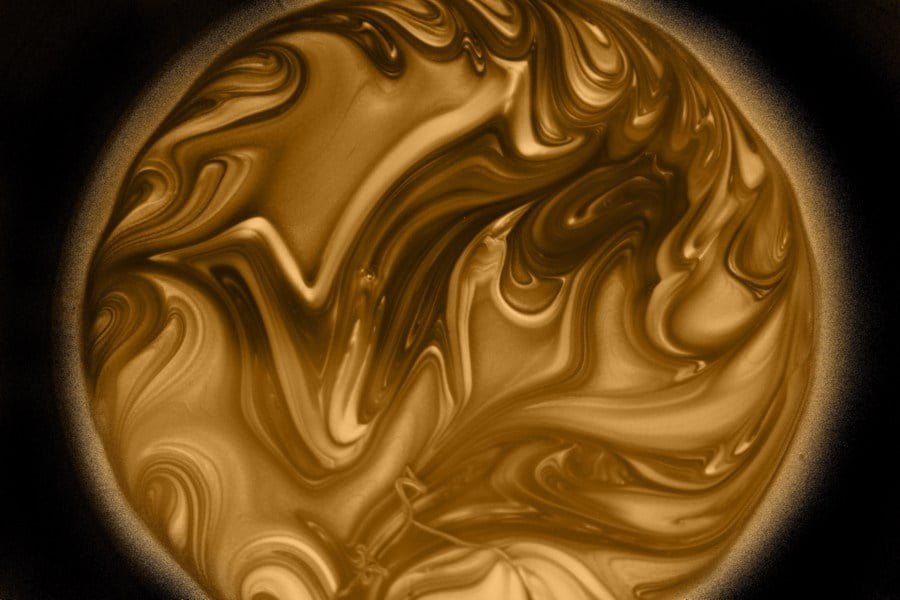
As much as I love exploring flashy examples of fluid dynamics, like shock waves around aircraft or what happens when non-Newtonain fluids get crushed by a hydraulic press, my favorite moments are the simple, everyday ones. Getting to see fluid dynamics in my daily life, whether I’m standing in the kitchen cooking or trying to wash my hands, is what excites me the most. The photo above is an example of this kind of simple, satisfying fluid experience. The image shows wax being melted in a crockpot. As it melts and its optical characteristics change, the wax reveals the mixing pattern inside the container. There’s nothing earth-shattering or scientifically important about something like this. But it’s still a moment where the otherwise unseen and unnoticed becomes visible and beautiful. It’s the fluid dynamical equivalent of stopping to smell the roses. When did you last pause to appreciate the flows around you? (Image credit: A. Unger et al.)
Search results for: “shock wave”

Exploding Meteors
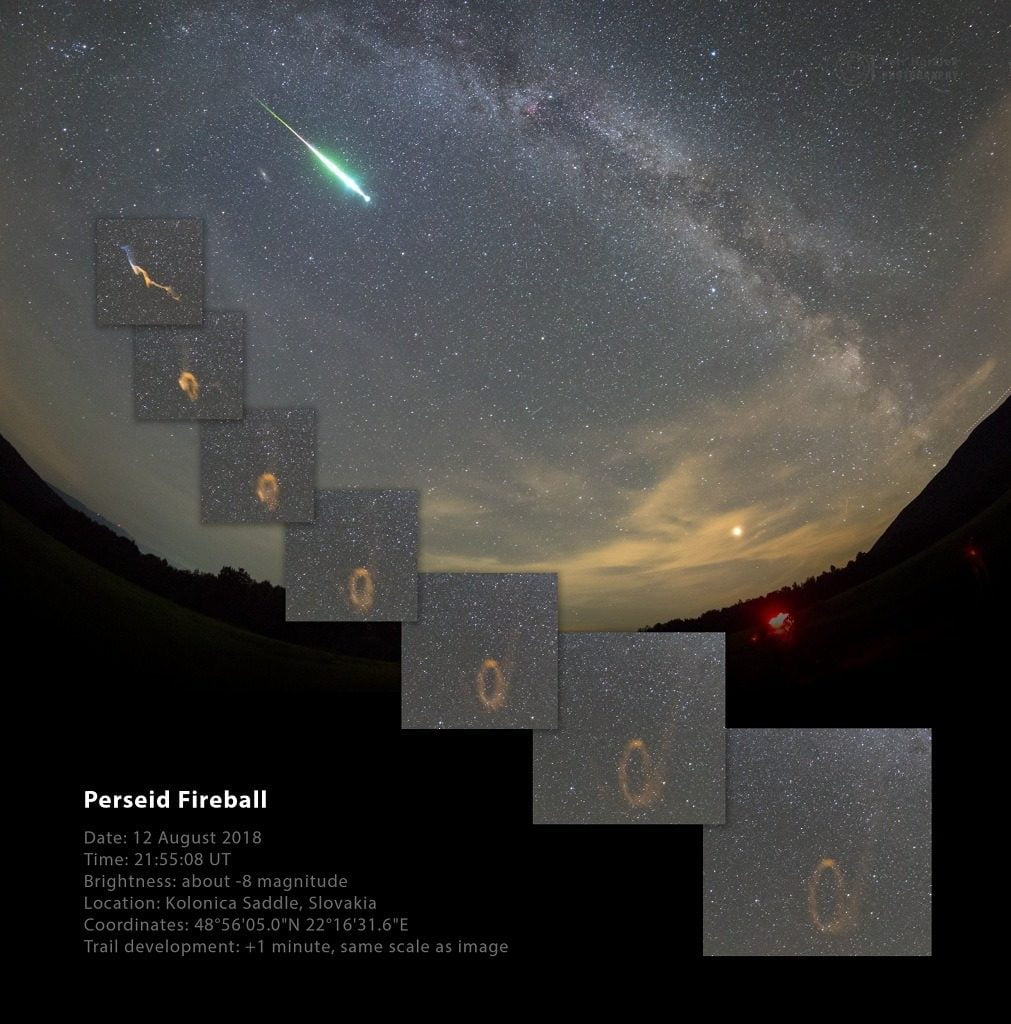

During the recent Perseid shower, photographer Petr Horálek caught an awesome timelapse of an exploding meteor and the vortex ring it created. This is a type of persistent train left when meteors pass through the upper atmosphere. The exact physics are not well understood because such events are difficult to observe; catching them at all is basically just happenstance. But one interpretation is that we’re seeing trails of plasma left by the ionization of parts of the meteor. When the meteor hits the upper atmosphere, there’s an extremely strong hypersonic shock wave. The jump in temperature across that shock wave is enough to pull atoms apart, creating a plasma. The train left by this meteor’s demise was faintly visible even an hour after the fireball. (Image credit: P. Horálek, video version; via APOD; submitted by Andrea S.)

Inside a Bubble Wall
Schlieren photography has an almost magical feeling to it because it enables us to see the invisible – like shock waves and the tiny currents of heat that rise from our skin. But it can also reveal new perspectives on things that aren’t invisible. Here we see soap bubbles viewed through the lens of a schlieren set-up. Schlieren is sensitive to small changes in density, so instead of appearing in their usual rainbow iridescence, the bubbles look glass-like and filled with tiny currents and bubbles. What we’re seeing are some of the many tiny flow variations across the surface of a soap bubble. They’re driven by a combination of forces – gravity, temperature, and surface tension variations, to name a few. Seen in video, you can really appreciate just how dynamic a thin soap film is! (Image credit and submission: L. Gledhill, video version, more stills)
Heating from Cavitation
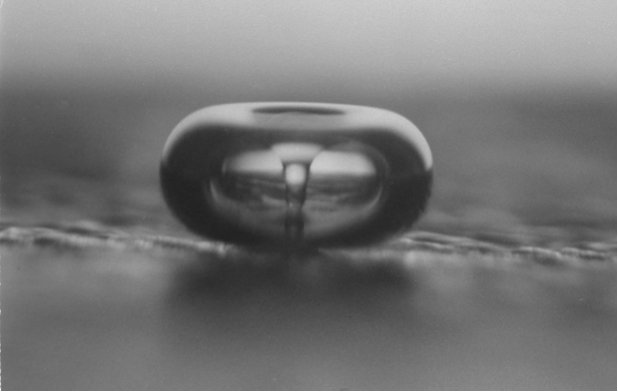
When cavitation bubbles collapse, they can produce temperatures well over 2,000 Kelvin. Since cavitation near a surface can be so destructive, researchers have long wondered whether the high temperatures inside the bubble can be transmitted to nearby surfaces. A new set of numerical simulations provides some insight into that process. The researchers found that collapsing cavitation bubbles raised nearby wall temperatures in two ways: bubbles that were further away sent shock waves that heated the material, and nearby bubbles could contact the surface itself as they collapsed.
Heat transfer requires time, however; this is part of why quickly dunking your hand in liquid nitrogen and pulling it out likely won’t damage you. (Still, we don’t recommend it.) The cavitation bubbles could only transmit these high temperatures for less than 1 microsecond, which means that most materials won’t actually heat up to their melting temperature. The researchers did conclude, however, that softer materials exposed to frequent bubble collapses could show localized melting under the barrage. (Image credit: L. Krum; research credit: S. Beig et al.)

Meteoroids
Meteoroids are debris from earlier eras in our solar system. They can be leftovers from planets that never formed or remains of ancient collisions. When these bits rock and metal enter our atmosphere, they become meteors. Since they travel at speeds of several kilometers per second, they create incredibly strong shock waves off their bow once they’re in the atmosphere. These shock waves are so strong that they rip the air molecules apart and create a hot plasma that can scorch the outside of the meteor. That plasma also glows, which is why meteors look like a streak of light from the ground. Any remains that make it to the ground are known as meteorites, and they have some pretty awesome features. Check out the full Brain Scoop episode below to learn some of the typical (and not so typical!) characteristics of meteorites. (Image and video credit: The Brain Scoop/Field Museum)

Craters and Rays
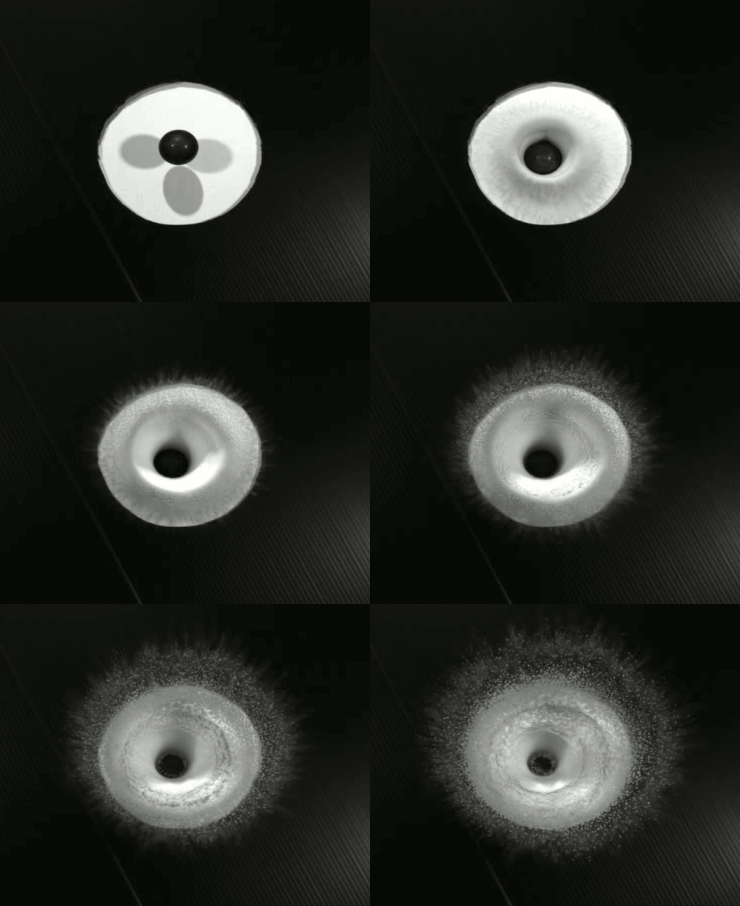
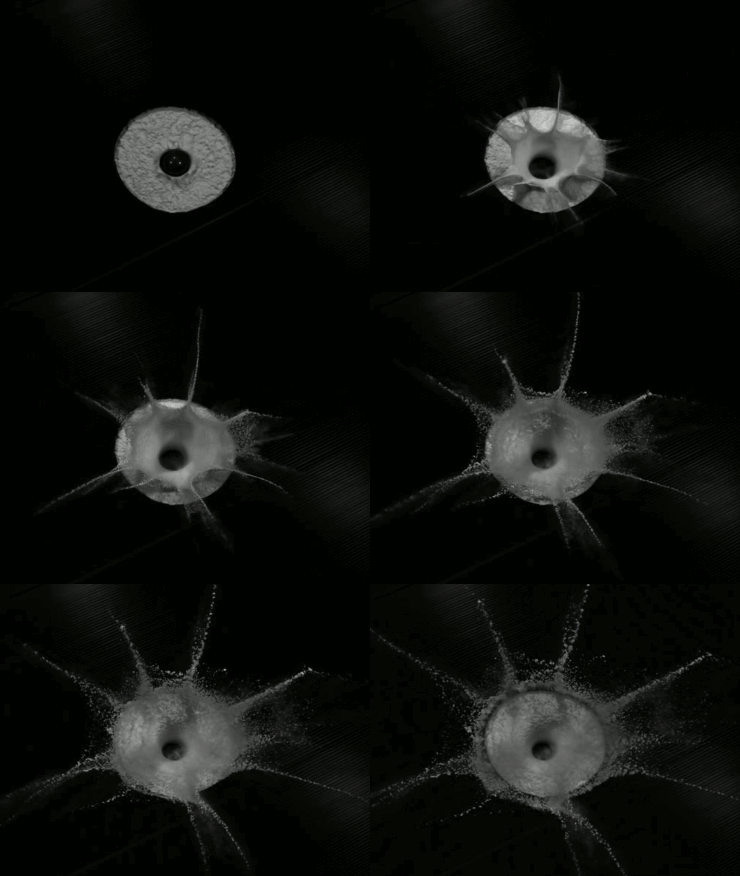

The history of our solar system is written in impact craters, but these craters have been remarkably mysterious for years. Scientists knew that you could recreate many of their features by dropping solid objects into granular materials like sand, but this did not produce the distinctive rays that we see around many real craters (bottom image, Mars). It was only by watching videos of schoolchildren recreating these experiments that scientists discovered what they’d been doing wrong: they’d smoothed the sand’s surface first.
It turns out that when you smooth the sand before impact (top left), you get an even ejecta curtain with no rays. But when the surface is uneven, as it is in kids’ experiments or on actual planetary bodies, suddenly rays form (top right). The object’s impact creates a shock wave in the granular medium, which becomes a rarefaction (i.e., expansion) wave when it reaches the surface. This is what actually ejects material. The uneven surface focuses those rarefaction waves, creating the distinctive ejecta rays. (Image credit: T. Sabawala et al., source; NASA; research credit: T. Sabawala et al.; via Jennifer O.)

The Catherine Wheel
When particles of different sizes fall in an avalanche, they separate out by size. Smaller particles form one layer with another layer of larger particles over the top. This happens because the smaller particles tend to fall in between the larger ones, similar to the percolation theory in the Brazil nut effect. In a slowly rotating drum, this size segregation during an avalanche forms a distinctive pattern (above) called a Catherine wheel pattern. Here, the gray layers form from smaller iron particles, while the white layers are large particles of sugar. Notice that the pattern starts to form during each avalanche, but it freezes in place after grains pile up against the drum wall and cause a shock wave to run back up the avalanche. (Image credit: J. Gray and V. Chugunov, reprinted in J. Gray, source)

Visualizing Acoustic Levitation
The schlieren photographic technique is often used to visualize shock waves and other strong but invisible flows. But a sensitive set-up can show much weaker changes in density and pressure. Here, schlieren is used to show the standing sound wave used in ultrasonic levitation. By placing the glass plate at precisely the right distance relative to a speaker, you can reflect the sound wave back on itself in a standing wave, seen here as light and dark bands. The light bands mark the high-pressure nodes, where the pressure generated by the sound waves is large enough to counteract the force of gravity on small styrofoam balls. This allows them to levitate but only in the thin bands seen in the schlieren. Move the plate and the standing wave will be disrupted, causing the bands to fade out and the balls to fall. (Video and image credit: Harvard Natural Sciences Lecture Demonstrations)
Space Shuttle Sonic Booms
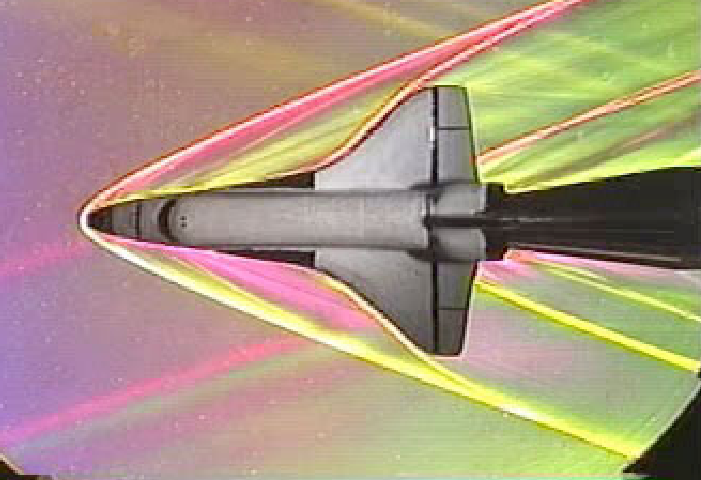
The Space Shuttle had a famous double sonic boom when passing overhead during re-entry. This schlieren flow visualization of a model shuttle at Mach 3 reveals the source of the sound: the fore and aft shock waves on the vehicle. The nose of the shuttle generates the strongest shock wave since it is the first part of the vehicle the flow interacts with. This initial shock wave turns the flow outward and around the shuttle. The second boom comes from the back of the shuttle and serves to turn the flow back in to fill the wake behind the shuttle. (The actual shock wave would look a little different than this one because there’s no sting holding the shuttle like there is with the model.) The other major shock wave comes from the shuttle’s wings, but, at least for this Mach number, the wing shock wave merges with the bow shock, making the two indistinguishable. (Image credit: G. Settles, source)

Cavitating Inside a Tube
Cavitation – the formation and collapse of low-pressure bubbles in a liquid – can be highly destructive, shattering containers, stunning prey, and damaging machinery. Inside an enclosure, cavitation can happen repeatedly. Above, a spark is used to generate an initial cavitation bubble, which expands on the right side of the screen. After its maximum expansion, the bubble collapses, forming jets on either end that collide as the bubble shrinks. Shock waves form during the collapse, too, although in this case, they are not visible.
Those shock waves travel to either end of the tube, where they reflect. The reflected waves behave differently; they are now expansion waves rather than shock waves. Their passage causes lower pressure. The two expansion waves meet one another toward the left end of the tube, in the area where a cloud of secondary cavitation bubbles form after the first bubble collapses. Pressure waves continue to reflect back and forth in the tube, causing the leftover clouds of tiny bubbles to expand and contract. (Image credit: C. Ji et al., source)
