Search results for: “shock wave”

  • “Transient 2”

    “Transient 2”

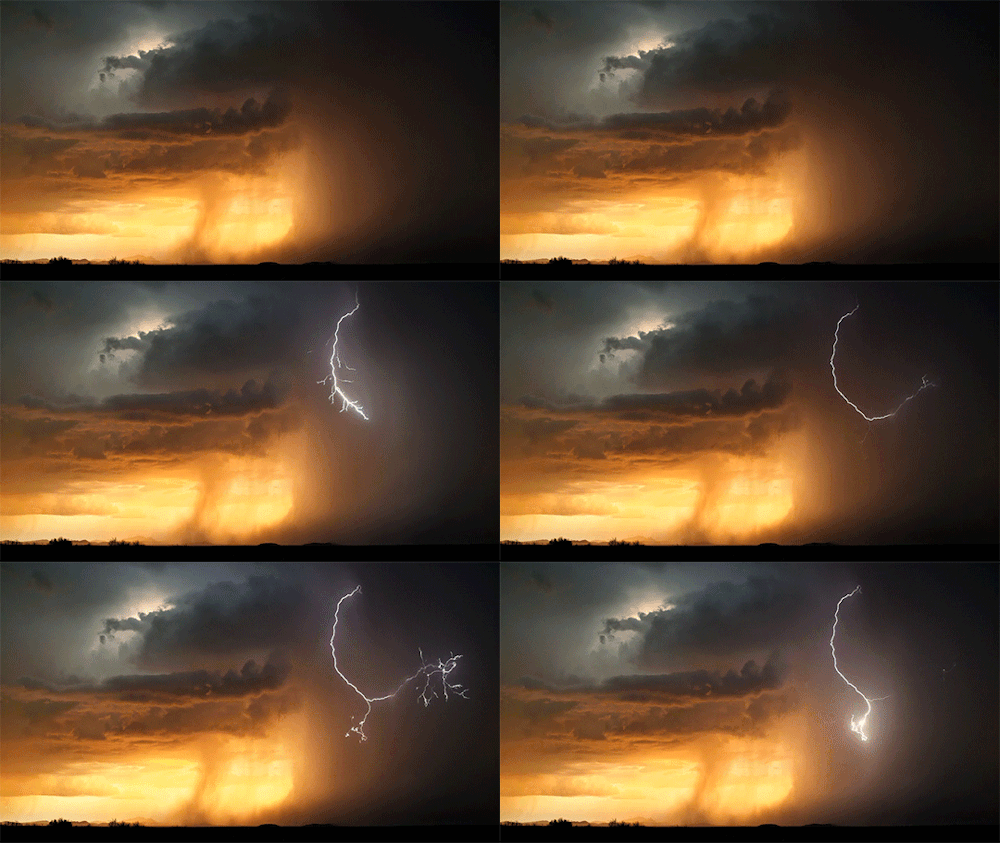
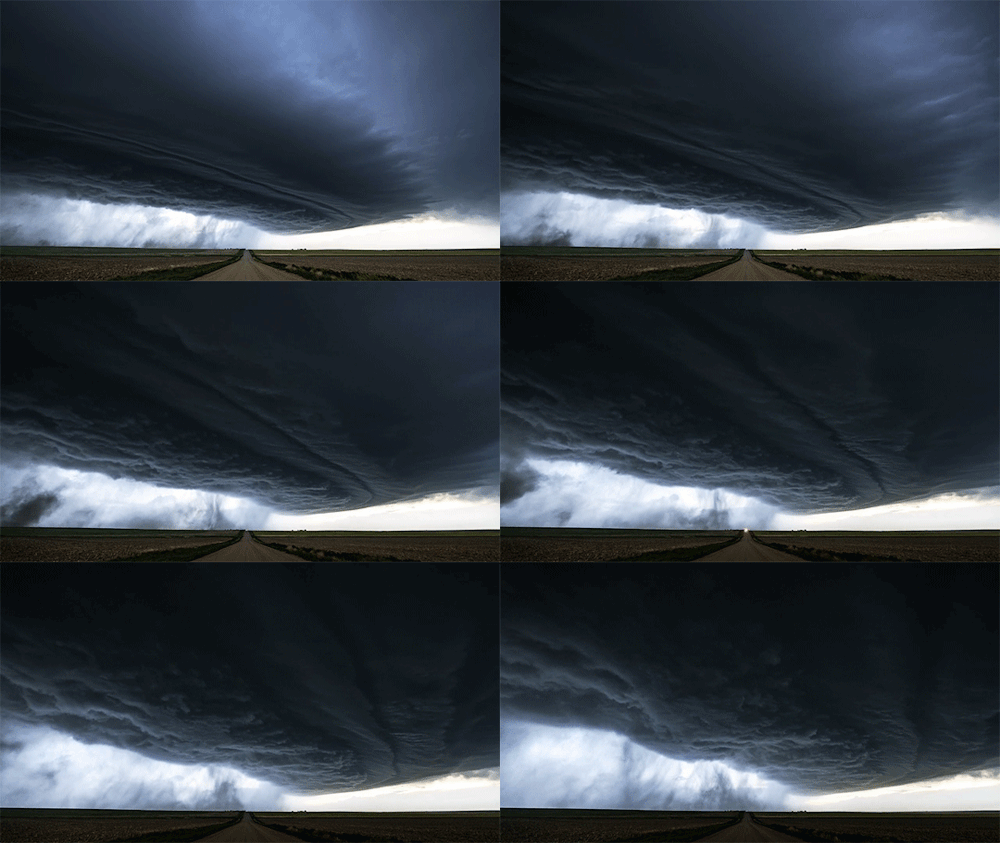
    Where cold and warm air meet, our atmosphere churns with energy. From the turbulence of supercell thunderclouds to the immense electrical discharge of lightning, there’s much that’s breathtaking about stormy skies. Photographer Dustin Farrell explores them, with a special emphasis on lightning, in his short film, “Transient 2″. 

    As seen in high-speed video, lightning strikes begin with tree-like leaders that split and spread, searching out the path of least resistance. Once that line from cloud to ground is discovered, electrons flow along a plasma channel that arcs from sky to earth. The estimated temperatures in the core of this plasma reach 50,000 Kelvin, far hotter than the Sun’s surface. It’s this heating that generates the blue-white glow of a lightning bolt. The heating also expands the air nearby explosively, producing the shock wave we hear as a crash of thunder. (Images and video credit: D. Farrell et al.; via Colossal)

  • Galileo’s Descent

    Galileo’s Descent

    In December 1995, the Galileo probe made its dramatic descent into Jupiter’s atmosphere at a velocity of more than 47 km/s. In 30 seconds, it decelerated from Mach 50 to Mach 1, undergoing incredible heating as it did so. Anytime an object moves through a fluid faster than the local speed of sound, it creates a leading shock wave that compresses the fluid, heats it, and redirects it around the object. The faster the speed, the hotter the fluid will be after passing through the shock wave. 

    Above about five times the speed of sound, the heating effect is so strong that it’s able to rip molecules apart, creating a chemically reactive mixture that will ablate away material from the object. For this reason, Galileo and other planetary entry vehicles carry heat shields made to sacrifice themselves while protecting the cargo and (in some cases) crew onboard. Data from Galileo showed that, although the heat shield survived the brunt of its descent, it experienced worse conditions than expected. Near the heat shield’s shoulder, almost all of its material ablated away. 

    Scientists continue to study Galileo’s descent even now, using it to test and inform their models of the flow and chemistry that occurs at these hypersonic speeds. The better we can understand and predict these flows, the better our designs will become. Mass that’s currently spent on overly-conservative heat shields can instead go toward additional instruments or supplies. (Image credit: Chop Shop Studio; research credit: L. Santos Fernandes et al.; via AIP)

  • Featured Video Play Icon

    Why Do Backwards Wings Exist?

    Over the years, there have been many odd airplane designs, but one you probably haven’t seen much is the forward-swept wing. While most early aircraft featured straight wings, rear-swept wings are fairly common today, especially among commercial airliners. A rear-swept wing has its forward-most point at the root of the ring, where it attaches to the fuselage. The sweep breaks up the incoming flow into a chordwise component that flows from the leading edge to the trailing edge of the wing and a spanwise component that flows along the wing. Compared to straight wings, a swept wing provides better stability and control when flying at transonic speeds where shock waves can form on the wing (even though the plane itself is not supersonic).

    The trouble with rear-swept wings is that when they stall, they do so from the wingtips inward. Since the ailerons that control the plane’s orientation are out near the wingtips, that’s a problem. Forward-swept wings were supposed to solve this issue because they would stall from the root outward. But they came with a whole new set of problems, which included the need for robust onboard computers controlling them constantly to keep them in stable flight. In the end, the disadvantages outweighed any gains and so, for the most part, the forward-swept wing design has seen little flight time. (Image and video credit: Real Engineering)

  • Cavitation Collapse

    Cavitation Collapse

    The collapse of a bubble underwater doesn’t seem like a very important matter, but when it happens near a solid surface, like part of a ship, it can be incredibly destructive. This video, featuring numerical simulations of the bubble’s collapse, shows why. 

    When near a surface, the bubble’s collapse is asymmetric, and this asymmetry creates a powerful jet that pushes through the bubble and impacts the opposite side. That impact generates a shock wave that travels out toward the wall. As the bubble hits its minimum volume, a second shock front is generated. Both shock waves travel toward the wall and reflect off it, generating high pressure all along the surface. (Image and video credit: S. Beig and E. Johnson)

  • Jets from Lasers

    Jets from Lasers

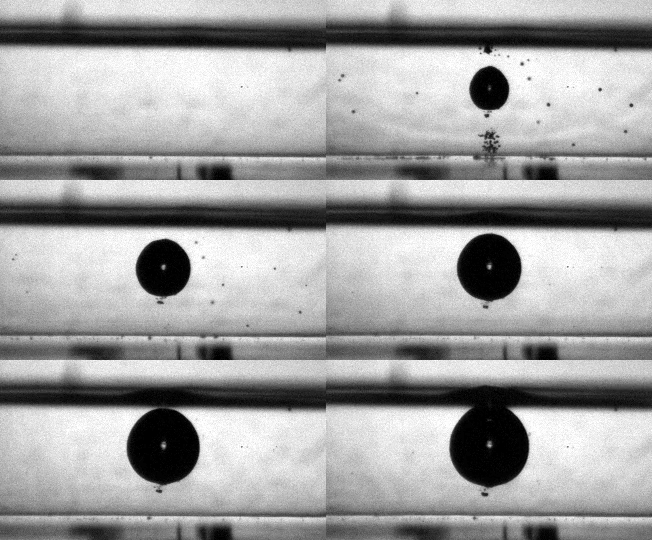
    Laser-induced forward transfer (LIFT) is an industrial printing technique where a laser pulse aimed at a thin layer of ink creates a tiny jet that deposits the ink on a surface. In practice, the technique is plagued with reproducibility issues, in part because it’s difficult to produce only a single cavitation bubble when aiming a laser at the liquid layer. This is what we see above. 

    The laser pulse creates its initial bubble just above the middle of the liquid layer. Shock waves expand from that first bubble and quickly reflect off the liquid surface (top) and wall (bottom). When reflected, the shock waves become rarefaction waves, which reduce the pressure rather than increasing it. This helps trigger the clouds of tiny bubbles we see above and below the main bubble. 

    The effect is worst along the path of the laser pulse because that part of the liquid has been weakened by pre-heating, but impurities and dissolved gases in the liquid layer are also prone to bubble formation, as seen far from the bubble. The trouble with all these unintended bubbles is that they can easily rise to the surface, burst, and cause additional jets of ink that splatter where users don’t intend. (Image and research credit: M. Jalaal et al.; submitted by Maziyar J.)

  • Astrophysical Turbulence

    Astrophysical Turbulence

    Subsonic turbulence – like the random and chaotic motions of air and water in our everyday lives – is something we have only a limited understanding of. Our knowledge of supersonic turbulence, where shock waves and compressibility rule, is even more tenuous. In part this is because, although we can observe snapshots of supersonic turbulence in astronomical settings like the Orion Nebula shown above, we cannot watch it evolve. On these scales, features simply don’t change appreciably on human timescales.

    This has limited scientists to mostly numerical and theoretical studies of supersonic turbulence, but that is starting to change. Researchers are now building experimental set-ups that collide laser-driven plasma jets to generate boundary-free turbulence at Mach 6. Thus far, the observations are consistent with what’s been seen in nature: at low speeds, the turbulence is consistent with Kolmogorov’s theories, with energy cascading from large scales to smaller ones predictably. But as the Mach number increases, the nature of the turbulence shifts, moving toward the large density fluctuations seen in nebulae and other astrophysical realms. (Image credit: F. Battistella; research credit: T. White et al.; see also Nature Astronomy; submitted by Kam-Yung Soh)

  • Noisy Jets

    Noisy Jets

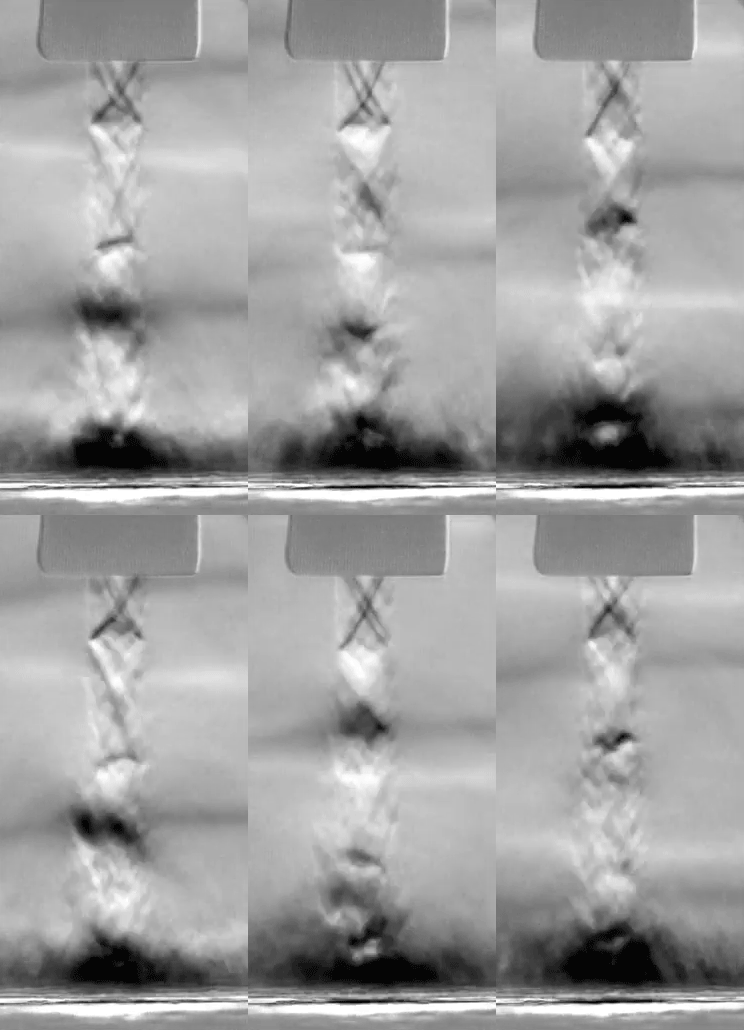
    One major problem that has plagued supersonic aircraft is their noise. The Concorde – thus far the only supersonic commercial airliner – was plagued with noise complaints that ultimately restricted its usability. Noise reduction is a major area of inquiry in aerospace, and the video below shows one experiment trying to understand the connections between supersonic flow and noise.

    Above you see a supersonic, Mach 1.5 microjet emanating from a nozzle at the top of the image. The jet is hitting a flat plate at the bottom of the image. Just beyond nozzle’s exit, you can see the X-shape of shock waves inside the jet. The position of that X is oscillating up and down.

    In the background, you can see horizontal light and dark lines traveling up and down. Those horizontal lines in the background are acoustic waves. When they hit the bottom plate, they reflect and travel upward until they hit another surface (outside the picture) and reflect back down. As they travel, they interact with the jet, causing those X-shaped shock waves to move up and down. This coupling between flow and acoustic waves makes the jet much louder – up to 140 dB – than it would be otherwise.

    Researchers hope that unraveling the physics of simpler systems like this one will help them quiet more complicated aircraft. (Image and video credit: F. Zigunov et al.)

  • A Golden Swirl

    A Golden Swirl

    As much as I love exploring flashy examples of fluid dynamics, like shock waves around aircraft or what happens when non-Newtonain fluids get crushed by a hydraulic press, my favorite moments are the simple, everyday ones. Getting to see fluid dynamics in my daily life, whether I’m standing in the kitchen cooking or trying to wash my hands, is what excites me the most. The photo above is an example of this kind of simple, satisfying fluid experience. The image shows wax being melted in a crockpot. As it melts and its optical characteristics change, the wax reveals the mixing pattern inside the container. There’s nothing earth-shattering or scientifically important about something like this. But it’s still a moment where the otherwise unseen and unnoticed becomes visible and beautiful. It’s the fluid dynamical equivalent of stopping to smell the roses. When did you last pause to appreciate the flows around you? (Image credit: A. Unger et al.)

  • Exploding Meteors

    Exploding Meteors

    During the recent Perseid shower, photographer Petr Horálek caught an awesome timelapse of an exploding meteor and the vortex ring it created. This is a type of persistent train left when meteors pass through the upper atmosphere. The exact physics are not well understood because such events are difficult to observe; catching them at all is basically just happenstance. But one interpretation is that we’re seeing trails of plasma left by the ionization of parts of the meteor. When the meteor hits the upper atmosphere, there’s an extremely strong hypersonic shock wave. The jump in temperature across that shock wave is enough to pull atoms apart, creating a plasma. The train left by this meteor’s demise was faintly visible even an hour after the fireball. (Image credit: P. Horálek, video version; via APOD; submitted by Andrea S.)

  • Inside a Bubble Wall

    Inside a Bubble Wall

    Schlieren photography has an almost magical feeling to it because it enables us to see the invisible – like shock waves and the tiny currents of heat that rise from our skin. But it can also reveal new perspectives on things that aren’t invisible. Here we see soap bubbles viewed through the lens of a schlieren set-up. Schlieren is sensitive to small changes in density, so instead of appearing in their usual rainbow iridescence, the bubbles look glass-like and filled with tiny currents and bubbles. What we’re seeing are some of the many tiny flow variations across the surface of a soap bubble. They’re driven by a combination of forces – gravity, temperature, and surface tension variations, to name a few. Seen in video, you can really appreciate just how dynamic a thin soap film is! (Image credit and submission: L. Gledhill, video version, more stills)