Search results for: “shock wave”

  • Richtmyer-Meshkov Instability

    Richtmyer-Meshkov Instability

    If you send a shock wave through a magnetized plasma–something that happens in both supernova explosions and inertial confinement fusion–it can trigger an instability known as the Richtmyer-Meshkov instability. The image above shows a form of this, taken from a simulation. Rather than treating the plasma as a single idealized fluid, the researchers represented it as two fluids: an ion fluid and an electron fluid. This allowed them to better capture what happens when certain components of the plasma react to changes faster than others do.

    The image itself shows the electron number density across the fluid, where darker colors represent higher electron number density. The interface between high and low-densities shows a roll-up instability that resembles the Kelvin-Helmholtz instability, but there are also regions of mushroom-like plumes that more closely resemble Rayleigh-Taylor instabilities.

    The authors note that these structures don’t appear in simulations that represent a plasma as a single fluid; you need the two-fluid representation to see them. (Image and research credit: O. Thompson et al.)

  • Featured Video Play Icon

    Understanding Schlieren

    Schlieren techniques are one of my favorite forms of flow visualization. They cleverly make the invisible visible through an optical set-up that’s sensitive to changes in density. They’re great–as seen in the examples here–for seeing local buoyant flows like the plumes that rise from a candle, or for making gases like carbon dioxide visible. They’re also excellent for visualizing shock waves.

    In this video, physicist David Jackson explains how one particular flavor of schlieren–one using a spherical mirror–works. There are lots of other possible schlieren set-ups, too, though each one has its quirks. (Video and image credit: All Things Physics; submitted by David J.)

    Fediverse Reactions
  • Compressing Jupiter’s Magnetosphere

    Compressing Jupiter’s Magnetosphere

    Shaped by its strong internal magnetic field and the incoming solar wind, Jupiter has the largest magnetosphere in the solar system. It also has highly active aurorae at its poles, though they are most visible in ultraviolet wavelengths. A new analysis of Juno’s data shows that on 6-7 December 2022, Jupiter’s magnetosphere got compressed, coinciding with aurorae six times brighter than usual. The compression itself came from a shock wave in the incoming solar wind. (Image credit: NASA/JPL; research credit: R. Giles et al.; via Eos)

    Fediverse Reactions
  • Veil Nebula

    Veil Nebula

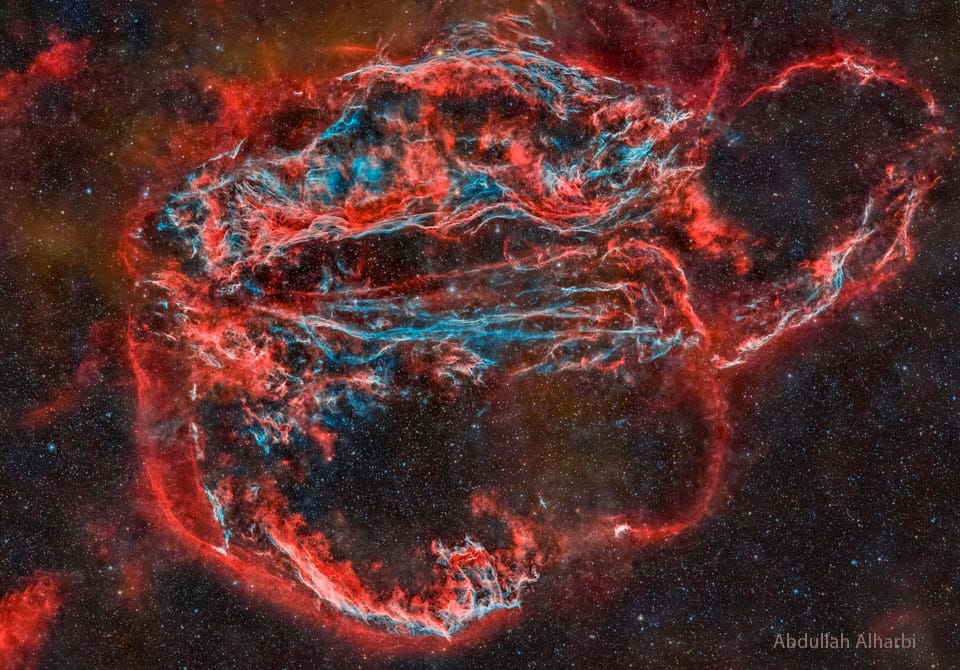
    These glowing wisps are the visible remains of a star that went supernova about 7,000 years ago. Today the supernova remnant is known as the Veil Nebula and is visible only through telescopes. In the image, red marks hydrogen gas and blue marks oxygen. First carried by shock waves, these remains of a former star now serve as seed material for other stars and planetary systems to form. (Image credit: A. Alharbi; via APOD)

    Fediverse Reactions
  • Interstellar Jets

    Interstellar Jets

    This JWST image shows a couple of Herbig-Hero objects, seen in infrared. These bright objects form when jets of fast-moving energetic particles are expelled from the poles of a newborn star. Those particles hit pockets of gas and dust, forming glowing, hot shock waves like those seen here in red. The star that birthed the object is out of view to the lower-right. The bright blue light surrounded by red spirals that sits near the tip of the shock waves is actually a distant spiral galaxy that happens to be aligned with our viewpoint. (Image credit: NASA/ESA/CSA/STScI/JWST; via APOD)

    Fediverse Reactions
  • Imaging a New Era of Supersonic Travel

    Imaging a New Era of Supersonic Travel

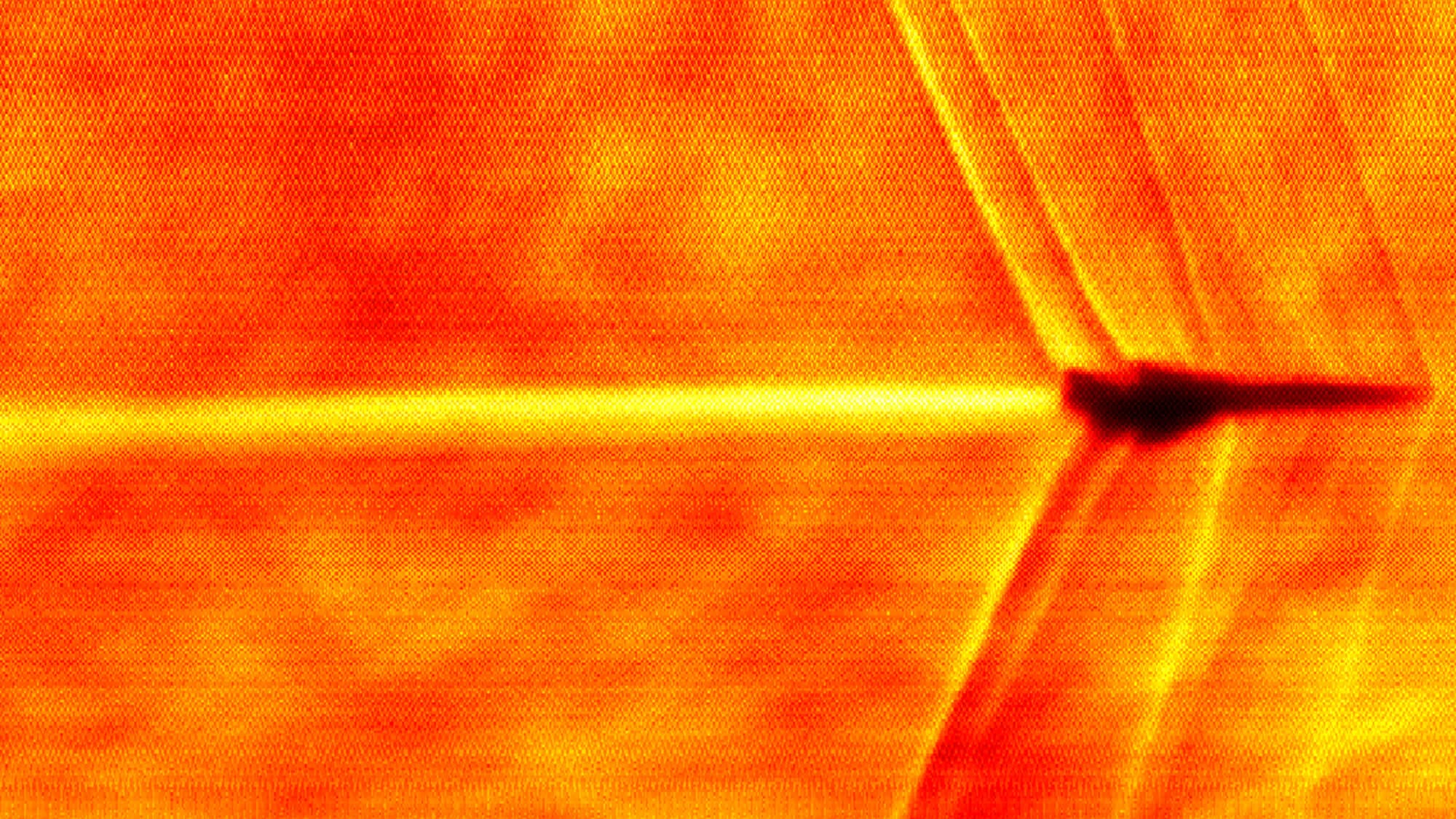
    Supersonic commercial travel was briefly possible in the twentieth century when the Concorde flew. But the window-rattling sonic boom of that aircraft made governments restrict supersonic travel over land. Now a new generation of aviation companies are revisiting the concept of supersonic commercial travel with technologies that help dampen the irritating effects of a plane’s shock waves.

    One such company, Boom Supersonic, partnered with NASA to capture the above schlieren image of their experimental XB-1 aircraft in flight. The diagonal lines spreading from the nose, wings, and tail of the aircraft mark shock waves. It’s those shock waves’ interactions with people and buildings on the ground that causes problems. But the XB-1 is testing out scalable methods for producing weaker shock waves that dissipate before reaching people down below, thus reducing the biggest source of complaints about supersonic flight over land. (Image credit: Boom Supersonic/NASA; via Quartz)

    The XB-1 test aircraft in flight.
    Fediverse Reactions
  • Tracking Tonga’s Boom

    Tracking Tonga’s Boom

    When the Hunga Tonga-Hunga Ha’apai volcano erupted in January 2022, its effects were felt — and heard — thousands of kilometers away. A new study analyzes crowdsourced data (largely from Aotearoa New Zealand) to estimate the audible impact of the eruption. The researchers found that the volume, arrival time, and nature of the rolling rumble reported by survey takers correlated well with seismic measurements. But humans provided data that monitoring equipment couldn’t. For example, reports of shaking buildings and rattling windows let researchers estimate the shock wave‘s overpressure far from the volcano. The team suggests that acting quickly to collect human impressions of rare events like this one can add valuable data that’s otherwise overlooked. (Image credit: NASA; research credit: M. Clive et al.; via Gizmodo)

  • A Dandelion-Like Supernova Remnant

    A Dandelion-Like Supernova Remnant

    In 1181 CE, astronomers in China and Japan recorded a new, short-lived star in the constellation Cassiopeia. After burning for nearly six months, this historic supernova disappeared from the naked eye. It was only in 2013 that an amateur astronomer identified a nebula in the vicinity of that supernova, and, in the years since, astronomers have collected evidence that identifies the object, known as Pa 30, as the remnants of that 1181 supernova. Now, astronomers have mapped the supernova remnant, revealing an unusual dandelion-like structure (shown in an artist’s conception above and below). Filaments of sulfur project outward from a dusty central region that houses the remains of the original star. Normally, a supernova destroys its original star, but this was a Type Iax supernova, a “failed” explosion that left behind a hot, inflated star that may eventually cool into a white dwarf star.

    Why the supernova remnant has this strange shape remains unclear. Scientists speculate that shock waves may have helped concentrate sulfur into these clumpy filaments. The material’s velocity suggests a ballistic trajectory (meaning, essentially, that it has neither sped up nor slowed down since the original explosion). Winding the trajectory backwards pegs their origin to 1181, helping confirm that Pa 30 is, indeed, the remains of that 1181 supernova. (Image and video credit: W.M. Keck Observatory/A. Makarenko; research credit: R. Fesen et al.; via Gizmodo)

  • Gigapixel Supernova

    Gigapixel Supernova

    Eleven thousand years ago, a star exploded in the constellation Vela, blowing off its outer layers in a spectacular shock wave that remains visible today. Today’s image is a piece of a 1.3-gigapixel composite image of the supernova remnant, captured by the Dark Energy Camera of the Víctor M. Blanco 4-meter Telescope at Cerro Tololo Inter-American Observatory in Chile. Below is a labeled version of the image, identifying the original star — now a fast-spinning pulsar that packs our sun’s mass into an object only kilometers across — its shock wave, and other features. To explore the full-sized image, see NOIRLab. (Image credit: CTIO/NOIRLab/DOE/NSF/AURA; via Colossal)

    A labeled version of the image shows the shock wave and other features.
    A labeled version of the image shows the shock wave and other features.
  • Reapproaching Supersonic Air Travel

    Reapproaching Supersonic Air Travel

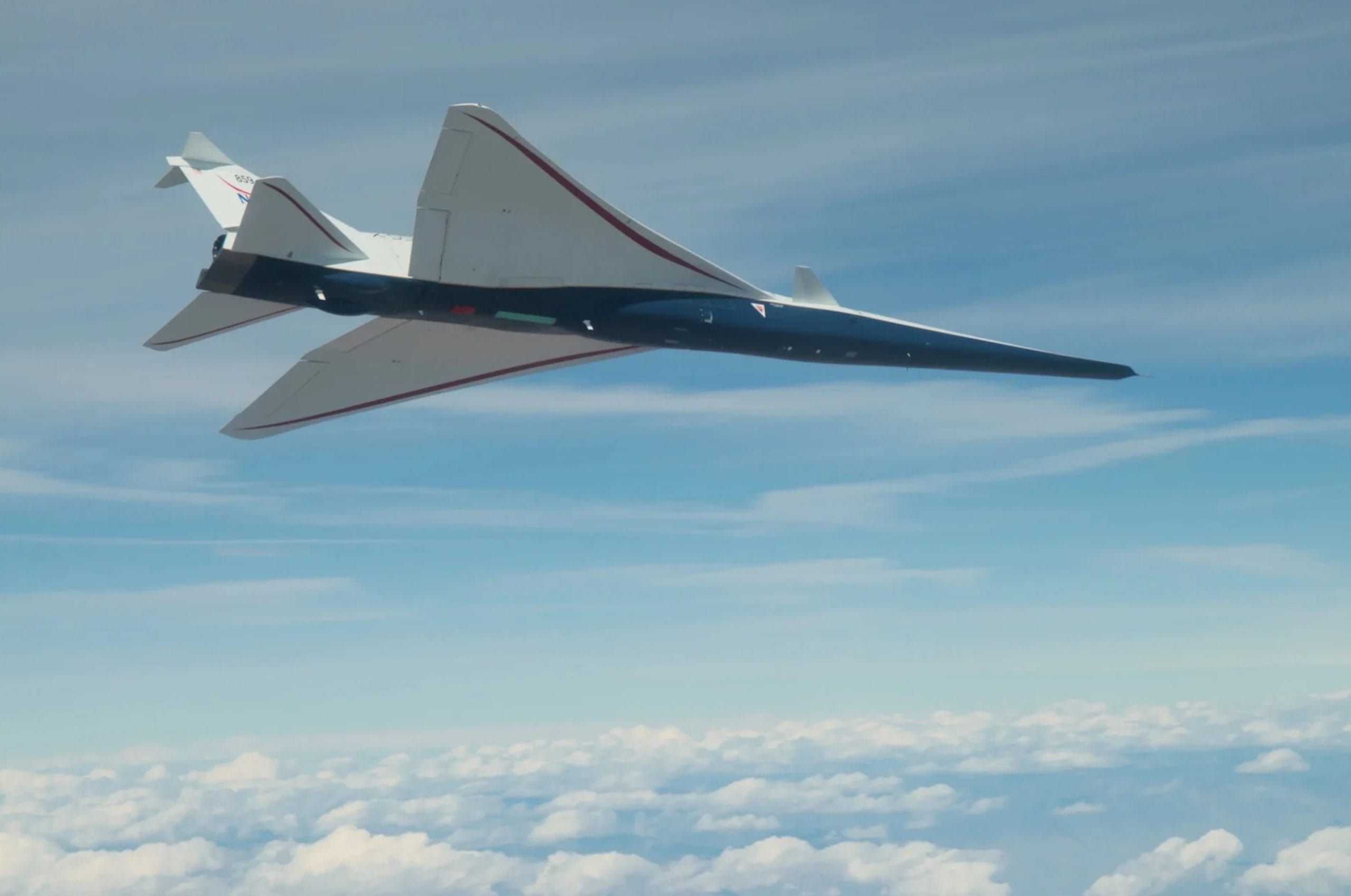
    Before the Concorde even began regular flights, protests over its sound levels caused the U.S. and many other countries to ban overland commercial supersonic flight. Those restrictions have stood for fifty years. But NASA and Lockheed Martin Aeronautics are hoping to make supersonic air travel a possibility again with their experimental X-59 aircraft, designed to have a much quieter sonic boom.

    In supersonic flight, every curve, bolt, and bump generates a shock wave, and these waves tend to coalesce at the front and back of the aircraft, creating strong leading and trailing shocks. It’s these shock waves that are responsible for the double sonic boom that rattles windows and startles those of us on the ground. The X-59 reduces its noise by spreading out those shock waves, a feat designers managed with heavy reliance on computational fluid dynamics. They used wind tunnel studies mainly for validation, since iterating designs in the wind tunnel was far slower than working computationally. With the initial aircraft built, the team will now do test flights and, starting in 2026, will fly over the public and solicit feedback on whether the aircraft is acceptably quiet. (Image credit: NASA; via Physics Today)

    The sound of the X-59's sonic boom compared to other familiar sound levels.
    The sound of the X-59’s sonic boom compared to other familiar sound levels.