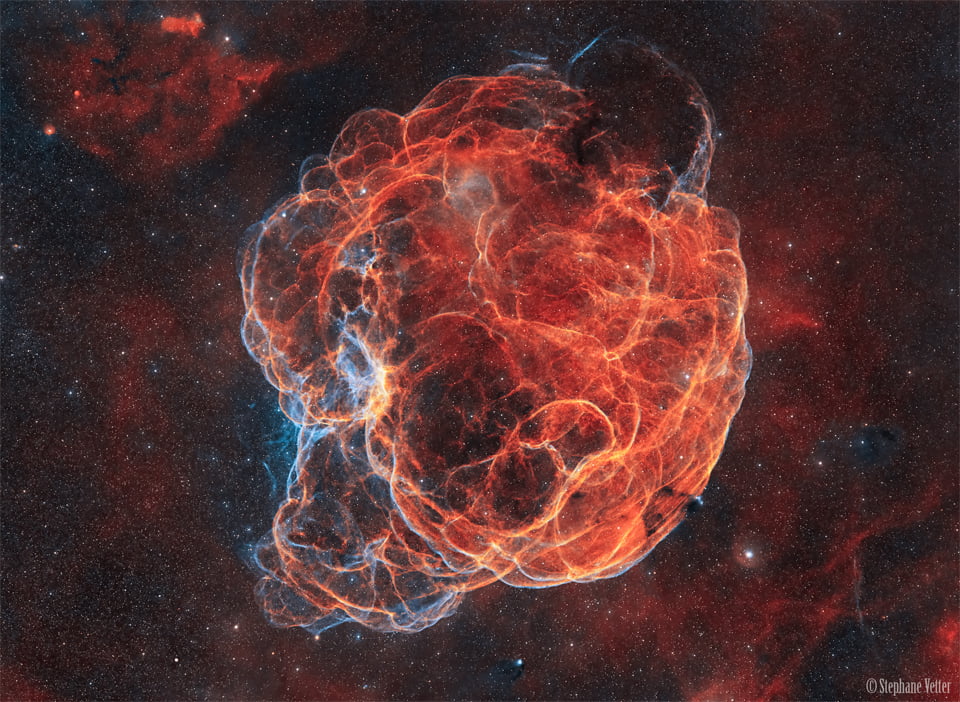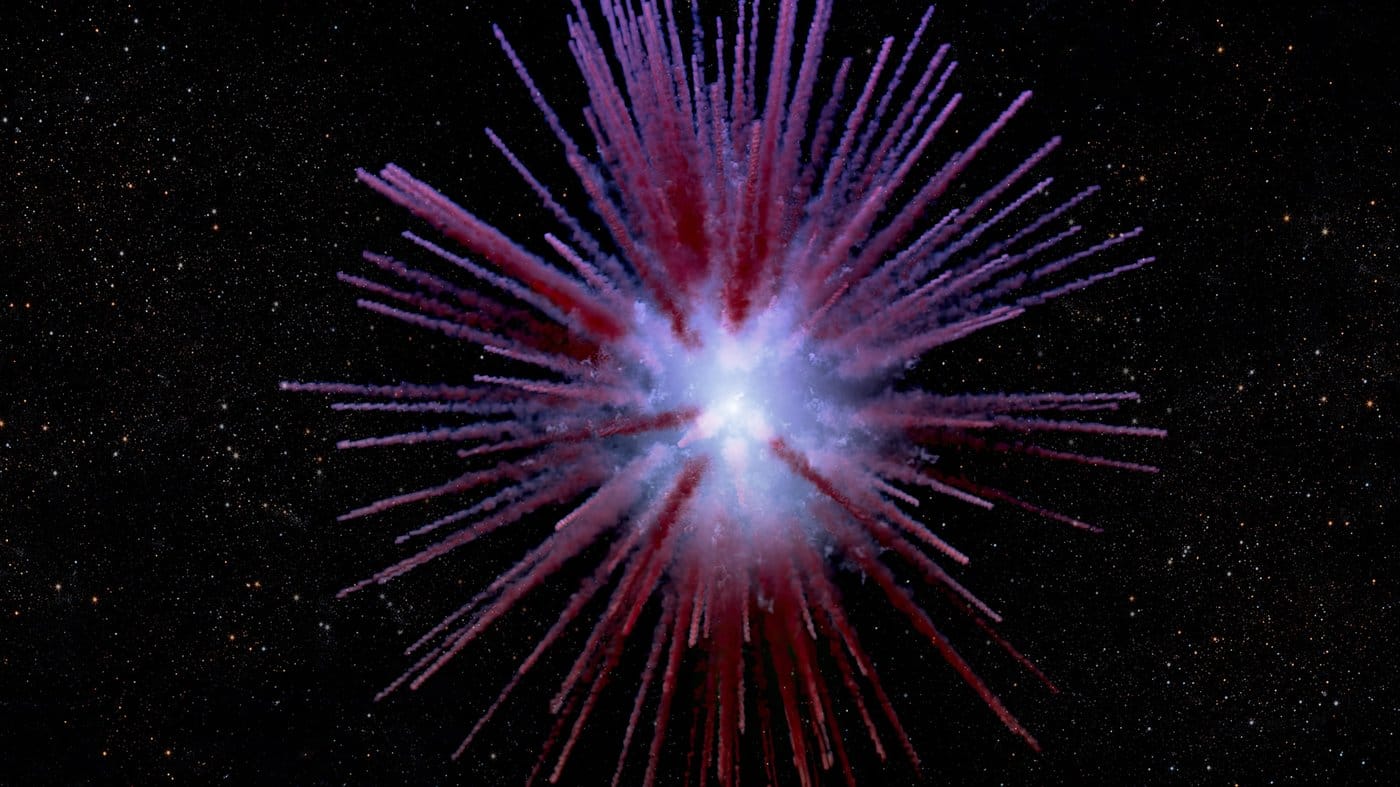
Sometimes known as the Spaghetti Nebula, Simeis 147 is the remnant of a supernova that occurred 40,000 years ago. The glowing filaments of this composite image show hydrogen and oxygen in red and blue, respectively. These are the outlines of the shock waves that blew off the outer layers of the one-time star within. What remains of that star’s core is now a pulsar, a fast-spinning neutron star with a solar wind that continues to push on the dust and gas we see here. (Image credit: S. Vetter; via APOD)
Search results for: “shock wave”

Lasers and Soap Films
Soap films are a great system for visualizing fluid flows. Researchers use them to look at flags, fish schooling and drafting, and even wind turbines. In this work, researchers explore the soap film’s reaction to lasers. When surfactant concentrations in the soap film are low, laser pulses create shock waves (above) in the film that resemble those seen in aerodynamics. The laser raises the temperature at its point of impact, lowering the local surface tension. That temperature difference triggers a Marangoni flow that draws the heated fluid outward. The low surfactant concentration gives the soap film relatively high elasticity, and that allows the shock waves to form.
In contrast, a soap film with a high concentration of surfactants has relatively little elasticity. In these films (below), the laser creates a mark that stays visible on the flowing soap film. This “engraving” technique could be used to visualize flow in the soap film without using tracer particles. (Image and research credit: Y. Zhao and H. Xu)

When surfactant concentrations are high, a laser pulse “engraves” spots onto a flowing soap film. Shown in terms of interference (left) and Schlieren (right) imaging. 
Test Firing a Rocket Engine
Watching a rocket engine start up in slow motion is always fun. This Slow Mo Guys video shows a test fire of one of Firefly’s engines, which is capable of 45,000 pounds of thrust. Gav walks us through the process of preparing to film the test as well as what his footage shows.
Green flames mark ignition of the initial fuel, and bursts of flame jerk back and forth as shock waves pass through the engine. That’s a necessary part of establishing supersonic flow through the bell-shaped diffuser at the end of the engine. Once the exhaust reaches supersonic speeds, expelling it creates a diamond-like pattern of standing shock waves and expansion fans that ultimately equalize the exhaust jet’s pressure to that of the surrounding atmosphere. (Video and image credit: The Slow Mo Guys)

Withstanding Rocket Launches
It takes a lot of power to lift a giant rocket‘s payload all the way to orbit, and in the first moments of a rocket launch, all that energy is directed downward at a concrete pad. How do engineers design and protect launch pads? In this Practical Engineering video, Grady tackles just that question through a comparison of SpaceX’s Stage Zero and NASA’s Launch Pad 39A.
SpaceX notoriously chose to build Stage Zero without a trench or water sprayer system like the ones NASA use. Trenches deflect the rocket exhaust to reduce the impact on infrastructure beneath the engines. And water sprayers reduce the temperatures the pad experiences and disrupt shock waves that otherwise hammer the pad. Without those precautions, even special heavy-duty concretes have a hard time holding together against a launch. (Video and image credit: Practical Engineering)

Star YY Hya
A team of professional and amateur astronomers discovered and then imaged this previously undiscovered galactic nebula. At the heart of the stellar remnant is a binary star pair. Shock waves of the gas and dust twist and spread in the surrounding space, the remains of an earlier star’s violent eruption. (Image credit: M. Drechsler et al.; via 2023 Astronomy POTY)

Exploding a Bubble
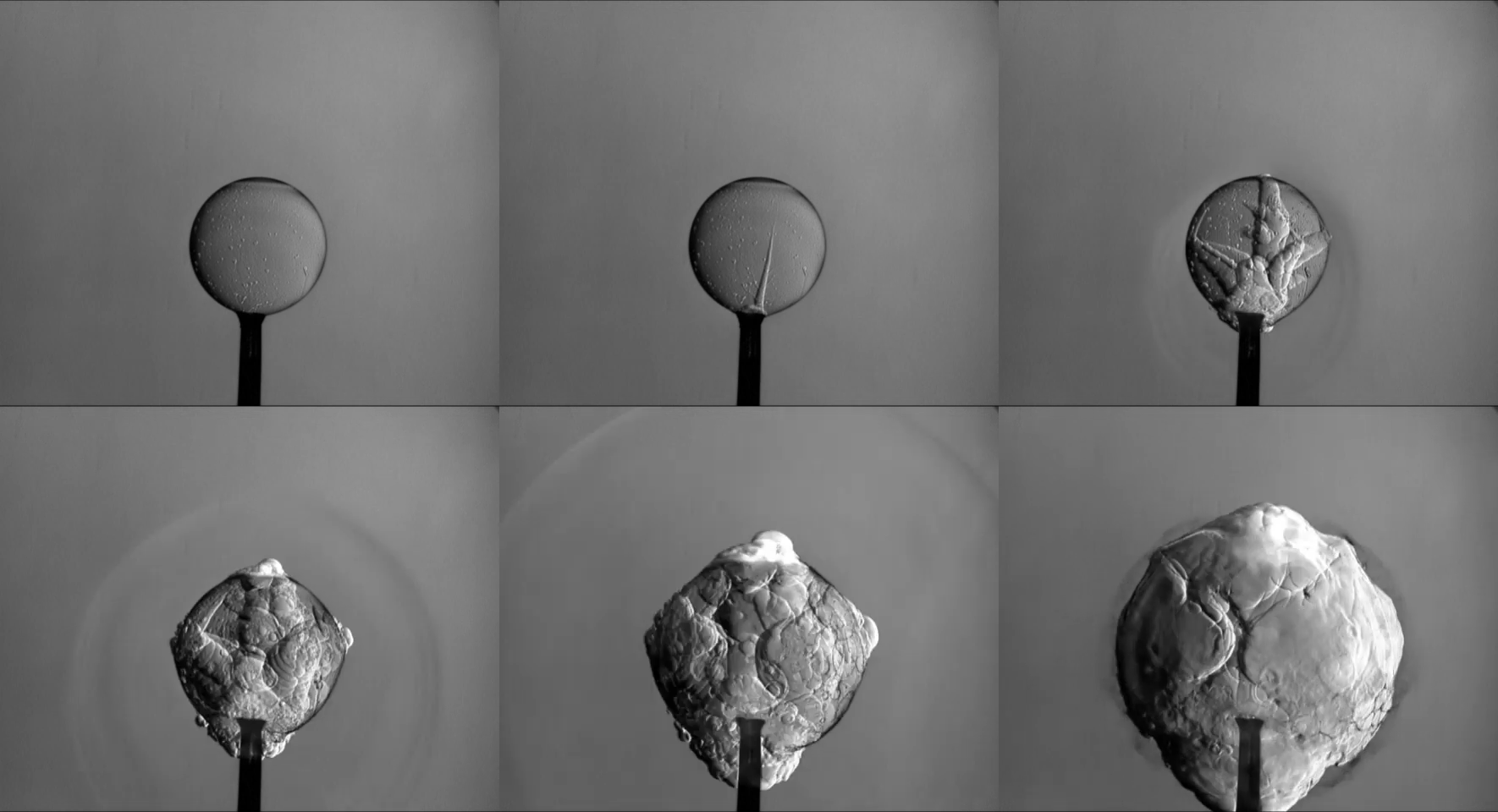
In this high-speed video, artist Linden Gledhill ignites a mixture of oxygen and hydrogen contained within a soap bubble. As neat as the video is, I decided to take a closer look at the initial detonation with this animation:

The ignition sequence within the bubble, slowed down further. Even here, it’s hard to appreciate just how fast ignition is; it lasts only a handful of frames, despite filming at 40,000 frames per second. But we can still pick out some very neat physics. The ignition begins with a spike-like jet but immediately forks into three ignition fronts that pierce the soap bubble. You can see the shadowy mist of the bubble bursting as the flame front expands. Watch the background carefully, and you can see a shock wave flying away from that moment of detonation.
Once the soap bubble is gone, the expanding flames begin to wrinkle and deform. Turbulence takes shape, eddying through the flames at a much slower speed than the initial detonation. This is where most of combustion takes place, with turbulence mixing the hydrogen and oxygen together to better enable burning. (Image and video credit: L. Gledhill)

Collapsing Cavitation Bubbles
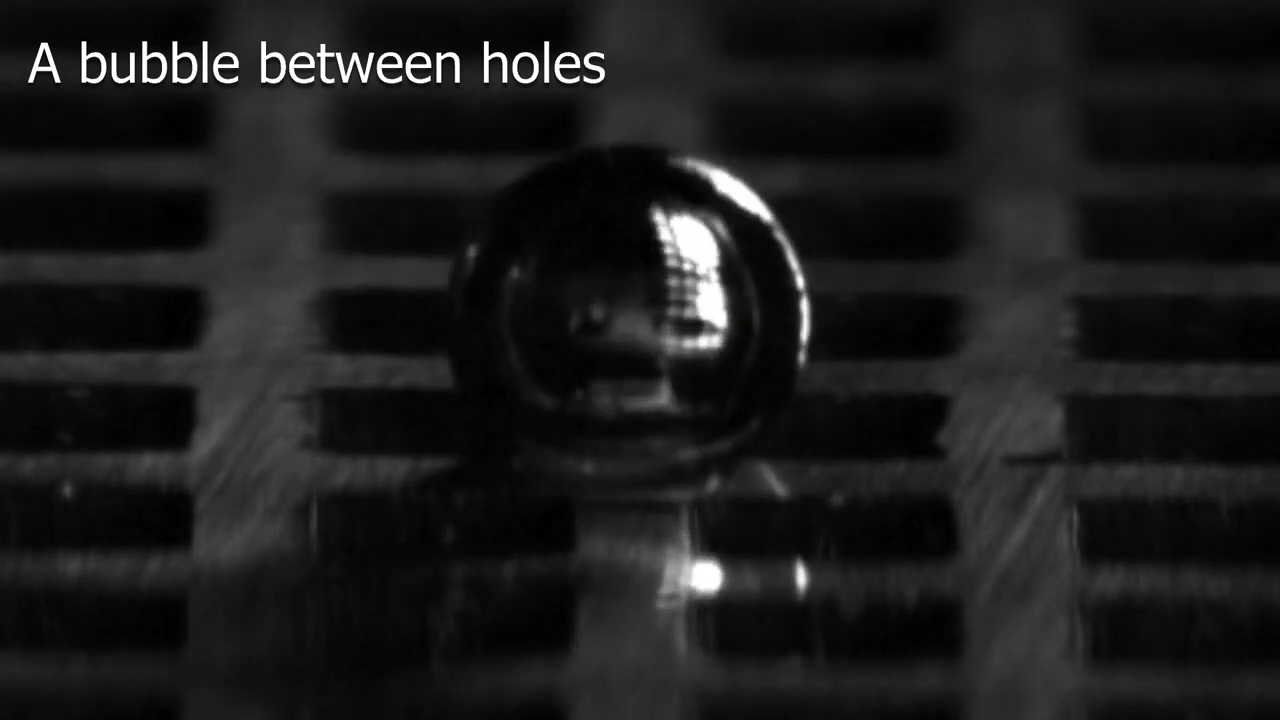
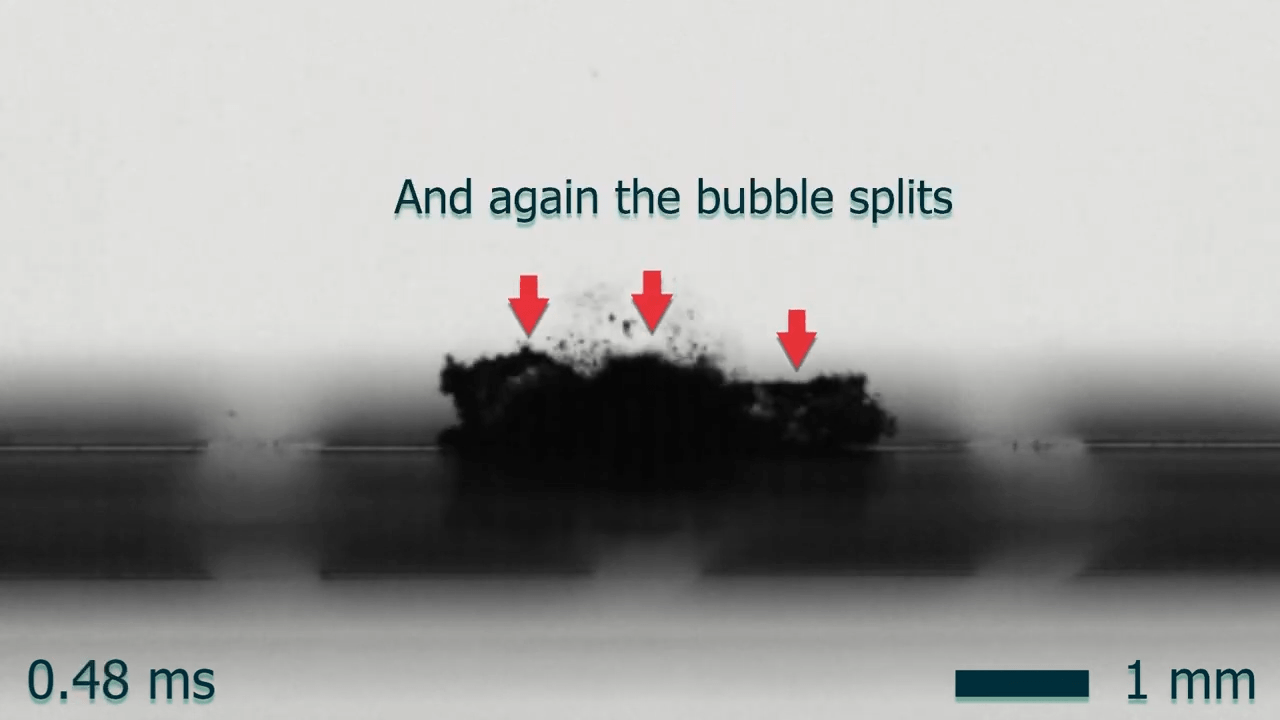
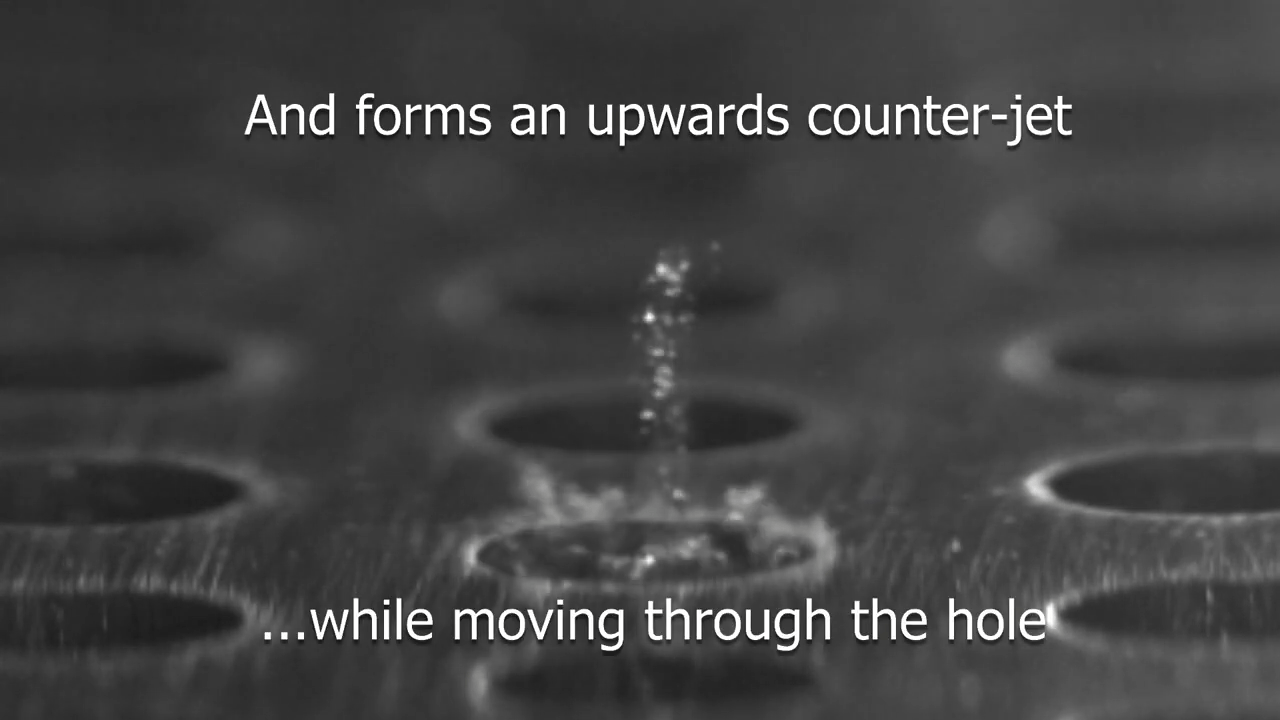
Cavitation bubbles live short, violent lives. Triggered here with a laser, these bubbles rapidly expand and then collapse, sending out shock waves. In this video, researchers explore how bubbles collapse when they’re near a plate with holes in it. For bubbles sitting between holes, collapse becomes asymmetric, eventually splitting the bubble into two as it falls in on itself. Bubbles centered over a hole perform a disappearing act, sucking themselves down into the hole during collapse. (Image and video credit: E. Andrews et al.)

Escaping the Sun
One enduring mystery of the solar wind — a stream of high-energy particles expelled from the sun — is how the particles get accelerated in the first place. The sun frequently belches out spurts of plasma, but without further momentum, that material simply falls back to the sun’s surface under the star’s gravity. Mechanisms like shock waves can further accelerate particles that are already moving quickly, but they cannot explain how the particles get going in the first place.
A recent study used supercomputers to tackle this challenging problem in turbulent plasma physics. Each simulation tracked nearly 200 billion particles, requiring tens of thousands of processors. The results showed that turbulence itself provides the necessary initial acceleration and serves as the first step to getting particles moving fast enough to escape the sun. (Image credit: NASA SDO; research credit: L. Comisso and L. Sironi; via Physics World)

Pistol Shrimp Snaps
Gram for gram, few animals can match the power of a pistol shrimp’s snap. When its claw closes, the shrimp ejects a jet of water so fast that the water pressure drops below the vapor pressure, causing a cavitation bubble. Like other cavitation bubbles, this one is short-lived, growing and collapsing (and sending out shock waves!) in less than a millisecond. That’s enough to knock any predator or prey for a loop. (Image and video credit: Ant Lab)

Microscale Kelvin-Helmholtz
When we think of cavitation in a flow, we often think of it occurring at a relatively large scale — on the propeller of a boat, for example. But cavitation takes place on microscales, too, including around fuel-injection nozzles. In this study, researchers investigated submillimeter-scale cavitation using a flow through a tiny Venturi tube. What they found was something we usually associate with larger scale flows: the Kelvin-Helmholtz instability.

The wavy shape of a Kelvin-Helmholtz instability forms when two layers of fluid move past one another at different speeds and the interface where they meet becomes unstable. Here, that happens along a cavitation bubble, where the bubble and the flow meet. Interestingly, at these scales, the Kelvin-Helmholtz instability seems to be the primary method of break-up, instead of shock wave interactions.
For those keeping track, we’ve now seen the Kelvin-Helmholtz instability from the quantum scale up to 160 thousand light-years. It’s hard to achieve a much wider range than that! (Image and research credit: D. Podbevšek et al.; submitted by M. Dular)