
Instabilities in fluids are sometimes remarkable in their uniformity. Here we see a hollow spinning cup with a thin film of fluid flowing down the interior. The rim of fluid at the cup’s lip stretches into long, evenly spaced, spiraling threads. These filaments stretch until centrifugal forces overcome surface tension and viscous forces and break the liquid into a multitude of tiny droplets. This process is called atomization and is vital to everyday applications like internal combustion and inkjet printing. (Photo credit: R. P. Fraser et al.)
Search results for: “liquid jet”

Drop-Tower Droplets
A microgravity environment can cause some nonintuitive behaviors in fluids. Many of the effects that dominate fluid dynamics in space are masked by gravity’s effects here on Earth. As a result, it can be very difficult to predict how seemingly straightforward technologies like heat exchangers, refrigeration units, and fuel tanks will behave. The photos above show two bubble jets–created by injecting a liquid-gas mixture into a liquid–colliding in microgravity. This particular experiment was conducted in a drop tower rather than on-orbit, which produced some side effects like the large bubbles seen in the images. These were created by the coalescence of smaller bubbles that congregated near the top of the tank shortly before the experiment attained free-fall. (Photo credit: F. Sunol and R. Gonzalez-Cinca)

Protruding Fingers
Instability is a common feature of fluid flows and can generate a near infinite set of patterns. The video above shows the Saffman-Taylor instability, an interface instability that occurs when a fluid of lower viscosity is injected into a higher viscosity fluid. In this case, the fluids inhabit a thin space between two glass plates. The less viscous fluid displaces the more viscous one in a series of branching finger-like shapes. If the situation were reversed, with a more viscous fluid injected into a less viscous one, the interface would be stable and expand radially without any pattern formation. (Video credit: William Jewell College)
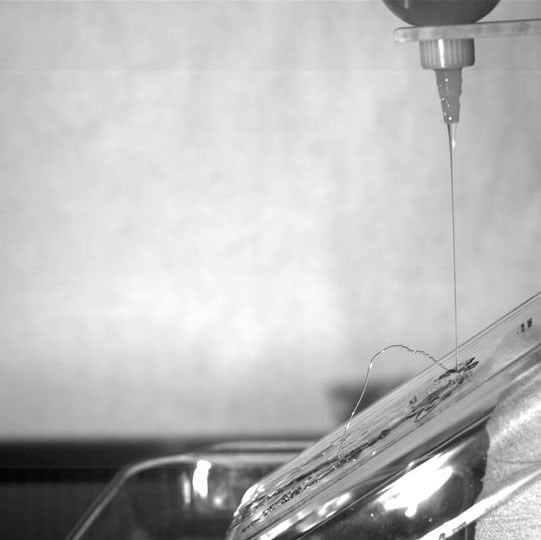
The Kaye Effect
When a viscous fluid falls onto a surface, it will form a heap, like honey coiling. But for shear-thinning liquids like soap or shampoo something a little wild can happen as the heap grows. A dimple can form and, when the incoming jet of fluid hits that dimple, it slips against it and is ejected outward. If you wonder why you don’t see this every day in the shower, it’s because the outgoing jet usually hits the incoming jet, causing the whole system to collapse in less than 300 ms. By dropping the fluid on an inclined surface, one can keep the two jets from colliding, thereby creating a stable Kaye effect. (Photo credit: E. Eichelberger)

Egg-Spinning Fun
If you have any leftover hard-boiled eggs, you can recreate this bit of fluid dynamical fun. Spin the egg through a puddle of milk, and you’ll find that the egg draws liquid up from the puddle and flights it out in a series of jets. As the egg spins, it drags the milk it touches with it. Points closer to the egg’s equator have a higher velocity because they travel a larger distance with each rotation. This variation in velocities creates a favorable pressure gradient that draws milk up the sides of the egg as it spins, creating a simple pump. To see the effect in action check out this Science Friday video or the BYU Splash Lab’s Easter-themed video. (Photo credit: BYU Splash Lab)
Gravity’s Effect on Bursting Bubbles
In a gravitational field, the pressure in a fluid increases with depth. You can consider it due to the weight of the fluid above. Outside of scuba diving or hiking at altitude, this effect is not one typically given much thought. But what effect can it have at a smaller scale? This video shows the collapse and rebound of three initially spherical cavitation bubbles inside a liquid. Each bubble is created in a different gravitational field – one in microgravity, one in normal gravity, and one at 1.8x Earth gravity. The bubble in microgravity remains axisymmetric and spherical, but the two bubbles recorded in gravitational fields develop jets during rebound. Even at a scale of only a few millimeters, gravity causes an imbalance in pressure across the bubble that creates asymmetry. (Video credit: D. Obreschkow et al.)
“Frozen” Water Stream
We saw previously how vibrating a falling stream of water and filming it with a matching camera frame rate appears to “freeze” the falling liquid. This video shows the same illusion, now with a 24 Hz sine wave, which the falling water mimics. Vibrating the speaker that drives the water stream slightly slower or slightly faster than the camera frame rate makes the water appear to slowly fall or rise relative to its “frozen” wave state. This is a beat effect caused by the slight difference in frequency between the water and the camera. (Video credit: brusspup; via BoingBoing; submitted by many readers)
Tuning Fork Fluids
This high-speed video shows a liquid crystal fluid vibrating on a tuning fork. As the surface moves, tiny jets shoot upward, sometimes with sufficient energy that the fluid column is stretched beyond surface tension’s ability to keep it intact, resulting in droplet ejection. The jets and surface waves create a mesmerizing pattern of fluid motion. (Video credit: J. Savage)
Spitting Droplets
Any phenomenon in fluid dynamics typically involves the interaction and competition of many different forces. Sometimes these forces are of very different magnitudes, and it can be difficult to determine their effects. This video focuses on capillary force, which is responsible for a liquid’s ability to climb up the walls of its container, creating a meniscus and allowing plants and trees to passively draw water up from their roots. Being intermolecular in nature, capillary forces can be quite slight in comparison to gravitational forces, and thus it’s beneficial to study them in the absence of gravity.
In the 1950s, drop tower experiments simulating microgravity studied the capillary-driven motion of fluids up a glass tube that was partially submerged in a pool of fluid. Without gravity acting against it, capillary action would draw the fluid up to the top of the glass tube, but no droplets would be ejected. In the current research, a nozzle has been added to the tubes, which accelerates the capillary flow. In this case, both in terrestrial labs and aboard the International Space Station, the momentum of the flow is sufficient to invert the meniscus from concave to convex, allowing a jet of fluid out of the tube. At this point, surface tension instabilities take over, breaking the fluid into droplets. (Video credit: A. Wollman et al.)

A Colorful Rinse
In this image a jet of water (clear/white) is rinsing a solution of polyacrylamide (PAM; blue) off a silicon surface. In the center, a hydraulic jump marks the interface where fast-moving laminar flow changes to a slower turbulent one. At the same time, the water, which is less viscous than the PAM, creates viscous finger-like protrusions into the blue liquid as it rinses the surface clean. (Photo credit: T. Walker, T. Hsu, and G. Fuller)