The sloshing of liquids inside solids is usually presented as a difficulty to overcome, as with the transport of tanks, the motion of fuel in satellites, or even the problem of walking with a full cup of coffee. But liquids also make a very effective damper, as in the case of a bouncing ball partially filled with liquid. Here we see high-speed video of the liquid’s motion inside the ball as it bounces and rebounds. Part of the ball’s kinetic energy at rebound is transferred into the fluid jet, reducing that available for the ball to transfer into potential energy. (Video credit: BYU Splash Lab)
Search results for: “liquid jet”

Bouncing and Break-Up
In the collage above, successive frames showing the bouncing and break-up of liquid droplets impacting a solid inclined surface coated with a thin layer of high-viscosity fluid have been superposed. This allows one to see the trajectory and deformation of the original droplet as well as its daughter droplets. The impacts vary by Weber number, a dimensionless parameter used to compare the effects of a droplet’s inertia to its surface tension. A larger Weber number indicates inertial dominance, and the Weber number increases from 1.7 in (a) to 15.3 in (d). In the case of (a), the impact of the droplet is such that the droplet does not merge with the layer of fluid on the surface, so the complete droplet rebounds. In cases (b)-(d), there is partial merger between the initial droplet and the fluid layer. The impact flattens the original droplet into a pancake-like layer, which rebounds in a Worthington jet before ejecting several smaller droplets. For more, see Gilet and Bush 2012. (Photo credit: T. Gilet and J. W. M. Bush)

Champagne Science
Today many a glass of champagne will be raised in honor of the end of one year and the beginning of a new. This French wine, known for its bubbly effervescence, is full of fascinating physics. During secondary fermentation of champagne, yeast in the wine consume sugars and excrete carbon dioxide gas, which dissolves in the liquid. Since the bottle containing the wine is corked, this increases the pressure inside the bottle, and this pressure is released when the cork is popped. Once champagne is in the glass, the dissolved carbon dioxide will form bubbles on flaws in the glass, which may be due to dust, scratches, or even intentional marks from manufacturing. These bubbles rise to the surface, expanding as they do so because the hydrodynamic pressure of the surrounding wine decreases with decreasing depth. At the surface, the bubbles burst, creating tiny crowns that collapse into Worthington jets, which can propel droplets upward to be felt by the drinker. For more on the physics of champagne, check out Gerard Liger-Belair’s book Uncorked: The Science of Champagne and/or Patrick Hunt’s analysis. Happy New Year! (Video credit: AFP/Gerard Liger-Belair)

Rebounding
A ping pong ball bounces off a puddle, drawing a liquid column upward behind it. This photo shows the instant after the fluid has disconnected from the ball, allowing it to rebound without further loss of momentum to the fluid. The fluid column begins to fall under gravity, the tiny undulations in its radius growing via the Rayleigh-Plateau instability and eventually causing the column to separate from the puddle. You can see the whole process in action in this high-speed video. (Photo credit: BYU Splash Lab)
Air Entrainment
When a liquid jet falls into a pool, air is often entrained along with the liquid, creating a cavity and, often, bubbles. Shown above is video of a low-speed laminar jet entering a quiescent pool. The jet appears to entrain a thin film of gas, which then breaks up in a three-dimensional fashion, despite the symmetry of the incoming jet. As the speed of the incoming jet is increased and turbulence is introduced, the resulting air entrainment becomes violent and chaotic. For additional information and videos, see Kiger and Duncan 2012 and their supplemental videos. (Video credit: K. Kiger and J. Duncan)
Fireball in Slow Motion
The high-speed video above shows an atomized spray of flammable liquid being ignited using a lighter. It was filmed at 10,000 fps and is replayed at 30 fps. Although uncontained, this demonstration is similar to the combustion observed inside of many types of engines. Automobiles, jet engines, and rockets all break their liquid fuel into a spray of droplets to increase the efficiency of combustion. The turbulence of the flames dances and swirls, with small-scale motions close to the sprayed droplets and larger-scale motions around the vaporized fuel. This variation in size of the scales of motion is a hallmark feature of turbulence and can be used to characterize a flow.

Viscous Dripping

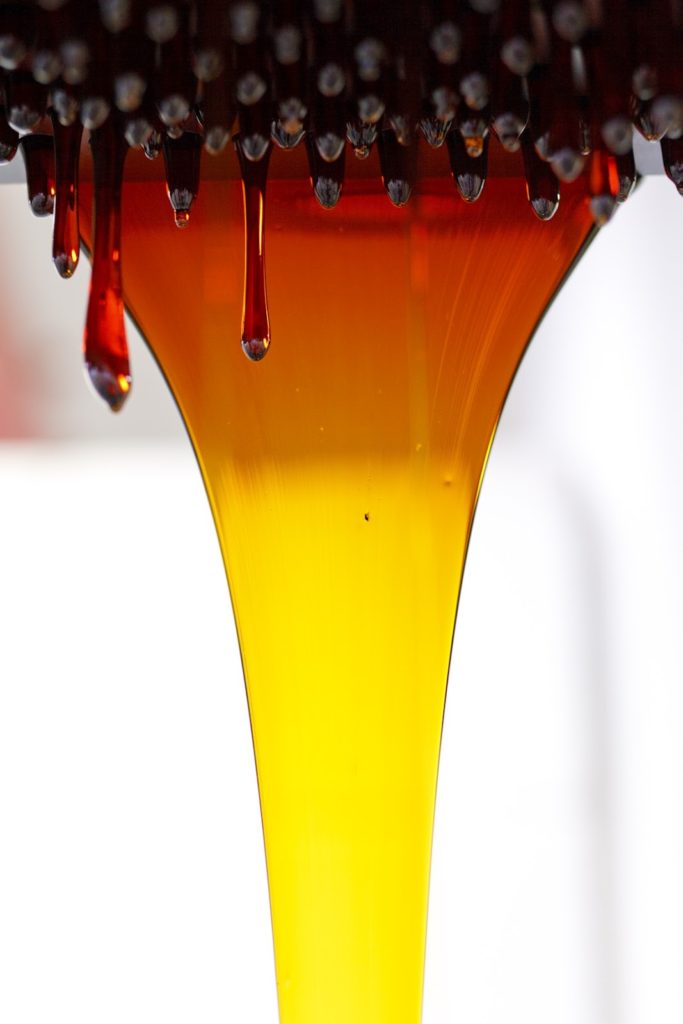
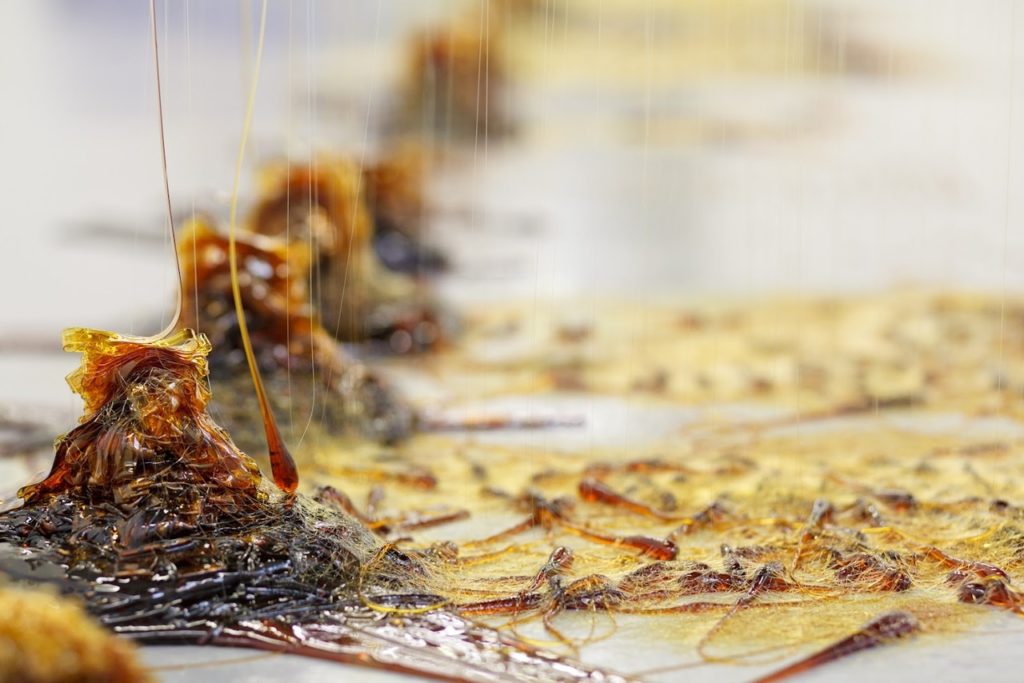
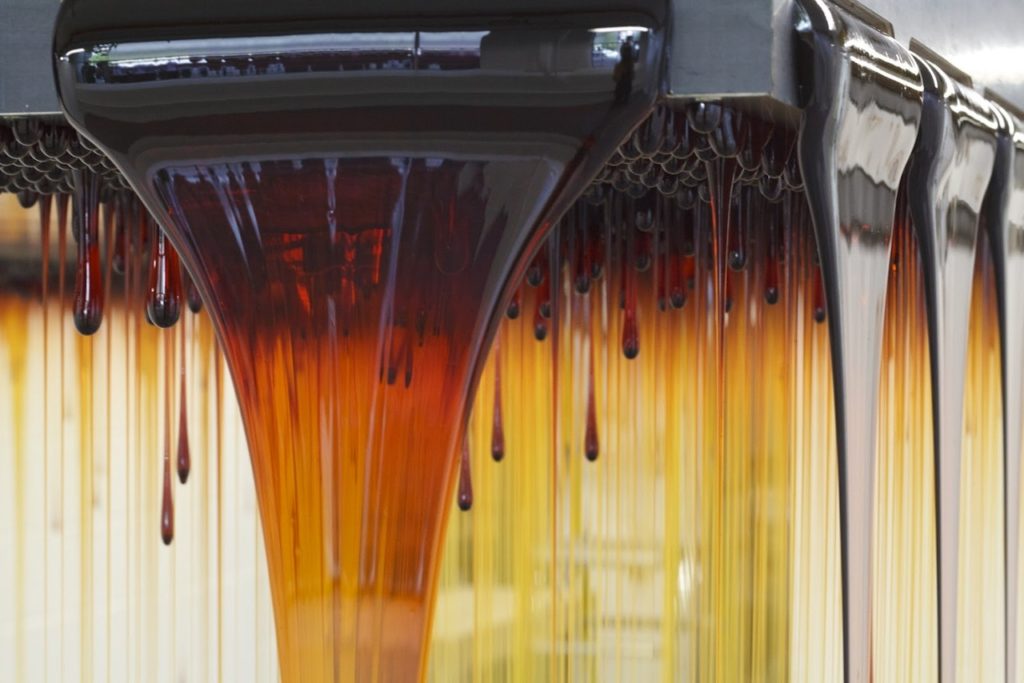


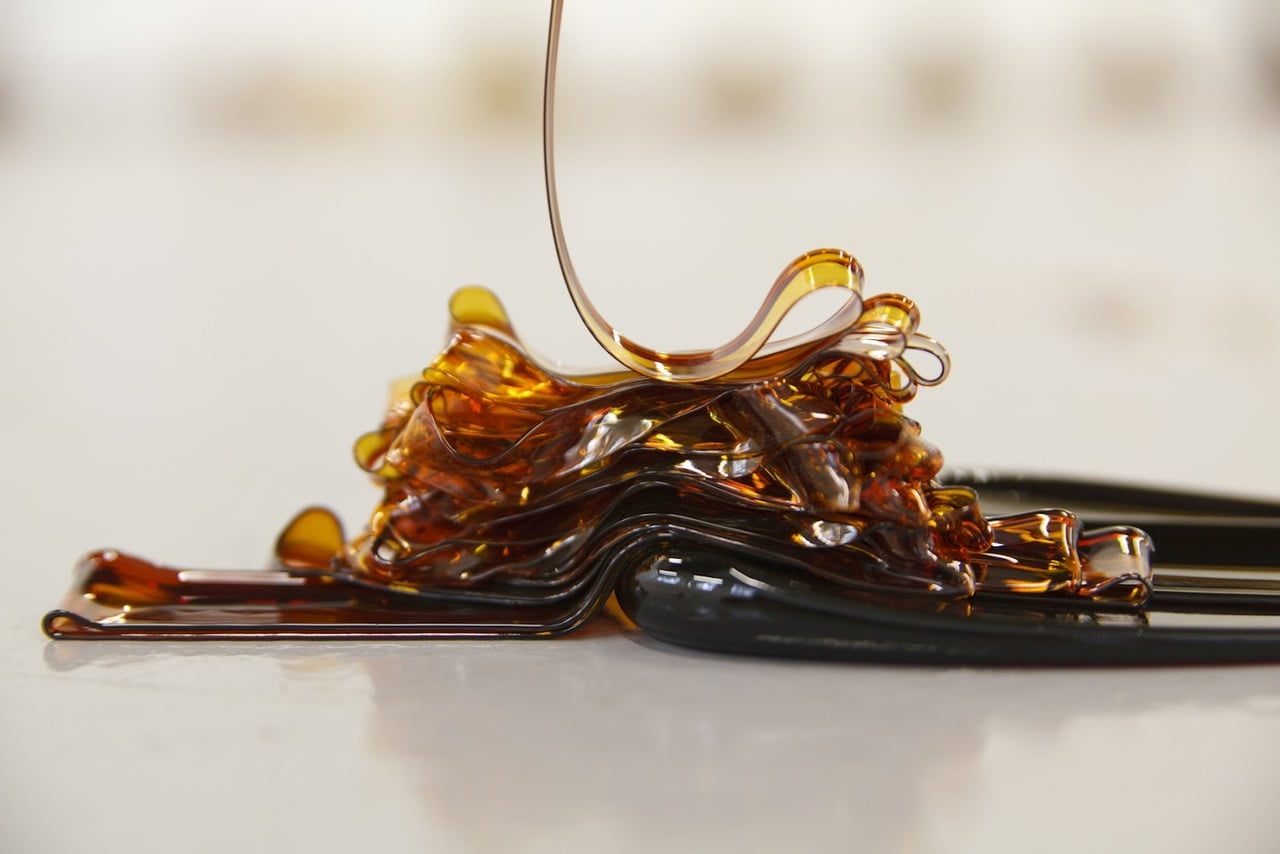


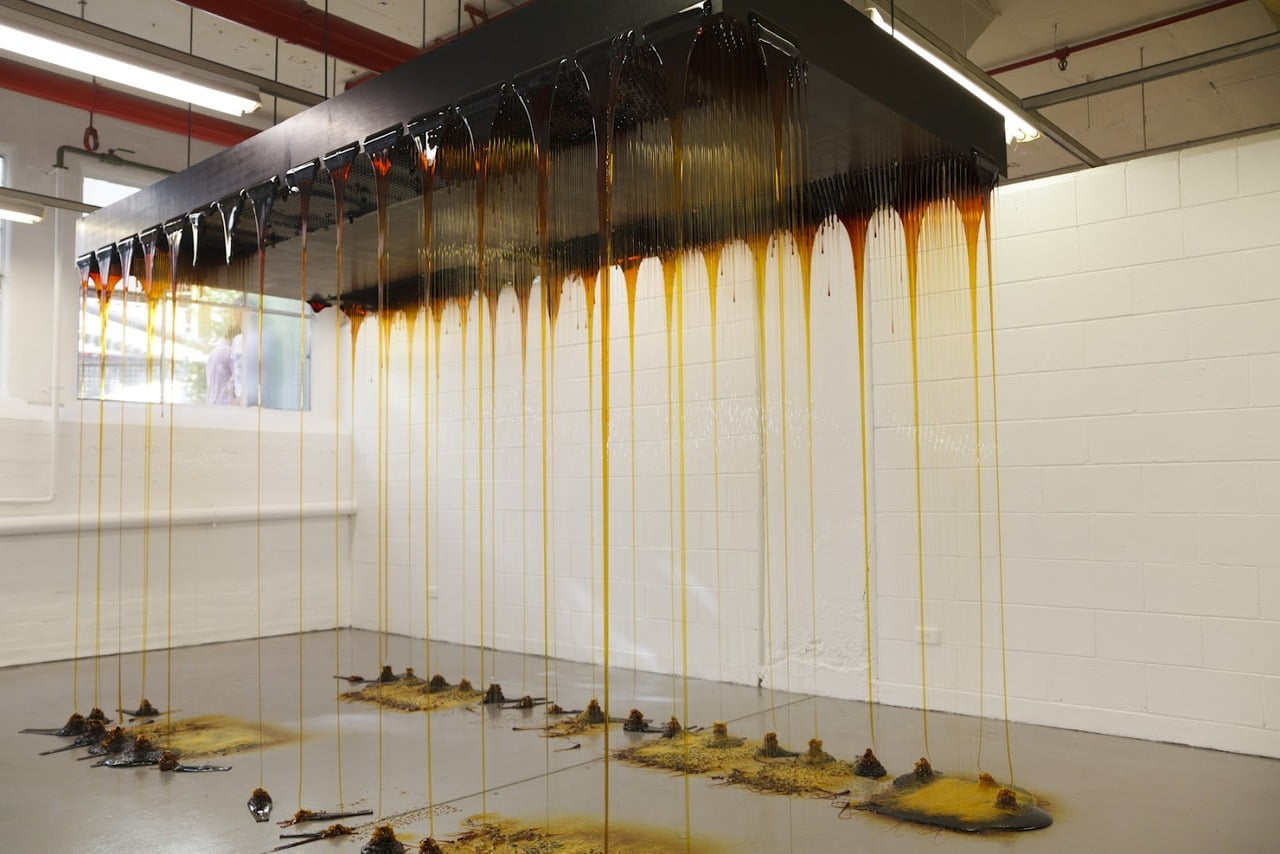
Artist Skye Kelly’s “Creep (strain)” sculpture shown above is made from toffee. The viscous fluid deforms under the force of gravity, resulting in elongated drips and slow jets that buckle and coil upon reaching the floor. (Photo credits: Skye Kelly; via freshphotons)

Splash Rebound
A ball dropped onto a puddle loses some of its rebound momentum to fluid motion. On impact, a splash curtain and radial jet form as the fluid is displaced by the ball. As the ball rebounds, the splash curtain is drawn inward into a column of fluid drawn up by the ball, reminiscent of the way cats and dogs drink. Eventually, when the gravity’s force on the fluid column overcomes the force of the ball’s inertia, the fluid column pinches off and falls back downwards, leaving the ball free to utilize its remaining kinetic energy as it flies upward. (Photo credit: T. Killian, K. Langley, and T. Truscott)
Honey Coiling
The liquid rope coiling effect occurs in viscous fluids like oil, honey, shampoo, or even lava when they fall from a height. The exact behavior of the coil depends on factors like the fluid viscosity, the height from which the fluid falls, the mass flow rate, and the radius of the falling jet. Here Destin of the Smarter Every Day series outlines the four regimes of liquid coiling behavior commonly observed. As with many problems in fluid dynamics the regimes are described in terms of limits, which can help simplify the mathematics. The viscous regime (2:34 in the video) exists in the limit of a small drop height, whereas the inertial regime (3:15) exists in the limit of large drop height. Many complicated physical problems, including those with nonlinear dynamics, are treated in this fashion. For more on the mathematics of the coiling effect, check out Ribe 2004 and Ribe et al. 2006. (Video credit: Destin/Smarter Every Day; submitted by inigox5)
Egg Spinning
Spin a hard boiled egg in a puddle of milk and you get a sprinkler. But how? The science starts at the surface. When the egg spins, the fluid touching its surface is dragged along due to friction, and, because of the fluid’s viscosity, other parts of the fluid will also be spun. Dynamics tells us that the velocity at the surface of the object varies with radius; the velocity at the bottom of a spinning sphere is much smaller than that at its equator because a particle at the equator traverses a larger distance in a single rotation. Likewise, the fluid touching the bottom of the egg is spun slower than the fluid just above it. Bernoulli’s principle tells us that, for an incompressible fluid, the pressure decreases as velocity increases, meaning that a favorable pressure gradient exists along the spinning convex surface. It is this pressure gradient that draws the fluid up the sides of the object. Near the equator, the pressure gradient is weakest and centrifugal force flings the the fluid outward. Surface tension, angular velocity, and viscosity all play a role in the jets and sheets created by the sprinklers. (Video credit: NPR Science Friday with Tadd Truscott et al)