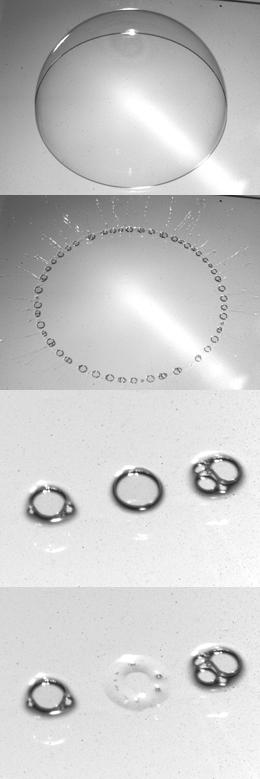
Sometimes bursting one bubble just leads to more bubbles. This high-speed video shows how popping a bubble sitting on a fluid surface can lead to a ring of daughter bubbles. When the surface of the bubble is ruptured, filaments of the liquid that made up the surface are drawn back toward the pool by surface tension, trapping small pockets of the air that had been inside the bubble. A dimple forms on the surface and rebounds as a jet that lacks the kinetic energy to eject droplets. Watch as the jet returns to the interface, and you will notice the tiny bubbles around it. At 56 ms, one of the daughter bubbles on the left bursts. See Nature for more. (Video credit: J. Bird et al)
Search results for: “liquid jet”

Vibrating Oil
This high-speed video shows the behavior of oil on a vibrating surface. As the amplitude of the vibration is altered various behaviors can be observed. Initially small waves appear on the surface of the oil, then the surface erupts into a mass of jets and ejected droplets, reminiscent of a vibrated interfaces within a prism or vibration-induced atomization. When the amplitude is reduced after about half a minute, we see Faraday waves across the surface, as well as tiny droplets that bounce and skitter across the surface. They are kept from coalescing by a thin layer of air trapped between the droplet and the oil pool below. Because of the vibration, the air layer is continuously refreshed, keeping the droplet aloft until its kinetic energy is large enough that it impacts the surface of the oil and gets swallowed up.

Drops Through Drops
The splashes from droplets impacting jets create truly mesmerizing liquid sculptures. Corrie White is one of the masters of this type of high-speed macro photography. Her work captures the instantaneous battles between viscosity, surface tension, and inertia. The fantastic structure seen here through the falling droplets is created by a series of drops timed so that the later ones strike the Worthington jet produced by the initial drop’s impact. (Photo credit: Corrie White)

Splash Sheets
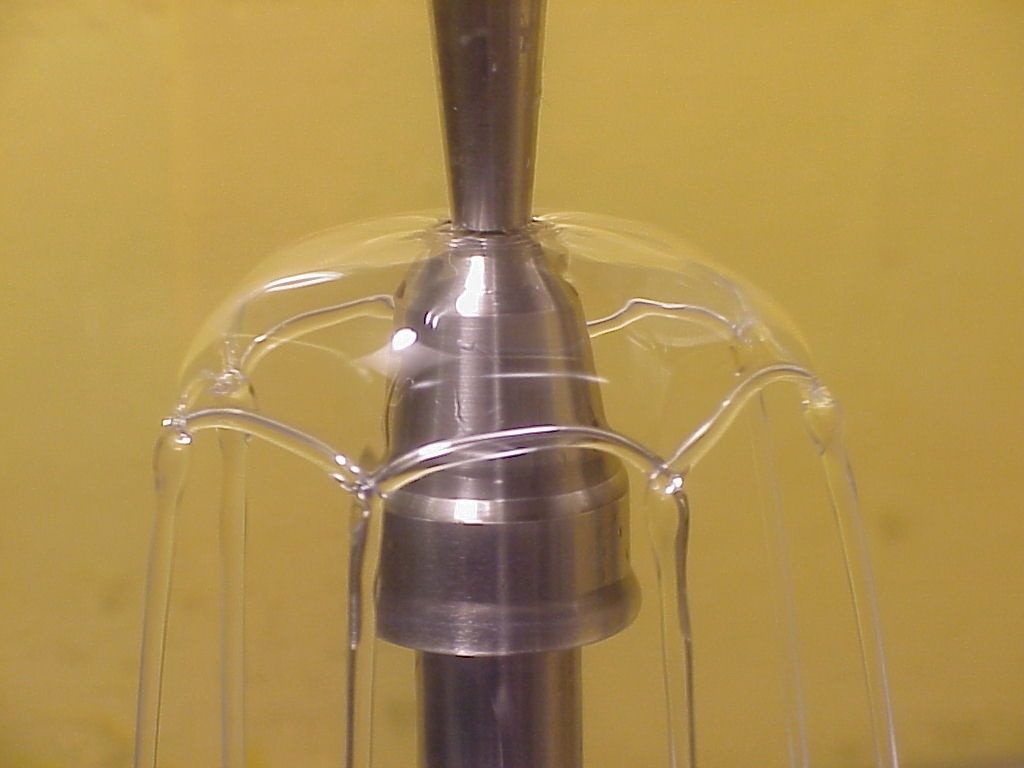
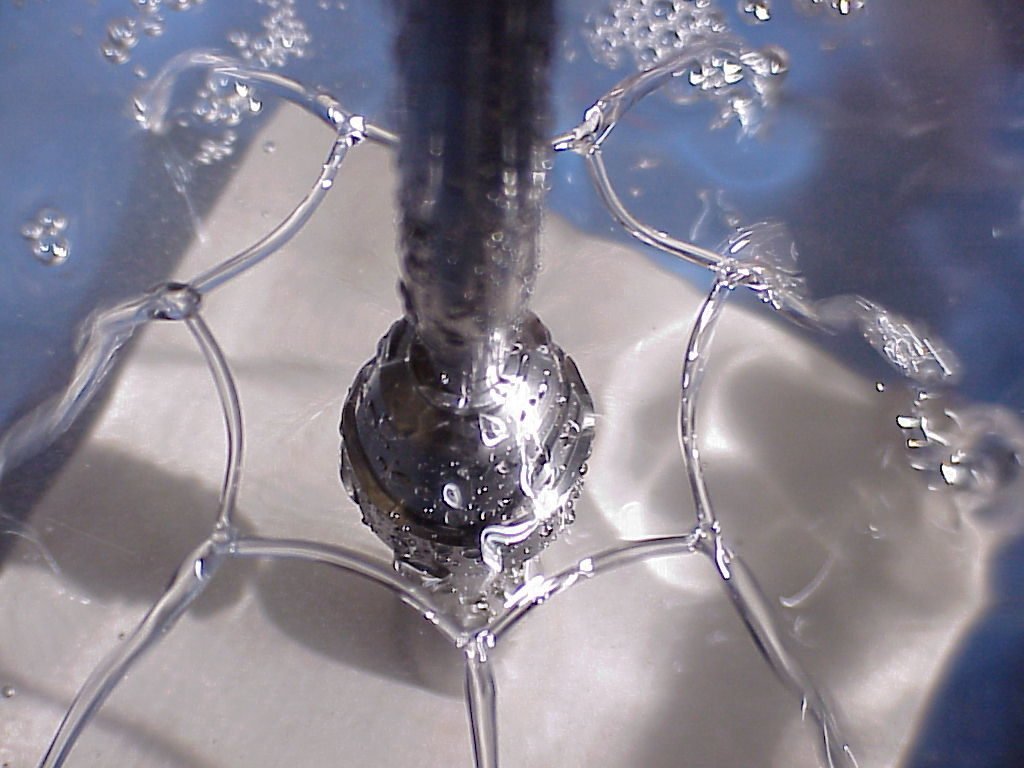


When a falling liquid jet hits a horizontal impacter, it is deflected into a sheet. The shape of the sheet is dependent upon the velocity of the jet and the viscosity of the fluid. At sufficiently high speeds the sheet will be circular; at lower speeds it may sag into a bell-shape. The circular sheets can also develop an instability that causes them to become polygonal, as shown in the photos above. The fluid then flows out along the sheet, into and along the rim, and then spouts outward in jets at the polygon’s corners. For some conditions, the jets at the corners even form a sort of fluid chain (top photo). (Photo credit: R. Buckingham and J. W. M. Bush; via 14-billion-years-later)
Cavity Collapse
When a solid object is driven into a quiescent liquid, a cavity is formed. As the cavity collapses jets–a type of singularity–form. In this video, researchers explore the effect of the geometry of a disk being driven into water on the shape of the cavity formed and how it collapses. As in this video of droplet impacts on posts of different geometries, there’s a lovely symmetry in the results. (Video credit: O. Enriquez et al)
Atomization
Atomization–breaking a flowing liquid into a fine spray–is important for fuel injection in a variety of engines, including automobiles, jet engines, ramjets, scramjets, and rockets. The more effectively a liquid fuel can be dispersed as a spray in an engine, the more efficient and stable the combustion will be. The apparatus in this high-speed video injects an annular water sheet with concentric jets of air on either side of the water. The video series shows the effects of increasing the outer and inner air velocities relative to the water on the breakup of the liquid. What to the naked eye looks like a deluge, high-speed video reveals as a complex undulating structure.

Fluid Sculpture
Droplet collisions captured instantaneously create beautiful fluid sculptures that, though common, are too fast for the human eye. Here a bubble was blown onto the surface of the fluid, then a droplet was released to fall into the center of the bubble, bursting it. As that droplet rebounded in a Worthington jet, a second droplet was released and impacted the jet, creating the umbrella-like shape in the center. See Liquid Droplet Art for more photos. (Photo credit: Corrie White and Igor Kliakhandler) #
Effects of Viscosity
[original media no longer available]
Today’s video demonstrates the effect of viscosity, which measures a fluid’s resistance to deformation. On the left is a column of highly viscous fluid; the fluids become less viscous as one moves right. When a jet of dye is released into the highly viscous fluid, the jet is very slow to penetrate, whereas, in the rightmost column, the dye expands quickly into a turbulent jet. Between these extremes, we see a laminar dye jet entering the liquid. The mushroom-like shape the laminar jet takes is the result of the Rayleigh-Taylor instability, which occurs when a denser fluid is on top of a lighter fluid in a gravitational field.
Whipping Instabilities
When jets of liquid are introduced into an electrified medium in a process known as electrospinning, they can exhibit behavior known as whipping instabilities.