Search results for: “liquid jet”

  • Featured Video Play Icon

    Hydraulic Jump in the Lab

    When fast-moving liquids encounter regions of slow-moving liquids, they decelerate rapidly, trading their kinetic energy for potential energy and creating a hydraulic jump. Flow in the video above is from left to right. The depth difference between the incoming and outgoing water can be directly related to the velocity of the incoming fluid. Hydraulic jumps in rivers and spillways are often extremely turbulent, like the one in this video, but laminar examples exist as well. In fact, with the right height and flow rate, you can create stable hydraulic jumps right in your kitchen sink. The hydraulic jumps formed from a falling jet are typically circular, but with the right conditions, all sorts of wild shapes can be observed. (Video credit: H. Chanson)

  • Featured Video Play Icon

    Hydrophobia

    On a recent trip to G.E., the Slow Mo Guys used their high-speed camera to capture some great footage of dyed water on a superhydrophobic surface. Upon impact, the water streams spread outward, flat except for a crownlike rim around the edges. Then, because air trapped between the liquid and the superhydrophobic solid prevents the liquid from wetting the surface, surface tension pulls the water back together. If this were a droplet rather than a stream, it would rebound off the surface at this point. Instead, the jet breaks up into droplets that scatter and skitter across the surface. There’s footage of smaller droplets bouncing and rebounding, too. Superhydrophobic surfaces aren’t the only way to generate this behavior, though; the same rebounding is found for very hot substrates due to the Leidenfrost effect and very cold substrates due to sublimation.  As a bonus, the video includes ferrofluids at high-speed, too. (Video credit: The Slow Mo Guys/G.E.)

  • Impacting a Viscous Pool

    Impacting a Viscous Pool

    Whenever a hollow cavity forms at the surface of a liquid, the cavity’s collapse generates a jet–a rising, high-speed column of liquid. The composite images above show snapshots of the process, from the moment of the cavity’s greatest depth to the peak of the jet. The top row of images shows water, and the bottom row contains a fluid 800 times more viscous than water. The added viscosity both smooths the geometry of the process and slows the jet down, yet strong similarities clearly remain. Focusing on similarities in fluid flows across a range of variables, like viscosity, is key to building mathematical models of fluid behavior. Once developed, these models can help predict behaviors for a wide range of flows without requiring extensive calculation or experimentation. (Image credit: E. Ghabache et al.)

  • Bouncing Off The Surface

    Bouncing Off The Surface

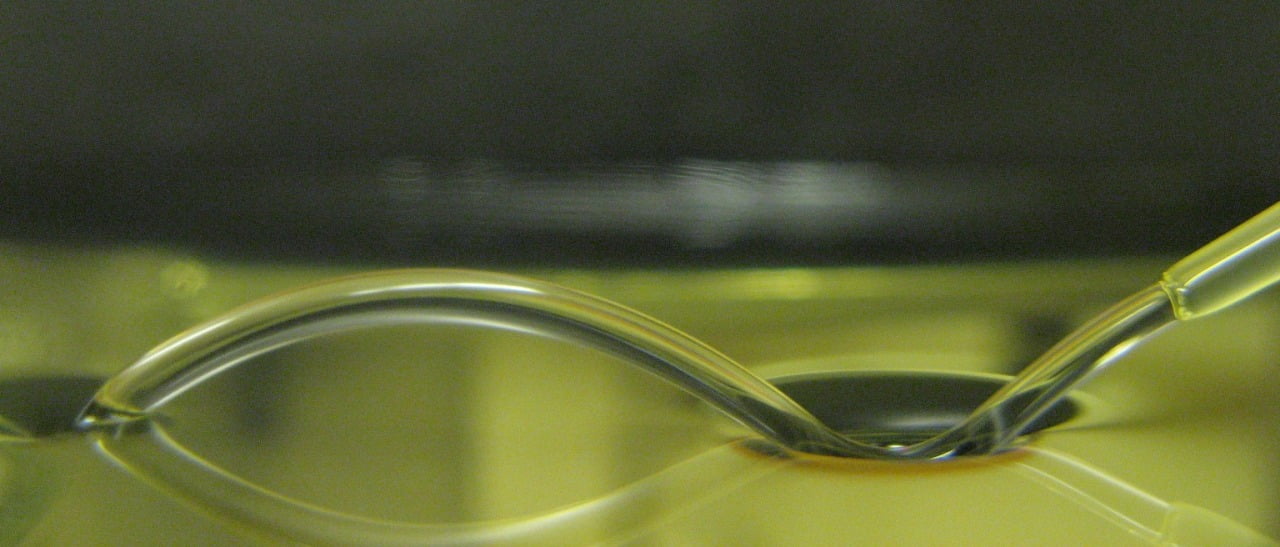
    For the right angles and flow rates, it’s possible to bounce a fluid jet off a pool of the same fluid. As the jet flows, it pulls a thin layer of air with it, entraining the air. This air film is what keeps the jet separate from the pool when it initially hits. In the photo above, the jet is flowing right to left; notice how it maintains its integrity within the dimple during the bounce. The pool’s surface tension acts almost like a trampoline, redirecting the jet’s momentum into the bounce. It’s even possible to get a double bounce. In this video, the mechanism is the same, although the apparatus is different. In the photo above, the jet is introduced with a horizontal velocity to induce air entrainment and bouncing. In the video, the pool is spinning, which provides the necessary horizontal velocity between the jet and the liquid pool. (Photo credit: J. Bomber and T. Lockhart)

  • Featured Video Play Icon

    Fluid Juggling

    It’s that time of the year – the 2013 APS Division of Fluid Dynamics meeting is not far off, and entries to this year’s Gallery of Fluid Motion are starting to appear. This week we’ll be taking a look at some of the early video submissions, beginning with one that you can recreate at home. This video demonstrates a neat interaction between a slightly-inclined liquid jet and a lightweight ball. The jet can stably support–or, as the authors suggest, juggle–the ball under many circumstances, as seen in the video. Initially, the jet impacts near the bottom of the ball and then spreads into a thin film over the surface. This decrease in thickness between the jet and the film is accompanied by an increase in speed due to conservation of mass. That velocity increase in the film corresponds to a pressure decrease because of Bernoulli’s principle. This means that there is a region of higher pressure where the jet impacts the ball and lower pressure where the film flows around the ball. Just as with airflow over an airfoil, this generates a lift force that holds the ball aloft. (Video credit: E. Soto and R. Zenit)

  • Hydraulic Bumps

    Hydraulic Bumps

    If you’ve ever noticed the circular jump in your kitchen sink when you turn on the faucet, you’re familiar with what a jet does when it plunges into a horizontal layer of liquid. If the liquid is deep enough, the jet will perturb the surface into a circular depression, as in Figure (a) above. As the flow rate increases, a recirculating vortex ring and hydraulic bump forms (Figure b photo and flow schematic). At a critical flow rate, the bump will become unstable and form polygons instead of circles. At even larger flow rates, the system will shift toward a hydraulic jump, with a larger change in fluid elevation. Like bumps, these jumps can also appear in a variety of shapes. (Image credit: M. Labousse and J. W. M. Bush)

  • Ferrofluid Thrusters

    Ferrofluid Thrusters

    Ferrofluids–magnetically-sensitive fluids made up of a carrier liquid and ferrous nanoparticles–may soon have a new application as a miniature thruster on nanosatellites. Microspray thrusters use tiny hollow needles to electrically spray jets of liquid that propel a satellite. But manufacturing the fragile microscopic needles used to disperse the propellant is expensive. Instead researchers are now using ferrofluids to create both the needle-like structures and to serve as the propellant. A ring of ferrofluid is placed on the thruster surface and a magnetic field applied to create the ferrofluid’s distinctive spikes. Then, when an electric force is applied, tiny jets of ferrofluid spray out from each tip, creating thrust. Unlike the conventional needles, the ferrofluid spikes are robust and can reform after being disturbed. (Photo credit: L. B. King et al.; submitted by jshoer)

  • Spiraling Break-up

    Spiraling Break-up

    Instabilities in fluids are sometimes remarkable in their uniformity. Here we see a hollow spinning cup with a thin film of fluid flowing down the interior. The rim of fluid at the cup’s lip stretches into long, evenly spaced, spiraling threads. These filaments stretch until centrifugal forces overcome surface tension and viscous forces and break the liquid into a multitude of tiny droplets. This process is called atomization and is vital to everyday applications like internal combustion and inkjet printing. (Photo credit: R. P. Fraser et al.)

  • Drop-Tower Droplets

    Drop-Tower Droplets

    A microgravity environment can cause some nonintuitive behaviors in fluids. Many of the effects that dominate fluid dynamics in space are masked by gravity’s effects here on Earth. As a result, it can be very difficult to predict how seemingly straightforward technologies like heat exchangers, refrigeration units, and fuel tanks will behave. The photos above show two bubble jets–created by injecting a liquid-gas mixture into a liquid–colliding in microgravity. This particular experiment was conducted in a drop tower rather than on-orbit, which produced some side effects like the large bubbles seen in the images. These were created by the coalescence of smaller bubbles that congregated near the top of the tank shortly before the experiment attained free-fall. (Photo credit: F. Sunol and R. Gonzalez-Cinca)

  • Featured Video Play Icon

    Protruding Fingers

    Instability is a common feature of fluid flows and can generate a near infinite set of patterns. The video above shows the Saffman-Taylor instability, an interface instability that occurs when a fluid of lower viscosity is injected into a higher viscosity fluid. In this case, the fluids inhabit a thin space between two glass plates. The less viscous fluid displaces the more viscous one in a series of branching finger-like shapes. If the situation were reversed, with a more viscous fluid injected into a less viscous one, the interface would be stable and expand radially without any pattern formation. (Video credit: William Jewell College)