Search results for: “lift”

  • Featured Video Play Icon

    Why Aren’t Trees Taller?

    Trees are incredible organisms, with some species capable of growing more than 100 meters in height. But how do trees get so big and why don’t they grow even taller? The limit, it turns out, is how far fluid forces can win over gravity.

    To live and grow, trees must be able to transport nutrients between their roots and their highest branches. As explained in the video, there are three forces that enable this transport inside trees: transpiration, capillary action, and root pressure. Of these, you are probably most familiar with capillary action, where intermolecular forces help liquids climb up the inside of narrow spaces, like the straw in your drink. Capillary action can’t lift liquids more than a few centimeters against gravity, though.

    Similarly, root pressure is limited in how far it can raise liquids. Functionally, it’s pretty similar to the way a column of water or mercury can be held up by atmospheric pressure acting at the base of a barometer. But atmospheric pressure can only hold up 10.3 meters of water, so what’s a tree to do?

    This is where transpiration — the most important force for sap transport in the tree — comes in. As water evaporates out of the tree’s leaves, it creates negative pressure that — along with water’s natural cohesion — literally drags sap up from the roots. It’s this massive pull that drives the flow and enables most of a tree’s height. (Image and video credit: TED-Ed)

  • Featured Video Play Icon

    Crystalline Critters

    In 5th grade, I grew crystals by evaporating solutions of salt water from miniature pie tins. The results were white, boxy crystals whose size depended on how much salt I’d managed to dissolve into the water. But it turns out I could have gotten much cooler results if I’d evaporated my salt water a drop at a time on a hot superhydrophobic surface. That’s how these researchers formed the “crystal critters” shown in the video above.

    Initially, the evaporating salt water drop is what we would expect, but once enough water is gone to leave a shell of salt, the drop grows legs and lifts off the surface. From that point, all growth occurs from the surface up. Because the surface is heated, evaporation happens quickest at that point of contact, and the water that remains is drawn down the legs, providing more fluid for evaporation as well as additional salt to grow the crystal. (Video, image, and research credit: S. McBride et al.)

  • Undulating Keeps Flying Snakes Steady

    Undulating Keeps Flying Snakes Steady

    Flying snakes undulate through the air as they glide. But, unlike on land, these wiggles aren’t for propulsion. A new study shows instead that they are key to the snake staying stable in flight.

    Upon take-off, a flying snake flattens its body, forming a wing-like shape that helps them generate lift and control drag. But while they glide, they also slither and pitch their tail.

    Researchers recorded more than 150 flights by live snakes, then used that data to construct their own digital snake. The model could fly like a real snake or be tested without undulations to see what would happen. The researchers discovered that, without that mid-air slithering, the snake quickly lost control and rolled to the side. (Image and research credit: I. Yeaton et al.; via NYTimes; submitted by Kam-Yung Soh)
  • Mimicking Insect Flight

    Mimicking Insect Flight

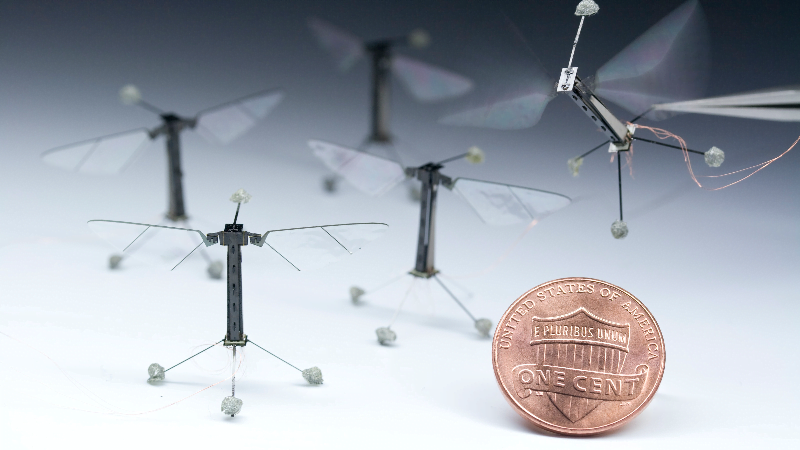
    There’s an oft-repeated tale that science cannot explain how a bumblebee flies. And while that may have been true 80 years ago, when engineers assumed they could apply their knowledge of fixed-wing aircraft to insects, it’s very far from the truth now.

    Being small, insects use aerodynamic tricks that are very different from the physics used by aircraft or even birds. Insects like fruit flies use a forward-and-backward sweeping motion at a very high angle of attack as they flap. This motion creates a vortex at the leading edge of the wing that provides the lift keeping the insect aloft. It still requires fast reflexes — most insects flap their wings hundreds of times a second — but the mechanism is robust enough to keep insects aloft and maneuverable. (Image credits: Robobee – K. Ma and P. Chirarattananon, simulation – F. T. Muijres et al., illustration – G. Lauder; via APS Physics)

  • Shedding Light on Martian Dust Storms

    Shedding Light on Martian Dust Storms

    In 2018, Mars was enveloped by a global dust storm that lasted for months. Although such storms had been seen before, the 2018 storm offered an unprecedented opportunity for observation from five orbiting spacecraft and two operating landers. As researchers comb through that data, they’re gaining new insights into the mechanisms that drive these extreme events.

    At NASA Ames, a team of researchers used observations of dust columns as input to a simulation of Mars’ global climate, then watched as the digital storm unfolded. Simulations like these have an important advantage over observations: the simulations allow scientists to track the transport of dust from one region to another.

    That dust tracking is critical for some of the team’s results. They found feedback patterns between dust lifting and deposition in different regions. For example, early in the storm dust was largely supplied from the Arabia/Sabaea regions, but once that dust was deposited in the Tharsis region, it kicked off a massive lifting event from Tharsis that put twice as much dust into the atmosphere as had landed there. Later, dust deposited back in Arabia by the Tharsis lofting generated new dust uplifts. As long as more dust got lifted than deposited, the intense storms continued. (Image credits: NASA, T. Bertrand/A. Kling/NASA Ames; research credit: T. Bertrand et al.; see also JGR Planets and AGU; submitted by Kam-Yung Soh)

  • Mossy Vortex Rings

    Mossy Vortex Rings

    Many plants have evolved an ability to move remarkably quickly. Often, this capability is driven by water. Here we see the moss Sphagnumaffine, which disperses its spores explosively. The process is triggered by the spore capsule gradually drying out; its shape changes from round to cylindrical, pressurizing the capsule. Once the internal pressure is high enough to overcome the strength of the capsule’s upper membrane, the capsule bursts, sending a plume of spores aloft. The sudden release of spore-laden air forms a vortex ring, which lifts the spores higher far more efficiently than they would be otherwise. (Image credit: capsule dry-out – J. Edwards et al., spore dispersal – J. Edwards et al. 2010; research credit: J. Edwards et al.)

  • Unifying Sediment Transport Theory

    Unifying Sediment Transport Theory

    On windy days, streaks of snowflakes snake in the air above a mountaintop snowfield. And when snorkeling in the surf, you can watch the inbound waves sculpt underwater ripples in the sand. Both are examples of sediment transport, and scientists have struggled to understand why the physics of these grains seems to differ between air and water. We observe certain behaviors, like saltation, in air and very different behaviors for grains underwater.

    One of the key differences is how much erosion occurs for a given amount of shear. In air, the relationship is linear; double the shear stress and you double the sediment transport rate. But in water, the relationship is nonlinear, meaning a small change in the shear stress can have a much larger effect on the rate of transport.

    A new study suggests that these differences are really only skin deep. Through detailed simulations, the researchers showed that what really matters is the energy dissipation caused by collisions between grains. Whether the medium is air or water, there are two important regions in the flow: the bed region where particles experience little movement, and the overlying region where grains are energized and lifted by the flow. In this framework, the researchers found no difference in how energy is dissipated, regardless of the medium.

    So why do measured sediment transport rates vary between air and water? The authors concluded that the relationship between shear and transport rate is, indeed, nonlinear. It’s just that the wind here on Earth is too weak to reach that nonlinearity. (Image credit: snow – wisconsinpictures, sand – J. Chavez; research credit: T. Pähtz and O. Durán; via APS Physics; submitted by Kam-Yung Soh)

  • Featured Video Play Icon

    Holding Pipes in Place

    Newton’s 3rd law states that any action has an equal and opposite reaction. Often engineers use this to our advantage; the thrust from expelling propellants is what lifts our rockets to space. But sometimes those reactions are undesirable, as illustrated in this Practical Engineering video with underground pipes.

    Anytime flow through the pipe is forced to change direction, the flow causes an equal and opposite force on the joint. Just as with rockets, engineers refer to this reaction force as thrust. And if the thrust goes unaccounted for, it will force pipe joints apart. Civil engineers use several methods to fix pipelines against these forces, including concrete blocks that distribute the force to the surrounding soil and flange fittings that resist pipe movement. (Video and image credit: Practical Engineering)
  • Kicking Droplets

    Kicking Droplets

    Moving the surface a droplet sits on creates some interesting dynamics, especially if the surface is hydrophobic. That’s what we see here with these droplets launched off an impulsively-moved plate.

    On the left, the drop has some limited contact with the plate and it takes time for the droplet to completely detach. When accelerated, the droplet first flattens into a pancake, the rim of which quickly leaves the plate. The center of the droplet is slower to detach, stretching the drop into a vase-like shape. When the drop does finally lose contact, it creates a fast-moving jet that shoots upward at several meters per second!

    In contrast the image on the left shows a levitating Leidenfrost droplet. Since this drop has no physical contact with the plate, the kick makes it leave the surface all at once, launching a pancake-like drop that quickly forms unstable lobes. (Image and research credit: M. Coux et al.)

  • Featured Video Play Icon

    Fluid Dynamics and Disease Transmission

    Right now people around the world are experiencing daily disruptions as a result of the recently declared coronavirus pandemic. There is a lot we don’t know yet about coronavirus, though researchers are working around the clock to report new information. Today’s video, though a couple years old, focuses on an area of medical knowledge that’s historically lacking but extremely relevant to our current situation: the mechanics behind disease transmission through sneezing or coughing.

    High-speed imagery of a sneeze cloud.

    Lydia Bourouiba is a leader in this area of research. Her studies have focused not on the size range of droplets produced but on the dynamics of the turbulent clouds that carry these droplets and what allows them to persist and spread. If you’ve wondered just why healthcare providers are recommending masks for sick people, keeping large distances between individuals, and frequent hand-washing, the image above hopefully helps explain why. Droplets carried in these turbulent clouds can travel several meters, and the buoyancy of the cloud’s gas components can help lift droplets toward ceiling ventilation. Right now, social distancing is one of our best tools against this disease transmission.

    My goal in posting this is not to panic anyone. Rather, I hope you leave better informed as to why these precautions are needed. With coronavirus, our detailed knowledge of its characteristics — how long it remains viable in the air or on surfaces, how much is needed for an infection to take hold, etc. — is limited. But from research like Bourouiba’s, we know that coughing and sneezing are remarkably efficient ways to deliver respiratory pathogens, and that’s why caution is warranted. Stay safe, readers. (Video credit: TEDMED; image credit: Bourouiba Research Group, source; research credit: L. Bourouiba et al., see also S. Poulain and L. Bourouiba, pdf)