Search results for: “lift”

  • Featured Video Play Icon

    Using Flow Separation to Fly

    Fixed-wing flight typically favors the efficiency of long skinny wings, which is why so many aircraft have them. But for smaller flyers, like micro air vehicles (MAVs), short and stubby wings are necessary to stand up the disruption of sudden wind gusts. But a new MAV design eschews that conventional wisdom in favor of a biological tactic: intentionally disrupting the flow.

    Usually designers aim to have a smooth, rounded leading edge to wings in order to guide air around the airfoil. But here researchers instead chose a sharp, thick leading edge that immediately disrupts the flow, causing a turbulent separation region over the front section of the wing. A rounded flap added over the trailing edge of the wing guides flow back into contact, giving the wing its lift generation.

    Odd as that design choice seems at first blush, it actually makes the aircraft extremely resilient, especially to the turbulence that so often thwarts small flyers. When your flow is already disrupted, a little extra turbulence doesn’t make a difference.

    The thicker wing also allows them to use a longer wingspan — thereby gaining that skinny wing efficiency — and move most of the components that would normally be in a fuselage into the wings themselves. By essentially turning most of the MAV into a wing, the designers avoid the loss of lift associated with the fuselage section of the wings.

    Diagram of new micro air vehicle wing design, showing the full device as well as a cross-section with flow separation and reattachment.

    (Image, video, and research credit: M. Di Luca et al.; via IEEE Spectrum; submitted by Kam-Yung Soh)

  • Featured Video Play Icon

    “Viscoelasticity Gives You Wings!”

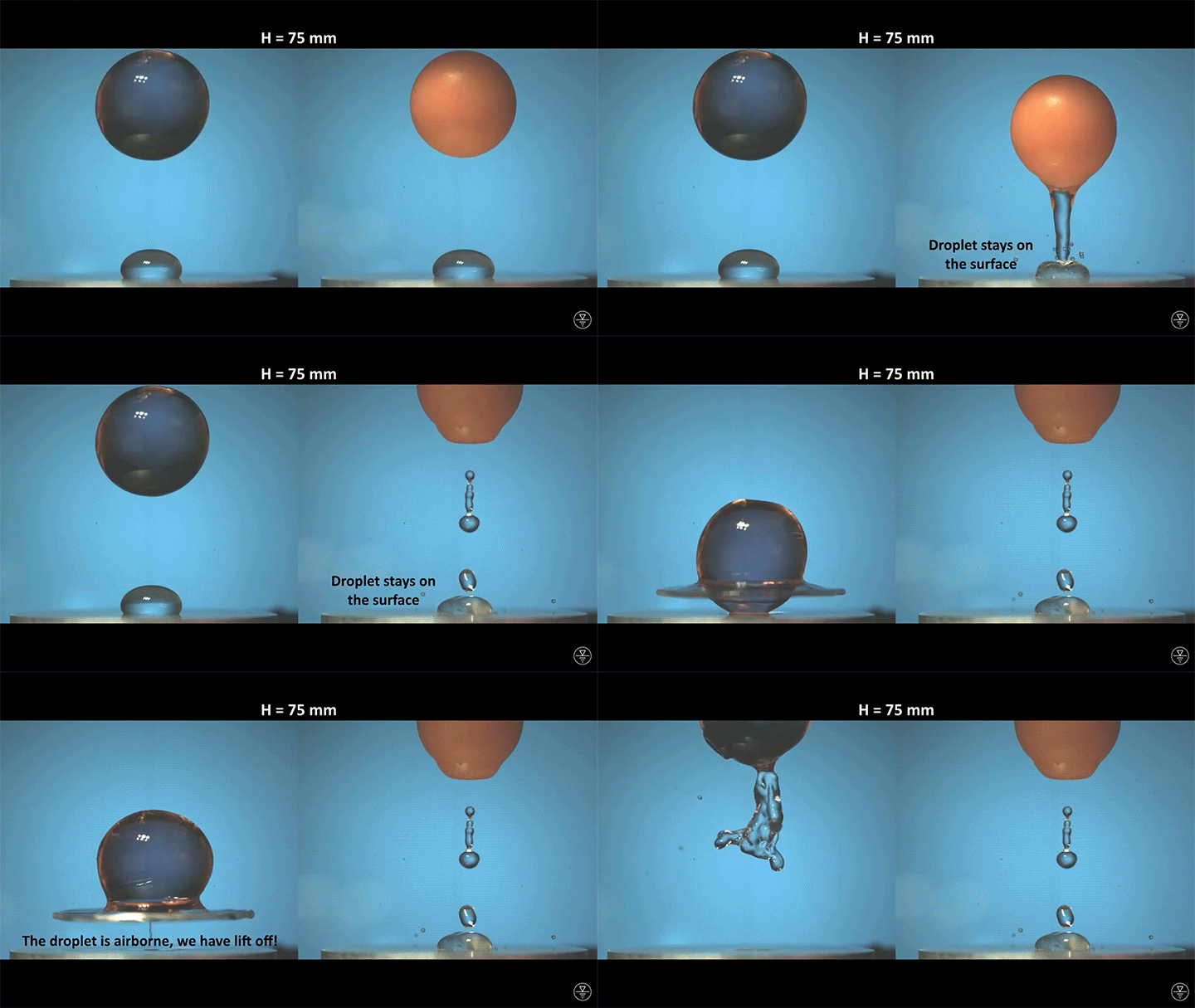
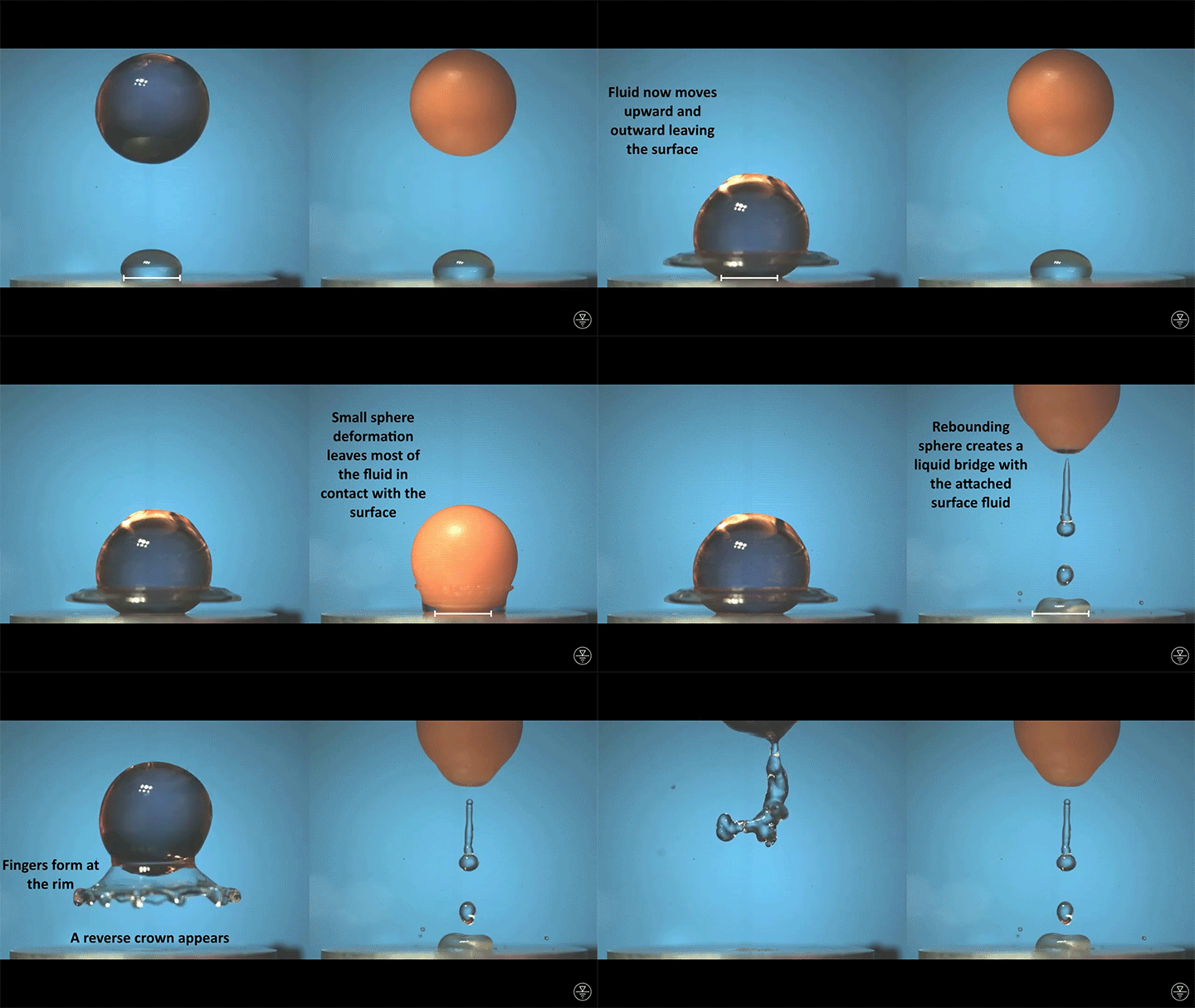
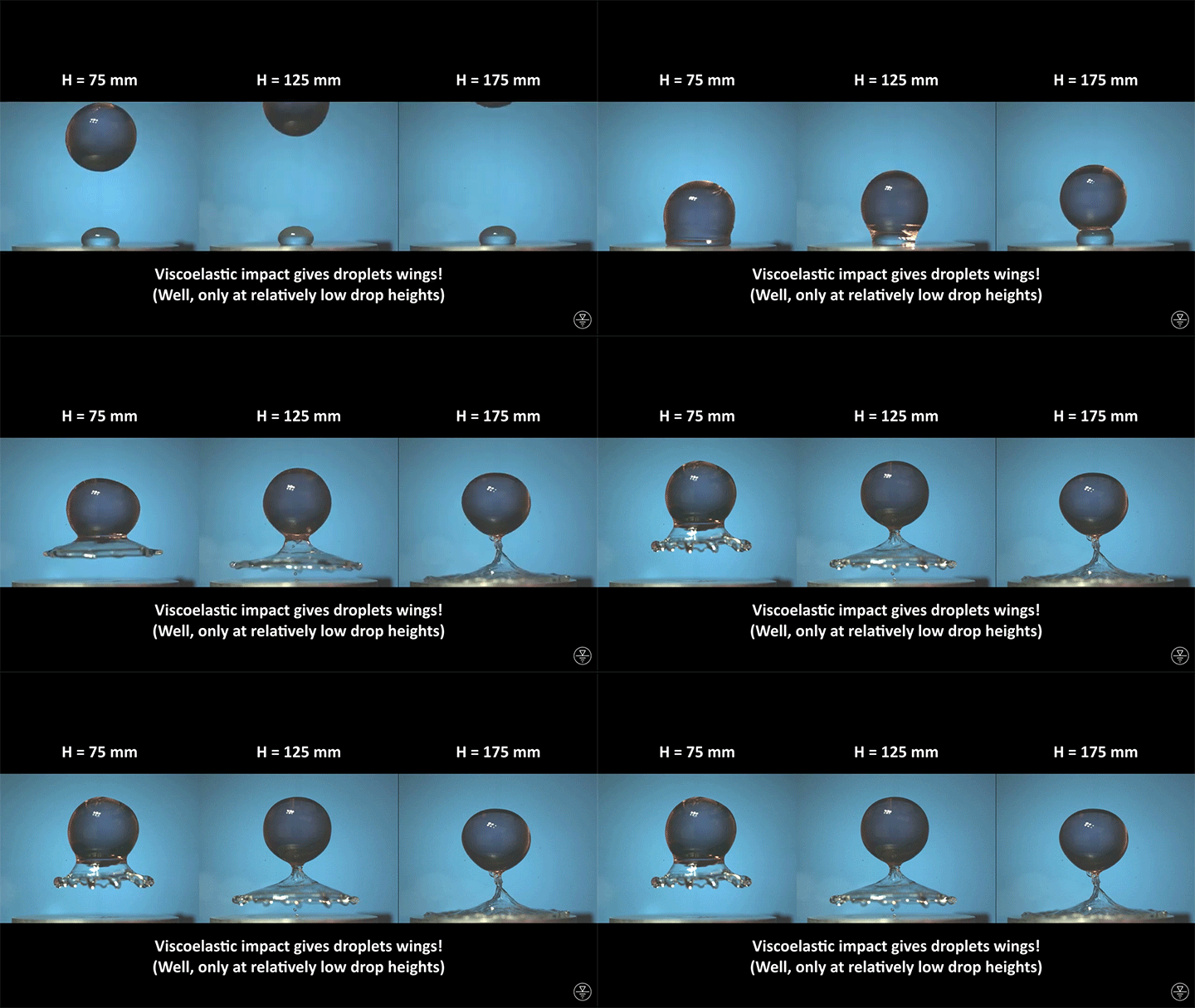
    What happens when you drop a hydrogel bead on a water droplet? Because of the hydrogel’s viscoelasticity and its hydrophilic nature, the rebounding bead carries the droplet with it. As seen in the video above, when the impact energy is small enough, the droplet forms a reverse crown during lift-off, kind of like giving the hydrogel bead a skirt. The key feature for lift-off is the bead’s deformation on impact. Because the hydrogel widens at its base, it is sometimes able to push the entire droplet off its initial footprint and detach it from the surface. (Image, research, and video credit: R. Rabbi et al.)

  • Flow on Commercial Wings

    Flow on Commercial Wings

    Even in an era of supercomputers, there is a place for quick and dirty methods of flow visualization. Here we see a model of a swept wing like those seen on many commercial airliners. It was painted with a layer of fluorescent oil, then placed in a wind tunnel and subjected to flow. As air blows across the model, it moves the oil, leaving behind streaks that show how air near the surface moves. 

    We can see, for example, that near the fuselage, the air flows mostly front to back across the wing. That’s what we expect, especially for a wing generating lift. But further out on the wing, the flow moves mostly along the wing, not across it. There’s also a distinctive line running just a short ways behind the leading edge on this outer section of wing. It looks as though air flowing over the wing separated at this point, leaving disordered and unhelpful flow behind. It’s likely that the model was tested at an angle of attack where the outer section of the wing was beginning to stall. (Image credit: ARA)

  • Surfing Honeybees

    Surfing Honeybees

    Honeybees have superpowers when it comes to their aerodynamics and impressive pollen-carrying, but their talents don’t end in the air. A new study confirms that honeybees can surf. Wet bees cannot fly–their wings are too heavy for them to get aloft when wet–but falling into a pond isn’t the end for a foraging honeybee.

    Instead, the bee flaps its wings, using them like hydrofoils to lift and push the water. This action generates enough thrust to propel the bee three body lengths per second. It’s a workout the bee can only maintain for a few minutes at a time, but researchers estimate honeybees could cover 5-10 meters in that time. Once ashore, the bee spends a few minutes drying itself, and then flies away no worse for the wear. (Image and research credit: C. Roh and M. Gharib; via NYTimes; submitted by Kam-Yung Soh)
  • Freezing Bubbles

    Freezing Bubbles

    Scientists have observed distinctive differences in the way soap bubbles freeze depending on their environment. If a bubble is surrounded by room temperature air but placed on a cold surface (top), it freezes from the bottom up, with a clear freeze front that slowly creeps upward.

    In contrast, bubbles in an isothermal environment – one where it’s equally cold everywhere – freeze with a snow-globe-like effect of ice crystals (bottom). This freezing mode is actually triggered by a Marangoni flow. As the thin bottom layer of the soap bubble begins to freeze, it releases latent heat. That local heating changes the surface tension enough to generate an upward flow. You can see the plumes form right as the bubble touches the surface. Those plumes lift up tiny ice crystals, which continue to grow, ultimately forming the snowy crystals we see take over the surface. (Image and research credit: S. Ahmadi et al.; submitted by Kam-Yung Soh)
  • The Impressive Take-Off of Pigeons

    The Impressive Take-Off of Pigeons

    One reason that peregrine falcons are such amazing fliers is that their prey, pigeons, are no slouches in flight, either. Able to take off vertically and accelerate to 100 kph in two seconds, pigeons are pint-sized powerhouses. With this high-speed video, BBC Earth highlights the mechanics of this vertical take-off. Pigeons begin by bending their legs and jumping high enough that their first downstroke can extend fully and still clear the ground. That gives them a headstart on generating the force they need to propel themselves upward. 

    Note the way the pigeon’s wings move, sweeping from directly behind the bird’s back to a full extension in front of it. With the bird moving vertically, this motion tells us that it’s thrust – not aerodynamic lift – from the wingstroke that’s powering this take-off. In that sense, the pigeon is something like a Harrier jet, using the thrust of air downward to take off vertically. (Image and video credit: BBC Earth)

  • The Skipping Dambusters

    The Skipping Dambusters

    During World War II, the Allies developed “dambuster” bombs that skipped repeatedly off the surface of the water before striking their target. The goal was to cleverly bypass their enemies’ defenses both above and below the surface. Although the original dambusters used spinning spheres, the ricochet physics works for many other configurations as well; essentially, the physics are identical to rock-skipping. Conventional bullets can also skip off the water, though the required angle for skipping depends strongly on the shape of the bullet. If the geometry of the bullet impact doesn’t generate enough hydrodynamic lift, there will be no skip. (Image credit: Barnes Wallis Foundation, source; research credit: V. Murali and S. Naik, pdf; submitted by Marc A.)

  • Jets from Lasers

    Jets from Lasers

    Laser-induced forward transfer (LIFT) is an industrial printing technique where a laser pulse aimed at a thin layer of ink creates a tiny jet that deposits the ink on a surface. In practice, the technique is plagued with reproducibility issues, in part because it’s difficult to produce only a single cavitation bubble when aiming a laser at the liquid layer. This is what we see above. 

    The laser pulse creates its initial bubble just above the middle of the liquid layer. Shock waves expand from that first bubble and quickly reflect off the liquid surface (top) and wall (bottom). When reflected, the shock waves become rarefaction waves, which reduce the pressure rather than increasing it. This helps trigger the clouds of tiny bubbles we see above and below the main bubble. 

    The effect is worst along the path of the laser pulse because that part of the liquid has been weakened by pre-heating, but impurities and dissolved gases in the liquid layer are also prone to bubble formation, as seen far from the bubble. The trouble with all these unintended bubbles is that they can easily rise to the surface, burst, and cause additional jets of ink that splatter where users don’t intend. (Image and research credit: M. Jalaal et al.; submitted by Maziyar J.)

  • Guiding Particles with Chladni Patterns

    Guiding Particles with Chladni Patterns

    During the 19th century, Ernst Chladni and Michael Faraday independently explored the patterns formed by particles of different sizes placed on a vibrating plate. Faraday found that large particles accumulated at nodes of the plate, where there was no vertical vibration, whereas smaller particles moved toward anti-nodes, where air currents caused by the large vibration amplitude lifted them up.

    The situation becomes a little different if you submerge the vibrating plate in water. Then large, heavy particles gather at the anti-nodes. Drag keeps the particles on the plate, while acoustic forces and gravity conspire to move the particles horizontally toward the anti-nodes (top). Because anti-node patterns change with frequency, this actually provides a way to manipulate particle’s trajectories. The researchers demonstrated this by steering a particle through a maze (bottom) as well as by manipulating an entire swarm of beads. (Image and research credit: K. Latifi et al.; via Physics World; submitted by Kam-Yung Soh)
  • How Rain Can Spread Pathogens

    How Rain Can Spread Pathogens

    Rainfall can help spread pathogens from an infected plant to healthy ones. This transfer can happen both through droplets and by dry-dispersal of pathogen spores (top). When a raindrop hits a leaf, its initial spread triggers a vortex ring of air that can lift thousands of dry spores into a swirling trajectory (bottom). That boost in height carries spores beyond the slower wind speeds of the plant’s boundary layer and into faster air streams that disperse it toward healthy plants. (Image and research credit: S. Kim et al.)