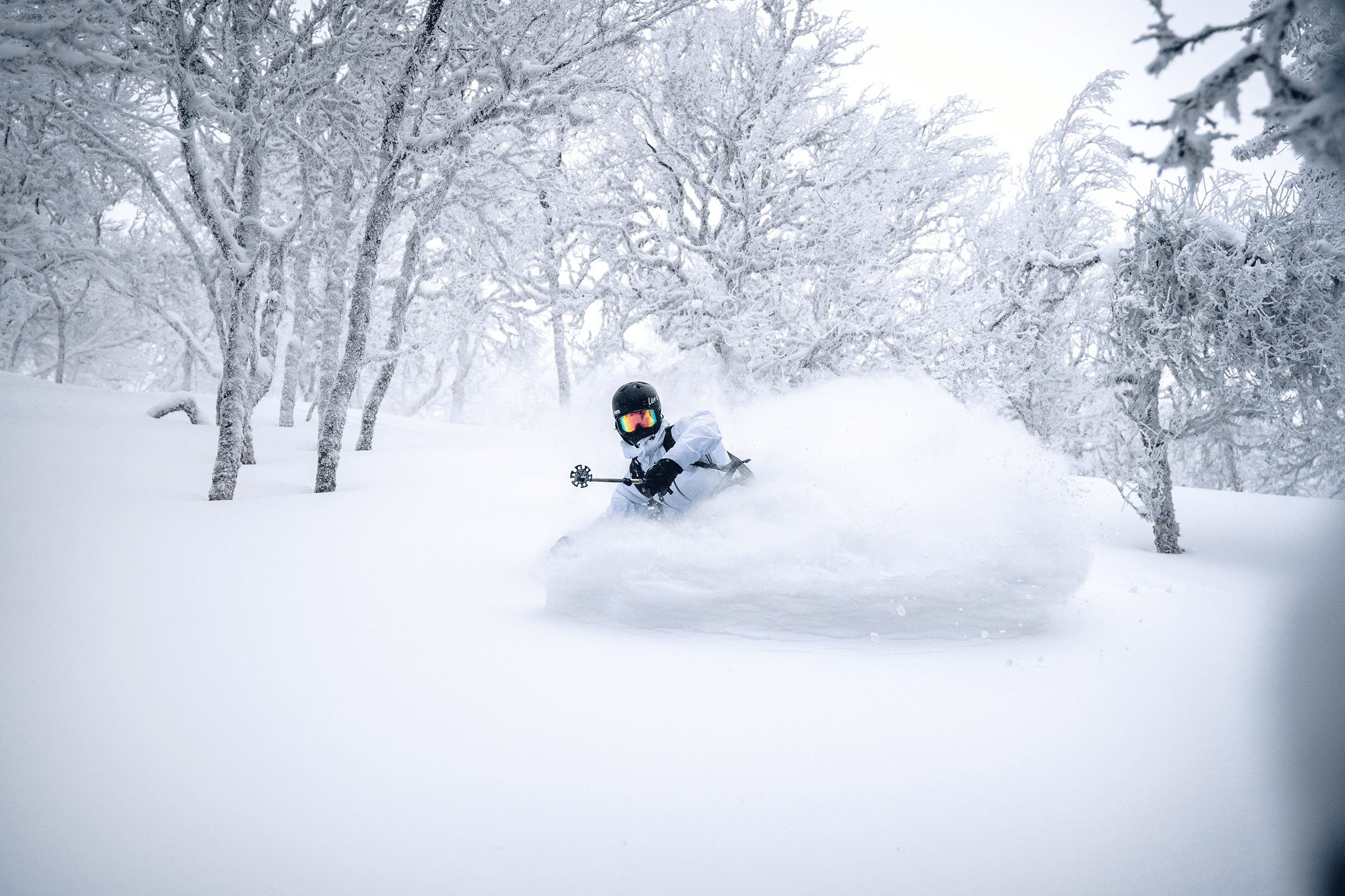
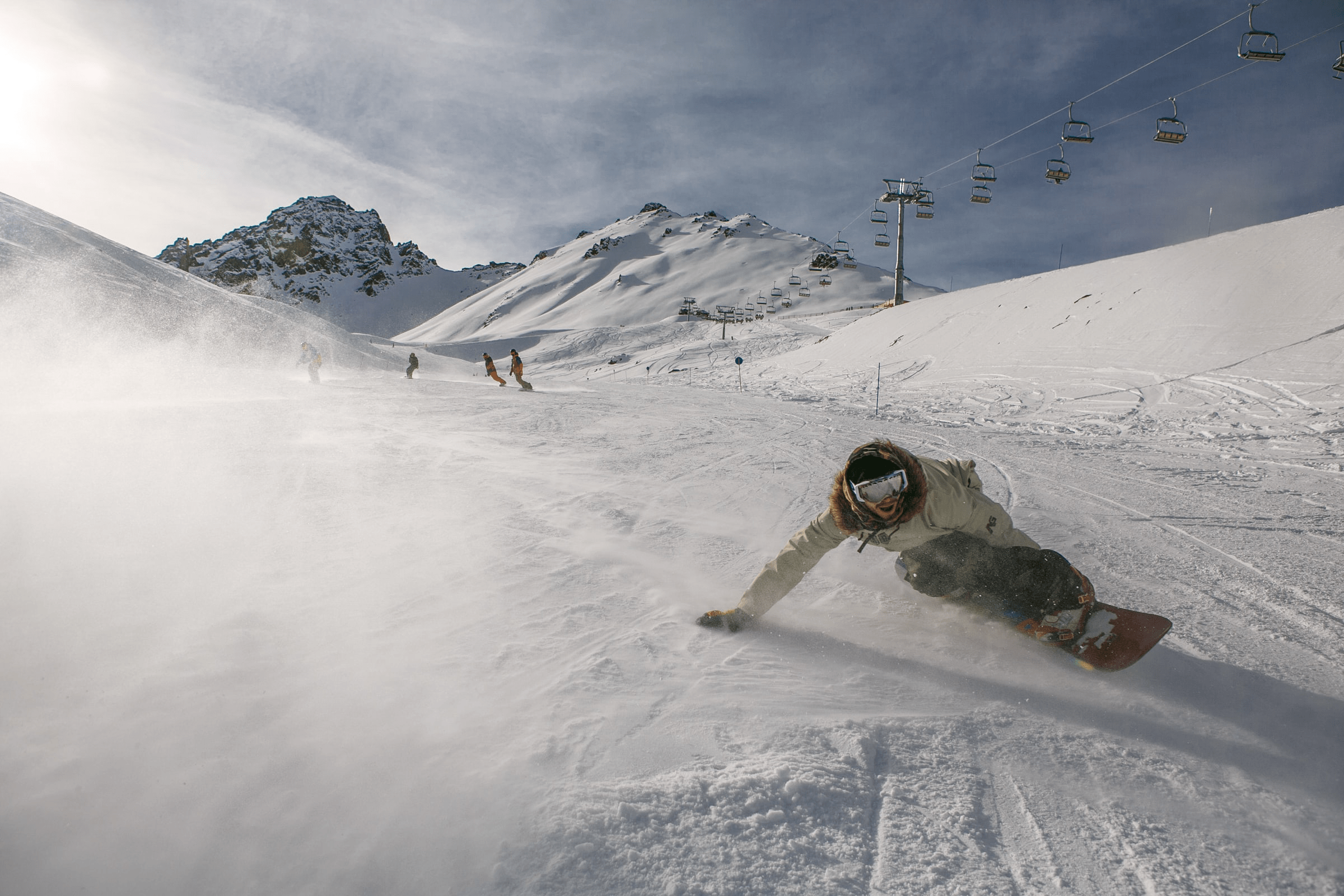
Skiing and snowboarding events rely on the peculiar physics of sliding on snow. According to classical lubrication theory, that sliding shouldn’t be nearly as low in friction as what we observe. The key here is that snow is soft and porous; it’s compressible, but it can also trap air (or water) in the pores between flakes. Because the passage of a skier or snowboarder is so fast, the air doesn’t have the time to slip out of the pores. Instead, it gets pressurized, providing lift that keeps the slider’s friction low. In the end, it isn’t the snow holding the slider up, it’s the air trapped in the snow beneath them! (Image credit: skier in powder – J. Andersson, snowboarder – Visit Almaty, halfpipe – P. T’Kindt; research credit: Z. Zhu et al.)
Search results for: “lift”

Beijing 2022: Ski Jumping
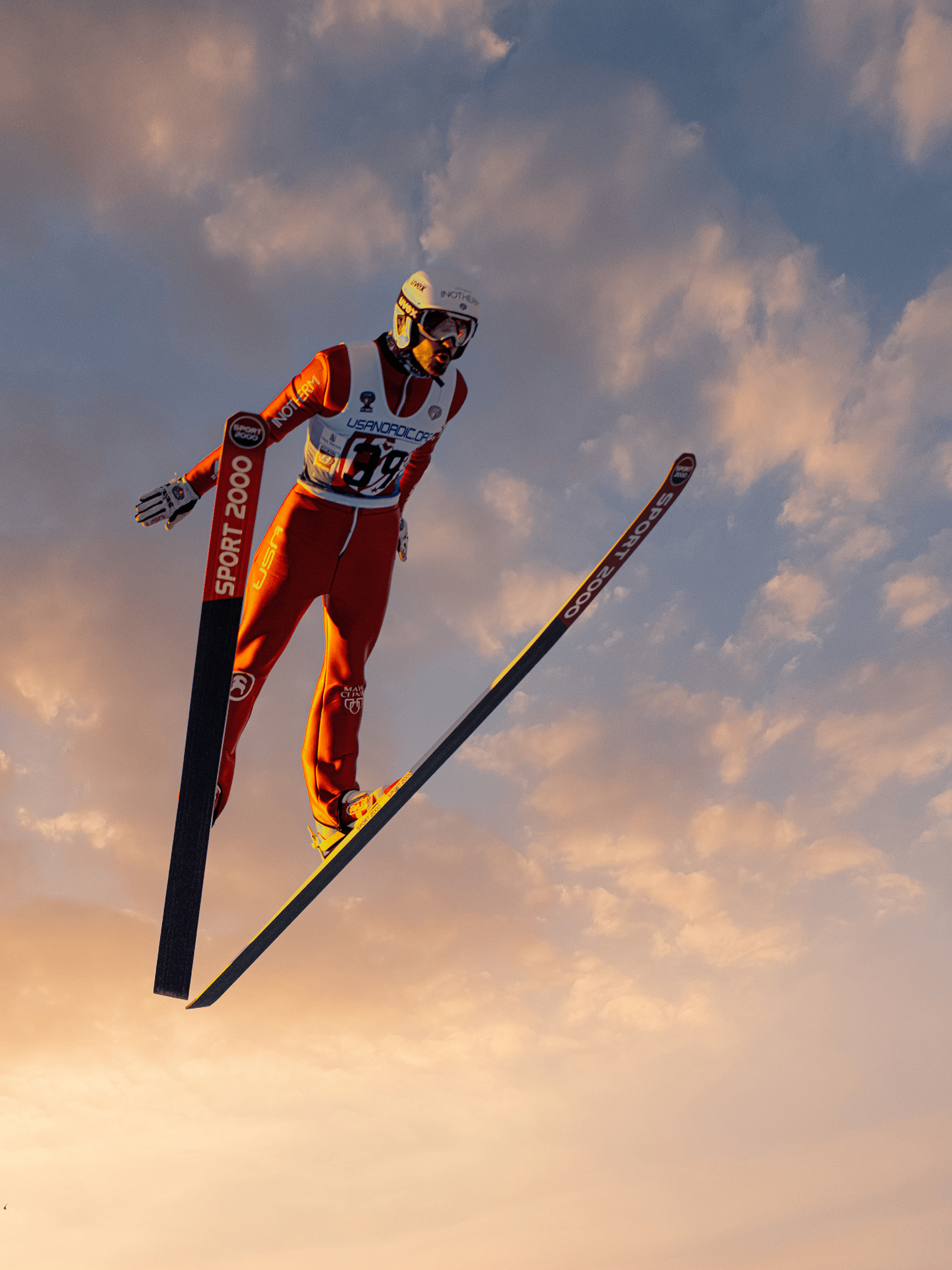
In ski jumping, aerodynamics are paramount. Each jump consists of four segments: the in-run, take-off, flight, and landing. Of these, aerodynamics dominates in the in-run — where jumpers streamline themselves to minimize drag and maximize their take-off speed — and in flight. During flight, ski jumpers spread their skis in a V-shape and lift their arms to the sides to turn themselves into a glider. Their goal is to maximize their lift-to-drag ratio, so that the air keeps them aloft as long as possible. Because of the short flight time and high risk of taking jump after jump, many elite ski jumpers use wind tunnel time to practice and hone their flight positioning, as seen in the video below.
Weather also plays a significant role in ski jumping; it’s one of the few sports where a headwind is an advantage to athletes. To try to adjust for wind effects, scoring for the sport uses a wind factor. (Image credit: T. Trapani; video credit: NBC News)

“In Flight”
Photographer Mark Harvey captured these stunning portraits of birds in flight. From acrobatic songbirds to soaring raptors, the images show the incredible morphology of a bird’s wing during flight. Most birds are constantly changing their wing shape to generate lift, change trajectory, and stabilize their flight. Note the separation between the flight feathers in all of these birds. Those gaps are thought help break up the birds’ wingtip vortices, thereby reducing their induced drag. You may also notice that the owls in Harvey’s photos have feathers that look a bit different from the other birds; owls have adaptations in their feathers that help damp out turbulence, which makes them quieter in flight. Prints of Harvey’s images are available on his website. (Image credit: M. Harvey; via Colossal 1, 2)

Insects Taking Flight
As awkward as they look sometimes, insects are amazing fliers. In this video from Ant Lab, we see all kinds of insects taking flight. Some, like the mantis, execute flying leaps to get in the air, whereas weevils begin flapping from a tripod stance. Watching these videos I’m always struck by how flexible insect wings are. They flex far more than I would imagine. And these insects have a lot of excess lift. Just check out that carrion beetle taking off despite being covered in mites! (Image and video credit: Ant Lab)

RC Ground Effect Plane
The ekranoplan was a massive, Soviet-era aircraft that relied on ground effect to stay aloft. In this video, RC pilots test out their own homemade version of the craft, including some neat flow visualization of the wingtip vortices. When an aircraft (or, for that matter, a bird) flies near the ground, it experiences less drag than at higher altitudes. This happens primarily because of the ground’s effect on wingtip vortices.
In normal flight, the vortices from an aircraft’s wingtips create a downwash that reduces the wing’s overall lift. But in ground effect, the vortices cannot drift downward as they normally do. Instead, they spread apart from one another, thereby reducing the drag caused by downwash from the aircraft. The end result is better performance, though it comes with added risk since there’s very little time to correct an error when flying at an altitude less than half the aircraft’s wingspan. (Video and image credit: rctestflight; submitted by Simplicator)

Animals Lapping
Without full cheeks, cats, dogs, and many other animals cannot use suction to drink. Instead, these animals press their tongue against a fluid and lift it rapidly to draw up a column of liquid. They then close their mouth on the liquid before it breaks up and falls down. (Cats are a bit neater about it, but as the high-speed images above show, dogs use the same method.)
A new study takes a look at the mathematics behind this feat, specifically how long it takes for the liquid column to break up. Normally, we describe that problem using the Plateau-Rayleigh instability, but in its usual form, the PR instability doesn’t account for the kind of acceleration drinking animals apply to the fluid. This new study modifies the equations to account for acceleration and finds that the predicted time it takes for breakup is consistent with the timing of animals closing their mouths on the water. In other words, cats and dogs are likely timing their lapping to maximize the amount of water they catch with each bite. (Image credits: top – C. van Oijen, others – S. Jung et al. 1, 2; research credit: S. Jung)

Flying Out of the Water
Flying fish and diving birds often navigate the interface between water and air in their flight, but few studies have actually looked at the effects of this transition on lift. In this work, researchers measured forces on a small, fixed wing as it egresses from water into air at a constant velocity.

The tests showed that exit velocity had a large effect on lift generation. At low speeds, an exiting wing experienced a strong, positive lift spike as soon as the leading edge broke the surface. But that lift changed to strongly negative as the wing continued out of the water. At higher speeds, the wings had no lift reversal but also reached lower peak lift coefficients. The team studied the effects of angle of attack and starting depth as well, concluding that any vehicles intended to navigate the water-air transition will need robust control systems prepared to deal with fast-changing forces. (Image credit: fish – J. Cobb, wing – W. Weisler et al.; research credit: W. Weisler et al.)

Whiffling Geese
This wild photograph shows a goose flying upside down with its head turned 180 degrees in a behavior known as whiffling. In this orientation, the bird’s typical lift characteristics are reversed, but as you can see in the video below, this doesn’t exactly make them fall out of the sky. I suspect the geese compensate by changing their angle of attack (unless descending rapidly is their goal). There are numerous theories as to why the birds whiffle, including escaping hunters by using an erratic flight path or just showing off to the other geese. Maybe they’re just out to have a little fun! (Image credit: V. Cornelissen; video credit: Flightartists Project; via Colossal; submitted by jpshoer)

Programmable Capillary Action
Capillary action combines the cohesive forces within a liquid and the adhesive forces between a liquid and solid to enable a liquid to fill narrow spaces, even against the force of gravity. To control capillary action, researchers are 3D-printing what they call “unit cells,” tiny structures that water and other liquids can climb. There’s no pump raising the liquid through these structures, just capillary action.
In a particularly neat demonstration of the technology, the researchers built a tree-like structure out of many open-walled unit cells and placed the “root” system in a closed reservoir. Capillary action drew liquid up the structure to the tips of its branches, where the dyed water evaporated. The process is similar to transpiration in trees, though in trees, capillary action provides much less of the lift. (Image and research credit: N. Dudukovic et al.; via Nature; submitted by Kam-Yung Soh)

Tokyo 2020: Sailing Faster Than The Wind
It’s a bit mindboggling, but by exploiting physics and geometry, a sailboat can reach speeds faster than the wind propelling it. Steve Mould demonstrates how in this video using some cool tabletop set-ups. Like a wing, a sail generates force by changing the direction of the incoming air. But the optimal speed for a sail is the one where the the flow doesn’t get deflected from its initial path at all (middle). If the sail were moving slower than this, the air would get pushed aside, creating a force that accelerates the boat. If the sail were moving faster, the air’s deflection would generate low pressure that would slow the boat down. Given this ideal match, it’s straightforward to show that, with the right sail angle, a boat can cover more distance than the air pushing it does in the same amount of time (right). Part of the mark of a great sailor is knowing how to manipulate this relationship to maximize your boat’s speed! (Image and video credit: S. Mould)
Missed some of our earlier Olympics coverage? Check out how to optimize oar lengths for rowing, volleyball aerodynamics, and the ideas behind future swim technologies.