Search results for: “lift”

  • Tornado from a Drone

    Tornado from a Drone

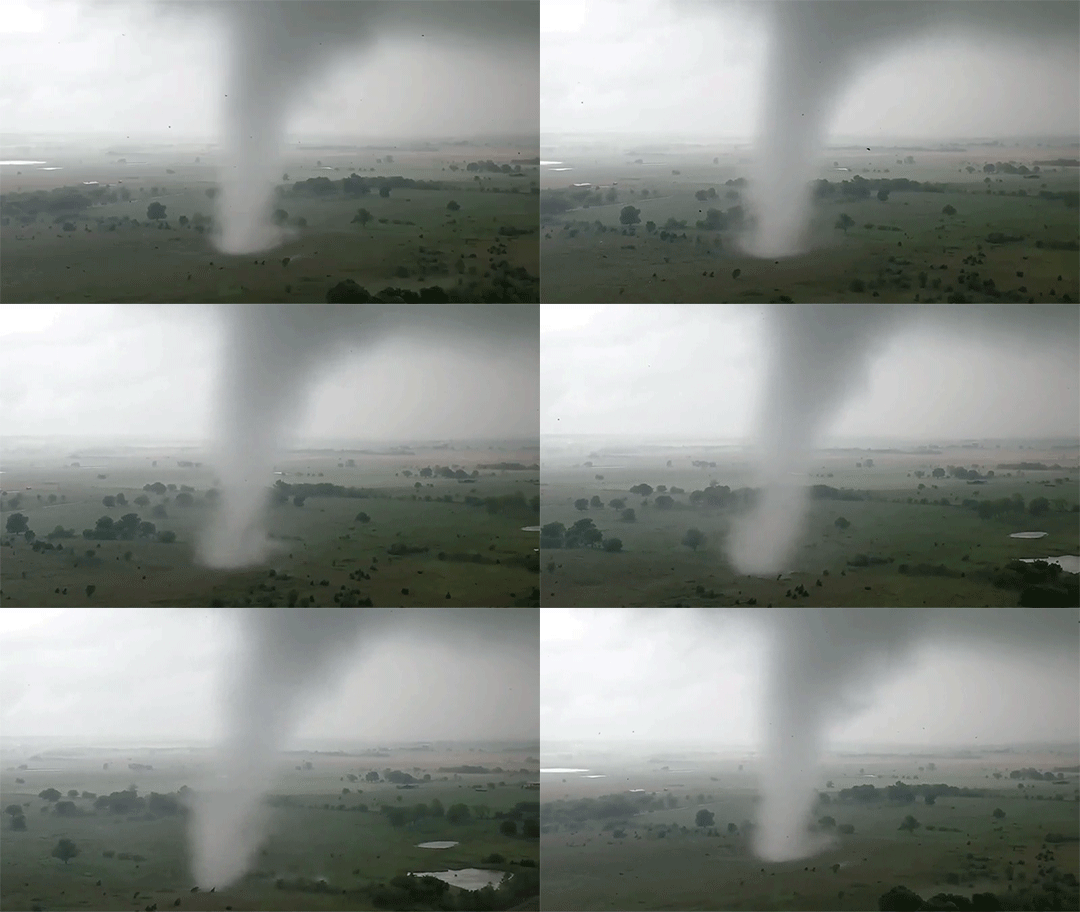
    One of the challenges in studying tornadoes is being in the right place at the right time. In that regard, storm chaser Brandon Clement hit the jackpot earlier this week when he captured this footage of a tornado near Sulphur, Oklahoma from his drone. He was able to follow the twister for several minutes until it apparently dissipated.

    Scientists are still uncertain exactly how tornadoes form, but they’ve learned to recognize the key ingredients. A strong variation of wind speed with altitude can create a horizontally-oriented vortex, which a localized updraft of warm, moist air can lift and rotate to vertical, birthing a tornado. These storms most commonly occur in the central U.S. and Canada during springtime, and researchers are actively pursing new ways to predict and track tornadoes, including microphone arrays capable of locating them before they fully form. (Image and video credit: B. Clement; via Earther)

  • Featured Video Play Icon

    Freezing Drop Impact

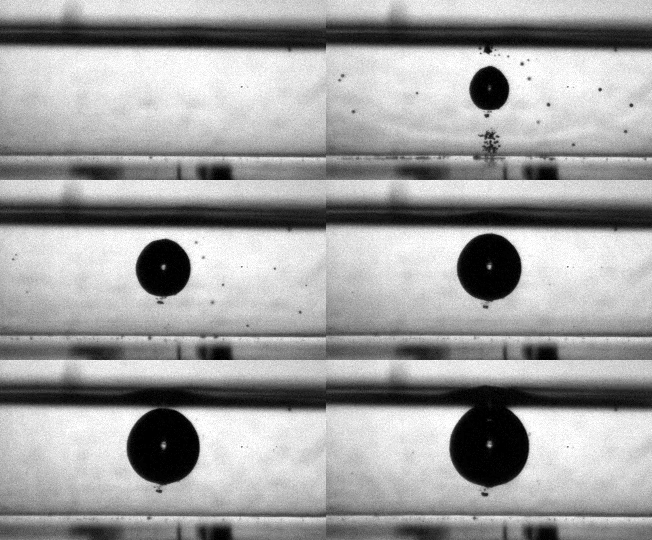
    At the altitudes where aircraft fly, it’s often cold enough for water drops to freeze in seconds or less. Once attached to a wing, such frozen drops disrupt the flow, reducing lift and increasing drag. To help understand how such droplets freeze, scientists study droplet impact on cold surfaces. Starting at room temperature (counter-clockwise from upper left), a drop will spread on the surface, then retract. When the temperature is colder, parts of the droplet freeze before retraction completes, leaving a thin sheet with a thicker center. At even colder temperatures, the droplet’s rim destabilizes and freezing occurs before the droplet has time to retract fully. And at the coldest temperatures, the droplet breaks apart into a frozen splash. (Image and video credits: V. Thievenaz et al.)

  • Inside a Wind Tunnel

    Inside a Wind Tunnel

    When I was in graduate school, I worked in a facility known as the High-Speed Wind Tunnel Lab. We were located next door to the Low-Speed Wind Tunnel, and every few months we’d receive a phone call asking whether we could film someone in the high-speed wind tunnel. This was impossible for several reasons – the size of human beings and the necessity of drawing the hypersonic tunnels down to vacuum-like pressures before initiating flow being only two of them – but what it really did was highlight the difference in definitions. 

    What these (usually) weather forecasters wanted was to simulate hurricane force winds on a human being. And to an aerodynamicist, that hundred mile-an-hour flow is still low-speed. Because we’re comparing it to the speed of sound, not the normal range of wind speeds a human experiences. That said, watching humans struggle inside a wind tunnel is always entertaining. 

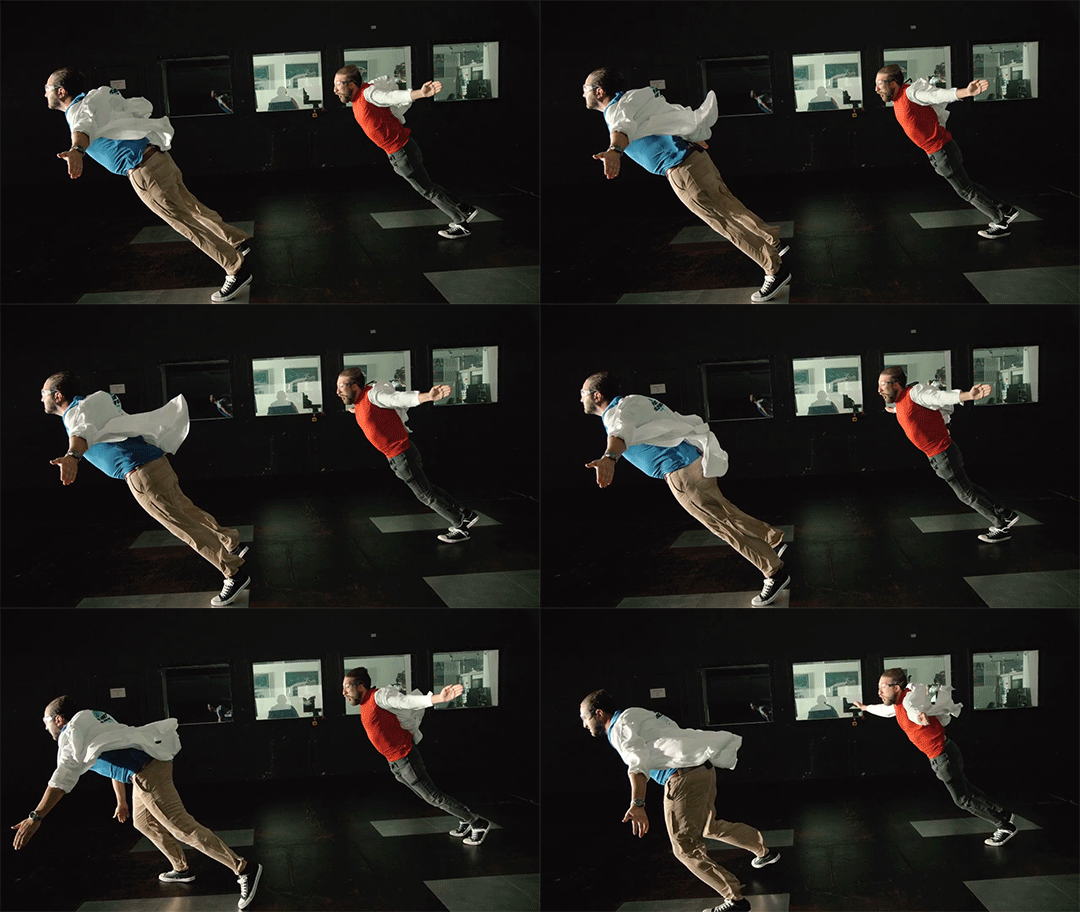
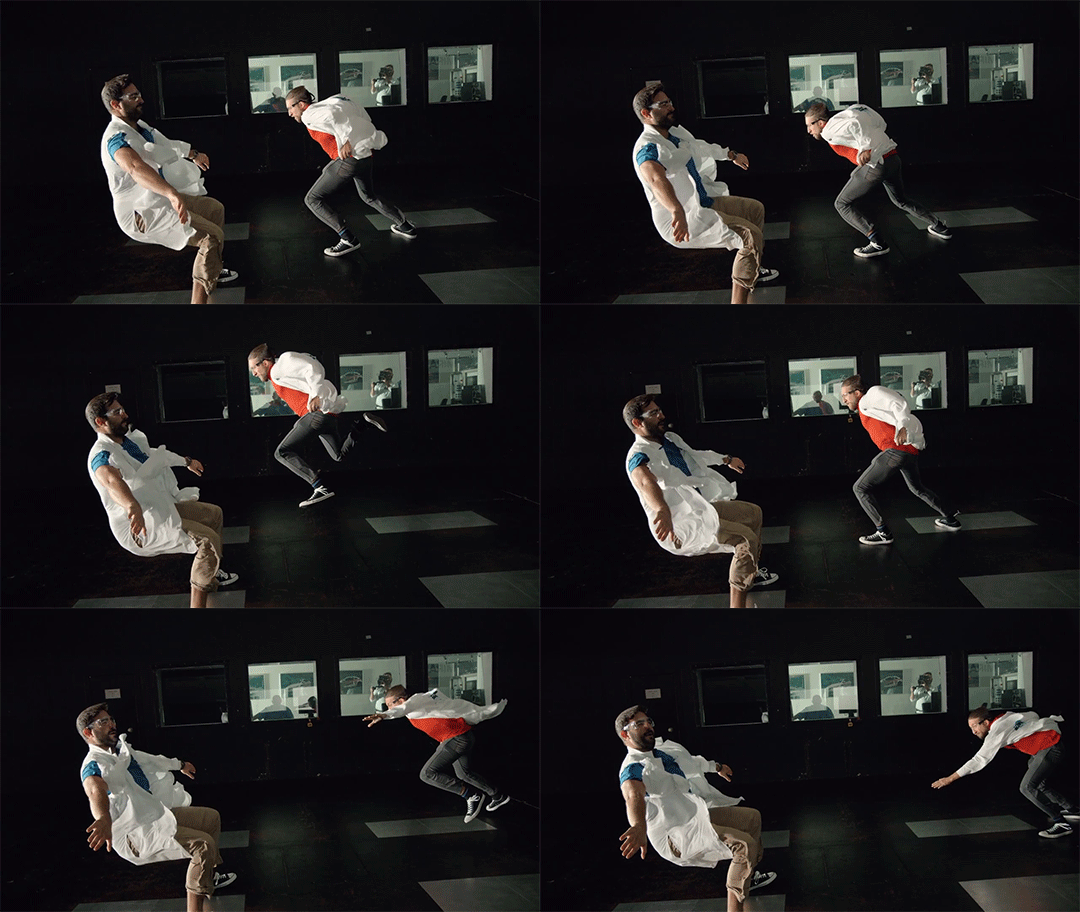
    As you can see from the Slow Mo Guys here, counteracting the lift and drag forces from these wind speeds is tough. On the bottom left, Dan has managed to balance his weight and the drag forces to hold himself in a virtual chair. Meanwhile, Gav’s attempt to jump forward against the wind just pushes him backward as his lab coat parachutes behind him. (Image and video credit: The Slow Mo Guys)

  • Dip Coating

    Dip Coating

    Imagine dipping a rod into a liquid mixture filled with particles. When you pull the rod out, do particles stick to it? The answer depends on the relative importance of two sets of forces: the viscous drag as you lift the rod and adhesive power of surface tension. Scientists express this as a dimensionless ratio known as the capillary number.

    When the capillary number is small, viscous drag dominates, and any particles that try to stick to the rod get pulled away (upper left). But as you increase the capillary number, surface tension helps particles clump together and stick to the rod (lower left and right). If the surface tension forces are strong enough – meaning that the capillary number is high –  you can actually get multiple layers of particles adhering to the dipped surface. (Image and research credit: E. Dressaire et al.)

  • Featured Video Play Icon

    “Winter’s Magic”

    Don Komarechka’s beautiful short film, “Winter’s Magic,” captures the beauty of soap bubbles as they freeze. It’s a delicate process and one difficult to capture in video. The bubble freezes first at the bottom, where it touches the cold surface – in this case, snow. That freezing releases latent heat and creates a temperature gradient along the thin liquid film. With that temperature gradient comes a variation in surface tension, and it’s this that creates the flow that lifts the ice crystals from the surface and turns the bubble into a snow globe. Eventually, as the frozen crystals continue growing, flow in the bubble walls comes to halt as the film solidifies.

    For more on the physics of freezing bubbles, check out this interview with the researchers, or, to learn more on how to film freezing bubbles, check out Komarechka’s description. (Video and image credit: D. Komarechka; via Laughing Squid; h/t to Jennifer O.)

  • Water-Walking Geckos

    Water-Walking Geckos

    Many animals can run on water. The tiniest creatures, like water striders, use surface tension to keep themselves atop the water.  Larger creatures like the basilisk lizard or the grebe slap the water’s surface to generate a vertical impulse that keeps them aloft. Geckos, it turns out, can run on water, too, but they’re too big to stay up with surface tension and too small to support their weight by slapping. So they’ve developed their own method.

    As you see in the top image, geckos use the slapping method for part of their support. Their slaps generate a little less than half of the force needed to keep them out of the water. 

    Surface tension is an important component, too. Geckos are extremely water repellent, which helps boost the lift they get from surface tension. In the bottom image, you see a gecko attempting to run on soapy water, which has a lower surface tension. The gecko is mostly submerged and more swimming than running – a clear demonstration that surface tension is important to its water-walking.

    Finally, the gecko undulates its body as it runs, much the way an alligator swims. The researchers suspect this helps the gecko generate forward thrust. Altogether, it creates a water-walking gait that, for now, is unique among observed mechanisms. (Image and research credit: J. Nirody et al.; via Ars Technica; submitted by Kam-Yung Soh)

  • Hovering

    Hovering

    Nectar-drinking species of hummingbirds and bats are both excellent at hovering – one of the toughest aerodynamic feats – but they each have their own ways of doing it. Hummingbirds (bottom) use a nearly horizontal stroke pattern that’s quite symmetric on both the up- and downstroke. To keep generating lift in the upstroke, they twist their wings strongly midway through the stroke. So although hummingbirds get most of their lift from the downstroke, they get quite a bit from the upstroke as well.

    Bats, on the other hand, use an asymmetric wingbeat pattern when hovering. Bats flap in a diagonal stroke pattern, using a high angle of attack in the downstroke and an even higher one during the upstroke. They also retract their wings partially during the upstroke. This flapping pattern gives them weak lift during the upstroke, which they compensate for with a stronger downstroke. Compared to non-hovering bat species, nectar-drinking bats do get more lift during the upstroke, but they’re nowhere near as good as the hummingbirds. The bats compensate by having much larger wings compared to their body size. Bigger wings mean more lift.

    In the end, the two types of hovering cost roughly the same amount of power per gram of body weight. That’s great news for engineers designing the next generation of flapping robots because it suggests two very different, but equally power-efficient methods for hovering. (Image credit: Lentink Lab/Science News, source; research credit: R. Ingersoll et al.; via Science News; submitted by Kam Yung-Soh

  • Stall with Pitching Foils

    Stall with Pitching Foils

    For a fixed-wing aircraft, stall – the point where airflow around the wing separates and lift is lost – is an enemy. It’s the precursor to a stomach-turning freefall for the airplane and its contents. But the story is rather different when the wing is actively pitching through these high angles of attack. In this case, you get what’s known as dynamic stall, illustrated in three consecutive snapshots above.

    In the top image, the flow has clearly separated from the upper surface of the wing, but this isn’t a cause for panic. As the middle image shows, there’s a vortex that’s formed in that separated region and it’s moving backward along the wing as the angle of attack continues to increase. That vortex causes a strong low-pressure region on the upper surface of the wing, allowing it to maintain lift.

    In the final image, the vortex is leaving the wing, taking its low-pressure zone with it. This is the point where the pitching wing loses its lift, but if the vortex’s departure is immediately followed by a pitch down to lower angles of attack, the aircraft will recover lift and carry on. (Image credit: S. Schreck and M. Robinson, source)

  • Settling in Straws

    Settling in Straws

    At some point in your life, you’ve probably stuck your finger over the end of a straw and used it to pick up the liquid you’re drinking. If you lift the straw so that the end is still in your drink and remove your finger from the top, the liquid level in the straw will drop, then bounce up and down a couple times before it settles. This is what we see happen in the series of snapshots in the top image. Eventually, the liquid level settles at its equilibrium position, marked by the red arrow at the far right.

    The liquid has to bounce before settling because capillary forces and the liquid’s inertia are battling it out moment by moment. Just how long the rebound takes depends on the initial height of the fluid and the depth the straw is immersed at, but it doesn’t depend on the fluid’s viscosity. Lower viscosity fluids do sometimes have a neat jet (bottom image) that forms at the immersed end of the straw, though. (Image and research credit: J. Marston et al.)

  • Featured Video Play Icon

    Flying on Flexible Wings

    Bats are incredible and rather unique among today’s fliers. Like birds, they flap to produce their lift and thrust, but where birds have relatively stiff wings, a bat’s wings are flexible. The thin webbing of skin stretched between the bat’s finger joints has muscles inside it that fire as the mammal flaps. This means that the bat may actively control just how stiff its wing is as it flies.

    Compared to other natural and manmade fliers, the bat is incredibly agile and stable, able to recover from wind gusts in less than a full wingbeat cycle. They also have some incredible acrobatic capabilities. When preparing to perch, a bat loses almost all of its aerodynamic lift but still manages to maneuver itself so it flips over and grabs hold. Check out the full video above to learn more about these fascinating animals. (Video and image credit: Science Friday; research credit: S. Swartz and K. Breuer)

    Editor’s Note: I’ll be travelling through the end of the month with limited email access. The blog should continue posting uninterrupted, but if you contact me, just know it may be awhile before I can get back to you. Thanks! – Nicole