Search results for: “lift”

  • Gliding Lizards

    Gliding Lizards

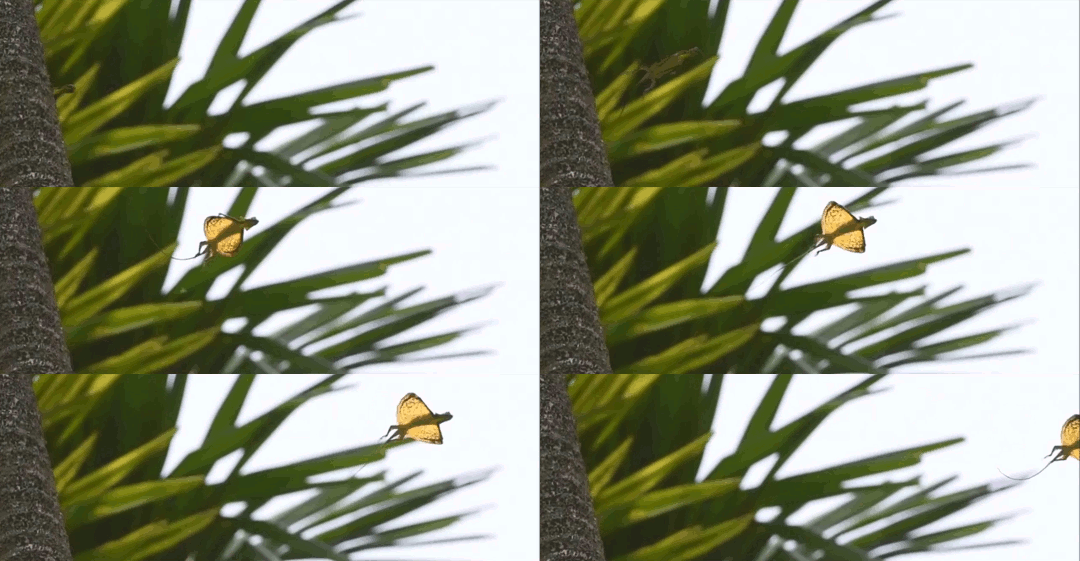
    Flying lizards are truly gliders, but that doesn’t mean they’re unsophisticated. Newly reported observations of the species in the wild show that flying lizards don’t simply hold their forelimbs out a la Superman. Instead, they reach back with their forelimbs, pressing their arms into the underside of the thin patagium that serves as their flight surface while rotating their hands to grasp the upper side of the patagium. This forms a composite wing with a thicker leading edge and seems to be how the lizards control their glide. Close observation of their flight shows that, while holding their patagium, the lizards actively arch their backs to camber their composite wing. This can increase their maximum lift coefficient, allowing them to glide longer distances. (Image and research credit: J. Dehling, source)

  • Delta Wing Flow Viz

    Delta Wing Flow Viz

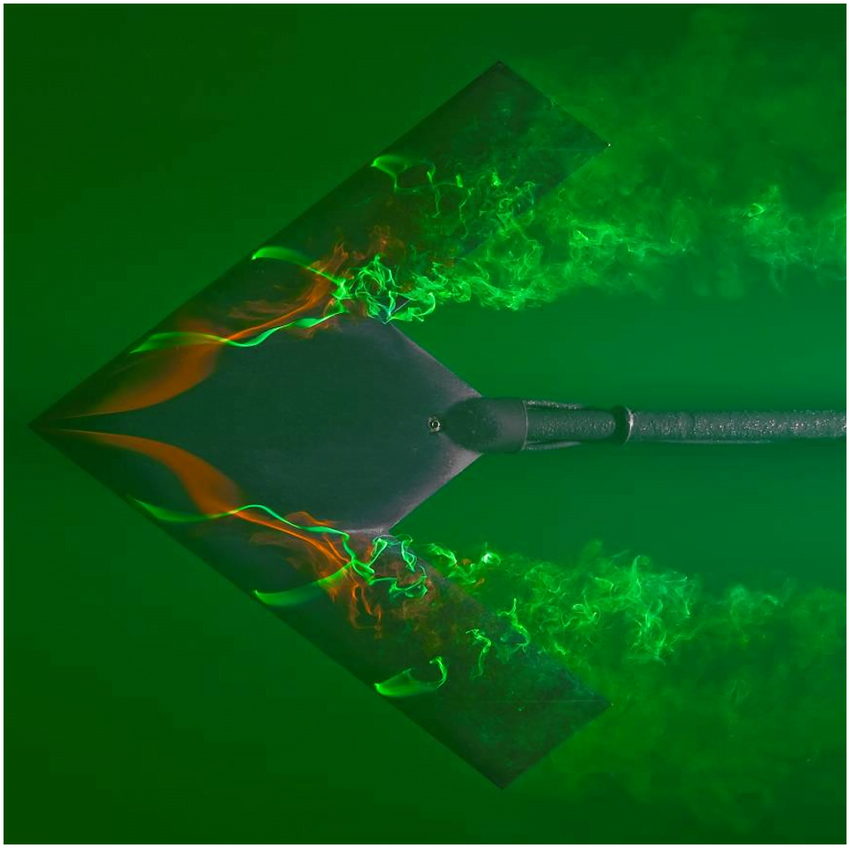
    Designing new aerodynamic vehicles typically requires a combination of multiple experimental and numerical techniques. The photo above shows a model for an unmanned flying wing-type vehicle. Here it’s tested in a water tunnel with dye introduced to the flow to highlight different areas. The model is at a high angle of attack (18 degrees) relative to the oncoming flow. This puts it in danger of flow separation and stall, the point where a wing experiences a drastic loss in lift. The smooth flow over the front of the model indicates it hasn’t reached this point yet, but notice how both the green and red dyes are separating from the model and becoming very turbulent over the back of the wing. If the model were pushed to an even higher angle of attack, that separation point would move further forward, bringing stall that much closer. (Image credit: L. Erm and J. Drobik; research credit: R. Cummings and A. Schütte)

  • Galapagos Week: Sea Turtles

    Galapagos Week: Sea Turtles

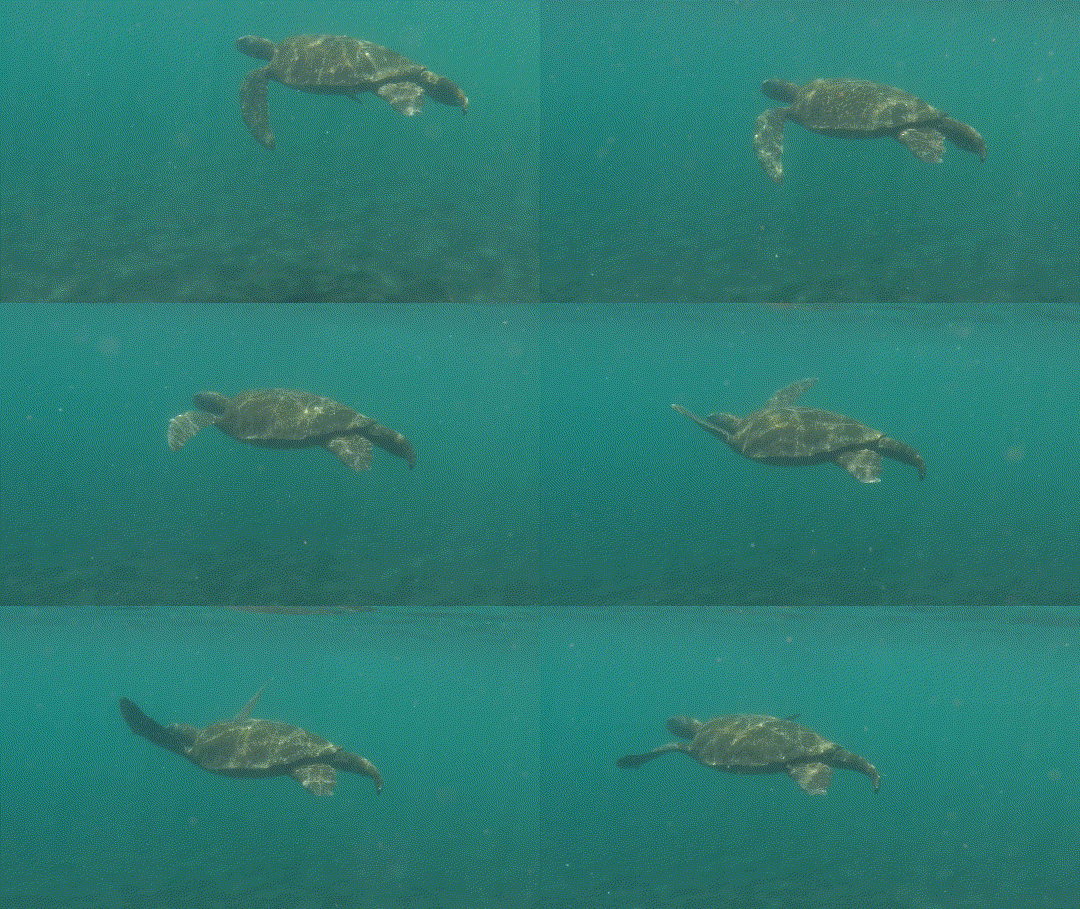
    It’s easy to imagine sea turtles as slow and awkward given our familiarity with their terrestrial cousins, tortoises, but this could hardly be further from the truth. There are currently seven living species of sea turtles and all use a mode of locomotion known as aquatic flight. As the name suggests, swimming sea turtles share a lot in common with birds and other fliers. They generate most of their propulsion by flapping their forelimbs. Like birds, they change the angle of attack of their flippers over the course of both their upstroke and downstroke. 

    Of course, a cruising sea turtle is more interested in thrust than lift, but the efficiency of flapping is far higher than that of a rowing motion. That holds true across a range of speeds and is probably why marine turtles, known for their vast migrations, predominantly use flapping. It’s also remarkable how fast they can move when they want to. The animations above show two species of sea turtles cruising casually at a speed where a snorkeler in fins could follow along. But when the turtles wanted to, they could take off at a clip no human could hope to match! (Image credit: N. Sharp; research credit: J. Davenport et al., J. Walker and M. Westneat, H. Prange, E. Dougherty et al.)

    Today’s post wraps up Galapagos Week here at FYFD, but there’s plenty more Galapagos-relevant fluid dynamics to go around. Here are some previous, related posts: how frigatebirds cruise the seas without getting wet;  aerodynamics of flying fish; hydrodynamics of humpback whales; incredible bioluminescent plankton; and leaping mobula rays

  • Flying Fish Aerodynamics

    Flying Fish Aerodynamics

    Flying fish, strange as it sounds, have aerodynamic prowess comparable to hawks. The fish aren’t true fliers, but they do glide for hundreds of meters using their large pectoral and pelvic fins as wings. Wind tunnel research shows the fish have their maximum lift at an angle of attack around 30-35 degrees, matching their typical take-off angle (top). Their best gliding performance occurs when they’re roughly parallel to the water (middle). The researchers even found that the fish use ground effect to enhance their lift. Although their aerodynamics allow flying fish to get out of reach of their aquatic predators, the fish must be wary of flying too high, as this makes them a target for frigatebirds (bottom). These acrobatic seabirds can’t get wet, but they have some impressive aerodynamics of their own to help make up for it.  (Image credit: BBC Earth, source; research credit: H. Park and H. Choi; see also SciAm)

  • Rocket Launch Systems

    Rocket Launch Systems

    If you’ve ever watched a rocket launch, you’ve probably noticed the billowing clouds around the launch pad during lift-off. What you’re seeing is not actually the rocket’s exhaust but the result of a launch pad and vehicle protection system known in NASA parlance as the Sound Suppression Water System. Exhaust gases from a rocket typically exit at a pressure higher than the ambient atmosphere, which generates shock waves and lots of turbulent mixing between the exhaust and the air. Put differently, launch ignition is incredibly loud, loud enough to cause structural damage to the launchpad and, via reflection, the vehicle and its contents.

    To mitigate this problem, launch operators use a massive water injection system that pours about 3.5 times as much water as rocket propellant per second. This significantly reduces the noise levels on the launchpad and vehicle and also helps protect the infrastructure from heat damage. The exact physical processes involved – details of the interaction of acoustic noise and turbulence with water droplets – are still murky because this problem is incredibly difficult to study experimentally or in simulation. But, at these high water flow rates, there’s enough water to significantly affect the temperature and size of the rocket’s jet exhaust. Effectively, energy that would have gone into gas motion and acoustic vibration is instead expended on moving and heating water droplets. In the case of the Space Shuttle, this reduced noise levels in the payload bay to 142 dB – about as loud as standing on the deck of an aircraft carrier. (Image credits: NASA, 1, 2; research credit: M. Kandula; original question from Megan H.)

  • Mosquito Flight

    Mosquito Flight

    Mosquitoes are unusual fliers. Their wings are long and skinny, and they beat at around 700 strokes a second – incredibly quickly for their size. Examining how they move has uncovered some interesting mechanics. Despite their short stroke length, the mosquito generates a lot of lift on both its upstroke (when the wing is moving backward) and its downstroke (when the wing moves forward). Some features of the mosquito’s flight are highlighted in the images above. In the animation, blue indicates areas of low pressure and red indicates high pressure.

    Like most flapping fliers, the mosquito generates a leading-edge vortex during its downstroke (and its upstroke). This vortex helps concentrate low pressure on the upward-facing wing surface, thereby creating lift. One of the things that makes the mosquito unique, however, is that it also creates trailing-edge vortices on both half-strokes. To do this, the mosquito rotates its wings precisely to catch the wake of its previous half-stroke. The flow gets trapped near the trailing edge of the wing and forms a vortex and low-pressure region. Like the leading-edge vortex, this low-pressure area on the upward-facing wing surface creates lift. For more secrets of mosquito flight, check out this video from Science or the original paper. (Image credit: R. Bomphrey et al., source)

  • Featured Video Play Icon

    Quad Copter Schlieren

    Schlieren photography is a classic method of flow visualization that utilizes small variations in density (or temperature) to make otherwise unseen air motion visible. Because changing air’s density or temperature changes its index of refraction, variations in either quantity show up as dark and light regions. Here researchers use it to reveal some of the airflow around a small quadcopter, including the vortices that spiral off each propeller and help generate the lift necessary for take-off. The full video includes a couple of neat demos, including what happens when the blades are wet (shown below). In that case, the wingtip vortices are somewhat disrupted by strings of water droplets being flung off the blades by centrifugal force. Beautiful!  (Video and image credit: K. Nolan et al., source; submitted by J. Stafford)

  • Featured Video Play Icon

    The Flying Draco

    Nature includes many animals that are so-called fliers: flying squirrels, flying snakes, and draco lizards, to name a few. These animals aren’t true fliers like birds, bats, or insects, though. Instead, they are expert gliders, able to produce enough lift to control their descent and land safely at a distance far greater than a normal leap could carry them. Like the flying squirrel, the draco lizard extends a thin membrane that acts as its wings. The additional area provides enough lift that the lizards can glide as far as 60 m (200 ft) while only losing 10 m (33 ft) in altitude. That’s an impressive glide ratio – about 3 times better than the Northern flying squirrel and twice as good as a wingsuit. (Video credit: BBC/Planet Earth II)

  • Using Jets to Find Food

    Using Jets to Find Food

    Archer fish are well-known for their ability to hit aerial targets with perfectly aimed jets of water, as we’ve discussed previously. But a new study shows they use a similar technique to form underwater jets that help them uncover food. The researchers found that the fish altered the timing of their jet formation based on the type of substrate – fine sand, course sand, or mud – that the food pellet was hidden in. A great next step in this research would be using a technique like particle image velociometry (PIV) to measure the flow field directly and see to what extent the fish’s actions are altering the jet they produce. (Image and research credit: J. Dewenter et al.; GIF source: freshphotons)

  • Turbine Wakes in the Sea

    Turbine Wakes in the Sea

    What we we build always has an impact on the environment around us. The white dots you see in the image above are an array of offshore wind turbines, standing in waters 20 to 25 meters deep. The brownish lines extending from each turbine show the underwater wakes of the turbines, colored by the sediment they’ve picked up. As with trees in a snowstorm, the currents flowing past the base of the turbine likely form a horseshoe vortex that lifts up the sediment into the wake. Because the tides in this area reverse direction every six hours, these sediment plumes can appear quite dynamic in satellite imagery, frequently changing strength and direction. (Image credit: NASA Earth Observatory)