Search results for: “lift”

  • Flying Backwards

    Flying Backwards

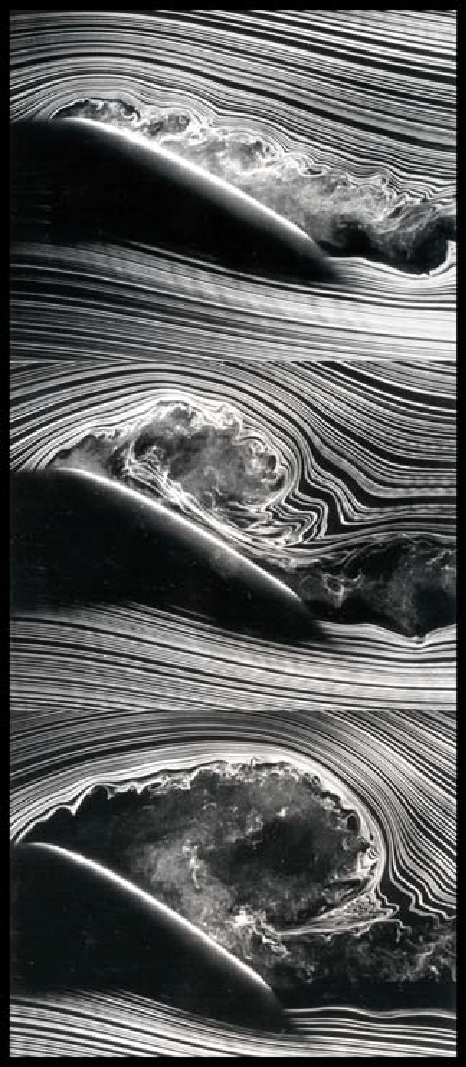
    Spend a summer afternoon floating in a kayak and chances are you’ll see some impressive aerial acrobatics from dragonflies. One of the dragonfly’s superpowers is its ability to fly backwards, which helps it evade predators and take-off from almost any orientation. To do this, the dragonfly rotates its body so that it is nearly vertical, thereby changing the direction it generates lift. In engineering terms, this is “force-vectoring,” similar to the techniques used by helicopters and vertical-take-off jets. 

    Scientists found that backwards-flying dragonflies could generate forces two to three times their body weight, in part due to the strong leading-edge vortices (bottom image) formed on the forewings. They also found that the hind wings are timed so that their lift is enhanced by catching the trailing vortex of the first pair of wings. Engineers hope to use what they’re learning from insect flight to build more capable flying robots. (Image and research credit: A. Bode-Oke et al., source; via Science)

  • Star Wars Aerodynamics

    Star Wars Aerodynamics

    Science fiction is not always known for hewing to scientific fact, so it will probably come as little surprise that Star Wars’ ships have terrible aerodynamics. But it’s nevertheless fun to see EC Henry’s analysis of drag coefficients of various Rebel and Imperial ships and just how poorly they fare against our own designs.

    Drag coefficients really only give a tiny piece of the story, though. We don’t know what speed Henry is testing the ships at, and we get no information about properties like lift or lift-to-drag ratio, which can be even more important than just the drag when it comes to evaluating an aircraft.

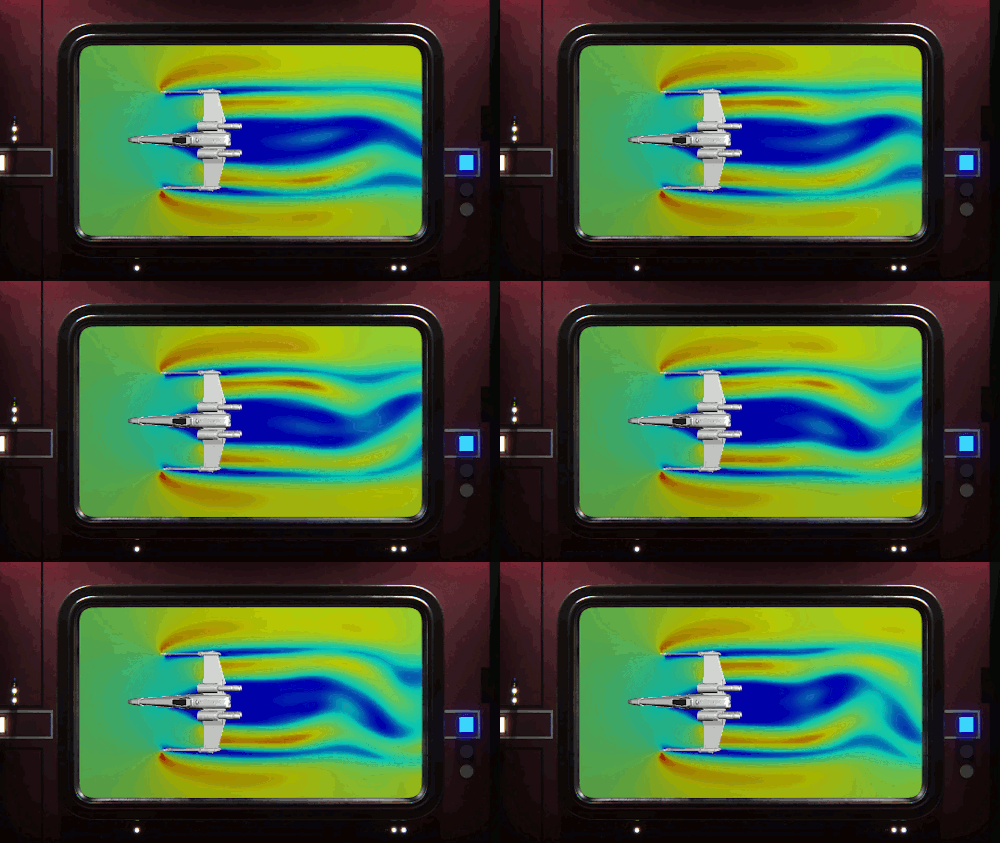
    There are some intriguing hints about other aerodynamic properties in the clips of flow around an X-wing and TIE fighter, though. Notice that the wake of both ships meanders back and forth. This is an indication of vortex shedding, and it means that both spacecraft would tend to be buffeted from side-to-side when flying in an atmosphere. Either the ships would need some kind of active control to counter those forces, or pilots would need iron constitutions to operate under those conditions! (Video and image credit: EC Henry)

    [original video no longer available]

  • Dust Envelopes Mars

    Dust Envelopes Mars

    Day has turned into night for NASA’s Opportunity rover as a massive dust storm envelopes Mars. The first signs of the dust storm were reported May 30th, and over the last two weeks, the storm has grown to an area larger than North America and Russia combined. Despite the low pressure and density of Mars’ atmosphere, solar heating can create fairly strong winds – they don’t reach hurricane-force speeds, but they’d qualify as a very windy day here on Earth. With the lower gravity on Mars, this can lift dust well into the atmosphere, choking out the sunlight Opportunity needs to continue operating. The rover has entered a low-power mode and is no longer responding to communications. Martian dust storms have been known to last for weeks or even months, and this may be the last we hear from the intrepid rover on its fifteen year journey. Here’s hoping that Opportunity makes it through the storm and can eventually get the solar power needed to phone home again. (Image credit: NASA JPL)

  • Leaping Mobulas

    Leaping Mobulas

    Mobula rays are second only to manta rays in size, and, unlike their larger cousins, relatively little is known about them. Like other rays, they propel themselves by flapping their large pectoral fins, and they generate thrust through hydrodynamic lift. They’re quite efficient swimmers, able to generate enough thrust to leap over 2 meters out of the water before flopping back into it. Why the mobula rays jump and why they seem to prefer belly-flopping is unclear. They may be using the slap and splash to communicate with one another. When aggregations of mobulas are observed from overhead, jumping seems to occur along the outside of the group. Maybe this is an effort to attract more mobulas to a group or a method of scaring prey into the midst of the hunting mobulas. In any case, it is spectacular to behold firsthand. (Image credit: BBC; source)

  • Bouncing Off a Moving Wall

    Bouncing Off a Moving Wall

    There are many ways to repel droplets from a surface: water droplets will bounce off superhydrophobic surfaces due to their nanoscale structures; a vibrating liquid pool can keep droplets bouncing thanks to its deformation and a thin air layer trapped under the drop; and heated surfaces can repel droplets with the Leidenfrost effect by vaporizing a layer of liquid beneath the droplet. But all of these methods will only work for certain liquids under specific circumstances. 

    More recently, researchers have begun looking at a different way to repel droplets: moving the surface. The motion of the plate drags a layer of air with it; how thick that layer of air is depends on the plate’s speed. (Faster plates make thinner air layers.) Above a critical plate speed, a falling droplet will impact without touching the plate directly and will rebound completely. This works for many kinds of liquids – the researchers used silicone oil, water, and ethanol – across many droplet sizes and speeds. The key is that the air dragged by the plate deforms the droplet and creates a lift force. If that lift force is greater than the inertia of the droplet, it bounces. (Image and research credit: A. Gauthier et al., source)

  • Hydrofoils and Stability

    Hydrofoils and Stability

    Today’s fastest boats use hydrofoils to lift most of a boat’s hull out of the water. This greatly reduces the drag a boat experiences, but it can also make the boat difficult to handle. One style of hydrofoil boat, called a single-track hydrofoil, uses two hydrofoils in line with one another to support and steer the boat. The pilot can steer the lead hydrofoil into the direction of a fall to correct it. Stability-wise, this is the same way that you keep a bicycle upright. On a boat, the situation is a bit tougher to manage, and, like riding a bike, it takes practice. A group of students published a full mathematical model for the dynamics of this kind of boat, which allows designers to test a prototype’s stability early in the design process and enables student teams to use computer simulators to train their pilots to drive a boat before putting them out on the water, similar to the way that airplane pilots train. (Image credit: TU Delft Solar Boat Team, source; research credit: G. van Marrewijk et al., pdf; via TU Delft News; submitted by Marc A.)

  • Riding Across Water

    Riding Across Water

    Humans may not be fast enough to run across water, but we’ve found other ways to conquer the waves. It’s even possible (though definitely not recommended) to ride across stretches of water on a dirt bike. To do so, you have to keep the bike (hydro)planing, and to understand what that means, let’s take a moment to talk about boats.

    At low speeds, boats stay afloat based on buoyancy, a force that depends on how much water they displace. But when moving at high speeds, modern speedboats lift mostly out of the water and skim the surface instead. At this point, it’s hydrodynamic lift that keeps the boat above the surface and we say that the boat is planing. Calculating that hydrodynamic lift is fairly complicated and depends on many factors – for those who are interested, check out some of David Savitsky’s papers – but, generally speaking, going faster gives you more lift.

    This brings us back to the dirt bike. There’s nothing particularly hydrodynamic about a dirt bike. It’s not shaped to provide hydrodynamic lift, but it does come with a high power-to-weight ratio. It’s this ability to create pure speed, and a rider’s keen sense for holding the bike at the right angle, that enables pros to cross open water. Needless to say, this is the kind of stunt that could end really badly, so don’t try it yourself. (Image credits: C. Alessandrelli, source; EnduroTripster, source; via Digg; submitted by 1307phaezr)

  • Fly Away!

    Fly Away!

    Spiders are often among the first colonists on newly formed volcanic islands. Thanks to their aerial skills, they are able to travel nearly anywhere by ballooning on strands of their own silk. Exactly how spiders as large as 20 milligrams manage this is still relatively known. A new study shows that crab spiders, like any careful aviator, use a foreleg to monitor wind conditions for 5 or more seconds before attempting take-off. The spiders will only spool out ballooning threads if the wind is warm and gentle. Wind speeds higher than 3 meters per second are an automatic no-go. When the spider decides conditions are favorable, they release as many as 60 nanoscale fibers that are several meters in length. The wind catches the silks and lifts them away to their next adventure. (Image credit: Science Magazine, source; research credit: M. Cho et al.)

  • PyeongChang 2018: Ski Jumping

    PyeongChang 2018: Ski Jumping

    No winter sport is more aerodynamically demanding than ski jumping. A jump consists of four parts: the in-run, take-off, flight, and landing. The in-run is where an athlete gains her speed, and to keep drag from slowing her down, she descends in a streamlined tuck that minimizes frontal area. The biggest aerodynamic challenge comes during flight, when the jumper wants to maximize lift while minimizing drag. The athlete spreads her skis in a V-shape and flattens her body, using her hands to adjust her flight. Flying the farthest requires careful management of forces while in the air. Wind plays a major role as well, with headwinds helping athletes fly farther. To compensate, scoring includes a wind factor calculated based on conditions for each jump. (Image credit: B. Pieper, Reuters/K. Pfaffenbach, PyeongChang 2018)

  • In the Eye of a Hurricane

    In the Eye of a Hurricane

    Although eyes are common at the center of large-scale cyclones, scientists are only now beginning to understand how they form. Since real-world cyclogenesis is complicated by many competing effects, researchers look at simplified model systems first. A typical one uses a shallow, rotating cylindrical domain in which heat rises from below. The rotation provides a Coriolis force, which shapes the flow. In particular, it causes a boundary layer along the lower surface of the domain, creating a thin region where the flow moves radially inward. (Its opposite forms at the upper surface of the domain, sending flow radiating outward.) Like an ice skater spinning, the flow’s vorticity intensifies as it approaches the central axis of rotation. When the conditions are right, this intensely swirling boundary layer flow lifts up into the main flow, forming an eyewall. The eye itself, it turns out, is merely a reaction to the eyewall’s formation. (Image credit: S. Cristoforetti/ESA; research credit: L. Oruba et al.)