


For more than a century, scientists have been fascinated by the jet that forms after a drop impacts a liquid. In this study, researchers tracked fluorescent particles in the fluid to understand the velocity and acceleration of flow inside the jet. They found that, within the first 10ms after the jet appears, it decelerates at up to 20 times the gravitational acceleration. That’s much too fast for gravity to cause, pointing instead to the critical importance of surface tension in dictating the behavior of these fast-moving jets. (Image and research credit: C. van Rijn et al.; via APS Physics; submitted by Kam-Yung Soh)
Search results for: “jet”

Blue Jets
Blue jets are a mysterious form of lightning that shoots upward from intense thunderstorms. The image above comes from one of the first color videos of blue jets, taken by an astronaut aboard the International Space Station. Scientist think blue jets form during an electric breakdown between the positively-charged upper region of a cloud and the negative charge at its boundary. Once the discharge starts, it can shoot to the stratopause in less than a second, forming a glowing, blue, nitrogen-based plasma. (Image credit: ESA/NASA/DTU Space; via NASA Earth Observatory)

Slow Mo Pulse Jet Engine


Pulse jet engines rely on their shape to maintain combustion without moving parts. The pressure waves that travel through the engine pump fresh oxygen into the combustion chamber and then ignite it with exhaust remaining from the last cycle. In this Slow Mo Guys video, we get to see that process in action. It’s a pretty neat view of combustion in a working engine, but these guys are definitely not going to win any awards for safety measures. Seriously, don’t try this at home! (Image and video credit: The Slow Mo Guys)
Jets Beneath Leidenfrost Drops


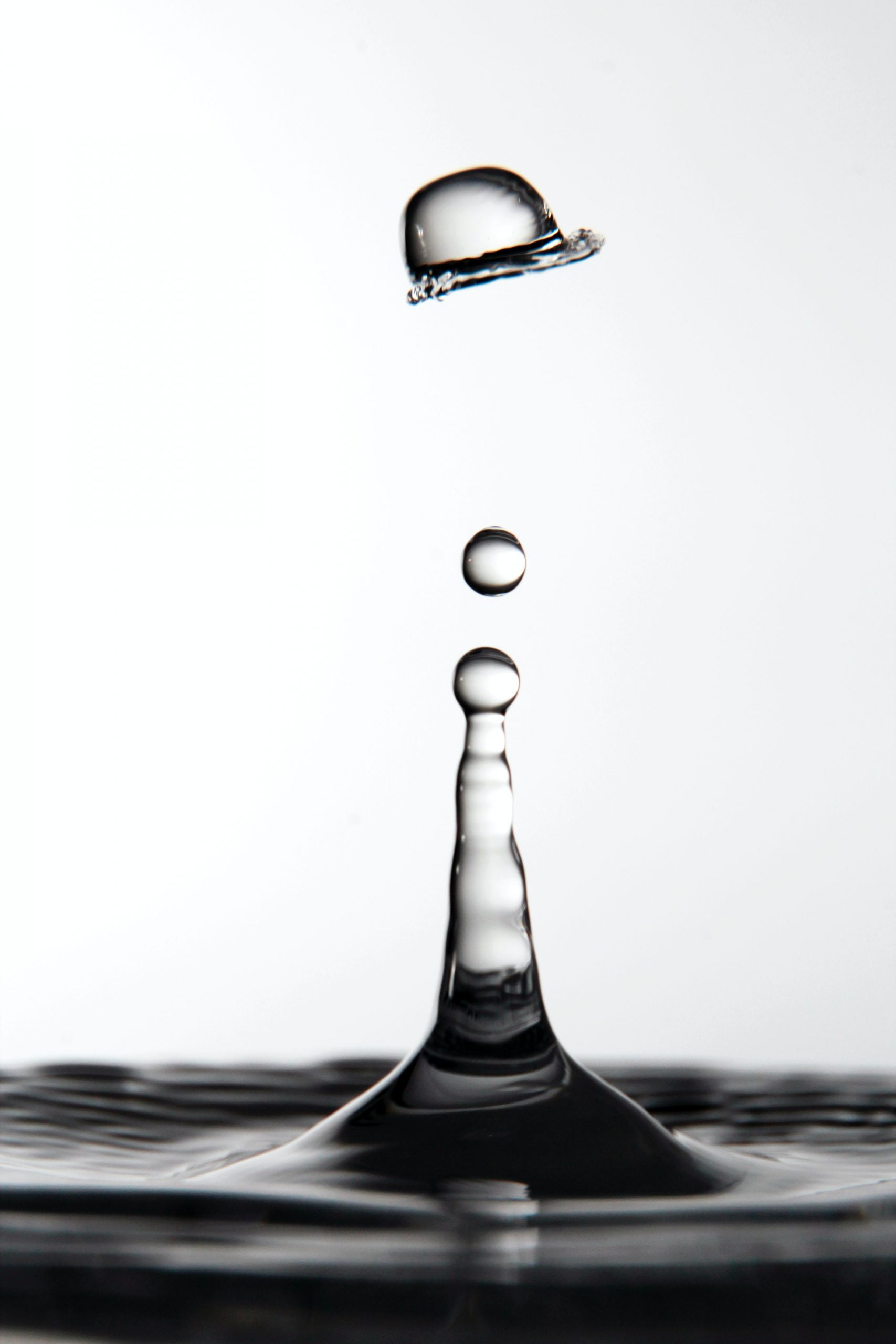
When a droplet impacts, it’s not unusual for converging ripples to form an upward jet, like the one seen here. But under the right circumstances, jets can form downward, too. This study looks at the ultrafast jets that can form beneath an impacting Leidenfrost drop.
These Leidenfrost drops are striking a surface much hotter than their boiling point, so a large vapor cavity forms quickly beneath them. Using x-ray imaging, the researchers were able to capture the dynamics of this cavity’s formation and collapse (Image 2). The field of view in the animation shows only a portion of the drop’s cavity, so Image 3 may help you orient relative to the drop at large.
Initially, we see the center of the droplet hitting the surface, followed by the fast growth of a vapor cavity. Rippling capillary waves converge on top of the cavity, creating a pinch-off. From there, a bubble rises up while a fast jet shoots downward. (Image credit: water jet – A. Min, others – S. Lee et al.; research credit: S. Lee et al.)
Droplets From Jets
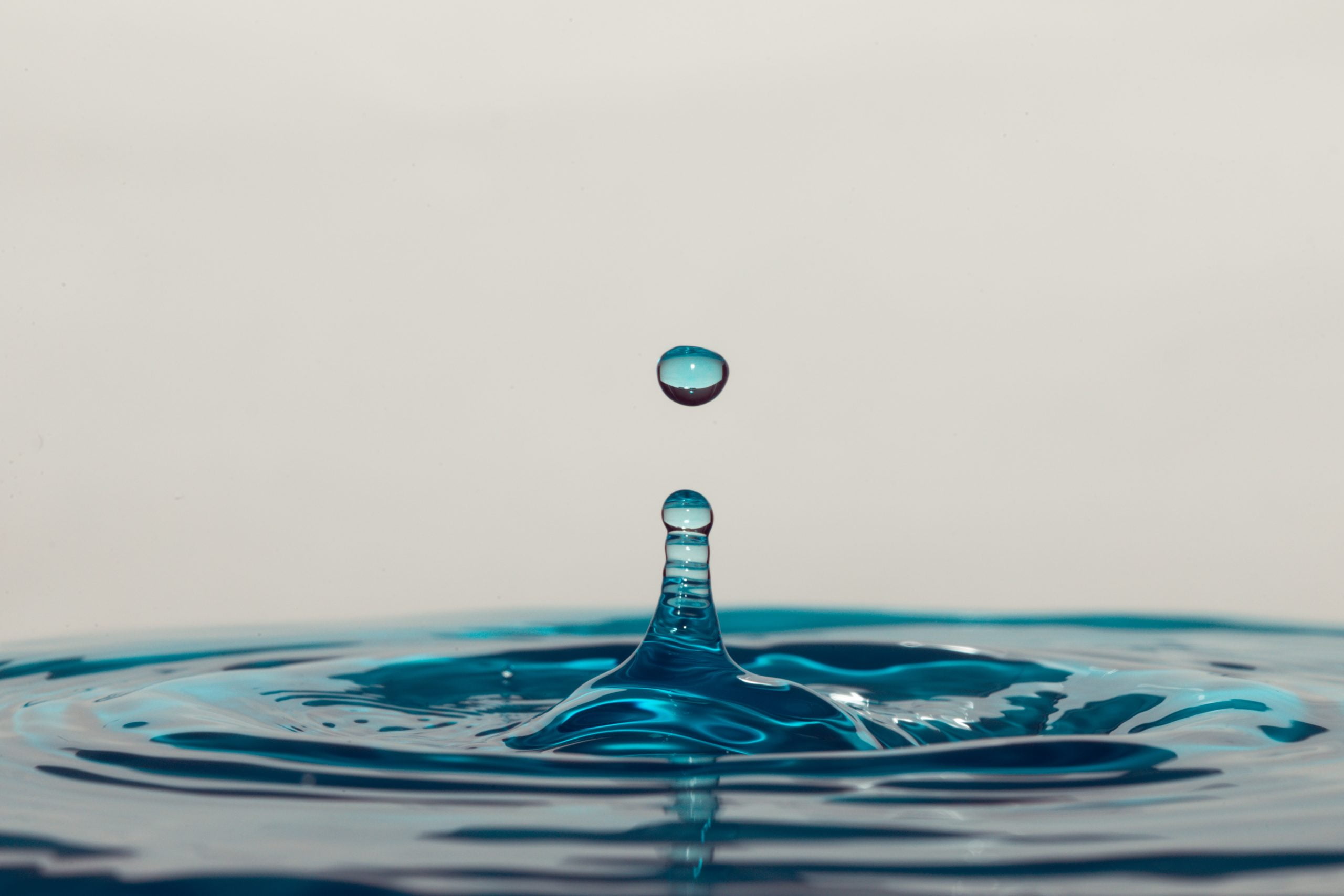
On the ocean, countless crashing waves are creating bubbles. When they burst, those bubbles generate jets and droplets that spray into the sky, carrying sea salt, dust, and biological material into the atmosphere. Researchers know these droplets and their evaporation are important for understanding environmental processes, but figuring out how to capture that importance in models continues to be a challenge.
In a new study, researchers concentrated on a simplified problem: the bursting of a single bubble in pure water. By studying a wide range of conditions, the team found that jets from these bubbles could eject as many as 14 droplets apiece. And though existing models have mostly ignored all but the first droplet, their work showed that all of the droplets should be accounted for in any evaporation models. (Image credit: C. Couto; research credit: A. Berny et al.)
Surface Jets in Coalescing Droplets


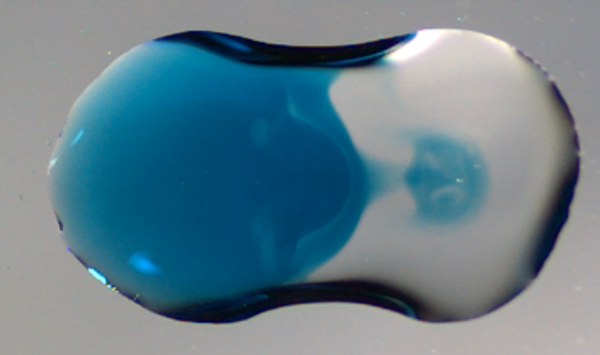
What goes on when droplets merge is tough to observe, even with a high-speed camera. There are many factors at play: any momentum in the droplets, surface tension, gravity, and Marangoni forces, to name a few. A new study that simultaneously records multiple views of coalescence is shedding some light on these dynamics.
The results are particularly interesting for droplets that are somewhat physically separated so that they only coalesce after one drop impacts near the other. In this situation, with droplets of equal surface tension, researchers observed a jet that forms after impact (Image 1) and runs along the top surface of the coalescing drops (Image 2). That location is a strong indication that the jet is created by surface tension and not other forces.
To test that further, the researchers repeated the experiment but with droplets of unequal surface tension. They found that when the undyed droplet’s surface tension was higher (Image 3), Marangoni forces enhanced the surface jet, as one would expect for a surface-tension-driven phenomenon. But if the dyed droplet had the higher surface tension (Image 4), it was possible to completely suppress the jet’s formation. (Image, research, and submission credit: T. Sykes et al., arXiv)