There’s something wonderfully serene about watching water droplets skate their way across the surface of a pool. Here the pool of water is being vibrated at a frequency just below the Faraday instability – meaning that no standing waves form on the surface. Instead, the bounce is just enough to create a thin layer of air between the droplet and the pool to prevent coalescence. With each bounce, gravity’s effect on the water tries to drain the air away, but each rebound lets more air rush in to hold the droplet up. Eventually, gravity wins and the droplets coalesce into the pool. In high-speed that process is mesmerizing, too. (Video credit: K. Welch)
Search results for: “high-speed video”
Imitating Flapping Flight
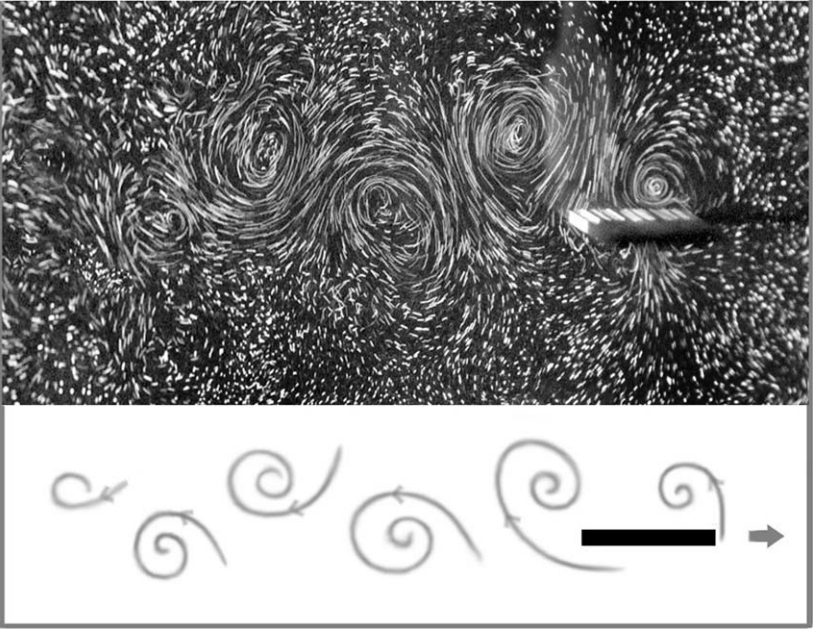
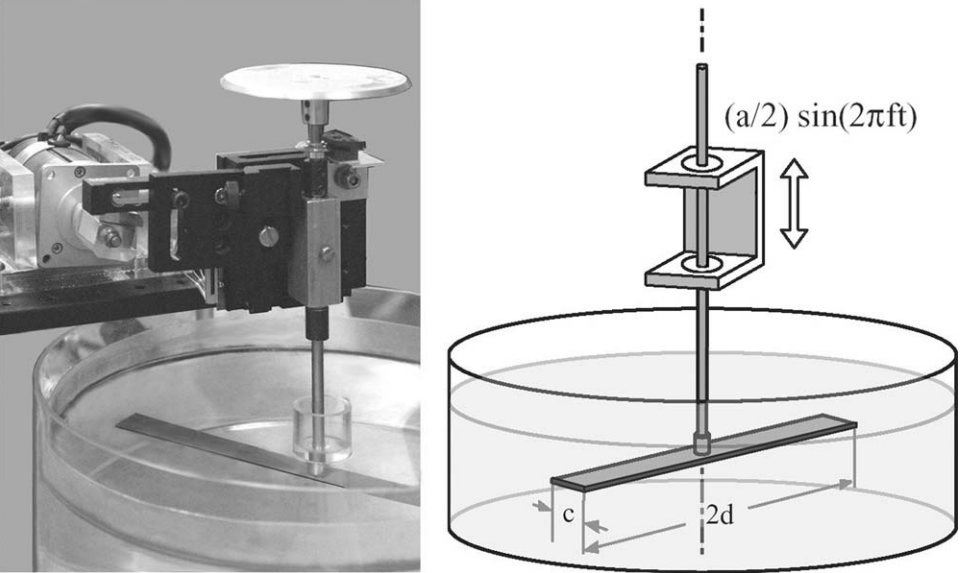
Flapping flight, despite being utilized by creatures of many sizes in nature, remains remarkably difficult to engineer. In this experiment, a simple rectangular wing is flapped up and down sinusoidally. Above a critical flapping frequency, the wing–which is free to rotate–accelerates from rest to a constant speed. This rotation is equivalent to forward flight. The upper image shows a photo and schematic of the setup, while the lower images shows flow visualization of the wing’s wake. The wing moves to the right, shedding thrust-providing periodic vortices in its wake. (Photo credits: N. Vandenberge et al.)

Droplet Springs
Prior to reaching terminal velocity, a falling droplet typically oscillates between a prolate shape (like an American football about to be kicked) and an oblate one (like that same football when thrown or carried). As explained by Minute Laboratory, this oscillation behaves very similarly to a mass on a spring. For a spring/mass system, the frequency of oscillation is related to the spring’s stiffness; for the falling droplet, it is instead governed by surface tension. If only high schools had high-speed cameras, this would make a fantastic fluids lab experiment! (Video credit: Minute Laboratory; submitted by Pascal W.)
FYFD is sporting a new look and new about and resources pages for those who want more fluidsy goodness.
Frozen Powder Drops
Droplet impacts on granular surfaces and water interactions with superhydrophobic surfaces are not unfamiliar topics for FYFD. But this behavior of water droplets falling on a superhydrophobic powder is unusual, to say the least. When the droplets impact in powder, they rebound with a partial coating of powder. In the case of the superhydrophobic powder, the shape of the droplet is “frozen” by the powder. A satellite droplet is ejected from the region not coated in powder and the resultant main drop falls back to the surface and comes to rest with little to no deformation. The researchers report a critical velocity at which the behavior is observed. (Video credit: J. Marston et al.; via Physics Buzz)
Detonation in a Bubble
Accidental releases of combustible gases in unconfined spaces can be difficult to recreate in a laboratory environment. Here researchers simulate the conditions using detonation inside a soap film bubble. Combustible gases are pumped inside the soap film and then a spark creates ignition. The resulting flame propagation is visualized using high-speed schlieren photography, making the density gradients in the flame visible. When the mixture of hydrogen fuel to air is balanced, the flame is spherically symmetric with a high flame speed. In contrast, weaker mixtures of fuel/air produce slow flame speeds and mushroom-like flames that leave behind unreacted fuel. This is due to buoyant effects; the time scale associated with buoyancy is smaller than that of the flame speed and chemical reactions when the fuel/air mixture is lean. (Video credit: L. Leblanc et al.)
Spray Starch
High speed video of of spray starch from a can. Once the initial transients die down, a cone-shaped annular sheet forms. Disturbances propagate in the sheet, tearing it into filaments that break down into droplets. Beautiful complexity hidden in a simple everyday device. (Video credit: John Savage)
Following a Breaking Wave
It’s fascinating to sit on the beach and watch the waves roll in and break, but rarely do we get a view like the one in this video. Here researchers have created a breaking wave in a wave tank and recorded the wave as it travels the length of the tank with a high-speed camera moving at the same speed as the wave crest. This perspective, moving alongside the fluid, is a Lagrangian coordinate system; if one instead stood still and watched the wave roll past, it would be an Eulerian measurement. Traveling with the wave, we can see how a lip forms on the wave crest, then rolls down, capturing a tube of air. As water begins to flow over the lip, perturbations grow, causing ripples in the laminar curtain. Then the water strikes the main wave and rebounds turbulently, creating a familiar white cap. In the second half of the video, the process is shown from above, highlighting the entrainment of air and the creation of the bubbles that form the white cap of a breaking wave. (Video credit: R. Liu et al)
Leidenfrost Dynamics
When a liquid impacts a solid heated well above the liquid’s boiling point, droplets can form, levitating on a thin film of vapor that helps insulate them from the heat of the solid. This is known as the Leidenfrost effect. Here a very large Leidenfrost droplet is shown from the side in high-speed. A vapor chimney forms beneath the drop, causing the dome in the liquid. When the dome bursts, the droplet momentarily forms a torus before closing. The resulting oscillatory waves in the droplet are spectacular. The same behavior can be viewed from above in this video. (Video credit: D. Soto and R. Thevenin; from an upcoming review by D. Quere)

Ferrofluid Drop
A drop of ferrofluid is shaped by seven small circular magnets sitting beneath the glass and paper. Ferrofluids are made up of nanoscale ferromagnetic particles suspended in a carrier liquid. Under the influence of magnetic fields, they can take on fantastic shapes, including sharp-tipped droplets and labyrinthine mazes. This image is taken from the National Academy of Science’s book Convergence, focused on the intersection between science and art. (Photo credit: Felice Frankel)
Astro Puffs
Microgravity continues to be a fascinating playground for observing surface tension effects on the macroscale without pesky gravity getting in the way. Here astronaut Don Pettit has created a sphere of water, which he then strikes with a jet of air from a syringe. Initially, the momentum from the jet of air creates a sharp cavity in the water, which rebounds into a jet of water that ejects one or more satellite drops. Surface waves and inertial waves (inside the water sphere) reflect back and forth until the fluid comes to rest as a sphere once more. Note how similar the behavior is to the pinch-off of a water column. Both effects are dominated by surface tension, but on Earth we can only see this behavior with extremely small droplets and high-speed cameras! (Video credit: Don Pettit, Science Off the Sphere)