The Leidenfrost effect occurs between a fluid and a solid of vastly different temperatures. In the case of liquid oxygen, a thin layer of the oxygen vaporizes on contact with the room temperature solid, leaving a droplet of liquid oxygen to float along on its own vapor. Oxygen droplets are paramagnetic, meaning that they are susceptible to magnetic fields; in this video, scientists demonstrate how magnets can affect the motion of these droplets.
Search results for: “droplet”

Frosting on Superhydrophobic Surfaces
Icing on airplane wings can be disastrous for lift and control, and thus how ice initially forms on a wing is an active area of research. New work shows that superhydrophobic (water-fearing) surfaces may actually promote ice buildup. Superhydrophobic surfaces are prone to frosting–collecting ice that forms directly from a vaporous state–and that fine layer of frost is conducive to further ice buildup from a liquid state. The photo above shows a water droplet striking a dry superhydrophobic surface (top) and a frosted superhydrophobic surface (bottom). (via Gizmodo) #

Airplanes Creating Snow
Scientists now think that that airplanes may be responsible for increasing local snowfall by flash-freezing supercooled water vapor in clouds. Water droplets can persist in the atmosphere to temperatures of -42 degrees Celsius. But when an airplane’s wing passes through moist air, the acceleration of the air passing over the wing causes a pressure decrease that can drop the temperature by as much as 19 C, causing the water droplets to form ice crystals immediately. (The particulate matter in the aircraft exhaust probably also aids this process.) The same behavior can also create holes in clouds and cause ice to form on the wings. # (Related behavior: vapor cones)
Photo credit: lhoon

Water Drops at 10,000 FPS
We’ve seen water droplets join a larger pool at 2,000 frames per second, but what about 10,000 frames per second? (via Gizmodo)

Crown Breakup
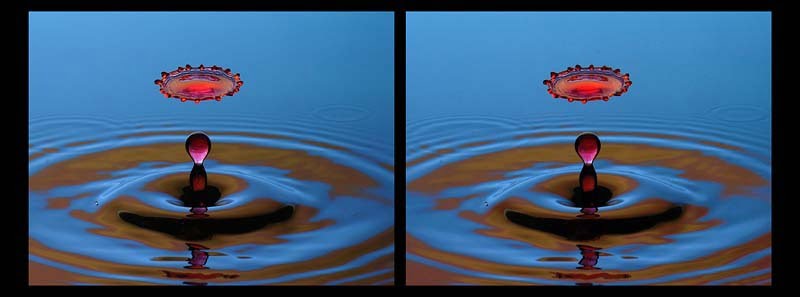
When a droplet falls into a pool of similar fluid, one often observes a crown-like impact effect. This student video shows high-speed footage of different fluids crowning and explores the effects of surface tension on crown breakup.

Superfluid Dripping
This high-speed video shows superfluid helium dripping and breaking up. Although superfluid has no viscosity, this does not prevent the Plateau-Rayleigh instability from breaking the helium into droplets once the mass of the liquid is too great for surface tension to contain.

Oil Chandeliers
What you see above is a composite of images of an oil droplet falling into alcohol from two different heights. The top row of images is from a height of 25 mm and the bottom from a height of 50 mm. The first droplet forms an expanding vortex ring which breaks down via the Rayleigh-Taylor instability due to its greater density than the surrounding alcohol. The second droplet impacts the alcohol with greater momentum and is initially deformed by viscous shear forces. Eventually it, too, breaks down by the Rayleigh-Taylor mechanism. This image is part of the 2010 Gallery of Fluid Motion. # (PDF)

Microfluidics
The field of microfluidics–where fluids are constrained to the sub-millimeter scale–is increasingly important in fields like chemistry, molecular biology, and microtechnology. At the microscale, surface tension often has greater effects than in our everyday world. This video shows how adding small amounts of a polymer drastically changes droplet breakup.

Zero-G Water Bubbles
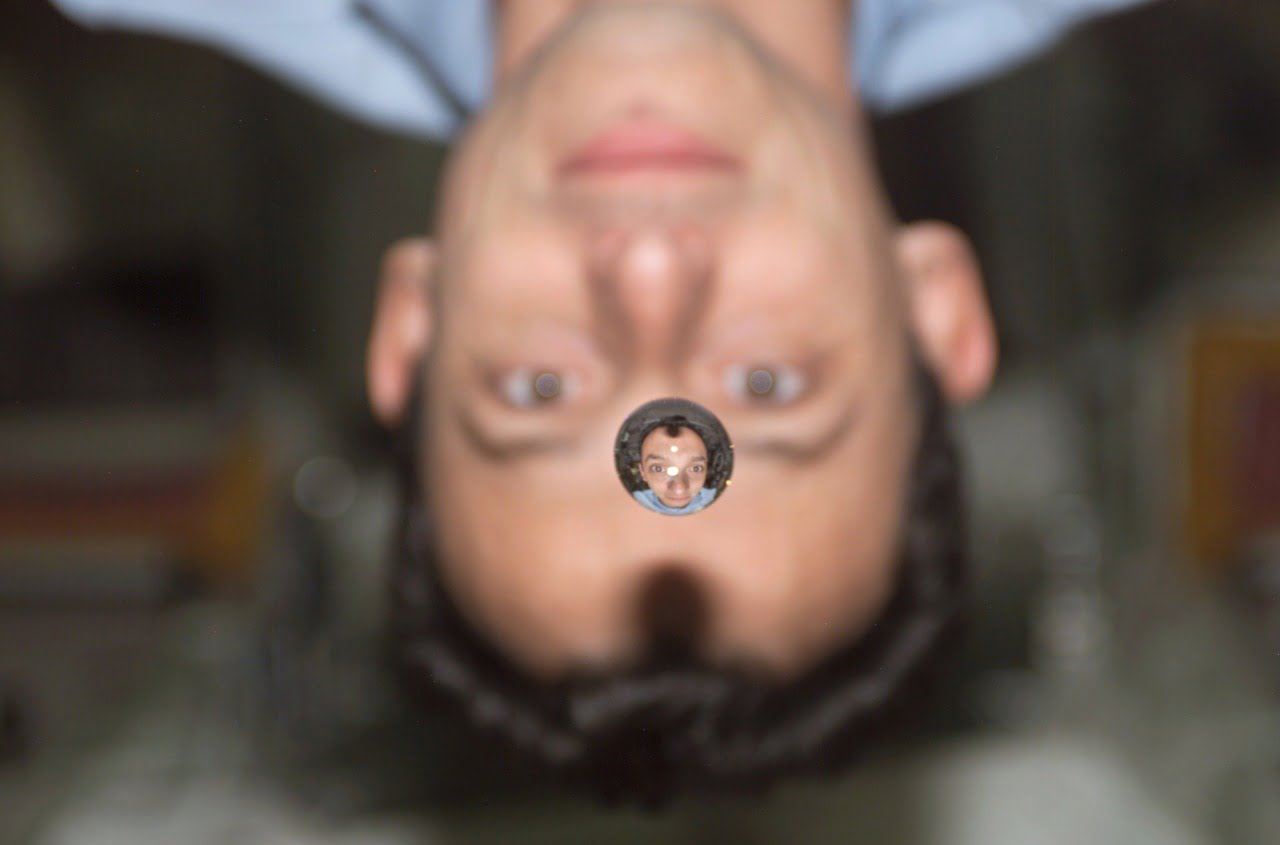
Astronaut Don Pettit narrates some of his experiments with air and water droplets in microgravity in this video. The lack of body forces and buoyancy in microgravity means that surface tension effects frequently dominate. Pettit’s demonstrations also involve some fun basic physics with bubble behaviors inside of water droplets. See more of Pettit’s Saturday Morning Science videos for additional microgravity fluid mechanics.

Superhydrophobic Carbon Nanotubes
Carbon nanotubes form a superhydrophobic (super water repellent) surface that interacts with water droplets in interesting ways. The droplet is unable to wet the surface and thus the bounces along. When the impact velocities are too great for surface tension to hold the decelerating mass together, it breaks into many, smaller droplets that also bounce along the surface. # (via @JetForMe and @Vinnchan)