
Droplets of oleic acid spread across a thin film of glycerol on a silicon wafer. The shapes here are driven by hydrodynamic instabilities, particularly Marangoni effects due to the differences in surface tension between the two fluids. (Photo credit: A. Darhuber, B. Fischer and S. Troian)
Search results for: “droplet”

Atomizing Jets
The breakup of impinging jets into droplets (also called atomization) and the subsequent dynamics of those droplets are important in applications like jet and rocket engines where the mixing of liquid fuel with oxygen is necessary for efficient combustion. This video showcases recent efforts in high fidelity numerical simulation and modeling of such flows. The complexity of the problem requires clever ways of reducing the computational efforts required. One such method uses adaptotive meshing to concentrate grid points in areas where variables are changing quickly while leaving the grid sparse in areas of less interest. Because the flow is constantly evolving, the mesh must be able to adapt as the simulation steps forward in time. Even so, such calculations typically require supercomputers to complete. (Video credit: X. Chen et al)
Testing Flames in Space
In microgravity, flames behave very differently than on earth due to a lack of buoyant forces. On earth, a flame can continue burning because, as the warm air around it rises, cooler air gets entrained, drawing fresh oxygen to the flame. In microgravity, both the heat from the flame and the oxygen it needs to burn move only by molecular diffusion, the random motion of molecules, or the background environmental flow (air circulation on the ISS, for example). This video shows a test of the Flame Extinguishment Experiment (FLEX) currently flying onboard the ISS. A fuel droplet is ignited, burns in a symmetric sphere and then eventually extinguishes either due to a lack of fuel or a lack of oxygen. Check out this NASA press release for more, including great quotes like this:
“As a Princeton undergrad, I saw in a graduate course the conservation equations of combustion and realized that those equations were complex enough to occupy me for the rest of my life; they contained so much interesting physics.” – Forman Williams
Cavity Collapse
When a solid object is driven into a quiescent liquid, a cavity is formed. As the cavity collapses jets–a type of singularity–form. In this video, researchers explore the effect of the geometry of a disk being driven into water on the shape of the cavity formed and how it collapses. As in this video of droplet impacts on posts of different geometries, there’s a lovely symmetry in the results. (Video credit: O. Enriquez et al)
Freezing Drops
[original media no longer available]
The physics of droplets freezing is important for understanding applications like ice formation on airplane wings. Here we see how a warm droplet deposited on a cold plate freezes. A freezing front advances through the drop, which expands vertically as it freezes. Ultimately, the expansion of the ice and the surface tension of the water create a pointed singular tip.
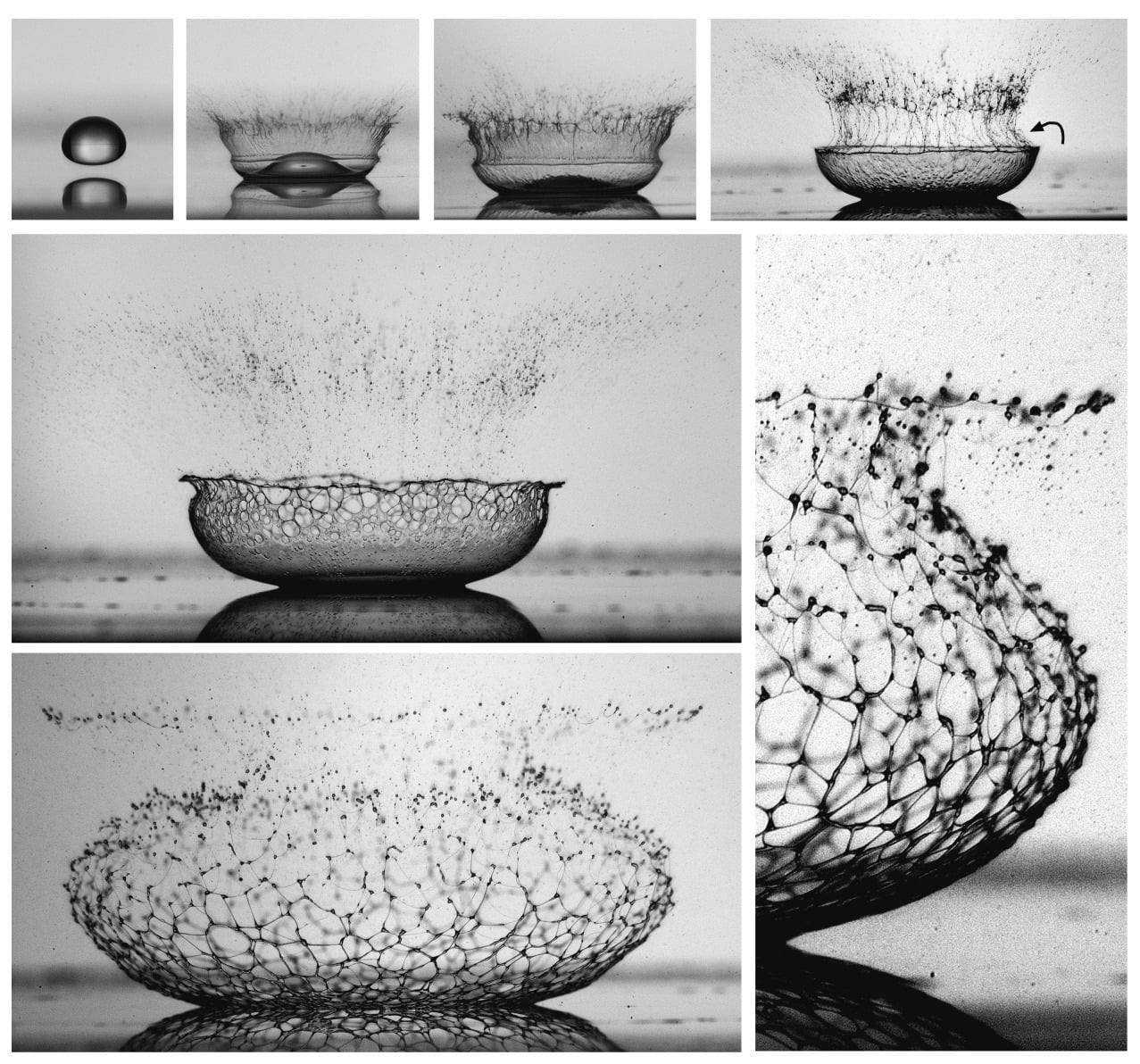
The Disintegrating Bowl
A viscous fluid droplet impacts a thin layer of ethanol, which has a lower surface tension than the viscous fluid. A spray of tiny ethanol droplets is thrown up while a bowl-shaped crown of the viscous fluid forms. As the ethanol droplets impact the bowl, the lower surface tension of the ethanol causes fluid to flow away from points of contact due to the Marangoni effect. This outflow causes holes to form in the crown, forming a network of thin fluid ligaments. For more, see this paper (PDF) and video. (Photo credit: S.T. Thoroddson et al)
Vibration-Induced Atomization
Atomization–breaking a liquid into a fine spay of droplets–is common in engines, printers, and in the shower. Here a droplet of water is placed on a thin metal diaphragm that is vibrated at 1 kHz with increasing vibrational amplitude. Capillary waves form on the droplet, and once a critical vibrational amplitude is achieved, tiny droplets are ejected. Full atomization of the original droplet is achieved in about 0.3 seconds real-time. #
The Coalescence Cascade
When a droplet impacts a pool at low speed, a layer of air trapped beneath the droplet can often prevent it from immediately coalescing into the pool. As that air layer drains away, surface tension pulls some of the droplet’s mass into the pool while a smaller droplet is ejected. When it bounces off the surface of the water, the process is repeated and the droplet grows smaller and smaller until surface tension is able to completely absorb it into the pool. This process is called the coalescence cascade.

Impinging Without Coalescing

Three impinging jets of silicone oil rebound without coalescence due to thin-film lubrication between the jets. The motion of the oil replenishes the thin layer of air separating the streams. The same phenomenon keeps droplets from coalescing as well. (Photo credit: BIF Lab, Department of Engineering Science and Mechanics, Virginia Tech) #
Disrupting the Coalescence Cascade
When a droplet contacts a pool, a thin layer of air can get trapped beneath the droplet, delaying the instant when the liquids contact and surface tension pulls the droplet into the pool. If the pool is being vibrated, air flows more easily into the gap, keeping droplets intact longer. It’s even possible to make them dance.