Search results for: “rayleigh taylor”

  • Quantum Rayleigh-Taylor Instability

    Quantum Rayleigh-Taylor Instability

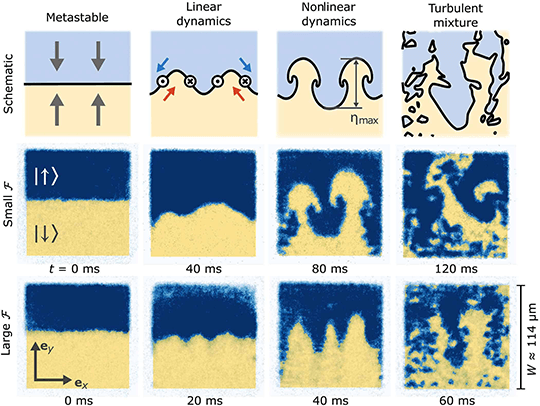
    The Rayleigh-Taylor instability–typically marked by mushroom-shaped plumes–occurs when a dense fluid accelerates into a less dense one. But researchers have now demonstrated the effect at quantum scales, too.

    For their experiment, the group used a Bose-Einstein condensate of sodium atoms and made the interface between them by exciting half of the atoms into a spin-up state and half into a spin-down one. With the interface is place, they reversed the magnetic field gradient, inducing a force on the atoms equivalent to the buoyant force seen in conventional Rayleigh-Taylor instabilities. As shown above, the interface first warped, then developed Rayleigh-Taylor mushrooms and eventually became turbulent. (Image and research credit: Y. Geng et al.; via Physics World)

    Fediverse Reactions
  • Rayleigh-Taylor Waves

    Rayleigh-Taylor Waves

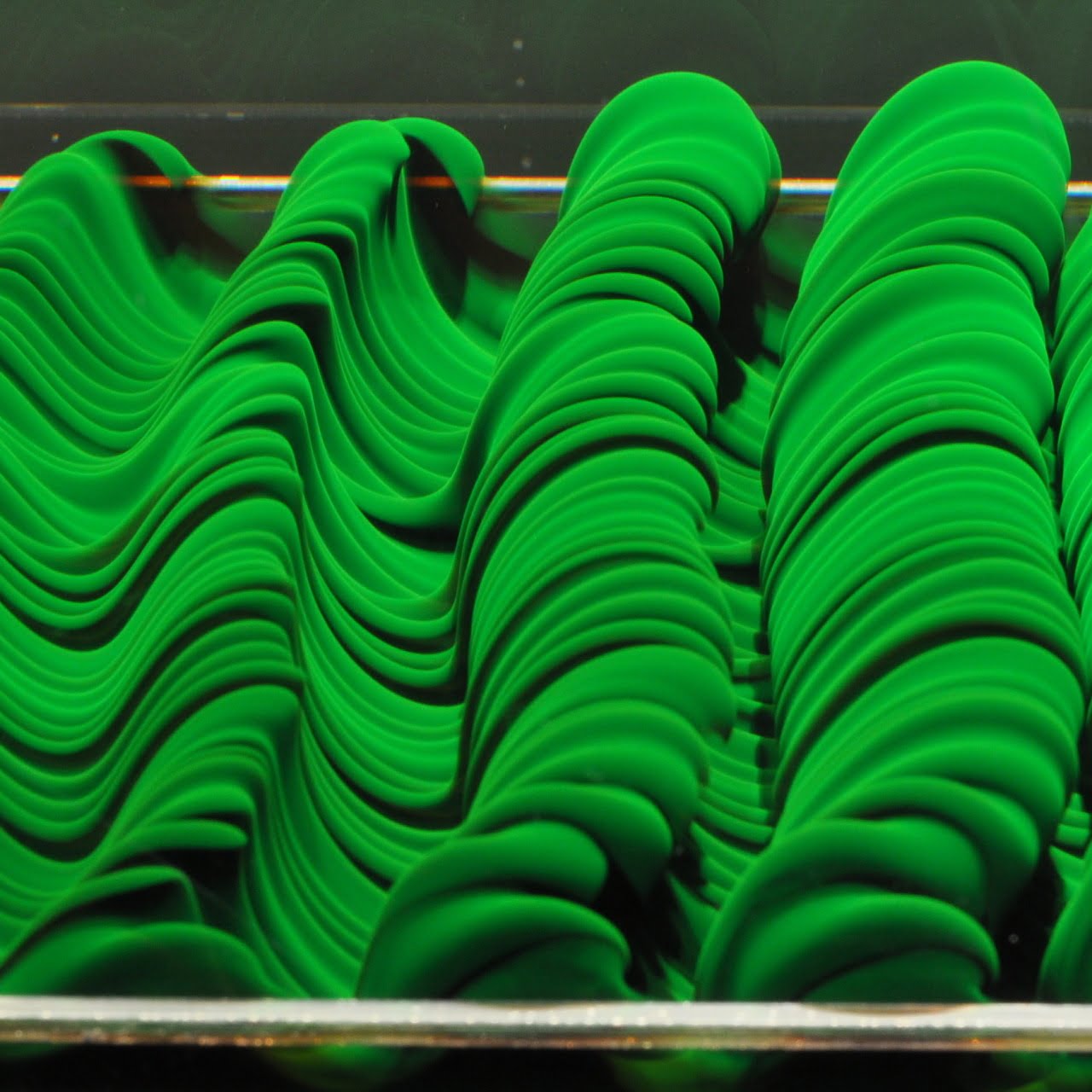
    Here on Earth, placing a denser fluid over a lighter one creates an unstable equilibrium. Thanks to gravity, the heavier, denser fluid wants to sink and the lighter fluid wants to rise. Any small disturbance will kick this into action, just like a tiny nudge can send a ball rolling down the hill. For the fluid, that nudge manifests as waviness in the interface between the two fluids. That waviness will quickly grow into billows like those shown above as the Rayleigh-Taylor instability takes over and the heavy (clear) fluid trades places with the lighter (green) fluid. You’ve probably witnessed this effect yourself when pouring milk into iced coffee. To see it in action, check out the video of this experiment or my FYFD video on the Rayleigh-Taylor instability. (Image credit: M. Davies Wykes)

  • Numerical Rayleigh-Taylor

    Numerical Rayleigh-Taylor

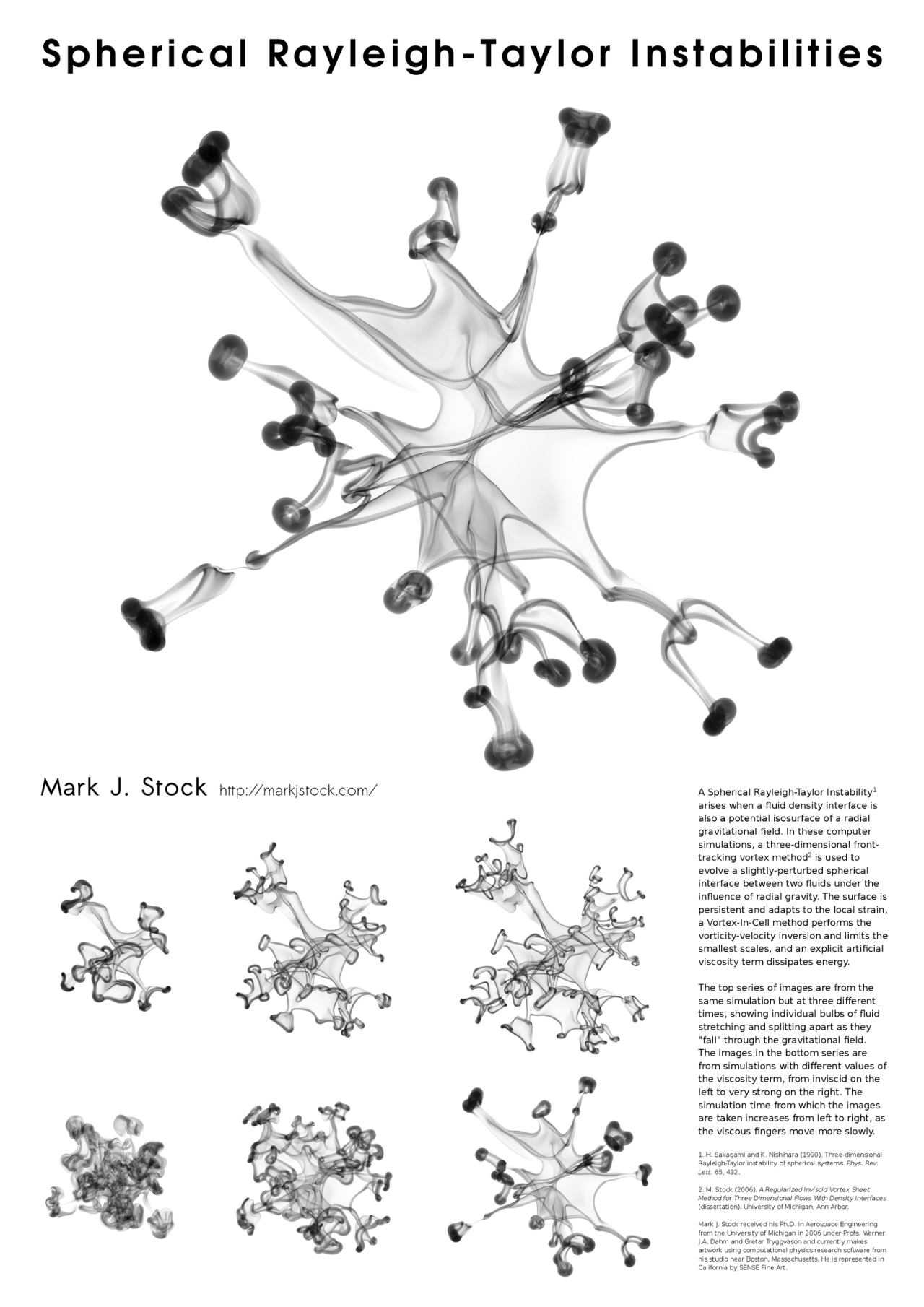
    If you’ve ever dripped food coloring or ink into a glass of water, you’ve probably created a cascade of tiny vortex rings similar to the images above. This is the Rayleigh-Taylor instability, in which the heavier ink/food coloring falls under gravity into the less dense water. What’s shown above is a special case–one that no experiment can recreate. It’s a numerical simulation of a spherical Rayleigh-Taylor instability. Imagine a sphere of a dense fluid “falling” outward under the influence of a radial gravitational field. This is one of the interesting aspects of computational fluid dynamics–it can simulate situations that are impossible to create experimentally. That can be both a strength and a weakness, allowing researchers to probe otherwise unavailable physics or fooling the unwary into thinking they have captured something real. (Image credit: M. Stock)

  • Featured Video Play Icon

    The Rayleigh-Taylor Instability

    What’s this? An FYFD video?! Yes, at long last, I’ve begun filming some videos of my own. This first one takes a look at the Rayleigh-Taylor instability and all that action that goes on in your coffee cup. I hope to bring you more FYFD-produced videos in the future, including some videos from the American Physical Society Division of Fluid Dynamics conference in San Francisco next week. What kind of topics would you guys be interested in for the future? (Video credit: N. Sharp)

  • Featured Video Play Icon

    High-Res Rayleigh-Taylor Instability

    When a heavy fluid sits atop a lighter fluid, the interface between the two breaks down through the Rayleigh-Taylor instability. This computation of a 2D interface shows the near fractal behavior of this instability as whorls and eddies of all different scales form and mix the fluids. (submitted by @markjstock)

  • Featured Video Play Icon

    Rayleigh-Taylor Art

    The Rayleigh-Taylor instability occurs when a denser fluid lies atop a lighter fluid (relative to the gravitational field). The interface between the fluids deforms and the two fluids form finger-like protrusions that turn into mushroom caps and mix the dissimilar fluids together. This video, though based on a 2D Rayleigh-Taylor instability numerical simulation, was actually part of an art exhibit. (submitted by Mark S)

    Personally, I recommend putting together a playlist of your favorite late 60s/early 70s rock (Pink Floyd, late Beatles, Jimi Hendrix, etc.) and sticking it on in the background while you watch the video in HD. It’s totally worth the 15 minutes. Especially in the later stages of each segment, the mixing between fluid layers really brings to mind cloud patterns on Jupiter or Saturn.

  • Featured Video Play Icon

    Suppressing Instability

    The Rayleigh Taylor instability is a common fluid phenomenon in which the interface between fluids of differing densities becomes unstable. It’s what’s responsible for all those awesome pictures of milk in ice coffee. For many years, fluid dynamicists theorized that the instability might be inhibited by rotation, which tends to suppress velocity changes along the axis of rotation. But actually creating an experiment demonstrating the effect was extremely difficult because any attempts to set a denser fluid over a lighter one before rotating it would kick off the instability. Recently, however, researchers succeeded in creating an experimental demonstration, seen in the video above. They did so by using magnetism. The initial set-up consists of two fluids of similar densities – a heavier, diamagnetic fluid on the bottom and a lighter, paramagnetic fluid floating on top. The tank was then spun up until both fluids were rotating like a rigid body. Then, the entire set-up was lowered into a vertically-oriented magnetic field. The paramagnetic fluid on top was attracted by the field while the diamagnetic fluid on the bottom was repelled. The end result is that the magnetic field created the effect of the upper fluid being heavier, thereby initiating the Rayleigh-Taylor instability. As you can see in the video, rotation does slow down–but not prevent–the instability. But it took some very clever and careful experimental design to show!  (Video credit: K. Baldwin et al.)

    ——————

    Don’t forget about our FYFD survey! I’ve teamed up with researcher Paige Brown Jarreau to create a survey of FYFD readers. By participating, you’ll be helping me improve FYFD and contributing to novel academic research on the readers of science blogs. It should only take 10-15 minutes to complete. You can find the survey here. Please take a few minutes to participate and share!

  • Richtmyer-Meshkov Instability

    Richtmyer-Meshkov Instability

    If you send a shock wave through a magnetized plasma–something that happens in both supernova explosions and inertial confinement fusion–it can trigger an instability known as the Richtmyer-Meshkov instability. The image above shows a form of this, taken from a simulation. Rather than treating the plasma as a single idealized fluid, the researchers represented it as two fluids: an ion fluid and an electron fluid. This allowed them to better capture what happens when certain components of the plasma react to changes faster than others do.

    The image itself shows the electron number density across the fluid, where darker colors represent higher electron number density. The interface between high and low-densities shows a roll-up instability that resembles the Kelvin-Helmholtz instability, but there are also regions of mushroom-like plumes that more closely resemble Rayleigh-Taylor instabilities.

    The authors note that these structures don’t appear in simulations that represent a plasma as a single fluid; you need the two-fluid representation to see them. (Image and research credit: O. Thompson et al.)

  • Featured Video Play Icon

    Instabilities in a Particle Flow

    Even though particles are not (strictly speaking) a fluid, they often behave like one. Here, researchers investigate what happens when two layers of particles–with different size and density–slide down an incline together. The video is tilted so that the flow instead appears from left to right.

    When the larger, denser particles sit atop a layer of smaller, lighter particles, shear between the two layers causes a Kelvin-Helmholtz instability that runs in the direction of the flow. This creates a wavy interface that lets some small particles work upward while large particles shift downward.

    At the same time, a slice across the flow shows that plumes of small particles are pushing up toward the surface, driven by a Rayleigh-Taylor instability. The researchers also look at what happens when the particles are fluidized by injecting a gas able to lift the particles. (Video and image credit: M. Ibrahim et al.; via GFM)

  • Cat’s Eye Halo

    Cat’s Eye Halo

    The Cat’s Eye Nebula is a planetary nebula located in the Draco constellation. At its center is a dying star. Seen here is the faint halo that stretches 3 light-years around the central nebula. The filaments of the halo are estimated to be 50,000 to 90,000 years old and were shed during earlier periods in the star’s evolution. Their shape is reminiscent of Rayleigh-Taylor instabilities, to my eye. (Image credit: T. Niittee; via APOD)

    Fediverse Reactions