As a follow-up to last week’s “dancing droplet” post, here’s a video that describes how to recreate the experiment yourself at home. The droplet motion is driven by the two-component structure of the droplets, where differing evaporation rates and surface tension values between the two fluids in the drop cause the attractions and chasing behavior you see. To demonstrate this at home, you’ll need glass, fire (for sterilization), tweezers, a pipette, water, and food coloring. Looks like a fun way to spend a weekend afternoon! (Video credit: M. Prakash et al.; via io9)
Search results for: “droplet”

Dancing Droplets


What makes drops of food coloring able to dance, chase, sort themselves, or align with one another? This unexpected behavior is a consequence of food coloring consisting of two mixed liquids: water and propylene glycol. Both have their own surface tension properties and evaporation rates, which ultimately drives the behavior you see in the animations above. Both long-range and short-range interactions are observed. The former are due to vapor from each droplet adsorbing onto the glass around the droplet, thereby changing the local surface tension and causing nearby drops to feel an attractive force. The short-range effects are also surface-tension-driven. Droplets with lower surface tension will naturally try to flow toward areas of higher surface tension, which causes them to “chase” dissimilar adjacent drops. You can learn more about the research in the videos linked below (especially the last two), or you can read about the work in this article or the original research paper. (Image credit: N. Cira et al., source videos 1, 2, 3, 4; GIFs via freshphotons; submitted by entropy-perturbation)
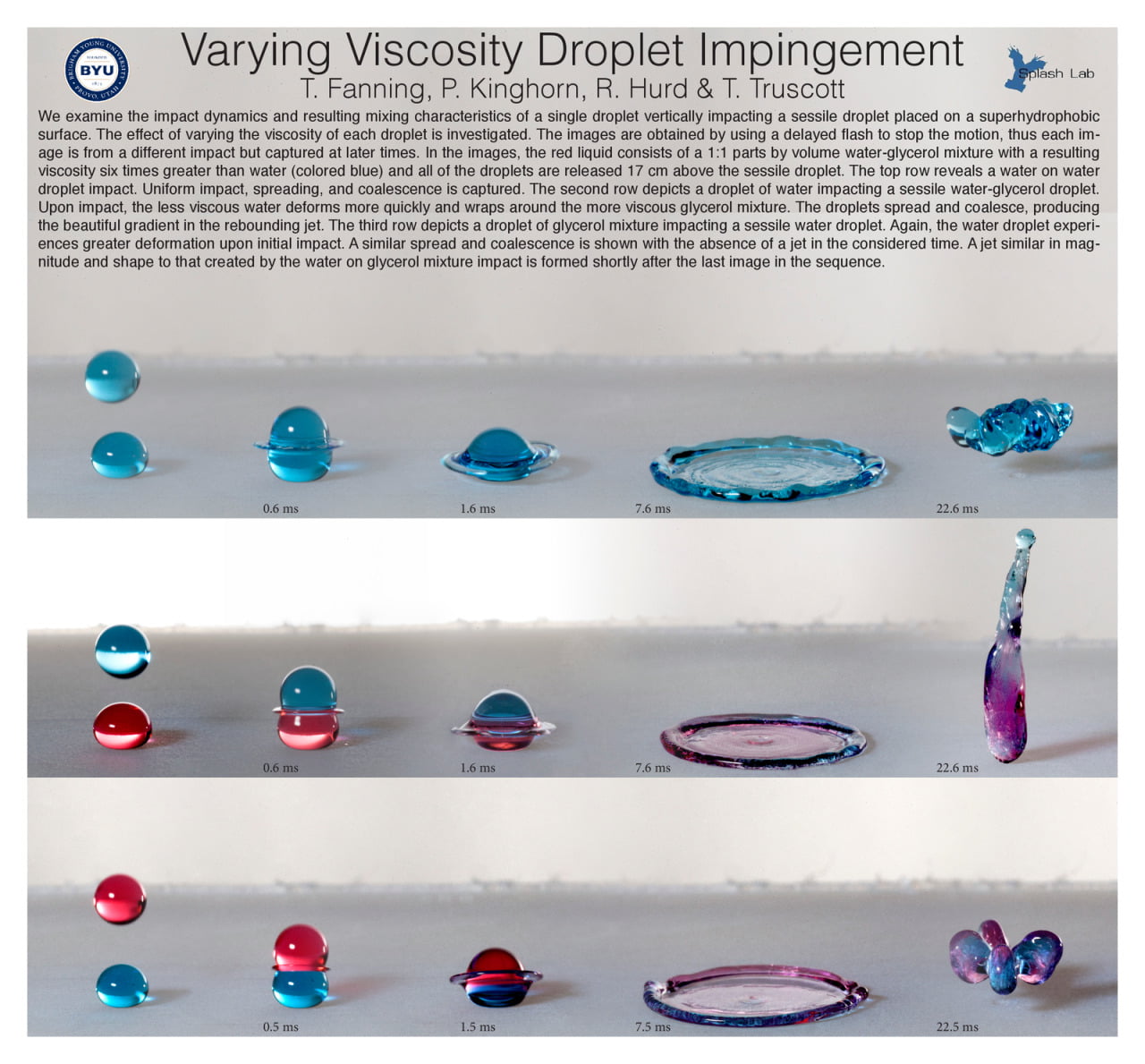
Viscous Droplet Impacts
Viscosity can have a notable effect on droplet impacts. This poster demonstrates with snapshots from three droplet impacts. The blue drops are dyed water, and the red ones are a more viscous water-glycerol mixture. When the two water droplets impact, a skirt forms between them, then spreads outward into a sheet with a thicker, uneven rim before retracting. The second row shows a water droplet impacting a water-glycerol droplet. The less viscous water droplet deforms faster, wrapping around and mixing into the other drop before rebounding in a jet. The last row switches the impacts, with the more viscous drop falling onto the water. As in the previous case, the water deforms faster than the water-glycerol. The two mix during spreading and rebound slower. In the last timestep shown, the droplet is still contracting, but it does rebound as a jet thereafter. (Image credit: T. Fanning et al.)

Jumping Droplets
When droplets on a superhydrophobic surface coalesce with one another, they jump. Individually, each drop has a surface energy that depends on its size. When two smaller droplets coalesce into a larger drop, the final drop’s surface energy is smaller than the sum of the parent droplets. Energy has to be conserved, though, so that excess surface energy gets converted to kinetic energy, causing the new droplet to leap up. Smaller droplets have higher jumping velocities. For more, see the original video. (Image credit: J. Boreyko and C. Chen, source video)

Levitating Droplets with Motion
There are many ways to levitate a droplet – heating, vibration, and acoustic levitation all come to mind – but this video demonstrates a simpler method: a moving wall. Depositing a drop on a moving wall keeps it aloft with a thin, constantly replenished layer of air. The thickness of this lubricating air film is directly measurable from interference fringes created by light reflecting off the surface of the drop. Incredibly, the air layer is only a few microns thick, but the resulting pressure in the air film is high enough to levitate millimeter-sized droplets! (Video credit: M. Saito et al.; via @AlvaroGuM)
Shooting Droplets with Lasers
Last week we saw what happens when a solid projectile hits a water droplet; today’s video shows the impact of a laser pulse on a droplet. Several things happen here, but at very different speeds. When the laser impacts, it vaporizes part of the droplet within nanoseconds. A shock wave spreads from the point of impact and a cloud of mist sprays out. This also generates pressure on the impact face of the droplet, but it takes milliseconds–millions of nanoseconds–for the droplet to start moving and deforming. The subsequent explosion of the drop depends both on the laser energy and focus, which determine the size of the impulse imparted to the droplet. The motivation for the work is extreme ultraviolet lithography–a technique used for manufacturing next-generation semiconductor integrated circuits–which uses lasers to vaporize microscopic droplets during the manufacturing process. (Video credit: A. Klein et al.)

Shooting Droplets
This animation shows high-speed video of a polystyrene particle striking a falling water droplet. Under the right conditions, the particle rips through the droplet, stretching the water into a bell-shaped lamella extending from a thicker rim. When the particle detaches, surface tension rapidly collapses the lamella into a ring which destabilizes. Thin ligaments and droplets fly off the crown-like ring as momentum overcomes surface tension’s ability to hold the droplet together. Be sure to check out the full video on YouTube or later next month at the APS Division of Fluid Dynamics meeting. (Yes, I will be there!) (Image credit: V. Sechenyh et al., source video)

Bead-Infused Droplet
A Leidenfrost droplet impregnated with hydrophilic beads hovers on a thin film of its own vapor. The Leidenfrost effect occurs when a liquid touches a solid surface much, much hotter than its boiling point. Instead of boiling entirely away, part of the liquid vaporizes and the remaining liquid survives for extended periods while the vapor layer insulates it from the hot surface. Hydrophilic beads inserted into Leidenfrost water droplets initially sink and are completely enveloped by the liquid. But, as the drop evaporates, the beads self-organize, forming a monolayer that coats the surface of the drop. The outer surface of the beads drys out, trapping the beads and causing the evaporation rate to slow because less liquid is exposed. (Photo credit: L. Maquet et al.; research paper – pdf)
Droplets Surfing
The Leidenfrost effect can make water droplets skitter across a hot griddle or briefly protect a hand dunked in liquid nitrogen. When a liquid is exposed to a solid surface much, much hotter than its boiling point, the contact vaporizes part of the liquid, and, in the case of a droplet, forms a thin lubricating layer of vapor that the liquid drop can skate around on. Researchers have found that releasing these Leidenfrost droplets on textured surfaces creates self-propelling drops by directing the flow of vapor. In this video, one team demonstrates some of the neat tracks they’ve built for their drops. (Video credit: D. Soto et al.)
Self-Propelled Droplets
Leidenfrost drops hover and move above hot surfaces on a thin layer of their own vapor. Over a flat surface, this vapor flows radially out from under the droplet, but creating rachets in the surface forces the vapor to flow in a single direction. The vapor then acts like exhaust, generating propulsion in the droplet and making it roll. How quickly the drop moves depends both on the droplet’s size and the rachets’ aspect ratio. For a given length, deeper rachets propel a drop faster than their shallower counterparts. The droplet’s size also affects the thrust with different scalings depending on the drop’s initial size. Like all of this week’s videos, this video is an entry in the 2013 Gallery of Fluid Motion. (Video credit: A. G. Marin et al.)