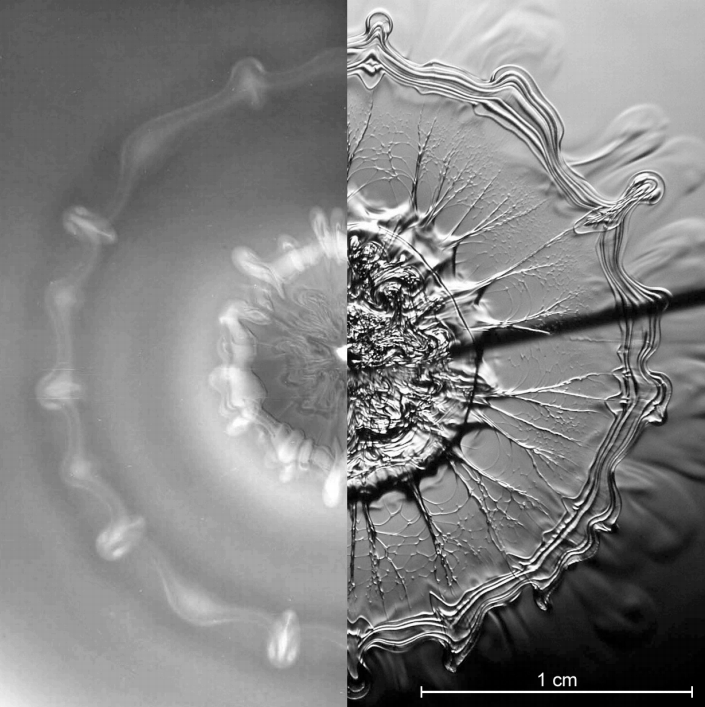
When a drop falls from a moderate height into a shallow pool, its impact creates a complicated pattern. The photo above is a composite image showing a top-down view 100 ms after such an impact. On the left side, the flow is visualized using dye whereas the right shows a schlieren photograph, in which contrast indicates variations in density. Both methods show the same general structure – an inner vortex ring generated at the edge of the impact crater and formed mostly of drop fluid and an outer vortex ring, consisting primarily of pool fluid, formed by the spreading wave. Both regions show signs of instability and breakdown. (Photo credit: A. Wilkens et al.)
Search results for: “droplet”

Encapsulating Droplets
In applications like drug delivery, it’s often desirable to encapsulate one or more liquid droplets in an additional immiscible fluid. These drops-within-drops, called double emulsions, are typically a multi-step process, created from the innermost drop outward. In this new microfluidic technique, though, researchers are able to create multi-component emulsions in a single step. A double-bored capillary tube creates the two inner droplets (both water, dyed different colors) while oil flows down the outside of the injection tube to encapsulate the droplets. The multi-component double emulsions then flow as one to the right in the outer carrier fluid. The spacing of the capillary tubes is critical to prevent the inner droplets from coalescing with one another. (Video credit: L. L. A. Adams et al.)
Shocking Droplets
Typical liquid drops will break apart into long, stretched ligaments and a spray of tiny droplets when deformed. But with just a small addition of polymers, these same liquids become viscoelastic and capable of some pretty incredible behaviors. This video shows a viscoelastic drop being struck by a shock wave that passes from right to left. The droplet is smashed and deformed, then stretches into jellyfish-like sheet of liquid. But incredibly, the elastic forces in the droplet are enough to hold it together. Researchers are interested in understanding these behaviors for many applications, including preventing accidental explosions caused by explosive fuels atomizing in air. (Video credit: T. Theofanous et al.)
Skittering Droplets
Water splattered onto a a hot skillet will skitter and skip across the surface on a thin layer of vapor due to the Leidenfrost effect. The partial vaporization of the droplet provides a low-friction cushion for the droplet to glide on and acts as an insulating layer that delays the vaporization of the rest of the droplet. Modernist Cuisine shows us how serene this common and sometimes explosive effect looks at 3,000 frames per second. (On the topic of cooking, you can use the Leidenfrost effect to see if your skillet is hot enough when making pancakes. If a few droplets of water skitter across the pan before sizzling away, then your pan is ready for batter!) (Video credit: Modernist Cuisine; submitted by Eban B.)
Droplet Springs
Prior to reaching terminal velocity, a falling droplet typically oscillates between a prolate shape (like an American football about to be kicked) and an oblate one (like that same football when thrown or carried). As explained by Minute Laboratory, this oscillation behaves very similarly to a mass on a spring. For a spring/mass system, the frequency of oscillation is related to the spring’s stiffness; for the falling droplet, it is instead governed by surface tension. If only high schools had high-speed cameras, this would make a fantastic fluids lab experiment! (Video credit: Minute Laboratory; submitted by Pascal W.)
FYFD is sporting a new look and new about and resources pages for those who want more fluidsy goodness.
Spitting Droplets
Any phenomenon in fluid dynamics typically involves the interaction and competition of many different forces. Sometimes these forces are of very different magnitudes, and it can be difficult to determine their effects. This video focuses on capillary force, which is responsible for a liquid’s ability to climb up the walls of its container, creating a meniscus and allowing plants and trees to passively draw water up from their roots. Being intermolecular in nature, capillary forces can be quite slight in comparison to gravitational forces, and thus it’s beneficial to study them in the absence of gravity.
In the 1950s, drop tower experiments simulating microgravity studied the capillary-driven motion of fluids up a glass tube that was partially submerged in a pool of fluid. Without gravity acting against it, capillary action would draw the fluid up to the top of the glass tube, but no droplets would be ejected. In the current research, a nozzle has been added to the tubes, which accelerates the capillary flow. In this case, both in terrestrial labs and aboard the International Space Station, the momentum of the flow is sufficient to invert the meniscus from concave to convex, allowing a jet of fluid out of the tube. At this point, surface tension instabilities take over, breaking the fluid into droplets. (Video credit: A. Wollman et al.)
Dancing Droplet Clusters
When a fluid surface is vibrated, it’s possible to bounce a droplet indefinitely on the surface without the droplet coalescing into the pool. This is because each bounce of the droplet replenishes a thin layer of air that separates the droplet and the pool. If many droplets are added to the surface, as in the video above, a clustering behavior is observed, with many droplets gathering together. There is a limit, however, to the size of the cluster based on the amplitude of vibration. If vibrational amplitudes are pushed to the point of creating Faraday waves–standing waves on the surface of the pool–then large clusters of droplets can be suspended and sustained. (Video credit: P. Cabrera-Garcia and R. Zenit; via io9; submitted by oneheadtoanother)
Dribbling Droplets
Ethanol droplets on a hot copper plate bounce under the influence of electrostatic forces from a charged rod. The temperature of the plate is high enough that the droplet is supported by a thin vapor film, which is what keeps it from wetting the plate. Ethanol does not have the strong polarity that water does, but the hydroxyl group on one end does make it susceptible to the electrostatic charge built up on the teflon rod. As a result, the droplets oscillate under electrostatic and gravitational forces, resulting in a dribbling effect. (Video credit: S. Wildeman et al.)
The Chaos of a Bouncing Droplet
This video explores chaos in a bouncing droplet. A drop of silicon oil bounces on a vibrating bath of oil; the thin layer of air injected with each bounce between the droplet and bath keeps them from coalescing. Initially, the droplet behaves like a bouncing ball, jumping once per oscillation. As the vibration amplitude increases, the droplet begins making a small jump, then a large jump, then a small jump, and so on. This is called period doubling since the droplet now jumps in a pattern with twice the period of the original and is a hallmark of nonlinear dynamical systems. Further increase in the vibration amplitude leads to chaotic bouncing and occasional ejecta. (Video credit: D. Terwagne et al.)
Moving Droplets with Electric Fields
Many microfluidic devices employ techniques that manipulate droplet motion for applications like sorting, manufacturing, or precisely controlling chemical reactions at a small scale. The video above shows the oscillations of a droplet on an inclined surface as it is perturbed with an electric field. (Video credit and submission: K. Nichols)