Search results for: “droplet”

  • Featured Video Play Icon

    Jumping Droplets

    Condensation, which removes heat by changing a vapor into a liquid, is a common feature in industrial heat transfer. When droplets form on surfaces, they typically have to grow to millimeter size before gravity causes them to slide off and open up the surface to new droplet formation. Hydrophobic surfaces can shed droplets a little sooner. Droplets only 100 micrometers in size will spontaneously jump off hydrophobic surfaces due to the release of excess surface energy during droplet coalescence, but this only happens when those droplets have a small contact area with the surface. Defects in the nanoscale structure of the surface can allow water to squeeze in between posts and hold on.

    To counter this, new experiments packed copper nanowires into a dense 3D array. This permits fewer defects and helps condensing droplets leap from the surface sooner. Each droplet carries away a bit of the surface’s heat. The new method is impressively efficient at it. Researchers found the new heat exchanger could remove 100% more heat than previous hydrophobic designs. (Video credit: Science; research credit: R. Wen et al.)

  • Pilot-Wave Hydrodynamics: Droplet Tunneling

    Pilot-Wave Hydrodynamics: Droplet Tunneling

    This post is part of a collaborative series with FYP on pilot-wave hydrodynamics. Previous posts: 1) Introduction; 2) Chladni patterns; 3) Faraday instability; 4) Walking droplets; 5) Droplet lattices; 6) Quantum double-slit experiments; 7) Hydro single- and double-slit experiments; 8) Quantum tunneling

    Quantum tunneling  is a strange subatomic behavior that was first described to explain how alpha particles escape a nucleus during radioactive decay. Classically, a particle trapped in a well can only escape if its energy is sufficiently high, but in quantum mechanics, even a particle with lower-than-necessary energy can occasionally “tunnel” out.

    To test whether hydrodynamic walkers can tunnel, researchers built corrals. In the central region, the pool on which the walker moves is relatively deep. Over the walls, the pool is much shallower. In this shallow area, the wave from the droplet’s bouncing decays quickly, creating a partially reflective barrier. For most collisions, the walker reflects off the barrier. Other times, apparently at random, a collision results in the walker crossing the wall and tunneling out of its well.

    Over many experiments, researchers were able to construct a probabilistic view of walker tunneling. In quantum mechanics, a particle’s likelihood of tunneling out of a well depends on the particle’s energy and the well’s thickness. The analogs for a walker are velocity and barrier thickness. The thicker the barrier, the harder it is for a walker to tunnel through. Conversely, a faster walker has a higher probability of tunneling through a barrier of a given thickness. As the authors themselves observe:

    “Although our experiment is foreign to the quantum world, the similarity of the observed behaviors is intriguing.” #

    As we wrap up our series tomorrow, we’ll consider some of those similarities more deeply.

    (Image credits: A. Eddi et al., sources)

  • Featured Video Play Icon

    Swimming Microdroplets

    Simple systems can sometimes have surprisingly complex behaviors. In this video, the Lutetium Project outlines a scheme for swimming microdroplets. Most of the droplets shown are just water, but they’re released into a chamber filled with a mixture of oil and surfactants. All flow through the chamber is shut off, but the droplets swim around in complicated, disordered patterns anyway. To see why, we have to zoom way in. The surfactant molecules in the oil cluster around the droplets, orienting so that their hydrophobic parts are in the oil and their hydrophilic parts point toward the water. They actually draw some of the water out of the droplets. This creates a variation in surface tension that causes Marangoni flow, making the droplets swim. Over time, the droplets shrink and slow down as the surfactants pull away more and more of their water and the variations in surface tension get smaller. (Image and video credit: The Lutetium Project; research credit: Z. Izri et al.)

  • Leaping Droplets

    Leaping Droplets

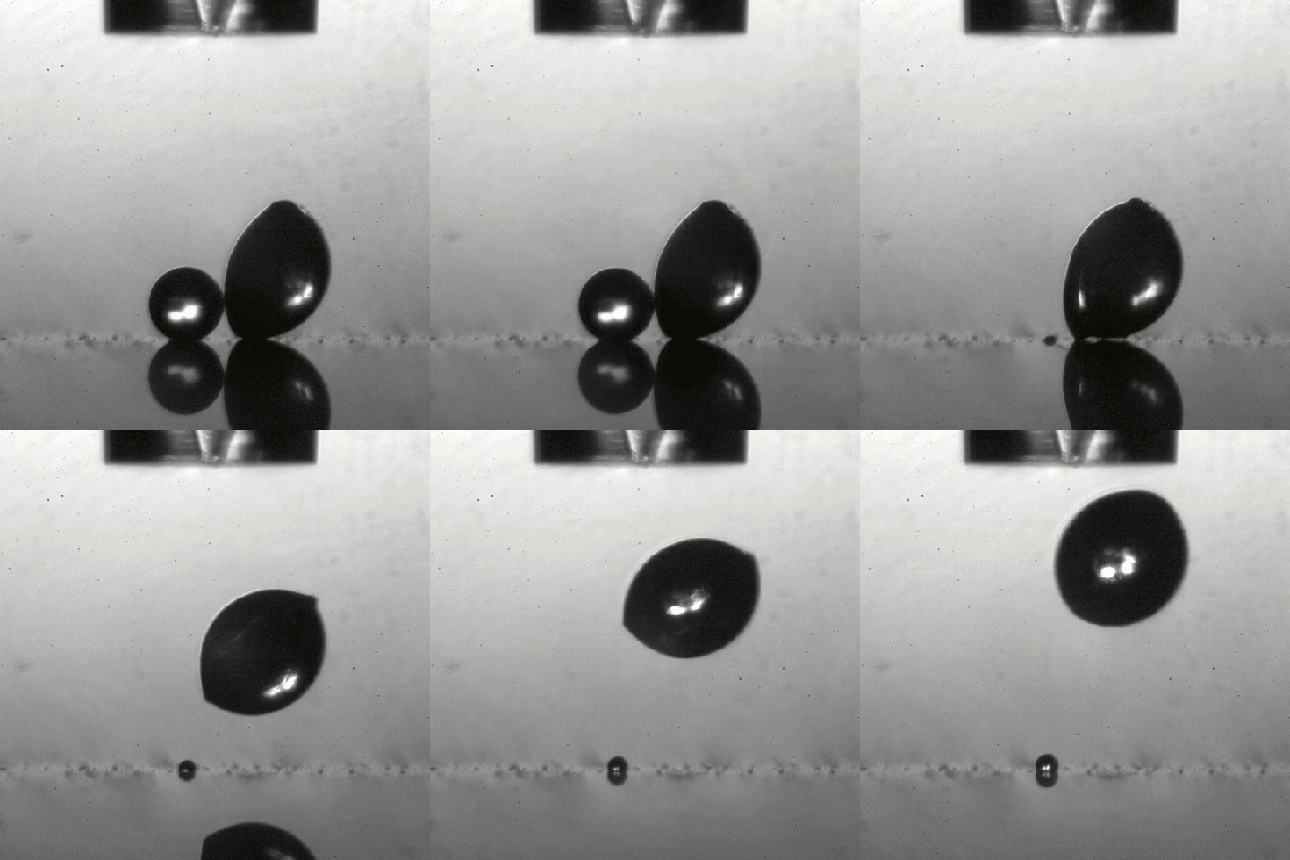
    Many fungi use coalescing water droplets to launch and spread their spores. The process is recreated in the laboratory in the animation above. Initially, there is a small spherical drop and a second, flattened drop stuck to the backside of the spore. In the animation, the large object on the right is actually both spore and droplet. The spore is spherical on one side and flattened on the other and starts out tipped up on its edge. When the spherical drop gets large enough to reach the flattened drop, they merge. This reduces the total surface area of the drop and thus releases some surface energy. It’s that surface energy that drives the spore’s jump. Even launching just a centimeter away from the host fungus is enough for a breeze to carry the spore further, allowing the fungus to reproduce.  (Image and research credit: F. Liu et al., source; submitted by Kam-Yung Soh)

  • Growing Droplets on a Trampoline

    Growing Droplets on a Trampoline

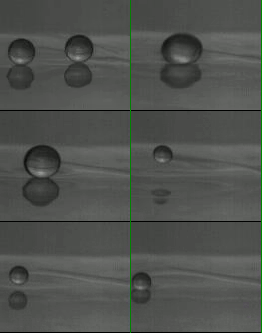
    Droplets on a liquid surface will typically coalesce, thanks to gravity and the low viscosity of the air layer between them and the pool. In certain cases, droplets will partially coalesce, producing smaller and smaller droplets until they finally coalesce completely. Vibrating the liquid surface can help prevent this coalescence but only when droplets are small.

    In fact, if the pool is more viscous than the droplets, bouncing can be used to produce droplets of a desired size, as shown above. Because the droplets are less viscous, they deform more than the pool does – behaving somewhat like a bouncy ball hitting a rigid wall. In this system, large droplets are unstable and will undergo partial coalescence until they are small enough to bounce stably. The size of stable drops is determined by the frequency and acceleration of the bouncing bath; by tuning these parameters, researchers can select what size droplets they want to end up with. (Research credit: T. Gilet et al.; images and submission by N. Vandewalle)

  • Featured Video Play Icon

    Bursting Droplets

    Mixing multiple fluids can often lead to surprising and mesmerizing effects, whether it’s droplets that dance or tears along the walls of a wine glass. A recent paper highlights another such mixture-driven instability – the bursting of a water-alcohol droplet deposited on an oil bath. The Lutetium Project tackles the physics behind this colorful burst in the short video above. The behavior is driven by the quick evaporation rate of alcohol in the droplet and the way this changing chemical concentration affects surface tension in the droplet. Alcohol evaporates more quickly from the edges of the drop, creating a region of higher surface tension around the edge. This pulls fluid to the rim of the drop, where it breaks up into droplets that get pulled outward as the inner drop shrinks.

    The oil bath plays an important role in the instability, too. Without it, friction between the drop and a wall is too high for the droplet to “burst”. A thick layer of oil acts as a lubricant, allowing the escaping satellite drops to speed away. (Video and image credit: The Lutetium Project; research credit: L. Keiser et al.; submitted by G. Durey)

  • Featured Video Play Icon

    Bouncing Droplets

    Droplets bouncing on a pool form a beautiful and fascinating system, as recently featured by Physics Girl, Veritasium, and Smarter Every Day. The Lutetium Project – a consortium of French physics, graphic design, and music students – have their own take on the subject with beautiful short videos constructed from experimental research footage. With simple text explanations and lovely original music, they combine science, art, and outreach brilliantly. Also check out their quantum walker video and be sure to subscribe to their channel (in English or French) for more!  (Video credit: The Lutetium Project; submitted by @g_durey)

  • Making Droplets

    Making Droplets

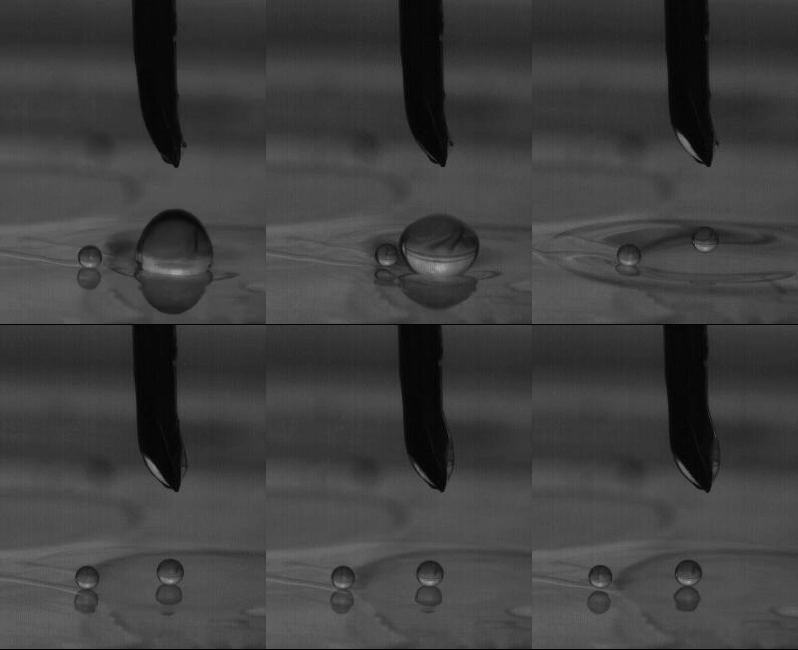
    If you’ve ever wondered how fluid dynamicists create those tiny perpetually bouncing droplets they study, wonder no further. A typical method, shown here, is to use a simple toothpick. First, you take a shallow container of silicone oil and vibrate it vertically. Then you dip the tip of the toothpick into the oil and pull it out, stretching the oil into a long filament. When it detaches from the toothpick, a droplet will start to form at the tip of the filament as it falls back toward the pool. But the bouncing of the surface is enough to keep the new drop from coalescing back into the pool, leaving the little drop to bounce along on its liquid trampoline. (Image credit: S. Lapointe)

  • Featured Video Play Icon

    Droplet Bounce

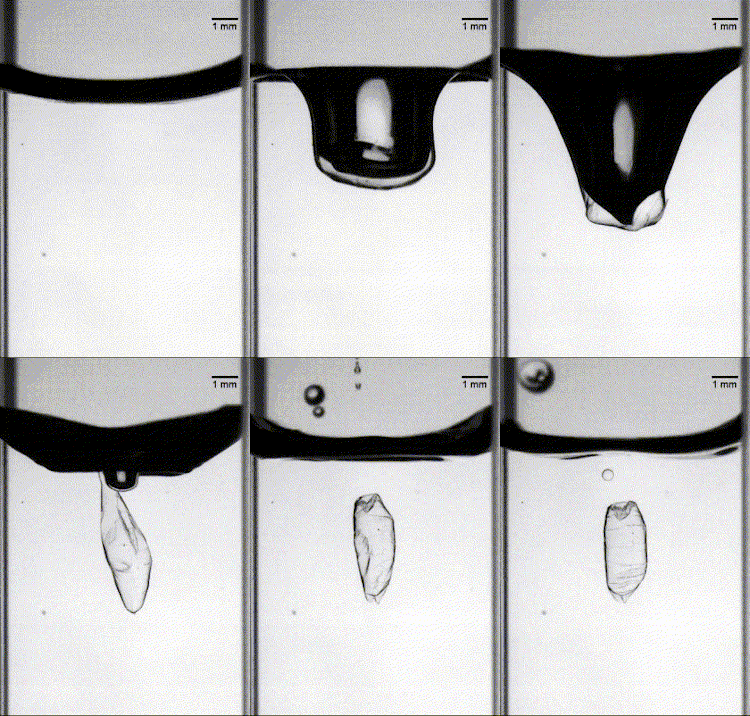
    Water droplets don’t always immediately disappear into a pool they’re dropped onto. If the droplet is small and doesn’t have much momentum, it will join the pool gradually through a process known as the coalescence cascade, seen here in high speed video. The droplet bounces off the surface, then settles. A thin layer of air is caught between it and the pool. Slowly the weight of the drop pushes that air out until there is contact between the drop and pool. Before the drop can merge completely, though, surface tension pinches it off, creating a smaller daughter droplet. Ripples caused by the merger help bounce the little droplet, which repeats the same process until the tiniest droplet merges completely. (Video credit: B. ter Huume)

  • Featured Video Play Icon

    Making Droplets Stick

    Lots of plants have evolved leaves that are superhydrophobic – that is, water repellent. For a plant, this makes a lot of sense. A superhydrophobic leaf will make water bounce and run off, draining down to where the plants roots can drink it up. But this same feature can be a frustration to farmers who spread pesticides by spraying plants. They need the pesticide to stick to the leaves if it’s to deter insects, and the superhydrophobicity of the leaves forces them to spray more pesticides in the hopes of getting some to stick. Researchers at MIT are looking to change this status quo with a few biodegradable polymer additives that can counter the leaves’ superhydrophobic tendencies and help droplets stick to the surface. This could reduce the amount of pesticides needed to protect crops. (Video credit: MIT)