Search results for: “density”

  • Crowds as a Fluid

    Crowds as a Fluid

    At a low density, crowds of people can behave like a fluid, which has led to numerous hydrodynamically-based crowd models. At higher densities, though, crowds are more like a soft solid, and researchers are adapting models developed for granular materials like sand to describe these crowds. In granular materials, these models help scientists identify how vibrations move through the complex network of grains and what circumstances might cause sudden reorganizations. In a large crowd, this could tell scientists the difference between the innocuous shuffle at a rock concert and the trigger for a deadly stampede. Getting real-world data for comparison is tough – obviously, it’s unethical to intentionally cause a crowd to panic – so thus far the models remain relatively untested. (Image credit: M. Lebrun; research credit: A. Bottinelli and J. Silverberg)

  • Seeing Sound

    Seeing Sound

    It’s not always easy to imagine how waves travel, but with this demonstration, you can see sound waves and how they reflect and defract. The set-up uses schlieren optics that show light and dark bands where strong changes in density take place. This, combined with a stroboscopic light, makes it possible to see the wave fronts from the acoustic transducer on the left side of the screen. Once the wave is apparent, introducing a reflective object lets us see exactly how sound waves bounce, reflect, and interfere. (Image and video credit: Harvard Natural Sciences Lecture Demonstrations)

  • Volcanic Plume

    Volcanic Plume

    Astronauts aboard the International Space Station captured this dramatic image of Raikoke Volcano’s eruption in late June. This uninhabited Pacific Island is part of the Kuril Islands off mainland Russia. The hot plume of ash and volcanic gas rose until its density matched that of the surrounding air, at which point it could only expand horizontally. This is why the plume appears to have such a flat top. It’s similar to the cumulonimbus clouds we associate with severe thunderstorms. Scientists speculate that the white ring around the plume’s base might be water vapor condensed from ambient air pulled in to the plume’s base or a side-effect of magma flowing into the surrounding sea. (Image credit: NASA; via NASA Earth Observatory)

  • Astrophysical Turbulence

    Astrophysical Turbulence

    Subsonic turbulence – like the random and chaotic motions of air and water in our everyday lives – is something we have only a limited understanding of. Our knowledge of supersonic turbulence, where shock waves and compressibility rule, is even more tenuous. In part this is because, although we can observe snapshots of supersonic turbulence in astronomical settings like the Orion Nebula shown above, we cannot watch it evolve. On these scales, features simply don’t change appreciably on human timescales.

    This has limited scientists to mostly numerical and theoretical studies of supersonic turbulence, but that is starting to change. Researchers are now building experimental set-ups that collide laser-driven plasma jets to generate boundary-free turbulence at Mach 6. Thus far, the observations are consistent with what’s been seen in nature: at low speeds, the turbulence is consistent with Kolmogorov’s theories, with energy cascading from large scales to smaller ones predictably. But as the Mach number increases, the nature of the turbulence shifts, moving toward the large density fluctuations seen in nebulae and other astrophysical realms. (Image credit: F. Battistella; research credit: T. White et al.; see also Nature Astronomy; submitted by Kam-Yung Soh)

  • Communication Between Microswimmers

    Communication Between Microswimmers

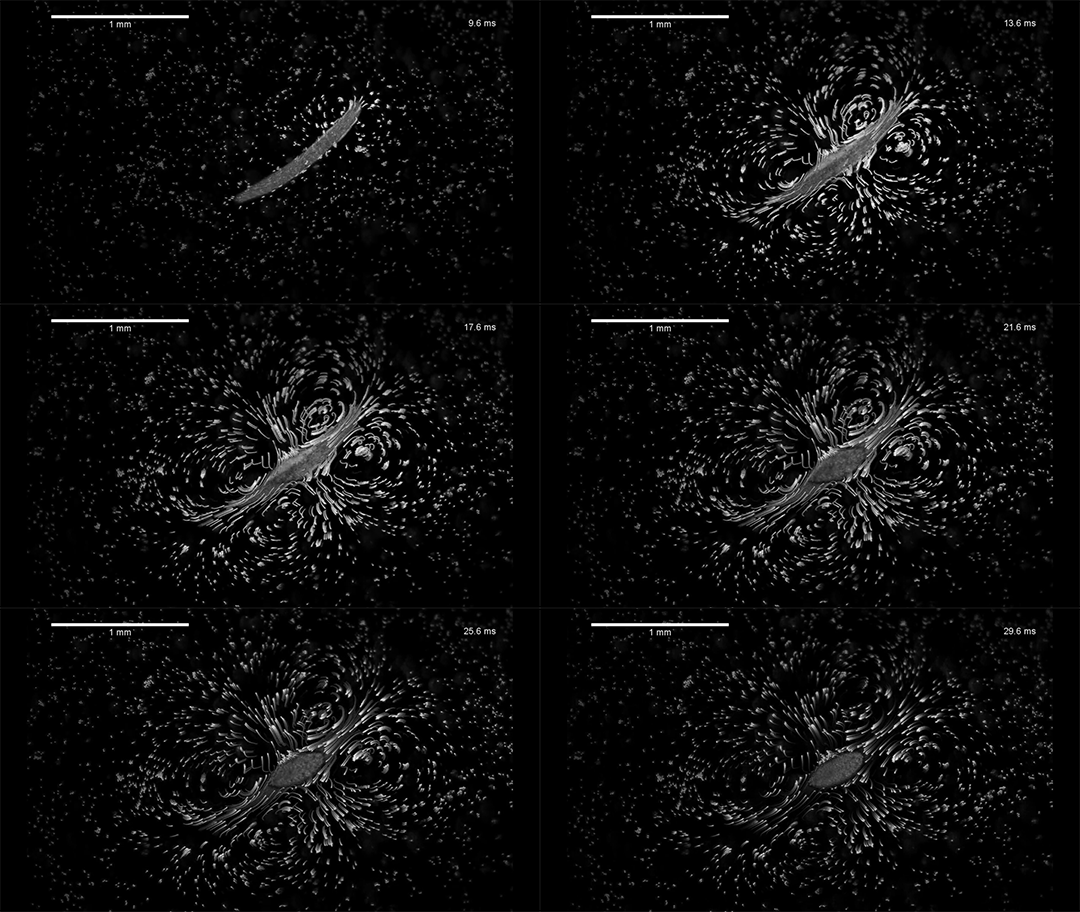
    The elongated cells of Spirostomum ambiguum swim using hair-like cilia, but when threatened, the cells contract violently, sending out long-range hydrodynamic waves, like those visualized above. Along with these waves, the cells release toxins aimed at whatever predator threatens them. In a colony, these waves act like a communication beacon. The swirl of a previous cell’s reaction tugs on its neighbors. As they contract, the message–and the toxins–spread. If the colony density is high enough, the hydrodynamic trigger waves will propagate through the entire colony, releasing enough toxins to disable even large predators. (Image and video credit: A. Mathijssen et al.)

  • What Drives Droplets

    What Drives Droplets

    There’s been a lot of interest recently in what goes on inside droplets made up of more than one fluid as they evaporate. This can be entertaining with liquids like whiskey or ouzo, but it has practical applications in ink-jet printing and manufacturing as well. And a new experiment suggests that we’ve been fundamentally wrong about what drives the flow inside these drops.

    As these drops evaporate, a donut-shaped recirculating vortex forms inside them, as seem in the cutaway views above. Conventional wisdom says that vortex is driven by surface tension. Evaporation of components like alcohol is more efficient at the edges of the drop, and as the alcohol evaporates, it creates a higher surface tension at the drop’s edge than at its peak. Marangoni forces then pull fluid down toward the edges, creating the vortex. That explanation is  consistent with observations of a sessile drop sitting on top of a surface (left side of images).

    But those observations are also consistent with another explanation: evaporating ethanol makes the local density higher, so alcohol-rich parts of the drop rise toward the peak while alcohol-poor regions sink. This difference in density would also create a flow pattern consistent with observations. So which is the real driver, surface tension or gravity?

    To find out, researchers flipped the drop upside-down (right side of images). When hanging, the preferred flow direction due to surface tension doesn’t change; flow should still go from the deepest point on the drop toward the edge. But gravity is swapped; alcohol-rich areas should be found near the edge and attachment points of the drop because buoyancy drives them there. And that is exactly what’s observed. The flow direction inside the hanging droplet is consistent with the direction prescribed by buoyancy-driven flow, thereby upending conventional wisdom. It turns out that gravity, not surface tension, is the major driver of internal flow in these multi-component droplets! (Image and research credit: A. Edwards et al.; via APS Physics; submitted by Kam-Yung Soh)

  • Sheep as a Compressible Flow

    Not everything that flows is a fluid. And when viewed from above traffic, crowds, and even herds of sheep flow in patterns like those of a fluid. In particular, these conglomerations move like compressible fluids – ones that allow substantial changes in density as they flow. From above, each sheep is just a few pixels of white, but you can see which areas of the herd have the highest density by how white an area looks. The highest density regions also tend to be the slowest moving – not surprising in a crowd.

    Now watch the gates. They act like choke points in the flow and, to some extent, like a nozzle in supersonic flow. As the sheep approach the gate, they’re in a dense, slow moving clump, but as they pass through it, the sheep speed up and spread out. This is exactly what happens in a supersonic nozzle. On the upstream end, flow in the nozzle is subsonic and dense. But once the flow hits the speed of sound at the narrowest point in the nozzle, the opening on the downstream side allows the flow to spread out and speed up past Mach 1.  (Video credit: MuzMuzTV*; submitted by Trent D.)

    *Editor’s Note: I do my best to credit the original producers of any media featured on FYFD, but this is especially difficult with viral videos as there can be many copies, all of which are uncredited. I’ve made my best guess on this one, but if this is your video, please let me know so that I can credit you properly. Thanks!

  • Replacing Kalliroscope

    Replacing Kalliroscope

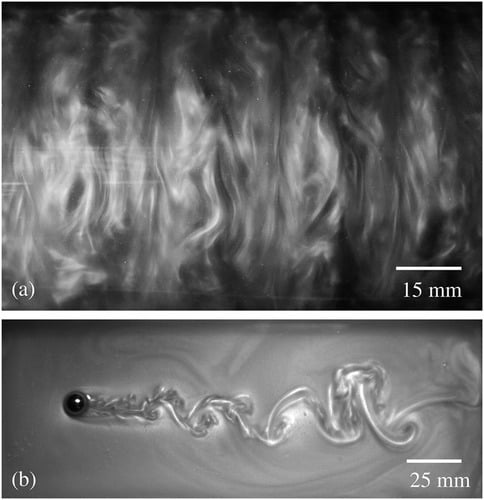
    Although you may not recognize the name, you’ve probably seen Kalliroscope (top image), a pearlescent fluid that creates beautiful flow patterns when swirled. This rheoscopic fluid was invented in the mid-1960s by artist Paul Matisse and, over the following decades, became a staple of flow visualization techniques. Kalliroscope contained a suspension of crystalline guanine. Since the crystals were asymmetric, they would orient themselves depending on the flow and, from there, scatter light, creating the beautiful pearlescent effect seen above.

    Unfortunately for researchers, the production of guanine crystals was expensive and difficult. The cosmetics industry was their main consumer and over time, they moved toward mica and other cheaper mineral alternatives. The company that produced Kalliroscope gave up production in 2014, leaving researchers scrambling for a suitable alternative.

    One contender for a new standard rheoscopic fluid is based on shaving cream. By diluting shaving cream 20:1 with water, researchers are able to extract stearic acid crystals, which form an admirable alternative to Kalliroscope (middle collage). Like Kalliroscope, the resulting fluid is pearlescent and reveals flow features well (bottom two images). Stearic acid crystals are also closer in density to water than guanine, so the fluid remains in suspension far better than Kalliroscope. Plus, the best shaving cream is cheap and widely available, meaning that this is a DIY project just about anyone can do! (Image credits: Kalliroscope – P. Matisse; other images – D. Borrero-Echeverry et al.; research credit: D. Borrero-Echeverry et al.)

  • Inside a Bubble Wall

    Inside a Bubble Wall

    Schlieren photography has an almost magical feeling to it because it enables us to see the invisible – like shock waves and the tiny currents of heat that rise from our skin. But it can also reveal new perspectives on things that aren’t invisible. Here we see soap bubbles viewed through the lens of a schlieren set-up. Schlieren is sensitive to small changes in density, so instead of appearing in their usual rainbow iridescence, the bubbles look glass-like and filled with tiny currents and bubbles. What we’re seeing are some of the many tiny flow variations across the surface of a soap bubble. They’re driven by a combination of forces – gravity, temperature, and surface tension variations, to name a few. Seen in video, you can really appreciate just how dynamic a thin soap film is! (Image credit and submission: L. Gledhill, video version, more stills)

  • Featured Video Play Icon

    “Le Temps”

    Thomas Blanchard is back with another beautiful music video. This one features ink cascading over various shapes underwater. Lots of tiny mushroom-shaped Rayleigh-Taylor instabilities here caused by the ink’s greater density compared to the surrounding water. There are also some lovely examples of transitional flow, especially around the spheres. Initially, flow over the spheres looks completely smooth and laminar. But, on the latter half of the sphere, where the flow is under increasing pressure, you see disturbances growing until little fingers of ink break away entirely. Be sure to watch the whole video; you don’t want to miss this! (Video and image credit: T. Blanchard)