I may never get tired of drone videos of sheep herding. They are mesmerizing to watch and full of so many characteristics of flow. Like a compressible fluid, the herd squeezes together as it passes through a gate, then spreads and decreases density as it reaches the pasture. The sequence of sheep moving down the road reminds me of pipe flow, with a boundary layer of sheep along the edge who choose to graze rather than move with the herd. There are even sheep vortices in this video, folks. Vortices of sheep! How could you resist watching?! (Video credit: L. Patel; via Colossal; submitted by Florian T. and Matevz D.)
Search results for: “density”

Pump Problems
Pumps are a critical piece of infrastructure, but to keep them operating, engineers have to account for several potential pitfalls. In this Practical Engineering video, Grady discusses some of the common fluid dynamical effects that can destroy a pump and its performance. As you’ll see in the video, a lot of the challenges boil down to keeping air out of the pump. Since air and water are vastly different in their density and compressibility, most pumps cannot handle both of them at the same time. Pumps need to be primed to displace any air inside them and allow them to develop the suction needed to pump water. On the other hand, too much suction can create cavitation, which damages pump parts. And, finally, the intake systems for pumps have to be designed to keep air from getting sucked in. If nothing else, having too much air in the lines reduces the pump’s efficiency. (Image and video credit: Practical Engineering)

Breaking Ocean Currents
Our global ocean currents move enough water to dwarf the flow of all Earth’s rivers. This worldwide circulation is driven largely by density and the movements of cold, salty water versus warmer, fresher water. The pump behind this action lies in the North Atlantic, where cold, salty water sinks down in the Atlantic Meridional Overturning Circulation, or AMOC. Among other things, AMOC is responsible for Western Europe’s relatively mild climate compared to similarly northern lands.
Unfortunately, as our world warms, AMOC gets weaker. That means less cold water sinking in the North Atlantic and a smaller driving force behind global oceanic circulation. There is even a small but real chance that global warming breaks our ocean current system entirely and drastically changes climates around the world in ways that cannot be easily fixed. Watch the full video to learn more. (Video and image credit: It’s Okay To Be Smart)

Meeting Without Mixing
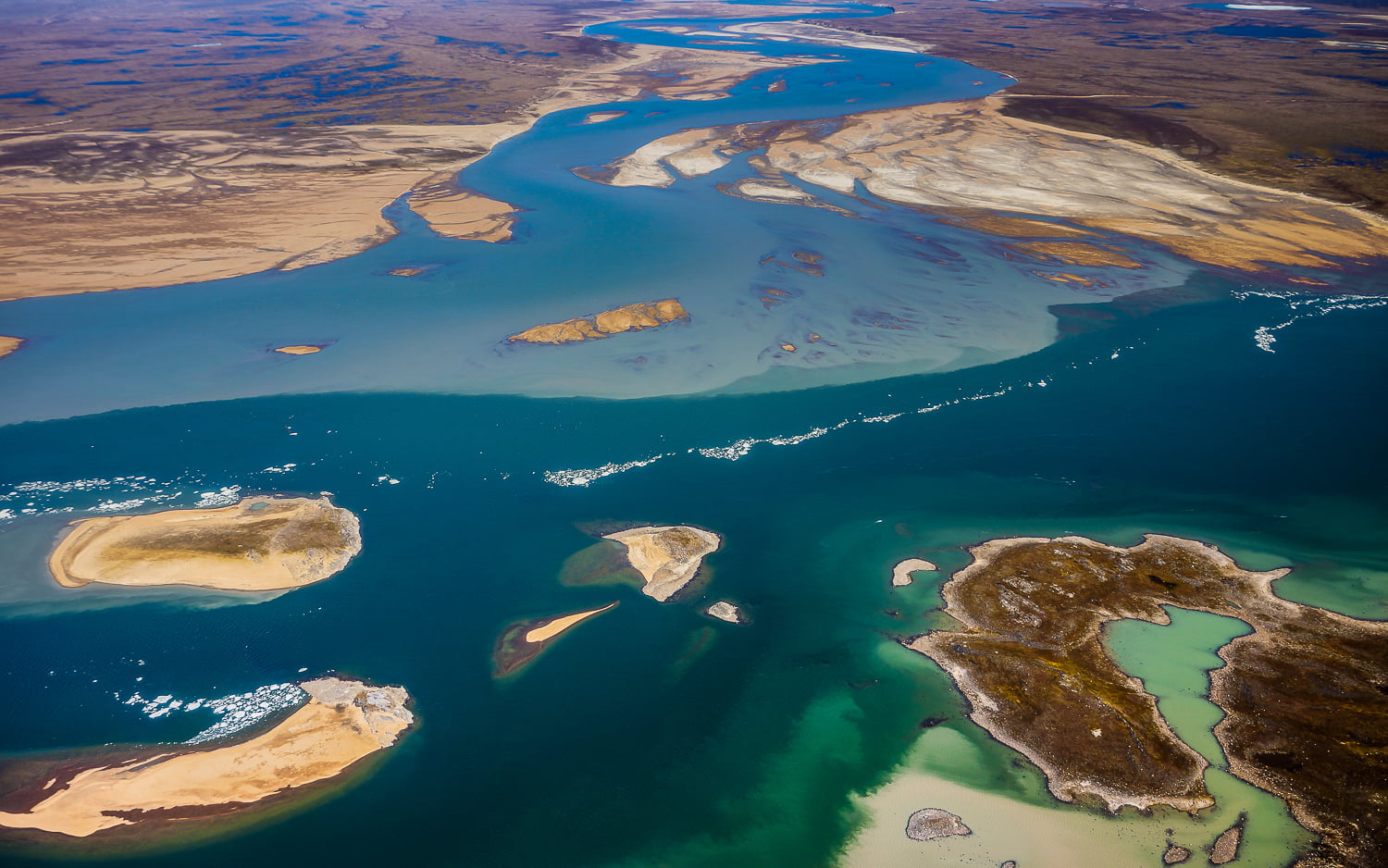
When bodies of water meet, they don’t always mix right away. Here we see the confluence of the Back and Hayes Rivers in the Canadian Arctic. The Back River appears as a darker blue-green color compared to the light turquoise Hayes River. The different colors reflect the levels of algae and sediment carried in their waters. As seen in both the aerial and satellite photos here, there’s a distinct line where the two waters meet without mixing, and that line persists for kilometers beyond their initial confluence. Typically, this lack of mixing between bodies of water is caused by differences in temperature, salinity, and turbidity (amount of sediment) that make the density of each river’s water different. (Image credit: top – R. Macdonald/Univ. of Manitoba, bottom – J. Stevens/USGS; via NASA Earth Observatory)


Oil in Water
In the decade since the Deepwater Horizons oil spill, scientists have been working hard to understand the intricacies of how liquid and gaseous hydrocarbons behave underwater. The high pressures, low temperatures, and varying density of the surrounding ocean water all complicate the situation.
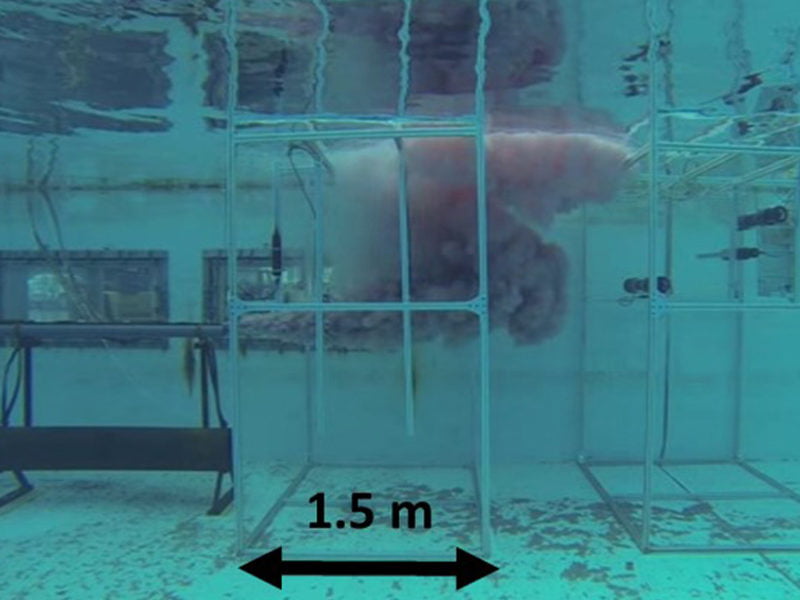
Released hydrocarbons form a plume made up of oil drops and gas bubbles of many sizes. Large drops and bubbles rise relatively quickly due to their buoyancy, so they remain confined to a relatively small area around the leak. Smaller drops are slower to rise and can instead get picked up by ocean currents, allowing them to spread. The smallest micro-droplets of oil hardly rise at all; instead they remained trapped in the water column, where currents can move them tens to hundreds of kilometers from their point of release. (Image and research credit: M. Boufadel et al.; via AGU Eos; submitted by Kam-Yung Soh)

Dual Structure of Water
Water is so ubiquitous in our lives that we rarely recognize just how strange it is. For example, when pure liquid water is supercooled well below its freezing temperature, it takes on not one but two molecular arrangements, one of which is high-density and one of which is low-density. Theory had posited this configuration for some time, but only recently has experimental evidence supported it.
The experimental challenge was water’s rapid crystallization in the temperature region of interest. Any time water was held at those temperatures in order to study it, it would crystallize before researchers could make their observations. To get around this, a team studied extremely thin layers of water which they heated with a laser before rapidly cooling. By repeating this heating-and-cooling cycle many times, they were able to measure water properties that only make sense if it conforms to the two-density theory. (Image credit: T. Holland/Pacific Northwest National Laboratory; research credit: L. Kringle et al.; via Science News; submitted by Kam-Yung Soh)

Rocket Yeast
Usually, microbial colonies are grown on a solid substrate, but what happens when they grow on a liquid surface? That’s the question explored in this Gallery of Fluid Motion video featuring colonies of brewer’s yeast on various liquid substrates. When the viscosity of the liquid is low enough, the colony actually gets pulled apart (Image 2). This behavior is driven by a convective flow in the liquid caused by the colony’s own growth. As the yeast grow, they deplete nearby sugar, creating a density gradient that triggers convection beneath the colony. (Image, video, and research credit: S. Atis et al.)

Shear and Convection in Turbulence
In nature, we often find turbulence mixed with convection, meaning that part of the flow is driven by temperature variation. Think thunderstorms, wildfires, or even the hot, desiccating winds of a desert. To better understand the physics of these phenomena, researchers simulated turbulence between two moving boundaries: one hot and one cold. This provides a combination of shear (from the opposing motion of the two boundaries) and convection (from the temperature-driven density differences).
Please note that, despite the visual similarity, these simulations are not showing fire. There’s no actual combustion or chemistry here. Instead, the meandering orange streaks you see are simply warmer areas of turbulent flow, just as the blue ones are cooler areas. The shape and number of streaks are important, though, because they help researchers understand similar structures that occur in our planet’s atmosphere — and which might, under the wrong circumstances, help drive wildfires and other convective flows. (Image, research, and video credit: A. Blass et al.)

Granular Fingers
Finger-like shapes often form on fluids injected between glass plates, but what happens when that injected fluid contains particles? That’s the situation in this recent study, where researchers sandwiched a fluid between two glass plates and then injected a second, similar fluid laced with particles.
Despite the differences from the traditional Saffman-Taylor set-up, the granular-filled fluid still forms fingers as long as there’s even a slight density difference between the original and injected fluids. It doesn’t even matter which of the two fluids has the greater density! (Image and research credit: A. Kudrolli et al.)

The Magic* Cork
*Spoiler alert: it’s not magic. It’s science!
Just what makes this dropped cork float beneath the surface? Just like a normal cork, it’s buoyancy! But this seemingly straightforward video is hiding a few key elements. Firstly, the cork has been modified; it has a metal sphere inside it so that its effective density is higher than that of water.
Secondly, that liquid is not pure water; notice the hazy swirls near the bottom of the flask when the cork drops in? This is tap water that’s had a layer of salt dissolving in the bottom of it for the last day. That creates a density gradient with denser, salty water at the bottom and lighter, fresh water at the top. In fluid dynamics, we’d say the fluid is stably stratified; “stratified” meaning that there are distinct layers (strata) of different density and “stably” because the heavier ones are at the bottom.
When the cork is dropped in, it settles at the fluid layer that matches its density. Because the surrounding fluid is stably stratified, poking the cork makes it bounce slightly but return to its initial height. Our atmosphere behaves just like this when it’s stably stratified. If you displace a parcel of air, it will oscillate up and down before settling back to equilibrium. In fact, the cork and the air even bounce at the same frequency! (Video and submission credit: F. Croccolo)