
Schlieren photography has an almost magical feeling to it because it enables us to see the invisible – like shock waves and the tiny currents of heat that rise from our skin. But it can also reveal new perspectives on things that aren’t invisible. Here we see soap bubbles viewed through the lens of a schlieren set-up. Schlieren is sensitive to small changes in density, so instead of appearing in their usual rainbow iridescence, the bubbles look glass-like and filled with tiny currents and bubbles. What we’re seeing are some of the many tiny flow variations across the surface of a soap bubble. They’re driven by a combination of forces – gravity, temperature, and surface tension variations, to name a few. Seen in video, you can really appreciate just how dynamic a thin soap film is! (Image credit and submission: L. Gledhill, video version, more stills)
Search results for: “density”

“Le Temps”


Thomas Blanchard is back with another beautiful music video. This one features ink cascading over various shapes underwater. Lots of tiny mushroom-shaped Rayleigh-Taylor instabilities here caused by the ink’s greater density compared to the surrounding water. There are also some lovely examples of transitional flow, especially around the spheres. Initially, flow over the spheres looks completely smooth and laminar. But, on the latter half of the sphere, where the flow is under increasing pressure, you see disturbances growing until little fingers of ink break away entirely. Be sure to watch the whole video; you don’t want to miss this! (Video and image credit: T. Blanchard)

Convection Without Heat


We typically think of convection in terms of temperature differences, but the real driver is density. In the animations above, cream sitting atop a liqueur is undergoing solutal convection – no temperature difference needed! The alcohol in the liqueur mixes with the cream to form a lighter mixture that rises to the surface. The lower surface tension of the alcohol is also good at breaking up the cream, forming little cells. As the alcohol in those cells evaporates, the cream gets heavier and sinks down into the liqueur, where it can pick up more alcohol, rise back to the surface, and begin the cycle again. (Image credit: J. Monahan et al., source)

Folding Fluids
Highly viscous liquids – like cake batter, lava, or the spider silk above – fold as they fall. Several factors impact this instability including the fluid’s density, viscosity, surface tension, and how thin the falling sheet is. As with the coiling of falling honey, this behavior is actually a form of buckling. It’s also fascinating to watch how persistent the layers are. Even out near the edge of the puddle, you can still see individual folds. This is a sign of just how incredibly viscous the spider silk is. Imagine if this were cake batter instead: we’d see folding just like we do with the spider silk proteins, but the individual folds would quickly fade as the batter flowed to fill its container. The spider silk is more viscous, so it’s more resistant to flowing. (Image credit and submission: D. Breslauer, source)

Dust Envelopes Mars
Day has turned into night for NASA’s Opportunity rover as a massive dust storm envelopes Mars. The first signs of the dust storm were reported May 30th, and over the last two weeks, the storm has grown to an area larger than North America and Russia combined. Despite the low pressure and density of Mars’ atmosphere, solar heating can create fairly strong winds – they don’t reach hurricane-force speeds, but they’d qualify as a very windy day here on Earth. With the lower gravity on Mars, this can lift dust well into the atmosphere, choking out the sunlight Opportunity needs to continue operating. The rover has entered a low-power mode and is no longer responding to communications. Martian dust storms have been known to last for weeks or even months, and this may be the last we hear from the intrepid rover on its fifteen year journey. Here’s hoping that Opportunity makes it through the storm and can eventually get the solar power needed to phone home again. (Image credit: NASA JPL)
Waves Below the Surface
Even a seemingly calm ocean can have a lot going on beneath the surface. Many layers of water at different temperatures and salinities make up the ocean. Both of those variables affect density, and one stable orientation for the layers is with lighter layers sitting atop denser ones. Any motion underwater can disturb the interface between those two layers, creating internal waves like the ones in this demo. In the actual ocean, these internal waves can be enormous – 800 meters or more in height! In regions like the Strait of Gibraltar where flowing tides encounter underwater topography, large internal waves are a daily occurrence. Internal waves can also show up in the atmosphere and are sometimes visible as long striped clouds. (Video and image credit: Cal Poly)


Wave Clouds
Stripe-like wave clouds can often form downstream of mountains. This satellite image shows such clouds in the South Pacific where rocky mountains jut 600 meters (2,000 ft) above the sea. This disrupts air flowing east by forcing it to move up and over the island topography. The air does not simply settle back down on the other side, though. It must come back into equilibrium with its surroundings in terms of density and temperature. While doing so it will travel up and down along a wavy path. As it reaches the crest of the wave, humid air cooling condenses and forms a cloud. At troughs, the air warms and the condensation disappears. This creates the stripey cloud pattern in the mountain’s wake, which fades out as the atmospheric gravity waves die out. (Image credit: NASA/J. Schmaltz; via NASA Earth Observatory)

Visualizing Acoustic Levitation
The schlieren photographic technique is often used to visualize shock waves and other strong but invisible flows. But a sensitive set-up can show much weaker changes in density and pressure. Here, schlieren is used to show the standing sound wave used in ultrasonic levitation. By placing the glass plate at precisely the right distance relative to a speaker, you can reflect the sound wave back on itself in a standing wave, seen here as light and dark bands. The light bands mark the high-pressure nodes, where the pressure generated by the sound waves is large enough to counteract the force of gravity on small styrofoam balls. This allows them to levitate but only in the thin bands seen in the schlieren. Move the plate and the standing wave will be disrupted, causing the bands to fade out and the balls to fall. (Video and image credit: Harvard Natural Sciences Lecture Demonstrations)

The Hairyflower Wild Petunia
Dispersing seeds is a challenge when you’re stuck in one spot, but plants have evolved all sorts of mechanisms for it. Some rely on animals to carry their offspring away, others create their own vortex rings. The hairyflower wild petunia turns its fruit into a catapult. As the fruit dries out, layers inside it shrink, building up strain that bends the fruit outward. Once a raindrop strikes it, the pod bursts open, flinging out around twenty tiny, spinning, disk-shaped seeds. That spin is important for flight. The best-launched seeds may spin as quickly as 1600 times in a second, which helps stabilize them in a vertical orientation that minimizes their frontal area and reduces their drag. Researchers found that these vertically spinning seeds have almost half the drag force of a spherical seed of equal volume and density. That means the hairyflower wild petunia is able to spread its seeds much further without a larger investment in seed growth. (Image and research credit: E. Cooper et al., source; via NYTimes; submitted by Kam-Yung Soh)
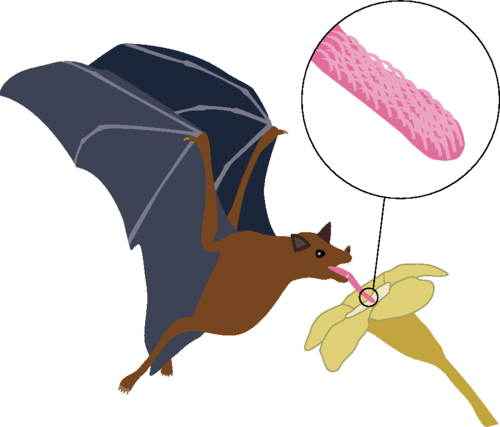
Hairy Tongues Help Bats Drink
Nectar-drinking bats, honey possums, and honeybees all use hair-like protrusions on their tongues to help them drink. In bats, these papillae have blood vessels that swell when drinking, stiffening the hairs. To investigate this drinking mechanism, researchers built their own version of a bat tongue by fabricating hairy surfaces and testing how well they trapped viscous oil when dipped and withdrawn. Through a combination of experiment and mathematical modeling, the researchers found that the optimal fluid uptake depended on the density of hairs, fluid viscosity, and the withdrawal speed. When they compared their results to actual bats, honey possums, and honeybees, they found that those animals’ tongues have hair densities very close to the predicted optimal value, suggesting that their model is capturing the important physical mechanisms that have driven evolutionary advantages for these species. (Image and research credit: A. Nasto et al.; submitted by Kam-Yung Soh)