Search results for: “density”

  • Shear in Shaken Sands

    Shear in Shaken Sands

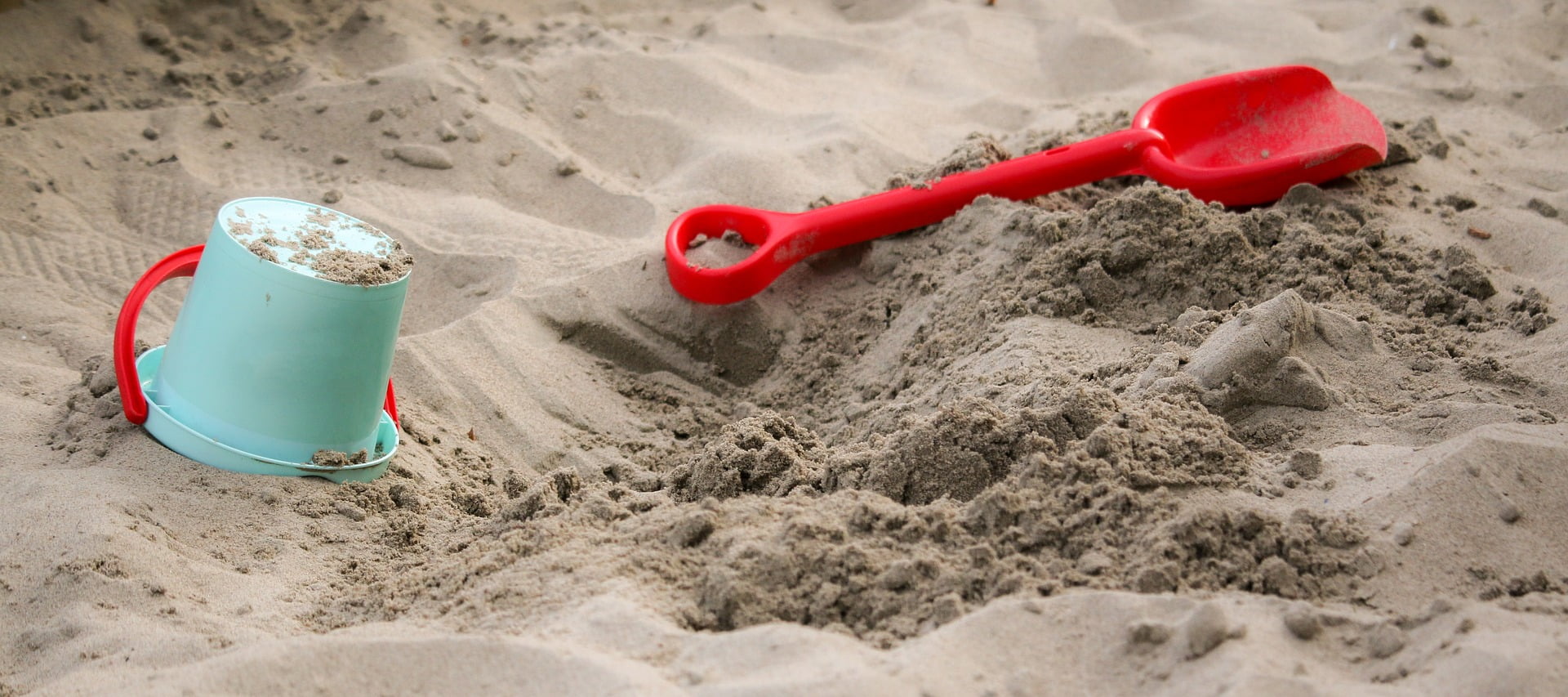
    The dynamics inside a shaken granular material, like sand, are fascinatingly complex. In this study, researchers used x-ray radiograms to peer inside a horizontally-shaken container of sand. They found that the sand soon formed bands of lower density (seen as yellow in the radiogram) near the center of the container. Because these bands show a lot of horizontal movement between grains, they’re known as shear bands.

    The shear bands don’t simply stay still, though. One remains more or less stationary at the center, but others split and rise through the upper half of the container. The researchers suggest this migration happens due to gravity; because the shear band is less dense than the material above, it cannot support the weight. Sand sinks into the void, making the less dense region effectively migrate upward. They also suggest that these moving shear bands are responsible for the fluctuations in sand height seen at the surface. (Image credit: beach – RAMillu, radiogram – J. Kollmer et al.; research credit: J. Kollmer et al.)

  • Ghostly Chandeliers

    Ghostly Chandeliers

    Highlighter ink sinks from the surface of water, like upside-down green mushrooms.

    Under a black light, highlighter fluid creates ghostly trails as it drips through water. The vortices that form and break into this chandelier-like shape are the result of density differences between the ink and water. Since ink is heavier than water, it sinks, but as the two fluids flow past, they shear one another, forming elaborate shapes. Formally, this is known as the Rayleigh-Taylor instability. While you may be most familiar with it from pouring cream into coffee, it’s also a key to mixing in the ocean and the explosions of supernovas. (Image credit: S. Adams et al.; via Flow Vis)

  • Featured Video Play Icon

    Traffic Flow and Phantom Jams

    We’ve all experienced the frustration of traffic jams that seem to come from nowhere — standstills that occur with no accident, construction, or obstacle in sight. Traffic shares a lot of similarities with fluid flows, including its waves and instabilities.

    These disturbances propagate and grow when traffic surpasses a critical density. Once that happens, any small speed adjustment made by a lead driver gets amplified by the larger and larger braking of each driver downstream. Effectively, this creates a wave of slower speed and higher density that travels downstream through the traffic.

    Each driver brakes more than the last largely because they can’t tell what the conditions upstream of them are. But that lack of knowledge may be less of an issue for driverless cars, which have the potential to communicate with cars and traffic sensors ahead of them. With enough automated vehicles on the highway, phantom traffic jams may become a thing of the past. (Video and image credit: TED-Ed)

  • Scaling High-Speed Impacts

    Scaling High-Speed Impacts

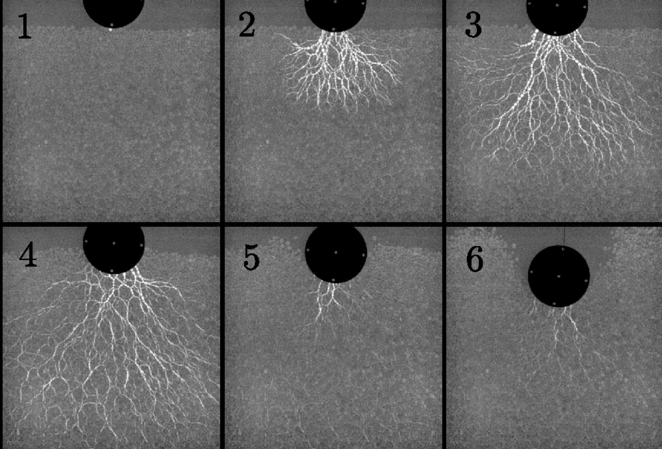
    The impact of a solid object into a bed of grains is a major topic in many fields from ballistics to astronomy. Researchers study these impacts experimentally using photoelastic disks, which display visible stress patterns when placed between polarizers. The lightning-like patterns you see above reveal how forces propagate inside the grains as the object hits.

    Researchers focused on the peak forces generated during high-speed impacts, an area that hasn’t been well-captured by existing impact models. They found that this peak force obeys its own scaling laws that depend on factors like impact speed, impacter size, grain stiffness, and grain density. (Image and research credit: N. Krizou and A. Clark)

  • Crisscrossing Wave Clouds

    Crisscrossing Wave Clouds

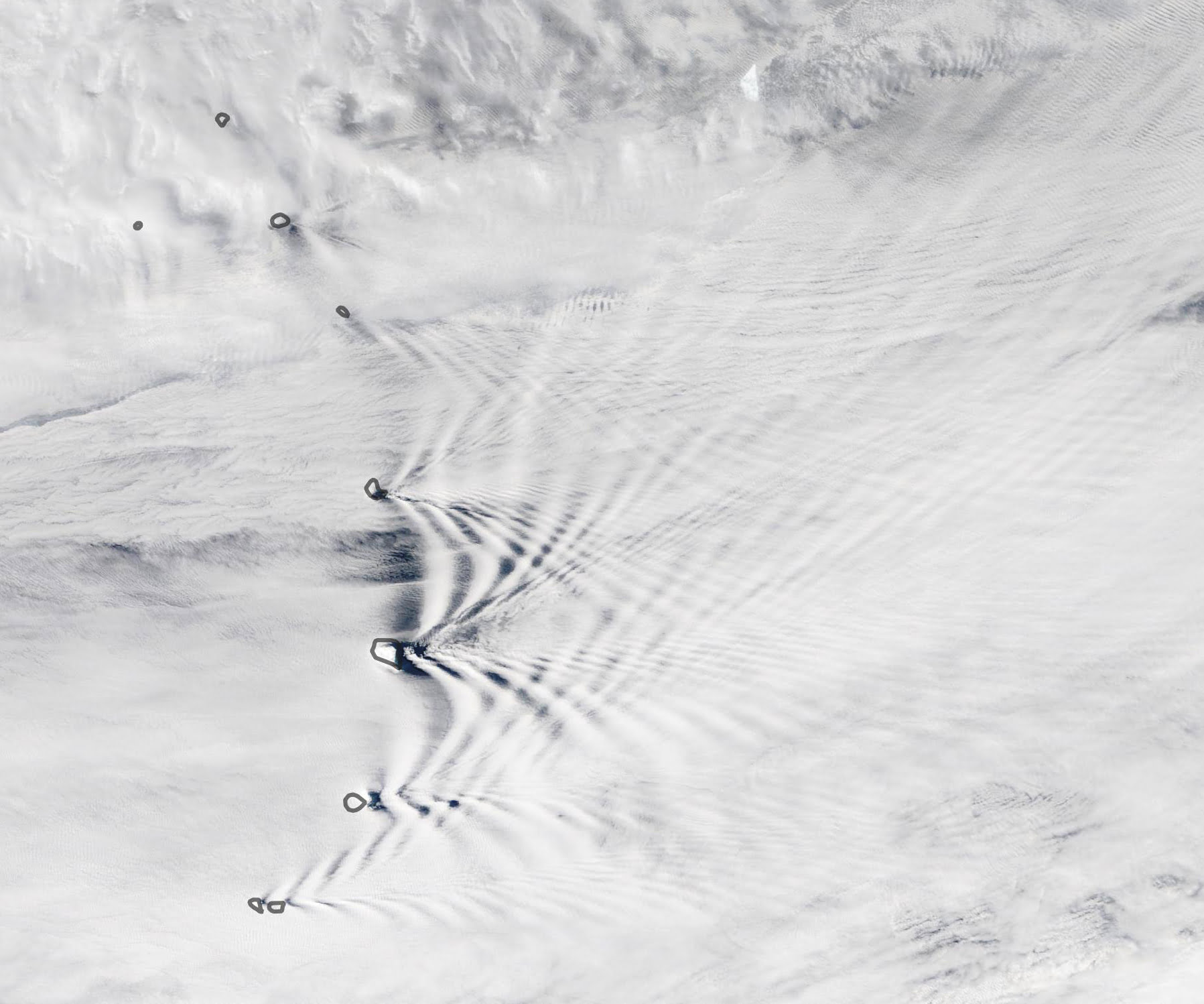
    Crisscrossing lines of wave clouds mark the wake of the Sandwich Islands in this satellite image. The tallest islands in the chain thrust rocky peaks more than 1000 meters above sea level, disrupting winds flowing across the ocean. Incoming air is forced up and over the mountain, which puts it at odds with the surrounding air at that height.

    Due to differences in temperature and density, the disrupted air will continue to rise and sink periodically as it flows onward. At some heights it will cool enough to condense its water vapor into clouds, and at others, it will warm enough to lose any cloud cover. This is what creates the bands of clouds we see behind each individual island. (Image credit: L. Dauphin/NASA; via NASA Earth Observatory)

  • Where are Titan’s Deltas?

    Where are Titan’s Deltas?

    Saturn’s moon Titan is the only other planetary body in our solar system known to have bodies of liquid on its surface. But where Earth has lakes and seas of water, Titan’s are hydrocarbon-based, primarily ethane and methane. As on Earth, these liquids rain from skies and run down rivers and streams into larger bodies. What they do not do, as far as scientists can tell, is form deltas.

    On Earth (and ancient Mars), rivers tend to slow and branch out as they run into larger, still bodies. Many of these river deltas — like the Nile, Ganges, and Mississippi — are visible from space. But so far we’ve seen no equivalent formations on Titan, even though the radar resolution of Cassini should have allowed for it.

    There are currently two hypotheses to explain this absence. One posits that density differences between hydrocarbon rivers and lakes mean that deltas do not form. On Titan, the larger bodies are warmer and do not absorb as much atmospheric nitrogen, making them lighter overall. That means a cold, dense river might just sink immediately beneath the lake without slowing to deposit sediment.

    Another hypothesis is that deltas do form but that the shifting shorelines of Titan’s seas wash them out and make them unrecognizable. There’s evidence that Titan’s northern and southern hemispheres can swap their liquid hydrocarbons back and forth on a 100,000 year timescale. If that’s true, those shifts could obscure any evidence of deltas.

    Experiments are underway to test the first hypothesis, but the final answers may have to wait until NASA’s Dragonfly mission reaches Titan in 2034. (Image credit: Titan – NASA/JPL-Caltech/ASI/Cornell, Alaska – NOAA; via AGU Eos; submitted by Kam-Yung Soh)

  • Featured Video Play Icon

    Coalescence in Heavy Metal Droplets

    When a drop of water falls into a pool, it doesn’t always coalesce immediately. Instead, it can go through a coalescence cascade in which the drop partially coalesces, a daughter drop bounces off the surface, settles, and itself partially coalesces. We’ve seen this many times before, but today’s video shows something a little different: here the drop and pool in question are made of a gallium alloy immersed in a background of sodium hydroxide. This means that the drop has very high surface tension (and density) but does not form an oxidation layer on its surface that could inhibit coalescence. And just like the water droplet, the gallium alloy undergoes a series of partial coalescences.

    A heavy metal droplet undergoes partial coalescence with a pool of the same liquid.

    There’s one key difference, though. Did you notice that the water droplets bounce higher as the drops get smaller, but the gallium droplets do the opposite? Previous research suggested that the droplet rebound height is driven by capillary forces, but the high surface tension of both of these liquids means that capillary forces should be large for both of them. Perhaps there’s much more viscous drag in the gallium and sodium hydroxide case? (Image, video, and research credit: R. McGuan et al.)

  • Self-Assembly Under Stratification

    Self-Assembly Under Stratification

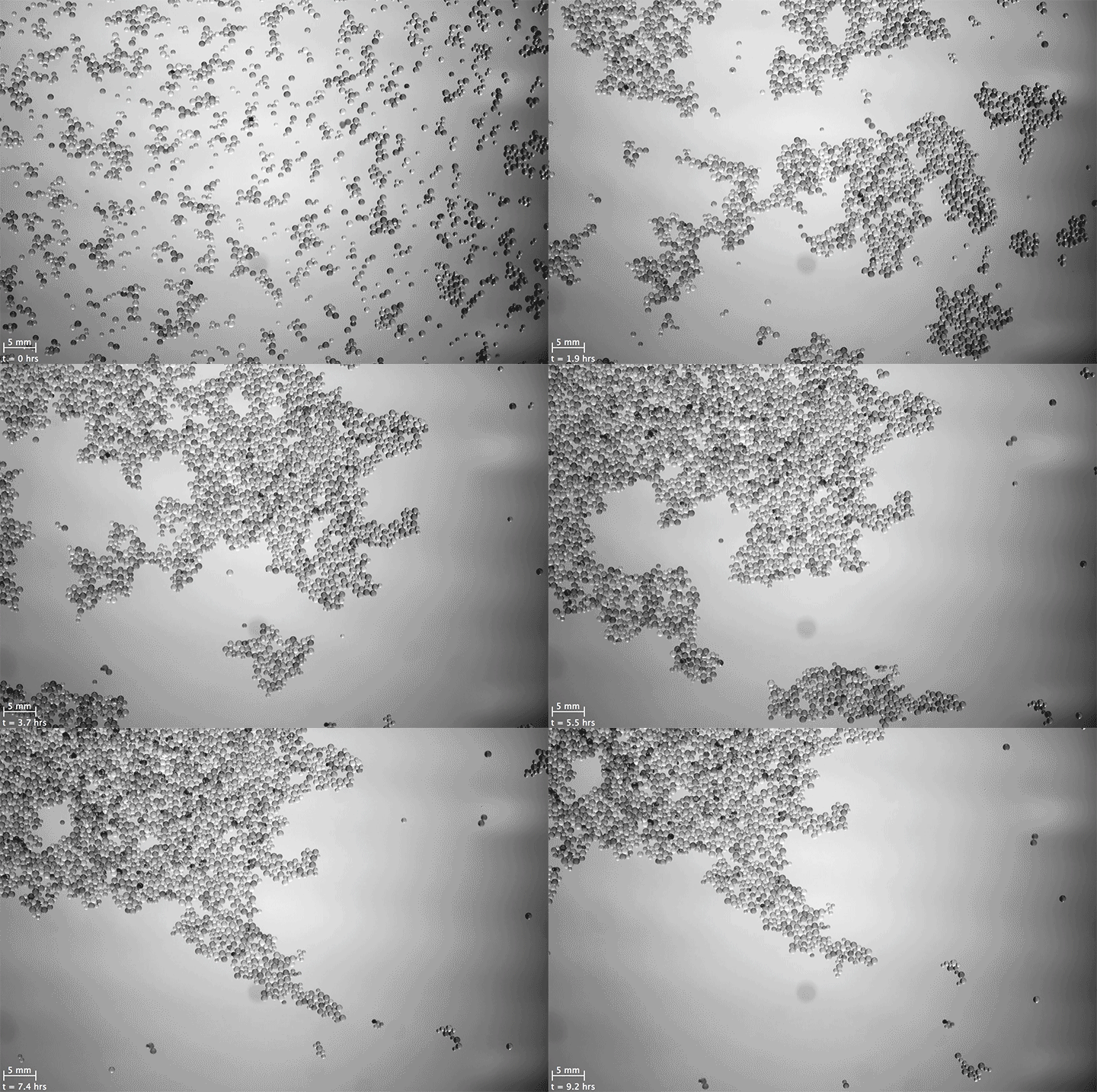
    Sometimes mistakes lead to great discoveries. After leaving a failed outreach demo overnight, researchers discovered a new mechanism for self-assembling particles. In the initial set-up, a layer of fresh water is poured atop a layer of denser, saltier water. This creates what’s known as a stably stratified fluid, with progressively denser mixtures of salt water as one moves downward. If you pour in particles of an intermediate density (heavier than fresh water and lighter than salt water), they’ll form a layer at one height, and, if you wait overnight, those particles will slowly form a disk-like raft.

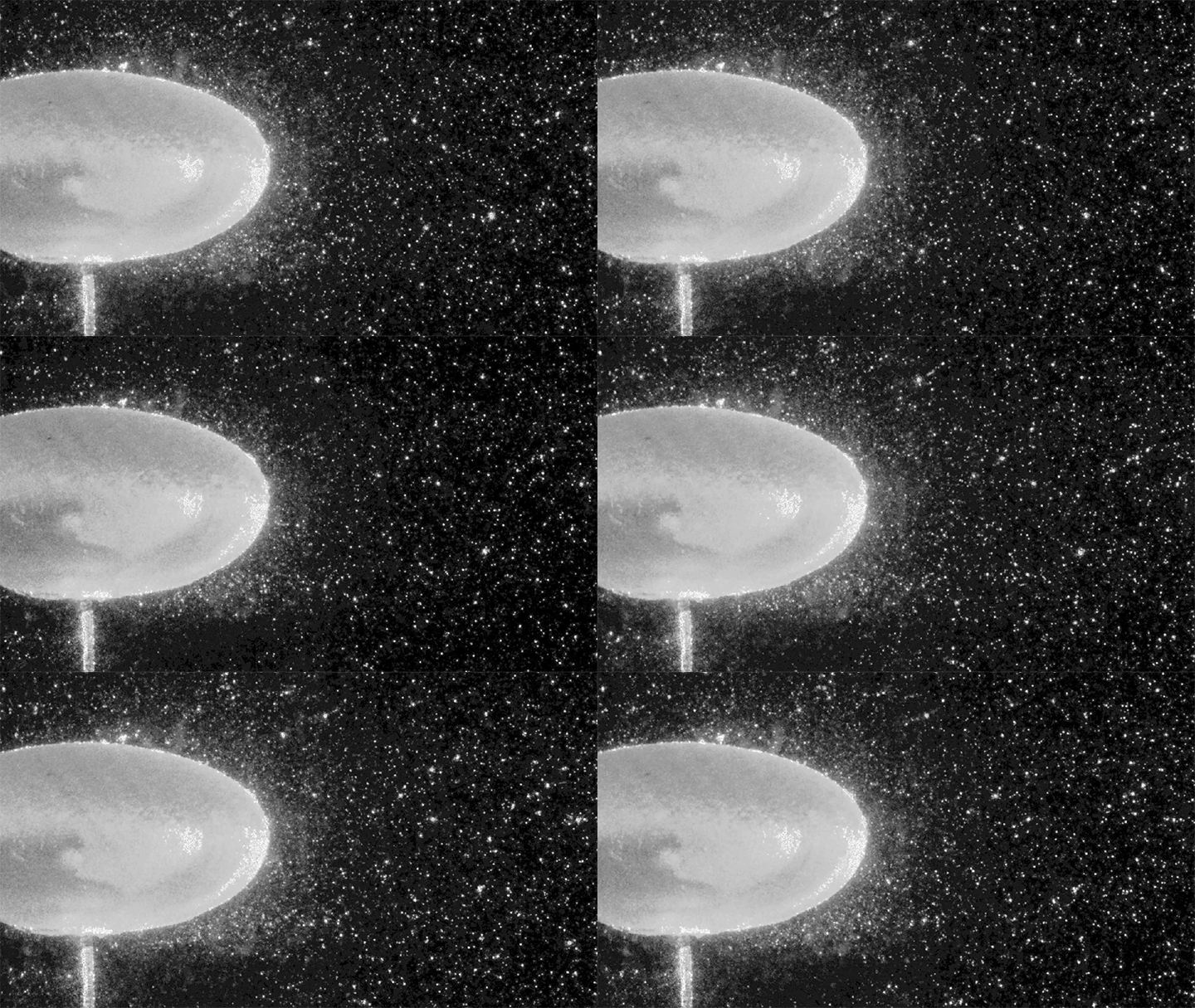
    A spheroidal particle causes attractive flow at its equator and repulsive flow at its poles.

    This self-assembly is driven by fluid dynamics — not by any attraction between the particles. Because the particles are unable to absorb salt, their boundaries distort the concentration gradients in the surrounding fluid. This generates subtle currents at the particle boundaries, like in the picture above, where flow moves toward the particle at the equator and away at the poles. Larger particle clusters generate stronger flows, allowing them to attract even more particles.

    Although the speeds involved are quite slow, this mechanism may play an important role in nature, where stratified flows are common. The researchers speculate, for example, that the effect could be important in the clustering of microplastics in the ocean. (Image and research credit: R. Camassa et al.; see also R. McLaughlin; submitted by Kam-Yung Soh)

  • Martian Landslides

    Martian Landslides

    Sometimes there are advantages to studying planetary physics beyond Earth. Mars does not have plate tectonics, vegetation, or the level of erosion we do, allowing geological features like those left behind by landslides to persist undisturbed for millions of years. And, thanks to a suite of orbiters, we’ve mapped most of Mars at a resolution better than many parts of our own planet. All together, this gives researchers a treasure trove of geological data from our nearest neighbor.

    One peculiar feature of many landslides is their long runout. Even over relatively flat ground, some landslides cover extreme distances from their point of origin. On Earth, we often see this behavior near glaciers, so scientists theorized that the presence of ice was somehow necessary for the landslide to cover such a long distance. But previous laboratory experiments with dry, ice-free grains showed the same behavior: long runouts marked with ridges running parallel to the flow. The mechanism behind the ridges is still somewhat unclear, but it seems to be connected to fluid dynamical instabilities that form between fast-flowing particles of differing density. But such results have been confined to lab-scale experiments and numerical simulations.

    A new report, however, shows that landslides on Mars share the same characteristic spacing and thickness between their ridges. This evidence suggests that the same ice-free mechanism could account for the long run-out of landslides on Mars and other planets. (Image credit: NASA/JPL-Caltech/University of Arizona; research credit: G. Magnarini et al.; via The Conversation; submitted by Kam-Yung Soh)
  • Resources

    I get a lot of questions from people who want to learn more about fluid dynamics, whether casually or seriously. Below are some resources that may be useful in such pursuits. Affiliate links are marked with an asterisk (*).

    Videos

    • NCFMF Fluid Mechanics Series – This series of videos date from the 1960s and is intended to teach undergraduates about fluid dynamics. They remain an incredible source of demonstrations on all kinds of subjects in fluids. They feel a bit slow, but they are well worth the time.
    • Khan Academy’s Fluids series – A twelve part video series addressing some fundamentals of fluid dynamics.
    • CrashCourse Physics – If you want to dig into fluids further, it helps to know the basics. After all, the Navier-Stokes equations are simply Newton’s Laws applied to a fluid!
    • Science Off The Sphere – This video series by astronaut Don Pettit features FD and other physics in space.
    • Physics Central – Not FD-specific, but this website features lots of great educational physics, including fluid dynamics.
    • MIT + K12 – Includes fluids-related video lessons as well as many other science subjects.

    YouTube Channels

    • Library Laboratory (LIB LAB) – This project comes from fluid dynamicist A. J. Fillo. It’s aimed toward kids but is fun for all ages. Includes fluid dynamics and other topics in physics.
    • The Lutetium Project – This channel is produced by fluid dynamicists in France in conjunction with art and music students, so it offers a great intersection of art and science. Videos are available in French and English.

    Websites

    • U of Colorado’s Flow Visualization – One of my favorite websites dedicated to FD, this interdisciplinary course features engineering and art students working together to make beautiful FD. If you are at Colorado, take this course. Seriously.
    • APS Gallery of Fluid Motion – Every year the American Physical Society’s Division of Fluid Dynamics publishes the year’s best FD photos and videos. Most of this will look familiar to FYFD readers. 
    • CFD-Online – For anyone looking to get into computational fluid dynamics (CFD), this website and forum is full of great resources and comprehensive links.
    • Learn ChemE – Full of videos, screencasts, and simulations relevant to fluid dynamics.
    • Flow Visualization Facebook group – A nice place to find links to fun FD and clouds.
    • eFluids – More pretty pictures and videos from researchers.
    • opencalculus – Not directly fluids-related, but if you want to dig further into the subject, a strong foundation in math is important (see note to undergrads below).
    • Teaching Fluid Mechanics – This website focuses on demonstrations that can be used in the classroom to help teach and illustrate fluid dynamics concepts.

    Other FD Blogs

    • FlowViz – Focuses on general FD, much like FYFD does
    • Physics in Drops – Exploring the world of microfluidics
    • Liquifun – Lots of car-related aerodynamics as well as general FD
    • Symscape – Computational fluid dynamics, for the most part, but with general FD thrown in

    Books (No Diff EQ Needed)

    • An Album of Fluid Motion(*) by Milton van Dyke – This is a classic visual guide to fluid dynamics for laymen and practitioners alike.
    • The Life and Legacy of G. I. Taylor(*) by G. K. Batchelor – A great biography of one of the major fluid dynamicists of the 20th century. Taylor’s adventures range from measuring atmospheric turbulence from a ship deck to teaching himself to fly in WWI to measure pressure on a wing; from studying the swimming of microorganisms to helping predict the blast wave from the atomic bomb. Batchelor provides great insight into the man and his scientific process.
    • Life in Moving Fluids(*) by Steven Vogel – This text was written as an introduction to fluid dynamics for biologists and focuses largely on the subject’s applicability to that field. There’s some math in here, but not too much. Check out my full review.

    Books (For Those With Calculus/Diff EQ)

    • Fundamentals of Aerodynamics(*) by John Anderson – Anderson is known for textbooks (he has a bunch) that are good at introducing important concepts in fluid dynamics and aerodynamics without super-advanced mathematics and notation. This was my first aerodynamics textbook and my first introduction to the Navier-Stokes equations during my junior year.
    • Boundary Layer Theory(*) by Hermann Schlichting – Most of this text actually comes from 1930s German fluid dynamics class notes. It’s not an easy read, but it’s a great reference for advanced undergrads/early graduates working in FD.

    For Undergrads Who Want More Fluids But Don’t Know Where To Start

    In addition to the resources above, I have a couple of tips.

    • Look for professors who study fluid dynamics. – Check your school’s websites. Profs who do FD are often found in mechanical, aerospace, civil, and chemical engineering, but they can also be found in physics, mathematics, geology, atmospheric science, and theoretical and applied mechanics departments. Check out their research pages, find their office hours, and go talk to them. Volunteer to work in their lab. Demonstrate your interest!
    • Check out the NSF Research Experience for Undergraduates (NSF REU) program. Positions in this program exist all over the U.S. and frequently involve doing research over the summer. Even if your school doesn’t have anyone who does FD, you can find a school that does and do research there over the summer. (Suggestion when looking for positions: search for “fluid”, “fluid dynamics”, “fluid mechanics”, etc.) If you like it, consider graduate school!
    • Build strong mathematical skills. – One aspect of fluids education I lament is its tendency to come so late (or not at all) in a students’ education—that’s part of why FYFD exists. But the truth is that researching FD requires a lot of math—calculus, differential equations, partial differential equations, etc.—courses that get taken in freshmen and sophomore years of college before professors even start talking about FD. Having a strong foundation in these subjects is very helpful, but it’s not a prerequisite to working in a lab as an undergrad.

    Got more suggestions for helpful fluid dynamics resources? Let me know.

    (*) Links marked with an asterisk are affiliate links. Following these links and making a purchase may provide a commission to FYFD at no additional cost to you.