Sometimes you need microgravity in order to observe the neat effects of surface tension on a fluid. Also, I hear it’s a good excuse for popping water balloons on the Vomit Comet. #
Search results for: “balloon”
Building Triboelectric Charge
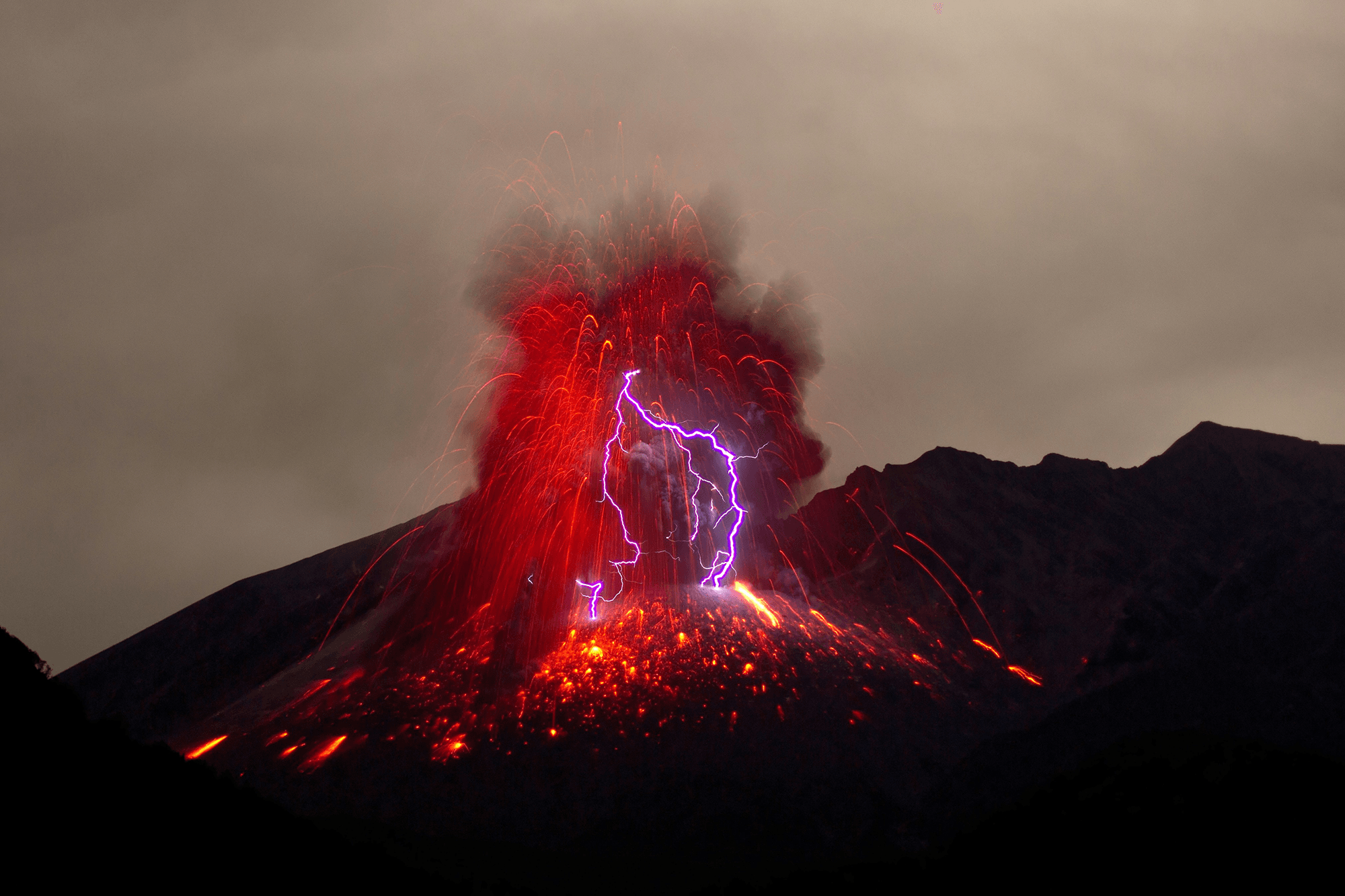
In volcanic eruptions, collisions between ash particles can sometimes build up enough electric charge for lightning to arc through the plume. Scientists have long debated how this happens–it’s not obvious that insulating materials like oxides would build up electric charges through contact, especially when dealing with substances of the same material. It’s not like rubbing a balloon against your hair, where each material–and its tendency to hold a charge–differs.

A 500-micron silica sphere acoustically levitated above a silica plate in the experiment. To test how charges build on identical materials, a team of scientists used acoustic levitation to repeatedly bounce a silica bead against an identically treated silica plate, observing their charge build-up. Then they would take one of the pieces–either the sphere or the plate–and treat it to strip away the film of molecules that naturally adsorb onto the surface over time. Then they bounced the treated and untreated surfaces off one another again.
The result was–pardon the pun–striking. Whichever surface had been treated to remove adsorbates charged more negatively the second time around. Looking more closely at what they were removing, the team found their surfaces were mostly adsorbing carbon molecules. And if they iteratively removed the carbon from both the sphere and plate, they could no longer charge the two through collision. It seems that the key to charging two oxides off one another is actually the difference between the incidental amounts of carbon on their surfaces! (Image credit: volcano – M. Szeglat, experiment – G. Grosjean et al.; research credit: G. Grosjean et al.; via Gizmodo)
Fediverse Reactions
-

Deep Breaths Renew Lung Surfactants + A Special Announcement
Taking a deep breath may actually help you breathe easier, according to a new study. When we inhale, air fills our alveoli–tiny balloon-like compartments within our lungs. To make alveoli easier to open, they’re coated in a surfactant chemical produced by our lungs. Just as soap’s surfactant molecules squeezing between water molecules lowers the interface’s surface tension, our lung surfactants gather at the interface and lower the surface tension, making alveoli easier to inflate.
But things are a little more complicated in our lungs than in our kitchen sink because of our constant cycle of breathing, which stretches and compresses our lungs’ surfaces and surfactant layers. Imagine a flat interface, lined with surfactant molecules; then stretch it. As the interface stretches, gaps open between the surfactant molecules and allowing molecules from the interior of the liquid to push their way to the newly stretched interface, changing the surface tension. If the interface gets compressed, some of the excess molecules will get pushed back into the liquid bulk.
In looking at how lung surfactants respond to these cycles of compression and stretching, the researchers found that the lung liquid develops a microstructure during cycles of shallow breathing that makes the surface tension higher, thus making lungs harder to fill. In contrast, a deep breath like a sigh replenished the saturated lipids at the interface, lowering surface tension and making lungs more compliant. So a deep sigh actually can help you breathe easier. (Image credit: F. Møller; research credit: M.. Novaes-Silva et al.; via Gizmodo)


P.S. — I’ve got a book (chapter)! Several years ago, I joined an amazing group of women to write two books (one for middle grades and one for older audiences) about our journeys as scientists. And they are out now! In fact, today we’re holding a “Book Bomb” where we aim for as many of us as possible to buy the book(s) on the same day. If you’d like to join (and get ahead on your gift shopping), here are (affiliate) links:
- Persevere, Survive, and Thrive (including my story of becoming a science communicator): Amazon, Bookshop.org
- For All the Curious Girls: Amazon, Bookshop.org
Fediverse Reactions

Predicting Droplet Sizes
Squeeze a bottle of cleaning spray, and the nozzle transforms a liquid jet into a spray of droplets. These droplets come in many sizes, and predicting them is difficult because the droplets’ size distribution depends on the details of how their parent liquid broke up. Shown above is a simplified experimental version of this, beginning with a jet of air striking a spherical water droplet on the far left. In less than 3 milliseconds, the droplet has flattened into a pancake shape. In another 4 milliseconds, the pancake has ballooned into a shape called a bag, made up of a thin, curved water sheet surrounded by a thicker rim. A mere 10 milliseconds after the jet and drop first meet, the liquid is now a spray of smaller droplets.
Researchers have found that the sizes of these final droplets depend on the balance between the airflow and the drop’s surface tension; these two factors determine how the drop breaks up, whether that’s rim first, bag first, or due to a collision between the bag and rim. (Image credit: I. Jackiw et al.; via APS Physics)
Jamming Soft Grains
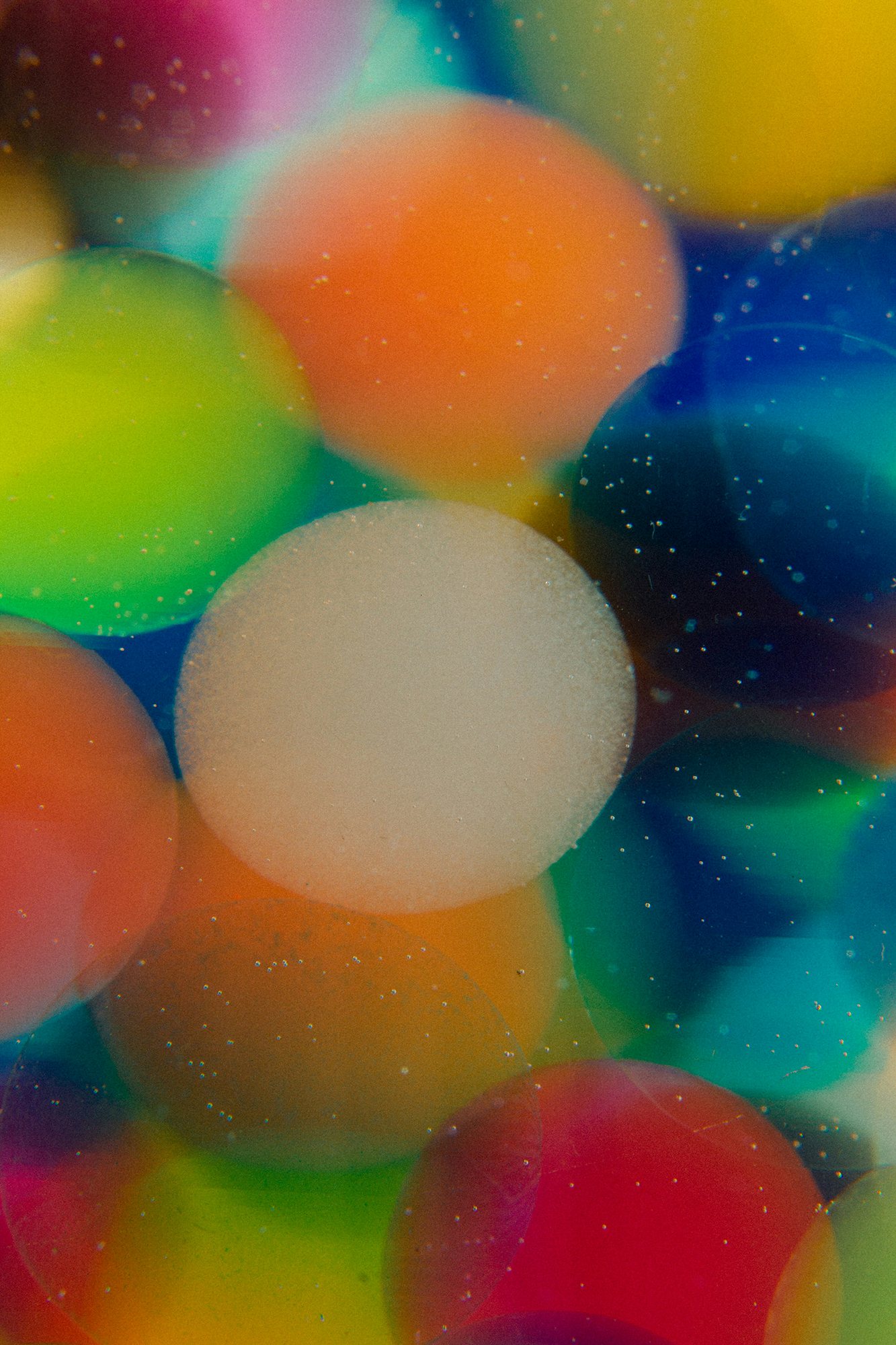
Hard granular materials — sand, gravel, glass beads, and so on — can flow, but, in narrow regions or under large forces, they can also jam up, essentially turning into a solid. Soft particles can also flow and jam, but do so under different conditions than hard particles. One group of researchers used a custom-built rheometer to measure jamming in soft particles like the hydrogel beads pictured here. They found that they could extend existing models for jamming in hard particles, but they had to rescale the mathematics to account for the way soft particles change their shape under pressure. (Image credit: Girl with red hat; research credit: F. Tapia et al.; via APS Physics)
How Water Droplets Charge Up
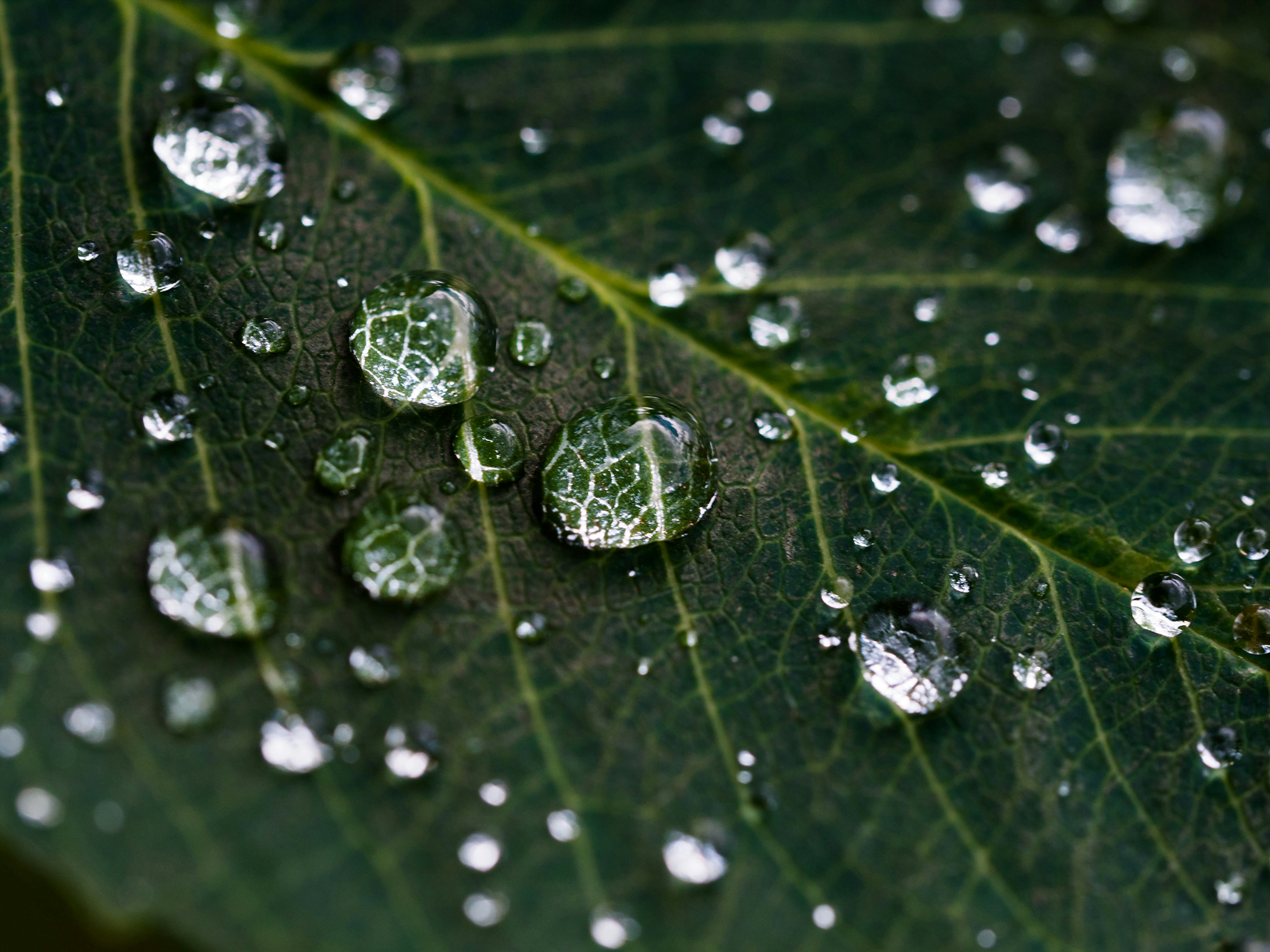
Rubbing a balloon on your hair can build a significant electrical charge. Water droplets have the same issue when they slide across a hydrophobic, electrically-insulated surface. A new study models why these charges build up and tests the model both experimentally and through simulation. They focused their theory on three effects that determine how much charge builds up. The first is a two-way chemical reaction that continuously creates charge at the interface, with positive charge building in the drop. Secondly, the drop’s contact angle with the surface sets how many protons can build up at the contact line, thereby affecting the electrical field they generate. And, finally, fluid motion at the rear of the drop deflects protons upward, shifting the electrical field. In particular, their model predicts that the higher contact angles of hydrophobic surfaces should increase charge build-up and faster sliding velocities should slow charge build-up, both of which agree with experiments.
The model should help researchers understand various charging scenarios, like those found on self-cleaning surfaces, in inkjet printing, and in semiconductor manufacturing. In the last scenario, rinsing semiconductor wafers in ultrapure water can build up charges in the kilovolt range, which is enough to damage the product. (Image credit: D. Carlson; research credit: A. Ratschow et al.; via APS Physics)

Rocky Exoplanet With an Atmosphere
In the past few decades, the number of exoplanets we’ve found has ballooned to over 5,000, but most of these worlds are gas giants closer to Jupiter than our rocky Earth. But a recent study has turned up evidence of a rocky exoplanet that, like Earth, has an atmosphere made up of more than hydrogen.
By combining observations from the JWST with those from other telescopes, the team found that 55 Cancri e — an exoplanet nearly 9 times more massive than Earth in a system about 41 light years from us — probably has an atmosphere made up of carbon dioxide or carbon monoxide. 55 Cancri e is still a planet extremely unlike our own, though; it’s tidally locked to its star so that one side always faces the star, and its equilibrium temperature is an estimated 2000 Kelvin. That’s actually a lower temperature than expected, indicating that an atmosphere is helping distribute heat around the planet. Based on the JWST measurements, the researchers suggest that the planet’s volatile atmosphere could be supported by outgassing from a magma ocean. (Image credit: NASA/ESA/CSA/R. Crawford; research credit: R. Hu et al.; via Gizmodo)

The Destructive Power of a Blank


Removing the slug does not make a bullet harmless, as the Slow Mo Guys demonstrate in this video. They’re shooting blanks — casings that still contain propellant but no projectile. There’s still more than enough force to obliterate an egg, lunch meat, and water balloons. You really don’t want one of these fired near you.
It looks as though the burning propellant is generally the first thing to puncture in each of these. Then the gas from the explosion blows the rest of the object away. The most interesting segment, to me, was the final (pink) water balloon, where the blast wave and its aftermath are visible in a schlieren-like effect that passes over the balloon before its destruction. The sun must have been at just the right position relative to their set-up. (Video and image credit: The Slow Mo Guys)
Flying Spiders Use Electric Fields


Many species of spider fly with a technique calling ballooning. We’ve touched on spider flight before, but more recent research adds a new dimension to the phenomenon. Researchers showed that spiders can actually use electrical fields in their flight. When isolated from flow or outside electrical fields, researchers found that spiders would still begin ballooning behaviors when subjected to electrical fields similar to those found in nature. The spiders were even able to take off in the artificial environment, using the electrostatic force between the surrounding fields and their negatively charged silk strands. While electrical fields alone were enough to get spiders aloft, the team thinks spiders in nature likely still use a combination of electrostatic force and aerodynamic drag in order to travel the vast distances spiders have been known to cover. (Video and image credit: BBC; research credit: E. Morley and D. Robert)
Underwater Explosions and Submarines

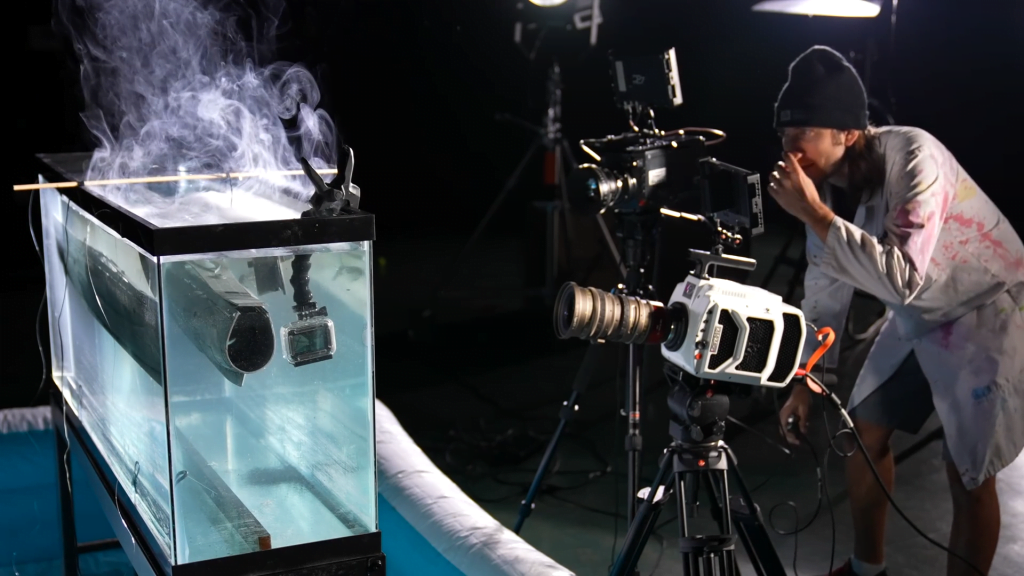


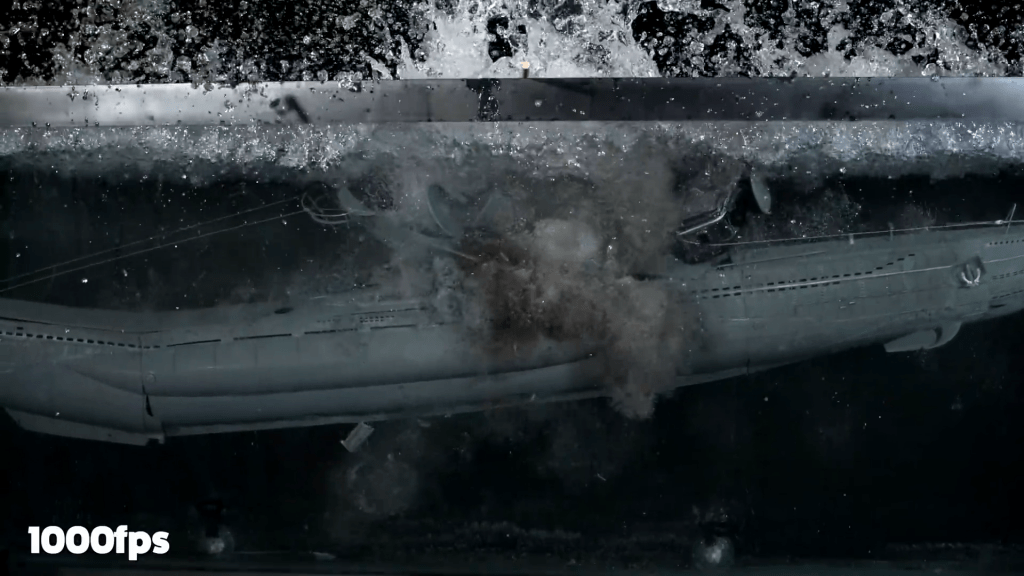


In the early days of submarines, it did not take physicists and engineers long to discover how destructive underwater explosions can be. In this Slow Mo Guys video, Gav gives us a glimpse of that destruction using a model submarine in a fish tank and several small explosives. You’ll have to be quick to notice the initial shock waves that ripple through the tank, but the footage captures spectacular detail on some of the slower-moving phenomena. You can see the uneven ripples of the explosion bubble’s surface as it expands. There are some great shots from the front and side showing the bubbly vortex ring that forms when the explosion hits the side of the tank wall (something that wouldn’t happen out in the ocean, of course). You can even catch a glimpse of some unexploded powder streaking out of the explosion. (Image and video credit: The Slow Mo Guys)